The majority of ad buyers on Facebook don’t have an issue with how to target ads, they have a creative issue.
Polished brand videos aren’t getting attention anymore. Because of this shift in the Facebook creative landscape by performance marketers towards UGC, marketers are finding that UGC converts 2-3x more than high production ads on Facebook. The reason for this is simple; UGC looks and feels like organic content, therefore stopping the scroll.
The next issue that arises is the quick enough production of UGC, for there are more ways than one to use UGC data to deliver ads on the Facebook marketplace. As such, once an ad is created and the frequency of that ad rises above 3-4 per week, your CTR (click-through rate) will fall and CPA (cost per action) will rise; rapidly.
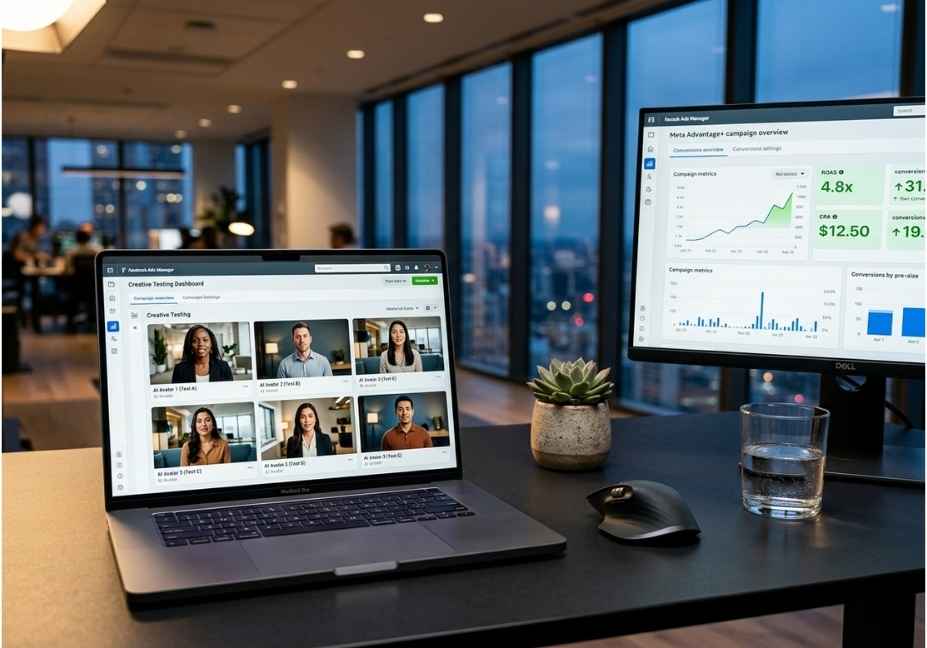
AI driven UGC video creation will solve this issue by allowing marketers to create a dozen or more testimonial-style ad variants in one afternoon, instead of briefing five different creators for five different versions of the same ad. Once these ads are created, you can then use Meta Advantage+ to find out which ad performs best.
One of the biggest problems marketers have today is that most outdoor ad tools are not built to accommodate the Facebook ad ecosystem. Key differentiators include whether or not the tool has licensing restrictions, how realistic the avatar used is, ASPECT Ratio support, and A/B Test throughput from month to month can quite often be wildly different from one ad tool to another. Making the wrong decision costs you countless hours and will create a headache when it comes to compliance matters.
This guide will provide you with seven of the best UGC video creation tools for Facebook ads as of 2026, along with a ranking of the pros and cons of each, to help you put together a creative stack that will scale appropriately.
What Is UGC Video Software for Facebook Ads?
UGC video software is a category of tools that helps marketers produce user-generated content-style video ads. These are typically short-form testimonials, talking-head reviews, or product demos created without hiring a creator for every single shoot.
In other words, instead of coordinating with influencers or real customers, you use software to produce content that feels authentic and organic at scale.
Modern tools fall into two categories:
AI avatar platforms such as Arcads.ai, HeyGen, Synthesia, and Colossyan generate videos featuring photorealistic digital humans reading your scripts. These offer the fastest iteration speed because there is no creator coordination involved.
Creator marketplace platforms such as Insense and Billo connect brands with real human creators who film authentic content on mobile. The cycle is slower, but the authenticity signal is higher.
For Facebook ad performance specifically, the three metrics that matter most are scroll-stop rate, hook retention past 3 seconds, and CPA across ad set variants. Consequently, your choice of tool should support all three not just produce videos that look good.
Why UGC Video Ads Outperform Traditional Creatives on Facebook
Facebook’s feed algorithm rewards content that mimics organic social behavior. Because a vertically framed talking head looks exactly like a friend’s story, it triggers the same pattern recognition which is why the thumb stops.
The data supports this clearly. According to an analysis of 12 million Facebook ad sets, vertical videos with audio produced a 12% higher conversion rate than other ad formats, and Reels with audio delivered a 35% higher CTR (wecantrack, 2026). That is the precise format UGC tools are built to produce.
Furthermore, creative fatigue is the second major driver pushing brands toward UGC software. Manual creator workflows simply cannot sustain the creative volume needed to keep CPA stable at scale. AI UGC tools, therefore, make high-volume creative rotation economically feasible for the first time.
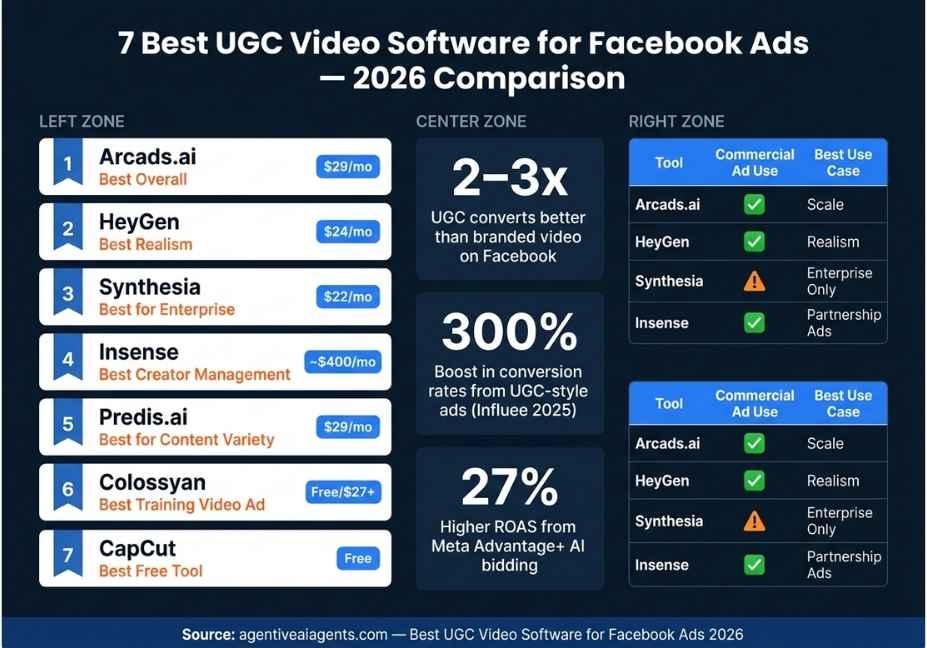
Did You Know? UGC-style video content can boost Facebook ad conversion rates by up to 300% compared to traditional branded creative, according to Influee’s 2025 benchmark data.
Now that you understand why UGC outperforms, let us look at the seven best tools available today.
The 7 Best UGC Video Software Tools for Facebook Ads (2026)
1. Arcads.ai Best Overall for AI UGC at Scale
It is best for Performance marketers running 10 or more creative variants per week
Key features: 1,000+ AI actors, product-in-hand avatar capability, multilingual generation, Facebook-native format presets
Pricing: Contact for growth and agency pricing
Arcads.ai was built specifically for paid social, and that focus shows in every feature. Its actor library is large enough that creative fatigue from avatar recognition is practically eliminated. Moreover, it exports natively in every aspect ratio Facebook actually rewards: 1:1 for Feed, 9:16 for Reels and Stories, and 16:9 for in-stream placements.
The product-in-hand avatar feature is particularly important. It simulates the creator unboxing format one of the highest-performing styles in e-commerce Facebook ads without requiring you to ship the physical product to a creator first.
Because of this, Arcads.ai is the strongest choice for brands that need creative volume without sacrificing format optimization.
Pro Tip: Use Arcads.ai’s multilingual export to run the same script in three languages against demographically segmented audiences. CPA variance by language is often between 40% and 60%, which means easy wins for any brand selling to multilingual markets.
2. HeyGen Best for Avatar Realism
It is best for Brands where photorealism and consistent spokesperson personas matter most
Key features: Custom avatar creation from a single photo, voice cloning, 300+ stock avatars
Pricing: Creator ($24/mo), Team ($69/mo), Enterprise (custom)
HeyGen currently produces the most photorealistic AI avatars available in any commercial video tool. For product categories where trust is the primary conversion lever supplements, financial services, skincare the visual quality difference between HeyGen and mid-tier tools directly affects ad performance.
In addition to realism, HeyGen’s custom avatar feature is a powerful brand asset. By submitting a 2–5 minute video of yourself or a contracted spokesperson, you can build a consistent digital presenter across all your creatives. This works especially well in retargeting sequences, where repeated avatar exposure builds familiarity and trust over time.
Licensing note: HeyGen permits commercial ad use on standard plans. Nevertheless, always confirm the current terms in their official documentation before scaling paid media spend.
3. Synthesia Best for Enterprise Teams, with One Important Caveat
It is best for Enterprise content operations with strict brand governance requirements
Key features: 230+ stock avatars, SCORM export for training content, team collaboration workflows
Pricing: Starter ($22/mo), Creator ($67/mo), Enterprise (custom)
Synthesia is the most established name in AI video generation. Its production quality is excellent, and its team collaboration tools make it well-suited to enterprise content operations. However, there is a critical licensing issue that trips up many performance marketers.
Specifically, Synthesia’s stock avatars cannot be used in paid advertisements without a separate enterprise licensing agreement. This means that if you run Facebook ads using Synthesia’s built-in actors without upgrading your license, you are in direct violation of their acceptable-use policy.
If you plan to use Synthesia for Facebook ads, therefore, you must either use a custom avatar built from your own likeness, or negotiate the appropriate license upgrade with their sales team.
Technical Note: This restriction applies only to Synthesia’s stock avatars not to custom avatars you build yourself. Misusing stock avatars in paid ads is an explicit policy violation and can result in permanent account termination.
4. Insense Best for Real-Human UGC and Meta Partnership Ads
It is best for Brands prioritizing authentic creator content and Meta Partnership Ads at scale
Key features: Creator marketplace, whitelisting and ad permissions workflow, brief-to-video delivery, full usage rights management
Pricing: From approximately $400/mo, plus individual creator fees
Insense operates at the intersection of UGC software and creator marketplace. Brands submit a creative brief, and vetted creators film and deliver content on their own mobile devices. Because of this, the output looks undeniably authentic because it genuinely is.
More importantly, Insense is specifically optimized for Meta Partnership Ads. This format, formerly called whitelisted ads, allows brands to run content directly from a creator’s personal Facebook or Instagram handle rather than from a brand page. Because of the social proof that comes with a creator’s handle, this format consistently outperforms standard brand-page ads in Facebook’s feed.
A documented case study cited by Insense reports that one brand generated $210,000 in revenue in a single month from UGC ads run through the platform.
5. Predis.ai Best for Speed and Creative Testing Throughput
It is best for Teams that need to generate and iterate ad concepts at maximum velocity
Key features: Text-to-ad video generation, AI UGC avatars, A/B creative variant generation, product URL input
Pricing: Starter ($29/mo), Agency ($79/mo)
Predis.ai’s primary advantage is iteration speed. You simply input a product URL and a target angle, and the platform generates multiple ad variations with different hooks, avatars, and scripts in just a few minutes. For early-stage campaigns where the goal is discovering winning creative angles before scaling spend, this throughput offers significant value.
Furthermore, Predis.ai integrates natively with Meta Business Suite for direct ad publishing. As a result, you can move from concept to live test without switching tools, which meaningfully cuts friction out of the test-launch-analyze cycle.
Pro Tip: Use Predis.ai specifically for the discovery phase of your creative calendar 15 to 20 low-budget tests per month to surface winning angles. Then rebuild your top performers in HeyGen or Arcads.ai with higher-polish production for scaling.
6. Colossyan Best Free Tier with Full Commercial Rights
It is best for Bootstrapped brands and agencies needing commercially licensed content without high upfront cost
Key features: 200+ AI avatars, interactive video elements including quizzes and branching scenarios, full commercial license on every plan including free
Pricing: Free plan available; paid plans from approximately $27/mo
Colossyan’s most important differentiator is its licensing policy. Every video produced on Colossyan including those made on the free plan comes with a full commercial license and no attribution requirement. This removes the single biggest legal risk for agencies managing multiple clients or early-stage brands testing Facebook ads before committing serious budget.
The avatar quality, while slightly below HeyGen’s newest models, is more than sufficient for most Facebook ad formats. In particular, for mobile-first Reels and Stories where viewer interaction time averages under 15 seconds the quality gap is not conversion-significant.
7. CapCut for Business Best for UGC Editing and Hook Optimization
It is best for Teams combining creator-filmed footage with AI-assisted editing and caption automation
Key features: AI auto-caption, trending hook format templates, text-to-speech, aspect ratio optimization
Pricing: Free (personal); Business tier pricing varies
CapCut sits downstream of the other tools on this list. It is an editor rather than an avatar generator. Nevertheless, for teams working with real creator footage or running hybrid workflows AI-scripted content combined with human-shot footage it fills a critical production gap.
Its auto-caption feature is especially valuable for Facebook specifically. Research from Wistia’s 2025 State of Video report shows that viewers spend an average of 4.7 seconds engaging with video creative versus just 1.4 seconds on a static image. However, a significant proportion of Facebook users watch video with sound off, meaning captions directly determine whether your message lands.
UGC Video Software Comparison Table
| Tool | Avatar Type | Commercial Ad Use | Starting Price | Best For |
|---|---|---|---|---|
| Arcads.ai | AI 1,000+ actors | Yes | Contact | High-volume scale |
| HeyGen | AI + Custom avatar | Yes | $24/mo | Photorealism |
| Synthesia | AI stock requires enterprise license | Enterprise only for stock | $22/mo | Enterprise teams |
| Insense | Real human creators | Yes whitelisted | ~$400/mo | Partnership Ads |
| Predis.ai | AI avatars | Yes | $29/mo | Testing velocity |
| Colossyan | AI 200+ avatars | Yes all tiers including free | Free / $27+ | Budget-conscious |
| CapCut | Editor no avatar generation | Yes | Free | Editing and captions |
How to Build a Facebook UGC Creative Testing System Step by Step
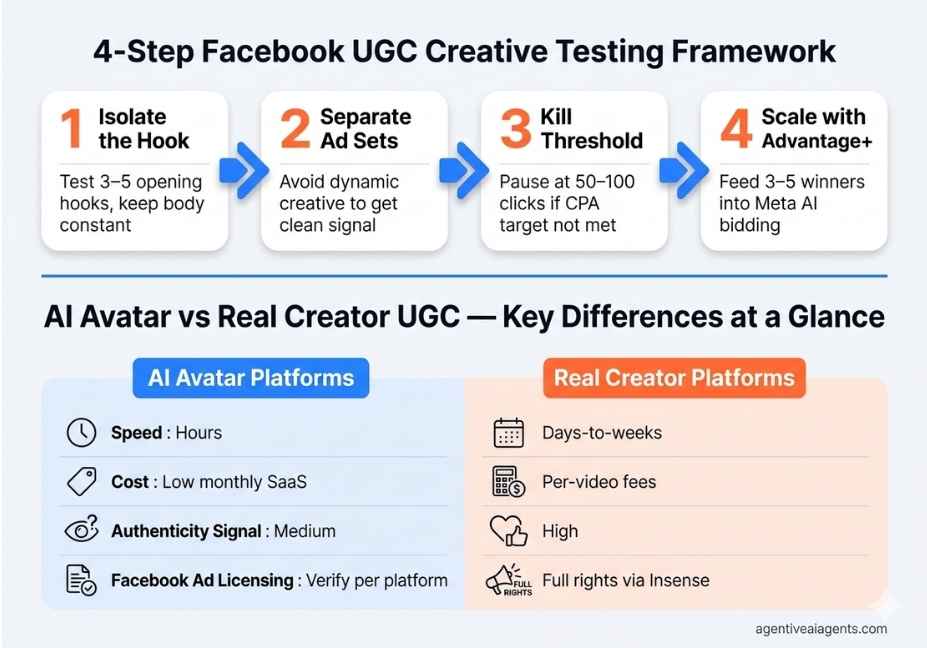
Choosing the right tool is only step one. The real performance leverage comes from how you run your creative testing system. Here is a proven four-step framework:
Step 1: Isolate the hook variable first.
Keep the body of your ad constant across all variants. Then test three to five different opening hooks a direct benefit claim, a problem-agitation opener, a surprising stat, and a social proof statement. Hook performance in the first three seconds determines whether Facebook’s algorithm delivers your ad at all.
Step 2: Run variants in separate ad sets not dynamic creative.
Dynamic creative combines results across variations, which makes it impossible to identify which specific hook or visual won. Manual ad set segmentation gives you the clean signal you need to make good scaling decisions.
Step 3: Set a clear kill threshold.
If a variant has not hit your target CPA after 50 to 100 clicks, pause it immediately. Do not wait for statistical significance at full scale because the cost of waiting is too high.
Step 4: Feed validated winners into Meta Advantage+.
Once you have three to five proven creatives, consolidate them into an Advantage+ Shopping campaign. Meta’s own data shows that AI bidding through Advantage+ delivers 27% higher ROAS than fully manual bidding (SQ Magazine, 2026). However, the algorithm needs real winning creative to optimize against not untested variants from the discovery phase.
Now that you have the testing framework, let us look at the mistakes that most teams make with UGC software.
Common Mistakes When Using UGC Video Software for Facebook Ads
Running stock avatars without checking the ad licensing terms.
Synthesia’s restriction is the most well-known, but other platforms carry similar limitations. Therefore, always read the acceptable-use policy in full before spending any media budget on AI avatar content.
Optimizing for video views instead of conversions.
A scroll-stopping hook is necessary but not sufficient on its own. Consequently, track CPA, not just CTR or ThruPlay. UGC that entertains but does not convert is a brand awareness play, not a performance ad.
Skipping the creative refresh calendar.
Even strong UGC creatives decay over time. In fact, most top-performing ads begin showing frequency fatigue within four to six weeks. Therefore, plan content refreshes as a recurring operational cost not as a one-time project.
Reusing the same avatar across too many different campaigns.
Audiences eventually recognize your AI avatar. Once they do, the content begins reading as branded rather than organic. For this reason, rotate actors across different campaigns. The large actor libraries in tools like Arcads.ai exist precisely to prevent this form of creative fatigue.
FAQ People Also Ask
What is the best UGC video software for Facebook ads?
For AI-generated UGC at scale, Arcads.ai is the strongest option in 2026 because of its 1000+ actor library, Facebook-native format presets, and product-in-hand avatar capability. For real human creator content with Meta Partnership Ads support, Insense leads the category. Ultimately, the best tool depends on whether you are optimizing for creative volume, avatar realism, or organic authenticity.
Can AI-generated UGC videos run as Facebook ads?
Yes. Meta’s advertising policies do not prohibit AI-generated video content, including AI avatar ads, provided you comply with standard advertising guidelines no deceptive claims, and proper disclosures where required. The licensing restriction is at the software level, not Meta’s level. For example, Synthesia requires an enterprise license before you can use its stock avatars in paid advertisements.
What makes a UGC video perform well on Facebook?
Three factors drive Facebook UGC performance. First, a hook that stops the scroll within the first two to three seconds. Second, a format that mirrors organic content vertical framing, mobile-shot aesthetic, and a conversational tone. Third, a single clear call-to-action. Audio also matters significantly: vertical videos with spoken dialogue produce 29% higher conversions than silent video ads on Facebook.
How many UGC ad variations should I test on Facebook?
Meta Advantage+ performs best when you supply three to five creative variations per ad set. For the initial discovery phase, however, generate 10 to 20 low-budget variants so you can identify your winning hook and angle before committing significant spend. AI UGC tools make this volume achievable without a proportional increase in production cost or time.
Is Synthesia allowed for Facebook paid ads?
Not by default. Synthesia’s built-in stock avatars require an enterprise-tier licensing agreement before they can be used in paid advertisements. Custom avatars built from your own video submission are permitted under standard plans. Always confirm the latest terms directly in Synthesia’s acceptable use policy at synthesia.io/legal/acceptable-use before running any paid ads.
What is the cheapest UGC video software for Facebook ads?
Colossyan offers the most accessible entry point a free plan with full commercial licensing on all content produced. For paid AI avatar generation, Predis.ai starts at $29 per month and CapCut’s editing tier is free. If you need real human creator content rather than AI avatars, however, Insense is the most cost-efficient marketplace option at approximately $400 per month.
Conclusion
The best UGC video software for Facebook ads in 2026 is not one single tool. It is a performance creative stack matched to your testing volume, budget, and authenticity requirements.
For most performance marketing teams, the strongest combination is an AI avatar platform either Arcads.ai or HeyGen for high-volume hypothesis testing, paired with Insense for top-funnel authentic content and Meta Partnership Ad placements.
Here are the three most important takeaways from this guide:
First, always check licensing terms before spending media budget especially with Synthesia stock avatars. Second, treat UGC software as a creative testing infrastructure tool, not just a production tool. The real ROI is in iteration speed and volume. Third, integrate validated winning creatives with Meta Advantage+ because the combination of proven UGC and AI bidding is where ROAS gains compound most reliably.
Bookmark this guide and explore more hands-on performance marketing and AI-powered workflow tutorials at agentiveaiagents.com.