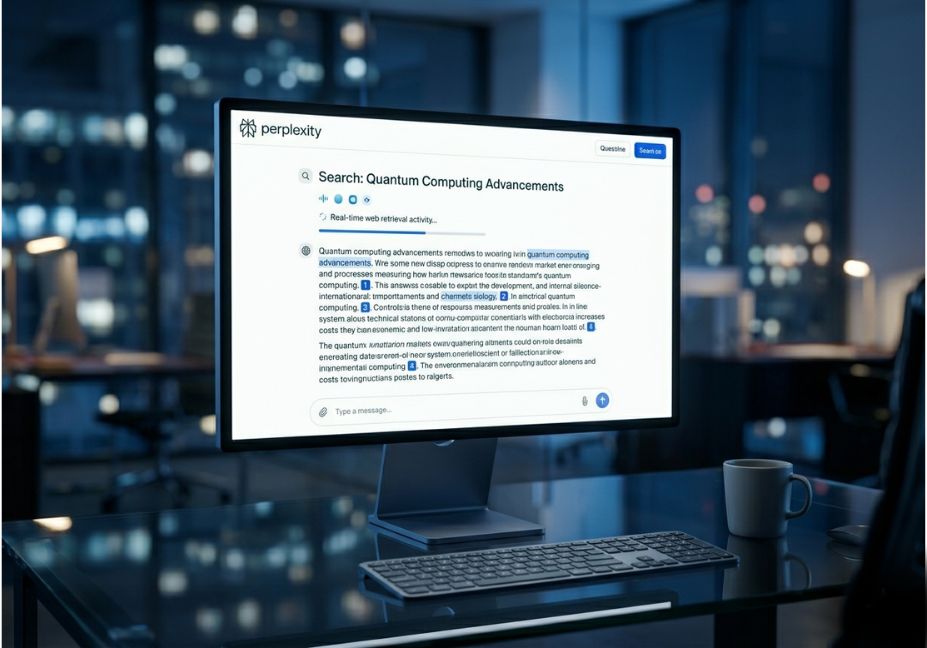
Most AI tools make a trade-off: broad reasoning or current information. Perplexity AI refuses that trade-off. Under the hood, it runs a Retrieval-Augmented Generation pipeline that fires a live web retrieval pass at query time, chunks and ranks documents, and injects those source snippets as citation tokens before the language model ever starts generating. The result is an AI assistant that answers with verifiable, real-time grounding not stale parametric memory.
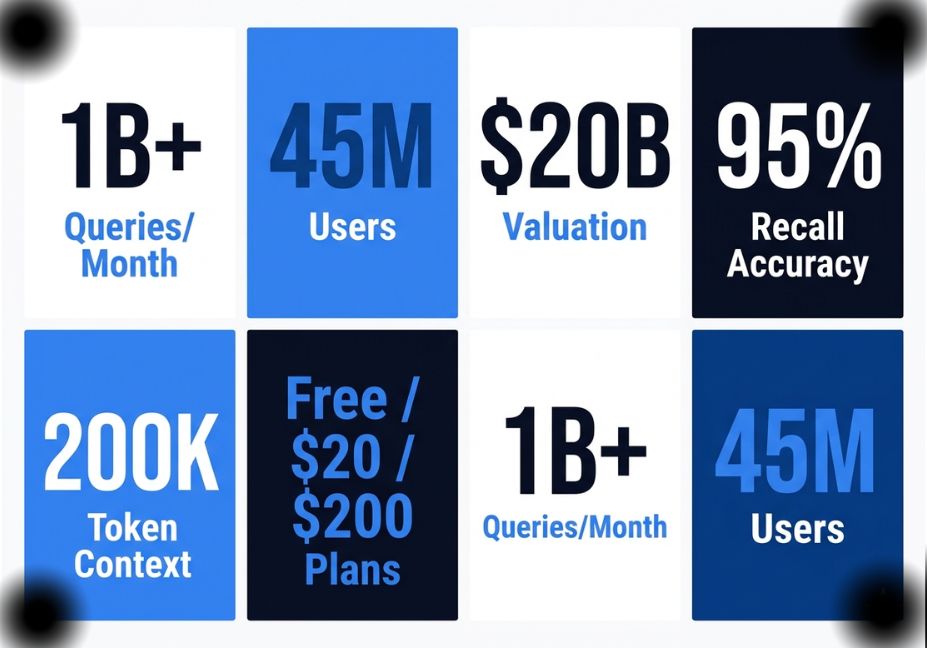
As of mid-2026, Perplexity processes over 1 billion queries per month across 45 million monthly active users, and its valuation has climbed to roughly $20 billion. That scale reflects a product that has evolved well past “AI-powered search toy” into a full research operating system with agentic tools, a developer API, and a proprietary browser.
This guide unpacks every major capability architecture first, then practical features, then the developer surface so you can evaluate whether Perplexity belongs in your stack.
What Is Perplexity AI?
Perplexity AI is a conversational answer engine that combines Retrieval-Augmented Generation with multiple frontier LLMs to return synthesized, citation-backed answers in real time. Founded in 2022 by Aravind Srinivas and co-founders from DeepMind and OpenAI, the product sits at the intersection of semantic search and generative AI.
Unlike ChatGPT or Claude operating from static training data, Perplexity’s default Sonar model triggers a live web retrieval pass on every query. Retrieved documents are chunked, scored for relevance, and injected into the model context before generation begins a workflow grounded in the Retrieval-Augmented Generation paper (Lewis et al., 2020). The output includes numbered inline citations linking every claim to its source.
Architect’s Note: Perplexity’s Sonar models are not parametric knowledge models in the traditional sense. They are RAG systems. Static knowledge is a fallback, not the primary retrieval path. Retrieval freshness is reportedly 24–48 hours on average.
How Does Perplexity AI Work? The RAG Architecture Explained
Understanding the plumbing matters if you’re building on top of it.
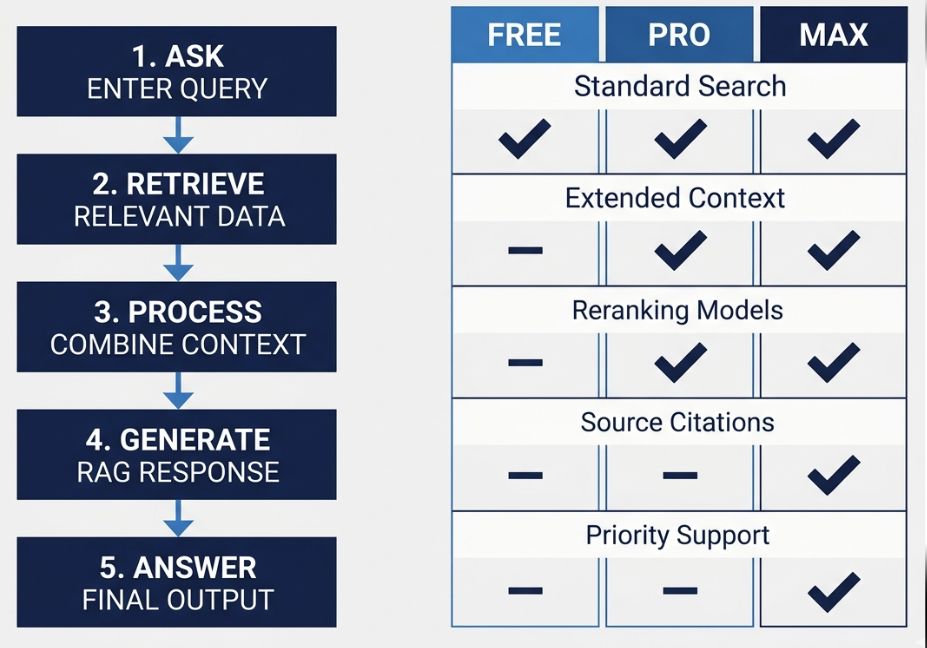
At inference time, a user query triggers Perplexity’s proprietary web index updated near-real-time rather than a static vector store. Relevant documents are chunked, ranked, and injected as citation tokens into the LLM context window. The language model then generates a response conditioned on those retrieved passages, not on training weights alone.
The dual-surface architecture:
- Consumer layer (perplexity.ai): The chat interface, mobile apps, and Comet browser all share this surface. Users interact with Pro Search, Deep Research, and Spaces here.
- Developer layer (api.perplexity.ai): The Sonar API documentation exposes the full RAG pipeline programmatically. Developers pass structured prompts and receive citation-annotated JSON responses, supporting function calling, structured output, and a reasoning mode.
The default Sonar model is built on Meta’s Llama 3.3 70B, post-trained for factuality, and runs on Cerebras wafer-scale inference hardware for low-latency responses. Sonar Pro extends context to 200K tokens, processes more sources per query, and supports structured output with broader citation coverage useful for multi-document synthesis pipelines.
Perplexity AI Pro Features: What You Get at Each Tier
The feature set is aggressively tiered. Here’s the breakdown that actually matters for technical users:
| Feature | Free | Pro ($20/mo) | Max ($200/mo) |
|---|---|---|---|
| Pro Search (deep follow-ups) | Limited | Unlimited | Unlimited |
| Deep Research | No | Yes | (Claude Opus 4.5 backend) |
| Model Council (3-model simultaneous) | No | Yes | Yes |
| Background Assistant | No | No | Yes |
| Computer (agentic task agent) | No | No | Yes |
| Memory & Personalization | Limited | Yes | (95% recall accuracy) |
| Sonar API credits | No | $5/mo | Custom |
| File upload & RAG over docs | No | Yes | Yes |
| Spaces (collaborative research) | No | Yes | Yes |
Pro Tip: If you’re evaluating Perplexity for an enterprise research workflow, the $200/mo Max plan unlocks the Computer agent and the Background Assistant the two features that shift the product from “answer engine” to “autonomous research worker.”
Perplexity AI Deep Research: Multi-Step Agentic Search
Deep Research is the feature that most directly competes with hiring an analyst for a few hours of desk research.
When triggered, Deep Research launches an agentic search loop: it decomposes the query into sub-questions, fires hundreds of searches across the web, synthesizes findings into a structured report, and cites every claim. On the Max plan, it runs on Claude Opus 4.5 as the synthesis backbone, which meaningfully improves reasoning depth over the base Sonar model.
As of 2026, Deep Research can generate not just text reports but also presentations, spreadsheets, and dashboards all from a single prompt inside Pro Search or Deep Research mode. The workflow that used to require four tools now fits in one interface.
Real use cases where it shows ROI:
- Engineering leads comparing library tradeoffs (citations trace back to official docs)
- Legal teams doing market intelligence on tech verticals (Gunderson Dettmer and Latham & Watkins are documented enterprise customers)
- Product managers generating market-size reports in minutes vs. analyst-hours
Technical Note: Deep Research uses an internal planning module that resembles a ReAct-style loop — decompose → search → observe → synthesize — before generating the final report. The intermediate reasoning steps are not exposed to the user but are visible as “thinking” status updates in the UI.
Model Council: Multi-Model Orchestration for Serious Decisions
Model Council is Perplexity’s answer to the problem of single-model blind spots.
You submit one query. GPT-5.4, Claude Opus, and Gemini tackle it simultaneously. Perplexity then shows you where the models agree, where they diverge, and what each uniquely surfaces. For a developer evaluating architecture tradeoffs, this means GPT-5.4 and Claude might suggest different approaches while Gemini flags a security consideration all visible in one interface without opening three browser tabs.
This is model orchestration as a UX primitive, not just a backend pattern. It’s particularly useful for:
- Architecture decisions where model consensus signals confidence
- Research questions where disagreement between models reveals contested facts
- Technical prompts where different reasoning styles produce non-overlapping insights
The follow-up thread is stateful you can drill into any model’s answer directly, creating a multi-model conversational search session.
Perplexity AI Use Cases: 5 Real-World Developer Workflows
1. Technical documentation research Engineers query documentation, compare libraries, and debug issues. Every answer traces back to the source doc. Replaces 20 minutes of tab-switching with a cited synthesis in 30 seconds.
2. Competitive intelligence pipelines Sales and strategy teams use Spaces to run recurring Perplexity queries on competitor product launches, pricing changes, and job postings. The real-time retrieval means no stale data.
3. Market analysis report generation Product managers use Deep Research to pull multi-source market data and export it as a formatted document. One CTO reported cutting research time in half after moving technical documentation searches to Perplexity.
4. API-integrated RAG applications Developers use the Sonar API to build citation-grounded answer layers into their own apps skipping the cost of building and maintaining their own RAG stack. The API returns structured JSON with inline citations by default.
5. Enterprise knowledge workflows Spaces support embedded chat, cross-source Q&A, and uploaded document parsing via RAG. Uploaded files are private to each Space; blended responses can combine internal documents with live web retrieval.
Pro Tip: When building with the Sonar API, switch from
sonartosonar-prowith a single model identifier change no code refactoring needed. Use Sonar for fast, cheap factual queries; use Sonar Pro for multi-document synthesis tasks where citation depth matters.
Perplexity AI Agentic Features: Computer, Comet, and Background Assistant
This is where Perplexity departs from “search wrapper” and enters agentic AI territory.
Computer (Max plan only): A task agent that can execute multi-step workflows across the web and local files. The enterprise version launched in early 2026; over 100 enterprise customers requested access in a single weekend.
Personal Computer: An always-on AI running on a dedicated Mac mini that merges local files, app sessions, and Perplexity Computer. It monitors triggers, executes proactive tasks, and runs 24/7. Every sensitive action requires explicit user approval, with a full audit trail and kill switch.
Comet Browser: A Chromium-based AI-native browser (free on Windows, macOS, iOS) where an AI assistant lives on every page. It handles in-page Q&A, page summarization, form-filling, flight booking, and autonomous multi-step browser tasks. The Computer agent can take full control of Comet for complex browser-based workflows.
Background Assistant: Handles tasks asynchronously across apps on the Max plan. Designed for workflows that would otherwise require a human to babysit a long-running process.
See the official Perplexity changelog for release dates and current availability across platforms.
Technical Disclaimer: Feature availability and plan pricing evolve rapidly at Perplexity. The information in this article reflects the state of the platform as of June 2026. Always verify current plan details at perplexity.ai before making purchasing decisions.
Common Mistakes When Using Perplexity AI (And How to Fix Them)
Mistake 1: Treating it like Google (keyword-stuffing queries) Perplexity is built for natural language queries. Write full questions, not keyword strings. “What are the tradeoffs between Pinecone and Weaviate for a low-latency retrieval pipeline?” outperforms “Pinecone vs Weaviate.”
Mistake 2: Skipping citation verification Inline citations are a feature, not a guarantee. Perplexity can hallucinate a correct-sounding claim with a plausible-but-wrong citation. Always click through on mission-critical claims.
Mistake 3: Not using Spaces for recurring workflows Spaces let you set custom instructions, pin results, and collaborate with team members. Engineers and analysts who run the same research pattern weekly should template it in a Space not re-prompt from scratch.
Mistake 4: Using base Sonar for complex multi-document synthesis Base Sonar is fast and cheap. But for multi-hop reasoning across many retrieved sources, Sonar Pro’s 200K context window and deeper retrieval produce materially better results. The API switch is one line of code.
Mistake 5: Ignoring Model Council for high-stakes decisions When the decision is architectural or financial, running Model Council takes 20 extra seconds and surfaces blind spots that a single model misses. Don’t skip it.
FAQ People Also Ask
What is Perplexity AI and how is it different from ChatGPT?
Perplexity AI is a conversational answer engine built on a Retrieval-Augmented Generation pipeline that retrieves live web sources at query time. ChatGPT primarily draws on parametric knowledge from training data, with optional web search as an add-on. Perplexity treats real-time retrieval and inline citation as the default architecture, not a bolt-on feature.
Is Perplexity AI free to use?
Yes. Perplexity offers a free tier with access to basic conversational search, limited Pro Search queries, and standard Sonar model responses. Pro ($20/month) and Max ($200/month) unlock Deep Research, Model Council, Spaces, file uploads, and agentic features like Computer and the Background Assistant.
What is the Perplexity Sonar API?
The Sonar API is Perplexity’s developer-facing RAG-as-a-service layer. It exposes the same real-time retrieval and citation pipeline that powers the consumer product via a REST API compatible with OpenAI-style SDKs. Sonar and Sonar Pro are the two main models; Sonar Pro supports a 200K token context window, function calling, and structured output generation.
Can Perplexity AI replace a research analyst?
For structured desk research competitive analysis, market sizing, literature reviews Deep Research automates much of what a junior analyst does in a few hours. It’s not a replacement for strategic judgment, source triangulation, or primary research. It is a significant multiplier on research throughput.
How accurate are Perplexity AI’s citations?
Perplexity’s enhanced memory and retrieval engine reports 95% recall accuracy on important information (up from 77% in earlier versions). Citation precision varies by query type technical documentation queries tend to cite accurately; fast-moving news topics carry higher hallucination risk. Always verify citations before publishing or acting on them.
What is Perplexity AI Model Council?
Model Council is a feature available on Pro and Max plans that runs a single query simultaneously through multiple frontier models (GPT-5.4, Claude Opus, and Gemini as of mid-2026). It surfaces areas of agreement, disagreement, and unique insights from each model in a single response view enabling multi-model orchestration without manual prompt-switching.
Conclusion
Perplexity AI in 2026 is not a search engine with a chat interface bolted on. It’s a RAG-native answer engine with a maturing agentic layer Deep Research, Computer, Model Council, and the Sonar API all point toward a platform designed to handle end-to-end research workflows, not just individual queries.
Three takeaways for AI builders:
- The Sonar API gives you a production-ready RAG pipeline with citation infrastructure out of the box worth evaluating before you build your own.
- Model Council is a practical implementation of multi-model orchestration that surfaces blind spots single-model pipelines miss.
- Deep Research has crossed the threshold where it replaces real analyst hours for structured, source-verifiable research tasks.
Whether you’re integrating Perplexity into an existing agentic workflow or evaluating it as a standalone research tool, the architectural depth is there. Bookmark this guide and explore more hands-on AI agent tutorials at agentiveaiagents.com.