Vector Store in Agentic AI: How Smart AI Remembers and Thinks
Why Smart AI Needs Memory
Artificial intelligence is getting smarter every year. Some AI systems can now plan tasks, make decisions, and even act on their own. These systems are called agentic AI.
But there is a big problem.
Most AI forgets everything after one conversation.
This is where a vector store in agentic AI becomes important. It helps AI remember past information, understand meaning, and use knowledge again later.
In this article, you will learn what a vector store is, why agentic AI needs it, and how it helps AI think better. Everything is explained in simple words, step by step.
No advanced math. No confusing jargon.
Just clear answers.
What Is Agentic AI?
Agentic AI is a type of artificial intelligence that can act on its own.
Instead of only answering questions, agentic AI can:
- Set goals
- Make plans
- Use tools
- Learn from past actions
These AI agents behave more like helpers than chatbots.
For example, an agentic AI can plan a project, search for information, store results, and improve its next decision.
To do this well, agentic AI needs memory.
Why Memory Is a Big Problem for AI
That means:
- They do not remember past chats
- They forget previous decisions
- They lose context after one task
This causes many problems.
AI repeats mistakes.
AI gives shallow answers.
AI cannot learn from experience.
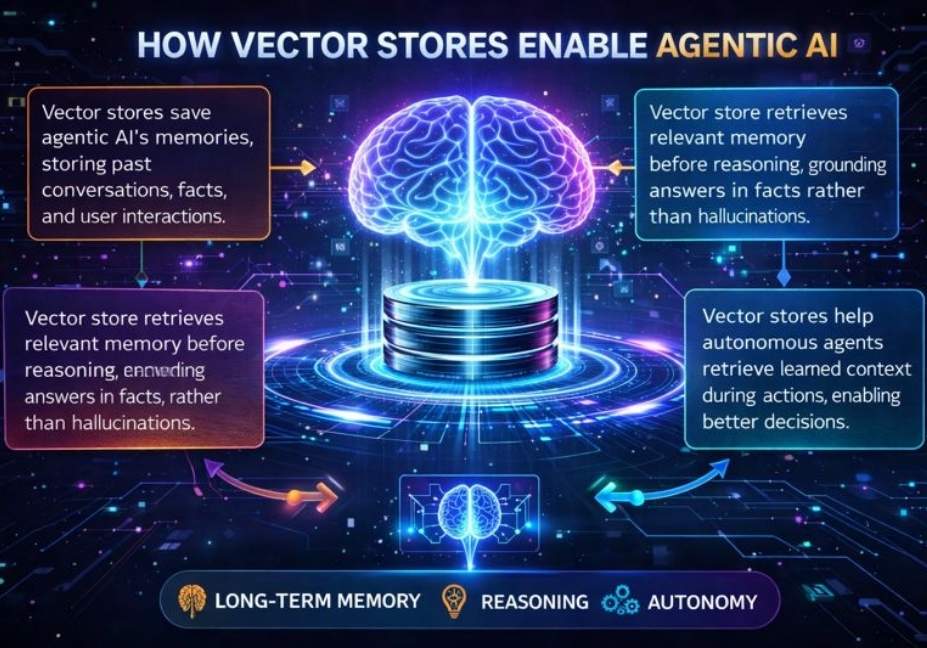
To fix this, agentic AI systems use long-term memory. This is where a vector store in agentic AI plays a key role.
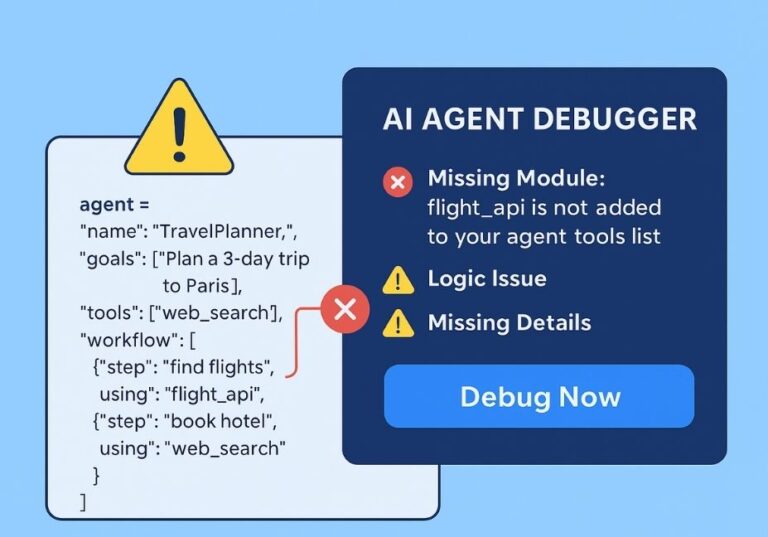
|| Also read AI Agent Debugger: The Ultimate Tool to Fix AI Agent Scripts Easily
What Is a Vector Store?
A vector store is a special type of database.
Instead of saving words as plain text, it saves meaning.
It does this using vectors.
A vector is a list of numbers that represents the meaning of text, images, or data.
When AI turns text into vectors, similar ideas get similar numbers.
This allows the AI to search by meaning, not just keywords.
Simple Example of a Vector Store
Imagine you save these notes:
- “Cats like warm places”
- “Dogs enjoy running outside”
Later, you ask:
“What animals enjoy comfort?”
A normal database might fail.
A vector store understands meaning and finds the cat sentence.
That is the power of a vector store.
This ability is essential for a vector store in agentic AI systems.
How Vector Stores Work Step by Step
Vector stores follow a clear process.
First, data is converted into embeddings.
Second, embeddings are saved as vectors.
Third, similarity search finds the best match.
This process uses NLP and machine learning.
It helps AI understand meaning instead of exact words.
What Are Embeddings?
Embeddings are numerical representations of text.
They are created using language models.
Each sentence becomes a vector.
Similar sentences create similar vectors.
Embeddings are the foundation of every vector store in agentic AI.
Without embeddings, semantic search is impossible.
Why Agentic AI Needs a Vector Store
Agentic AI must remember past actions.
It must recall facts.
It must learn from experience.
A vector store in agentic AI makes this possible.
It gives agents long-term memory.
It allows reasoning across time.
It reduces repeated errors.
Vector Store as Long-Term Memory
Short-term memory lives inside prompts.
Long-term memory lives inside vector stores.
A vector store allows AI to:
- Remember past conversations
- Store decisions and outcomes
- Recall useful information later
This turns AI into a learning system.
Vector Store and Context Awareness
Context is everything.
Without context, AI gives generic answers.
With context, AI gives precise help.
A vector store in agentic AI retrieves relevant memory before answering.
This keeps responses accurate and focused.
Vector Store and Decision Making
Agentic AI makes decisions.
Good decisions require past knowledge.
A vector store helps AI:
- Recall similar situations
- Compare outcomes
- Choose better actions
This improves autonomous behavior.
Vector Store vs Traditional Databases
Traditional databases use exact matching.
Vector stores use semantic similarity.
This difference is huge.
SQL databases answer “What matches this word?”
Vector stores answer “What means the same thing?”
For agentic AI, meaning matters more than keywords.
Why SQL Databases Are Not Enough
SQL databases are structured.
Agentic AI works with unstructured data.
Examples include:
- Conversations
- Notes
- Logs
- Documents
A vector store in agentic AI handles this naturally.
Vector Store vs NoSQL Databases
NoSQL databases store flexible data.
But they still rely on exact matching.
They do not understand meaning.
Vector stores understand relationships between ideas.
This makes them better for intelligent agents.
How Vector Stores Enable Reasoning
Reasoning requires memory.
Memory requires retrieval.
Retrieval requires vectors.
This chain makes vector stores essential.
Agentic AI retrieves relevant thoughts before thinking.
This improves logic and accuracy.
Retrieval-Augmented Reasoning
Before answering, agentic AI retrieves memory.
This process is called retrieval-augmented reasoning.
A vector store in agentic AI supports this flow.
It grounds reasoning in stored knowledge.
Reducing AI Hallucinations
Hallucinations happen when AI guesses.
Guessing happens without memory.
Vector stores reduce hallucinations by:
- Providing factual grounding
- Reusing verified information
- Preventing random answers
This improves trust.
Types of Memory in Agentic AI
Agentic AI uses different memory types.
Each type plays a role.
Vector stores often support all of them.
Short-Term Memory
Short-term memory lives in prompts.
It handles current tasks.
It disappears quickly.
Vector stores are not used here.
Long-Term Memory
Long-term memory stores facts.
It grows over time.
It lives inside a vector store.
This is where learning happens.
Episodic Memory
Episodic memory stores experiences.
Examples include:
- Past conversations
- Task results
- Errors and fixes
A vector store in agentic AI saves these episodes.
Semantic Memory
Semantic memory stores knowledge.
Examples include:
- Definitions
- Rules
- Concepts
Vector stores retrieve this knowledge when needed.
Metadata and Vector Stores
Metadata adds context.
It includes:
- Time
- Source
- Importance
- Task ID
Metadata helps filter results.
This improves retrieval accuracy.
Architecture of Vector Store in Agentic AI
The architecture is simple.
Agent sends query.
Query becomes embedding.
Vector store searches.
Relevant memory returns.
This loop happens constantly.
Where Vector Stores Fit in the AI Stack
Vector stores sit between data and reasoning.
They connect memory to intelligence.
Without them, agentic AI stays shallow.
With them, AI becomes adaptive.
Popular Vector Store Technologies
Many tools support vector storage.
They vary by scale and design.
The choice depends on use case.
Open-Source Vector Stores
Examples include FAISS and Milvus.
They offer flexibility.
They require setup and tuning.
They are common in research systems.
Managed Vector Databases
Examples include Pinecone and Qdrant.
They handle scaling.
They simplify deployment.
They are used in production agentic AI.
Embedded Vector Stores
Embedded stores run locally.
They are useful for small agents.
They reduce latency.
They still support semantic search.
Use Cases of Vector Store in Agentic AI
Vector stores power many applications.
They make agents smarter and more useful.
Customer Support Agents
Support agents remember past tickets.
They personalize answers.
They avoid repeated questions.
A vector store in agentic AI makes this possible.
Research and Knowledge Agents
Research agents store papers and notes.
They retrieve relevant sections quickly.
They connect ideas across sources.
This speeds up analysis.
Coding and Development Agents
Coding agents remember errors.
They recall fixes.
They learn coding patterns.
Vector stores improve developer productivity.
Personal AI Assistants
Personal agents remember preferences.
They recall habits.
They improve over time.
Memory makes assistance feel human.
Challenges of Using Vector Stores
Vector stores are powerful.
But they come with challenges.
Understanding them helps avoid mistakes.
Embedding Drift
Embedding models change.
Old vectors may lose accuracy.
This causes retrieval errors.
Regular updates are needed.
Memory Pollution
Not all data is useful.
Storing everything creates noise.
Agents must filter memory.
Quality matters more than quantity.
Retrieval Accuracy Problems
Too many results confuse AI.
Too few results limit context.
Balancing precision and recall is important.
Cost and Performance Issues
Large vector stores grow fast.
Storage costs increase.
Search latency can rise.
Optimization is necessary.
Best Practices for Vector Store in Agentic AI
Good design improves results.
These practices help.
Store Only Valuable Information
Do not store raw noise.
Store:
- Decisions
- Outcomes
- Verified facts
This improves memory quality.
Use Smart Chunking
Break data into meaningful chunks.
Avoid too large pieces.
Avoid tiny fragments.
Semantic chunking works best.
Optimize Metadata Usage
Use metadata filters.
Reduce search space.
Improve relevance.
Metadata boosts retrieval speed.
Prune Old Memory
Old data loses value.
Remove outdated memory.
Refresh important knowledge.
Memory management keeps agents efficient.
Vector Store vs RAG Systems
RAG systems retrieve documents.
Agentic memory retrieves experiences.
Both use vector stores.
But goals differ.
Key Differences Explained Simply
RAG supports answering questions.
Agentic memory supports decision-making.
A vector store in agentic AI does more than RAG.
Future of Vector Store in Agentic AI
The future looks advanced.
Vector stores will evolve.
Agents will manage memory themselves.
Self-Managing Memory Systems
Future agents will decide what to store.
They will delete low-value memory.
They will improve autonomously.
Shared Memory Across Agents
Multiple agents will share vector stores.
This creates collective intelligence.
Knowledge will spread faster.
Combining Vector and Symbolic Memory
Future systems will mix logic and vectors.
This improves reasoning.
Hybrid memory is coming.
FAQ: Vector Store in Agentic AI
What is a vector store in agentic AI?
A vector store in agentic AI is a memory system that stores meaning-based data using embeddings, allowing AI agents to retrieve relevant information and past experiences for better decisions.
Why do agentic AI systems need vector stores?
Agentic AI needs vector stores to remember past actions, retrieve context, reduce hallucinations, and improve reasoning across time.
Is a vector store required for agentic AI?
Yes, most advanced agentic AI systems require a vector store to support long-term memory and autonomous behavior.
Conclusion: Why Vector Store in Agentic AI Matters
Agentic AI is not just about smart responses.
It is about learning, remembering, and improving.
A vector store in agentic AI provides memory, context, and meaning.
It transforms AI from reactive to intelligent.
As AI becomes more autonomous, vector stores will become essential infrastructure.
They are not optional.
They are foundational.
One Comment