Most legal AI tools fail attorneys the same way general-purpose LLMs fail developers: they generate confident, fluent output that is factually wrong. Cite a clause that does not exist. Benchmark a term against nothing. Hallucinate a governing law provision for the wrong jurisdiction.
The law insider AI assistant addresses this problem at the architectural level not by building a better chat interface, but by grounding every output in a live corpus of millions of publicly filed contracts. For AI developers and legal tech founders evaluating where this tool fits in a production stack, that distinction matters more than any feature checklist.
This guide covers how Law Insider’s AI layer works under the hood, how it compares against Harvey, CoCounsel, and LexisNexis, and where it belongs in a modern legal workflow.
What Is the Law Insider AI Assistant?
Law Insider started as a contract clause database a searchable index of publicly filed agreements drawn from SEC filings, M&A transactions, and commercial contracts. In April 2026, it launched a full AI layer on top of that database: Law Insider’s AI Assistant, which handles clause drafting, contract review, redlining, and benchmarking via both a web platform and a Microsoft Word add-in.
The architectural detail that separates it from a generic LLM wrapper: the AI does not generate output in isolation. Every clause it drafts or validates is cross-referenced against Law Insider’s contract index in real time. This is a form of retrieval-augmented generation (RAG) the same pattern used in production pipelines to ground LLM outputs in authoritative source documents rather than relying on parametric model weights.
The underlying LLM is GPT-4o (OpenAI). The retrieval layer is Law Insider’s proprietary contract corpus. The combination is the product neither component alone produces what the platform delivers.

How Does Law Insider’s AI Architecture Work?
Understanding Law Insider as a RAG system rather than a chatbot clarifies both its strengths and its hard limits.
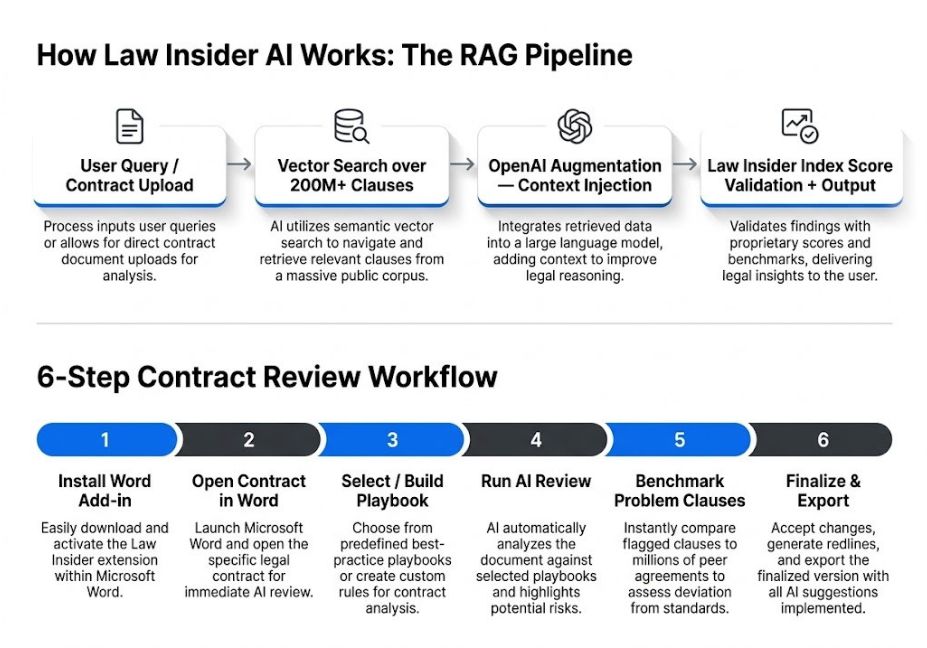
The retrieval layer performs semantic search over Law Insider’s corpus of millions of real contracts. When a user queries the AI Assistant, the system surfaces the most relevant precedent clauses for the current drafting context using vector similarity matching.
The generation layer uses GPT-4o to synthesize the retrieved clause examples into a new draft, constrained by the user’s context: governing law, party type, risk posture, and any loaded playbook rules.
The validation layer is Law Insider’s core differentiator. Rather than just outputting generated text, the assistant benchmarks every clause against the Law Insider Index Score a scoring system that compares the generated clause against the statistical distribution of how that clause type appears across the real deal population. You can see whether your indemnification cap is narrow, market-standard, or aggressive relative to actual filed contracts not against a model’s internal priors.
Architect’s Note: This is structurally similar to how Perplexity uses citation-grounded generation, except Law Insider’s retrieval corpus is domain-specific (contracts only). Domain-specific vector search dramatically improves retrieval precision compared to general-purpose web retrieval, which is why clause benchmarks here carry more signal than outputs from a general LLM.
The full loop: user query → semantic search over contract corpus → clause retrieval → GPT-4o synthesis → Index Score validation → benchmarked output.
Law Insider AI Use Cases: 4 Real-World Scenarios
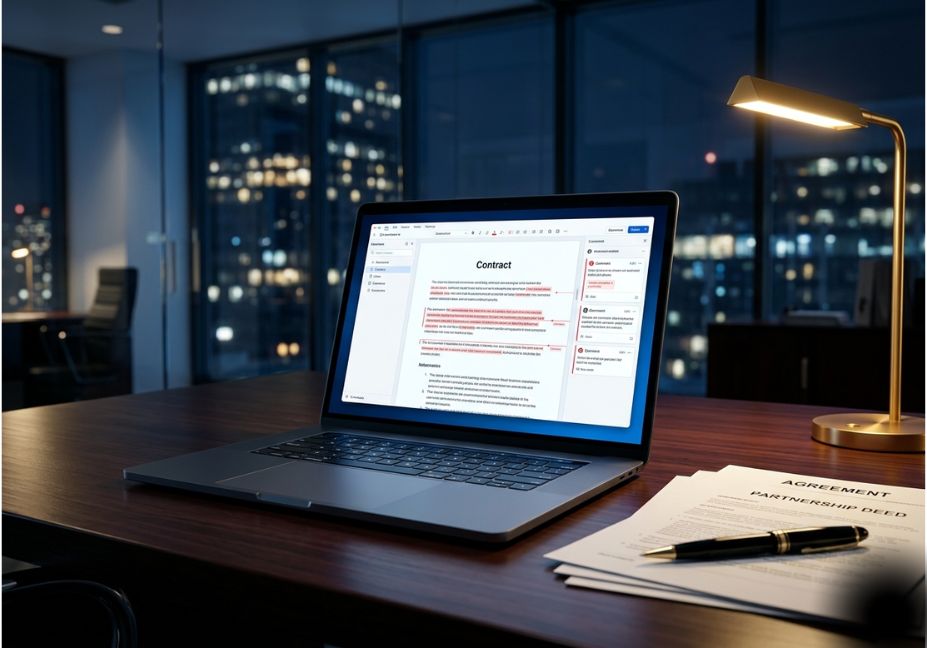
1. Contract review and redlining Upload a third-party contract to the Word add-in. The assistant reads each clause, flags deviations from your playbook, and inserts redline comments with suggested replacements. A 30-page NDA that normally requires 2–3 hours of first-pass review can be triaged in under 20 minutes.
2. Clause drafting with database validation Ask the assistant to draft a limitation of liability clause for a SaaS agreement. It generates the clause, then surfaces the Index Score showing whether the output is aggressive, balanced, or weak relative to how similar clauses appear in the corpus. Attorneys tune language from data, not intuition.
3. Benchmarking during negotiation A procurement team receives a supplier contract with unusual payment terms. The AI Assistant lets them instantly benchmark the clause against market precedent and pull comparable examples to anchor a counterproposal.
4. Multi-language contract work The AI Assistant supports work in virtually any modern language, making it usable for global in-house teams handling cross-border agreements without tool-switching.
Did You Know? Legal AI adoption reached 79% of law firms in 2026. But most enterprise platforms Harvey, CoCounsel require minimum seat counts that price out solo practitioners and boutique firms entirely. Law Insider’s individual tier at $29/month was built specifically for this underserved segment.
Law Insider vs. Harvey, CoCounsel, and LexisNexis: Honest Comparison
The legal AI market has fragmented sharply by target user and task type. Here is where Law Insider sits relative to the major platforms:
| Tool | Primary Strength | AI Model | Pricing | Best For |
|---|---|---|---|---|
| Law Insider | Database-grounded clause drafting and benchmarking | GPT-4o + proprietary corpus | $29/mo individual | Solos, small firms, in-house |
| Harvey AI | Complex legal reasoning, M&A, multi-jurisdictional | Proprietary (GPT-4 based) | ~$1,200+/seat/mo | BigLaw, enterprise |
| CoCounsel | Research depth, Westlaw and Practical Law integration | Proprietary | $225–$500/seat/mo | Mid-to-large firms |
| Lexis+ with Protege | Shepard’s citation validation, research | Proprietary | Enterprise negotiated | Research-heavy practices |
| Spellbook | MS Word-native AI drafting, style learning | GPT-4 / Claude | Per-user subscription | Transactional lawyers |
The first independent benchmark comparing legal AI tools the Vals AI VLAIR study from February 2026 found Harvey achieved 94.8% accuracy on document Q&A tasks, significantly above the 70.1% human lawyer baseline. CoCounsel led on document summarization at 77.2%. But redlining was the weakest task across all AI platforms human lawyers outperformed every tested AI tool on contract redlining at 79.7%. That finding is relevant context for evaluating any playbook-driven, database-grounded tool.
Pro Tip: Do not pick a legal AI tool based on its aggregate benchmark score. Match the tool to the specific task. Law Insider wins on clause drafting and benchmarking at the right price point for small teams. It is not a litigation research platform. For deep case law research, Westlaw plus CoCounsel or Lexis+ with Protege are the correct tools.
Step-by-Step: How to Integrate Law Insider AI Into a Legal Workflow
Step 1: Install the Word Add-In Get the Law Insider Word Add-In from Microsoft AppSource. This integrates the AI Assistant directly into your document environment review, redlining, and clause generation without context-switching between applications.
Step 2: Build a custom playbook Law Insider supports customizable AI playbooks a defined set of review rules the assistant applies consistently across every contract. Define your standard positions on key clause types: indemnification, limitation of liability, IP ownership, termination for convenience. The assistant will flag deviations automatically on every review.
Step 3: Use the AI Assistant for first-pass drafting For original drafts, generate clause-level output through the web-based AI Assistant, anchored to the contract database. Review the Index Score on each clause before finalizing language.
Step 4: Benchmark before counterproposals When receiving third-party paper, run key clauses through the benchmarking tool to quickly assess whether counterparty positions are standard or aggressive. This compresses negotiation prep from hours to minutes.
Step 5: Validate all outputs before sending RAG pipelines deployed in legal environments reduce hallucination risk significantly compared to general-purpose LLMs but no current system is hallucination-free. Final language must be reviewed by a licensed attorney before sending to any counterparty.
Here is a simplified pseudocode representation of how the RAG validation loop works under the hood:
python
def validate_clause(generated_clause: str, corpus_index: VectorStore) -> dict:
    # Embed the generated clause
    query_embedding = embed(generated_clause)

    # Retrieve top-k similar clauses from the contract corpus
    similar_clauses = corpus_index.similarity_search(query_embedding, k=20)

    # Score the generated clause against the distribution
    index_score = compute_market_position(generated_clause, similar_clauses)

    # Return output with benchmark context
    return {
        "clause": generated_clause,
        "index_score": index_score,       # "below market" / "standard" / "aggressive"
        "comparable_examples": similar_clauses[:3]
    }
Technical Disclaimer: Law Insider’s AI tools launched in April 2026 using OpenAI GPT-4o. The API and underlying models will evolve. Always check the official documentation at lawinsider.com before building any production integrations.
Common Mistakes When Using AI Legal Assistants
Treating generated output as final legal advice. Law Insider’s clause outputs are market-grounded drafts, not attorney opinions. They are starting points not finished products that can be sent to counterparties without review.
Ignoring the Index Score. The benchmarking feature is the most technically differentiated part of the platform. Attorneys who use the AI Assistant purely as a text generator are bypassing the validation layer that separates it from a standard GPT-4o wrapper.
Uploading sensitive client data without a privacy review. Law Insider states it does not use customer data to train its models. But any legal professional handling privileged client information should review the current data processing agreement before uploading third-party contracts or internal documents.
Using it for litigation research. Law Insider’s corpus is publicly filed commercial contracts not case law, statutory materials, or regulatory guidance. It is not a Westlaw or LexisNexis substitute. Attempting to use it for litigation research produces shallow, unreliable outputs.
Skipping playbook configuration. Contract review without a loaded playbook produces generic, low-signal feedback. The feature becomes meaningfully useful once your standard positions are defined and loaded.
FAQ People Also Ask
What is the Law Insider AI Assistant?
Law Insider AI Assistant is an AI-powered contract drafting, review, and benchmarking tool built on top of Law Insider’s database of millions of publicly filed contracts. It uses GPT-4o combined with a semantic retrieval layer to generate and validate contract clauses against real market precedent. Available via web and Microsoft Word add-in, starting at $29/month for individual users.
How does Law Insider reduce AI hallucinations in contract drafting?
Law Insider uses database-grounded generation: every clause the AI produces is benchmarked against its real contract corpus using the Law Insider Index Score. This retrieval-augmented generation approach grounds output in actual filed agreements rather than the LLM’s parametric memory alone, which significantly reduces the risk of fabricated, non-market, or jurisdiction-incorrect clause language.
How does Law Insider compare to Harvey AI or CoCounsel?
Law Insider targets solo practitioners and small firms at $29–$49/month. Harvey and CoCounsel are enterprise tools priced at $225–$1,200+/user/month, built for large law firms handling complex M&A, litigation, and multi-jurisdictional compliance. Law Insider’s differentiator is the clause benchmarking system and its affordability. Harvey and CoCounsel lead on deep legal research depth and institutional workflow integration.
Does Law Insider work inside Microsoft Word?
Yes. The Law Insider Word Add-In allows review, redlining, and clause analysis directly within Word documents. Users can trigger AI-generated suggestions, playbook-based flag checks, and Index Score benchmarking without leaving their document editing environment.
Is the Law Insider AI Assistant suitable for non-English contracts?
The AI Assistant supports work in nearly any modern language, making it functional for global in-house teams handling cross-border agreements. However, the underlying contract corpus is predominantly English-language filings, which may reduce the precision of benchmarking scores for clause types in other languages where the database coverage is thinner.
What is the Law Insider Index Score?
The Law Insider Index Score is a benchmarking system that evaluates a contract clause against the statistical distribution of how similar clauses appear across Law Insider’s contract corpus. It tells attorneys whether a given clause is market-standard, aggressive, or weak relative to actual deal data giving negotiators objective evidence to defend or challenge positions, rather than relying on intuition or anecdote.
Conclusion
The law insider AI assistant occupies a specific and technically well-reasoned position in the legal AI stack. It is not a general-purpose legal chatbot, and it is not a litigation research engine. It is a database-grounded contract intelligence tool that applies retrieval-augmented generation to the highest-volume AI legal task contract drafting and review at a price point accessible to individual attorneys.
For AI developers and legal tech founders, the architectural takeaway is transferable: domain-specific retrieval outperforms generic generation for professional use cases where accuracy carries legal and financial consequences. Law Insider applies this principle to contracts. The same pattern is replicable across compliance monitoring, regulatory tracking, IP management, and any domain where a proprietary corpus can be used as the grounding layer for LLM output.
Three things to carry forward:
- The Index Score is the platform’s most differentiated feature. Use it do not treat the tool as a clause generator that happens to have a database behind it.
- At $29/month, Law Insider is the lowest-cost entry point for database-grounded legal AI currently available.
- Match it to the right task. Contract drafting, review, and benchmarking. Not case law research.
Bookmark this breakdown and explore more technical deep-dives on AI agents and legal tech architecture at agentiveaiagents.com.