
Most agencies don’t fail at AI adoption because the model is weak. Instead, they fail because they deploy a consumer chatbot into an environment that was never built for sensitive government data. A government AI chatbot tool like ChatGPT, by contrast, solves a narrower problem than public ChatGPT: it has to authenticate federal users, keep prompts out of third-party training sets, and often run inside a FedRAMP-authorized boundary.
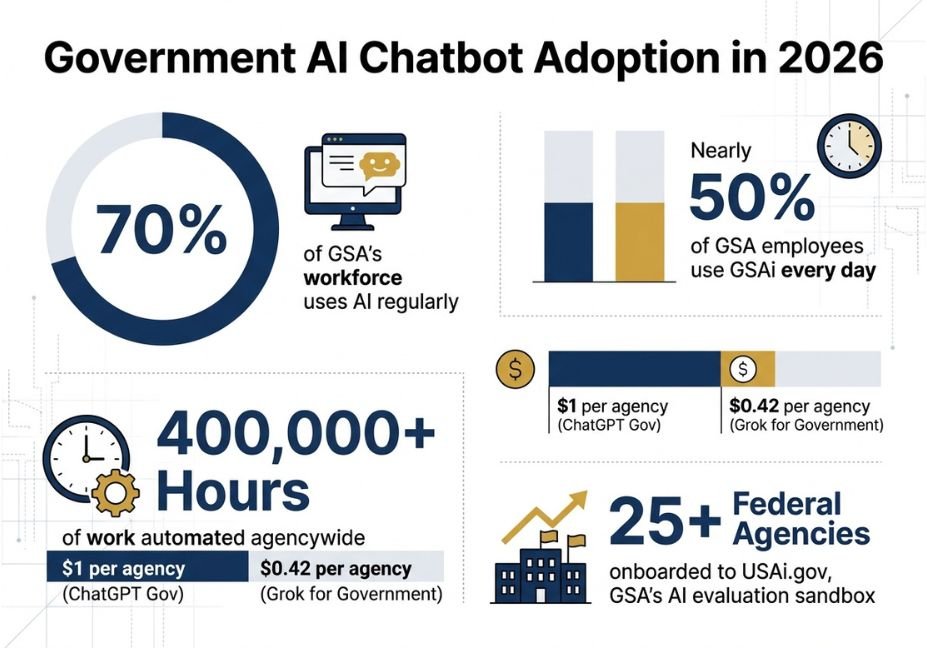
As a result, adoption has scaled fast. GSA’s own reporting puts usage at roughly 70% of its workforce using AI regularly, and that scale only became possible once tools like GSAi, ChatGPT Gov, and DHSChat replaced ad hoc consumer chatbot use. So, what actually separates these federal tools from the ChatGPT app on your phone? This guide breaks down how they differ, what’s under the hood, and how to evaluate one for your own agency or team.
What Is a Government AI Chatbot Tool?
A government AI chatbot tool is a large language model interface built or licensed specifically for public-sector use. It typically adds agency-controlled data boundaries, audit logging, and in most cases a path to FedRAMP authorization. Unlike consumer ChatGPT, these tools sit behind an agency’s identity provider and restrict where prompts and outputs are stored or processed.
In other words, the concept overlaps with what NIST calls “trustworthy AI”: a system designed around accountability and transparency rather than raw capability alone. Most current deployments therefore pair a commercial model from OpenAI, Anthropic, Google, Meta, or xAI with an agency-specific retrieval layer, rather than training a model from scratch.
How Does a Government AI Chatbot Work?
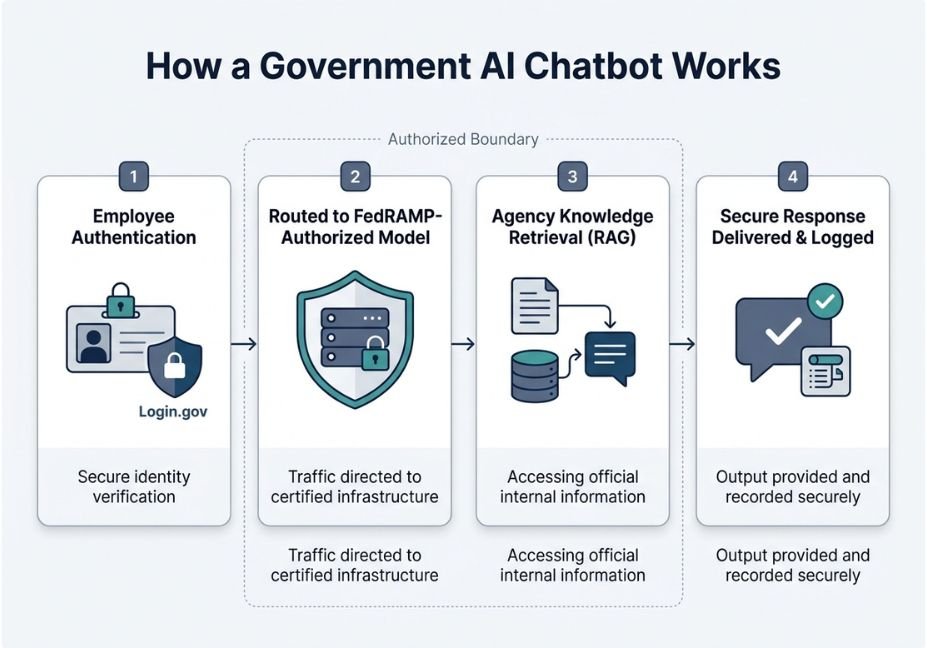
The mechanism is closer to a retrieval-augmented generation (RAG) pipeline than a standalone chatbot. Specifically, a typical request flow looks like this:
- First, an employee authenticates through the agency’s identity system (often tied to Login.gov or PIV credentials).
- Next, the prompt is routed to a self-hosted or FedRAMP-authorized instance of the underlying model not the public consumer endpoint.
- If the tool supports document grounding, relevant agency records are then retrieved from an internal knowledge base and injected into the model’s context window.
- Finally, the response is generated, logged, and returned with the underlying provider contractually barred from using the prompt to train future models.
Technical Note: This is architecturally similar to enterprise LLM deployments in the private sector. However, there’s an added compliance layer: every component in the request path model host, retrieval store, logging system usually needs to sit inside an authorized security boundary before an agency’s CISO will approve production use.
Government AI Chatbot Use Cases 5 Real-World Examples
- CBP’s chatCBP built for Customs and Border Protection staff, offering document summarization, information extraction, and multi-file analysis to cut down time spent searching internal records.
- DHSChat a Department of Homeland Security-wide tool aimed at routine staff tasks across DHS components, predating the more specialized chatCBP.
- GSAi / USAi.gov GSA’s internal chatbot, since scaled into a governmentwide evaluation sandbox now hosting over 25 agencies for model testing before procurement.
- ChatGPT Gov OpenAI’s dedicated federal deployment, self-hosted so agencies manage their own security and compliance rather than relying on OpenAI’s consumer infrastructure.
- Grok for Government xAI’s federal offering, contracted through GSA at a steep discount and covering reasoning-focused Grok 4 and Grok 4 Fast models.
Did You Know? GSA’s deputy administrator has said nearly half of the agency’s employees use GSAi every single day a sharper adoption curve than most private-sector enterprise AI rollouts.
Is There a Government Version of ChatGPT?
Yes it’s called ChatGPT Gov. Unlike the consumer app, it’s self-hosted, so agencies manage their own security, privacy, and compliance rather than relying on OpenAI’s standard infrastructure. This rollout is part of a broader federal push: GSA’s OneGov Strategy, which supports the executive branch’s AI Action Plan, has pushed agencies to formally evaluate and adopt tools like this instead of leaving employees to use public AI chatbots informally.
Best Government AI Chatbot Tools and Frameworks — Comparison Table
Suggested image alt text: “Comparison table of government AI chatbot tools including ChatGPT Gov, GSAi, DHSChat, chatCBP, and Grok for Government.”
| Tool | Provider | Deployment Model | Best For |
|---|---|---|---|
| ChatGPT Gov | OpenAI | Self-hosted, agency-managed compliance | Agencies needing full security control |
| GSAi / USAi.gov | GSA (multi-model) | Governmentwide evaluation sandbox | Testing models before procurement |
| DHSChat | DHS-internal | Department-wide internal chatbot | Cross-component DHS staff tasks |
| chatCBP | CBP-internal | Sub-agency-controlled LLM deployment | Document-heavy operational workflows |
| Grok for Government | xAI | Contracted via GSA OneGov Strategy | Reasoning-heavy tasks at low per-agency cost |
Pro Tip: Before locking in a vendor contract, run the model through USAi.gov, GSA’s no-cost evaluation suite. It lets agencies pilot OpenAI, Anthropic, Google, and Meta models against real workflows before committing budget.
Step-by-Step: How to Evaluate and Implement a Government AI Chatbot
- Define the workflow, not the model. Start with a concrete task document summarization, ticket triage, policy lookup rather than “we need AI.”
- Check FedRAMP status. Then confirm the tool’s authorization level matches your data sensitivity; Wikipedia’s overview of the FedRAMP authorization process is a useful primer if your team is new to the framework.
- Pilot inside a sandbox. For example, GSA’s OneGov rollout of USAi.gov gave agencies a governmentwide way to test models from multiple vendors before procurement — a pattern worth mirroring even at the sub-agency level.
- Build the retrieval layer separately from the chat interface. This way, responses stay grounded in your own document store rather than relying on the base model’s memory.
- Log everything and review outputs regularly. After all, hallucination risk doesn’t disappear just because the vendor is federally authorized.
python
# Minimal example: routing a query through a RAG layer before the model call
def answer_query(query, agency_docs_index):
    retrieved = agency_docs_index.search(query, top_k=5)
    context = "\n".join(doc.text for doc in retrieved)
    prompt = f"Context:\n{context}\n\nQuestion: {query}"
    return llm_client.generate(prompt, source="fedramp_endpoint")
Technical Disclaimer: Federal AI procurement terms and per-agency pricing change frequently. For example, OpenAI has offered ChatGPT Enterprise to agencies for as little as $1 per agency for a limited period, while xAI’s Grok contract runs at 42 cents per organization through March 2027. Always verify current pricing and authorization status directly with GSA before budgeting.
Common Mistakes and How to Avoid Them
- Treating consumer ChatGPT as “close enough.” Public ChatGPT prompts aren’t guaranteed to stay outside training data the way ChatGPT Gov’s terms specify. OpenAI’s ChatGPT Gov offering, in fact, was built specifically to address federal agencies’ security concerns which is the entire point of using it over the consumer product.
- Skipping the retrieval layer. Without it, a raw model with no agency-grounded context will hallucinate policy details with total confidence.
- Ignoring the NIST AI Risk Management Framework. It isn’t mandatory everywhere, but it’s the closest thing to a shared federal vocabulary for evaluating AI risk, so skipping it makes cross-agency conversations harder.
- Assuming one model fits every workflow. After all, GSA’s own sandbox exists precisely because different agencies get different results from OpenAI, Anthropic, Google, and Meta models on the same task.
What Federal Workers Are Saying
Adoption numbers back up the anecdotal chatter. GSA reported around 400,000 hours of automated work unlocked through AI tools agencywide, and officials say requests for new use cases come in daily as more components ask to onboard. Still, the sentiment isn’t uniformly positive some federal employees have raised concerns that the AI rollout coincided with workforce reductions. Even so, the operational use case (document search, summarization, drafting) is now treated as standard tooling rather than novelty.
FAQ People Also Ask
What is a government AI chatbot tool?
It’s a large language model interface built or contracted specifically for public-sector use, with agency-controlled data handling and, typically, a path to FedRAMP authorization distinct from consumer chatbots in how prompts and data are stored.
Is ChatGPT Gov different from regular ChatGPT?
Yes. ChatGPT Gov is self-hosted so agencies manage their own security, privacy, and compliance requirements, rather than relying on OpenAI’s standard consumer infrastructure.
Can federal employees use ChatGPT?
Increasingly, yes but usually through a government-specific deployment like ChatGPT Gov, GSAi, or an agency-specific tool rather than the public consumer app, due to data-handling requirements.
What AI chatbot does the U.S. government use?
There’s no single tool GSA runs GSAi and USAi.gov as a multi-model evaluation platform, while individual agencies like DHS and CBP run their own internal chatbots (DHSChat, chatCBP) alongside contracted access to ChatGPT Gov and Grok.
Is a government AI chatbot’s data secure?
Security depends on the specific deployment’s FedRAMP status and data-handling contract terms; self-hosted or agency-controlled deployments are generally considered more secure than routing sensitive data through consumer-facing endpoints.
How much does ChatGPT Gov cost?
Pricing has varied by agreement GSA negotiated ChatGPT Enterprise access for as little as $1 per agency for a limited period, though standard federal contract pricing may differ; agencies should confirm current terms directly with GSA.
Conclusion
The shift from “employees using ChatGPT informally” to dedicated government AI chatbot tools like ChatGPT GSAi, ChatGPT Gov, DHSChat, chatCBP, and Grok for Government reflects a real architectural difference, not just a rebrand. It comes down to agency-controlled data boundaries, FedRAMP-aligned deployment, and retrieval layers grounded in internal documents. So, if you’re evaluating one of these tools, start with the workflow you’re solving for, pilot through a sandbox like USAi.gov before procurement, and never skip the retrieval and logging layers just because the base model is federally authorized. Bookmark this guide and explore more hands-on agentic AI tutorials at agentiveaiagents.com.