

A medical AI report generator that writes fluent sentences isn’t the same as one you can trust. That’s the gap most teams miss. Most medical AI tools don’t fail because the underlying model is weak they fail because their deliverable report format was never engineered as a first-class artifact. For example, a team fine-tunes a model on clinical text, gets confident, well-written output, and only later discovers that “reads well” isn’t the same as “structured, auditable, and safe to hand to a clinician or an EHR pipeline.” As a result, the report looks professional but can’t be validated, versioned, or traced back to its source data.
This guide is written for the people actually building a medical AI report generator — not the clinicians consuming the output. Below, we’ll walk through what a production-grade medical AI report deliverable needs to contain, how to enforce that structure with structured output at the model layer, and a concrete schema you can copy and adapt today. Along the way, we’ll also touch on where regulatory frameworks like HIPAA and coding standards like ICD-10 and SNOMED CT intersect with report design, since compliance shapes the schema just as much as the AI architecture does.
Architect’s Note: Every example below treats the report as a data object first and a human-readable document second. The rendered version PDF, HTML, whatever a clinician reads is always a view of the schema, never the source of truth itself.
What Is a Medical AI Tool Deliverable Report?
A medical AI tool deliverable report is the structured output an AI system produces after processing clinical input a transcript, a scanned chart, lab data, or imaging metadata. In short, it’s the machine-readable “receipt” of everything the AI extracted, plus a human-readable rendering of that same data.
Unlike a free-text clinical note, a well-formed deliverable is built around a defined JSON schema, which means it can be validated, stored, and consumed programmatically downstream — including by systems that expect the FHIR standard for structured health data, or that need to map findings against ICD-10 or SNOMED CT codes for billing and interoperability.
The distinction matters because a clinical note is written for another clinician who already shares context. A deliverable report from an AI tool, on the other hand, has to work without that shared context: it needs to stand alone, cite its sources, and openly expose its own uncertainty.
How Does a Medical AI Report Generator Actually Work?
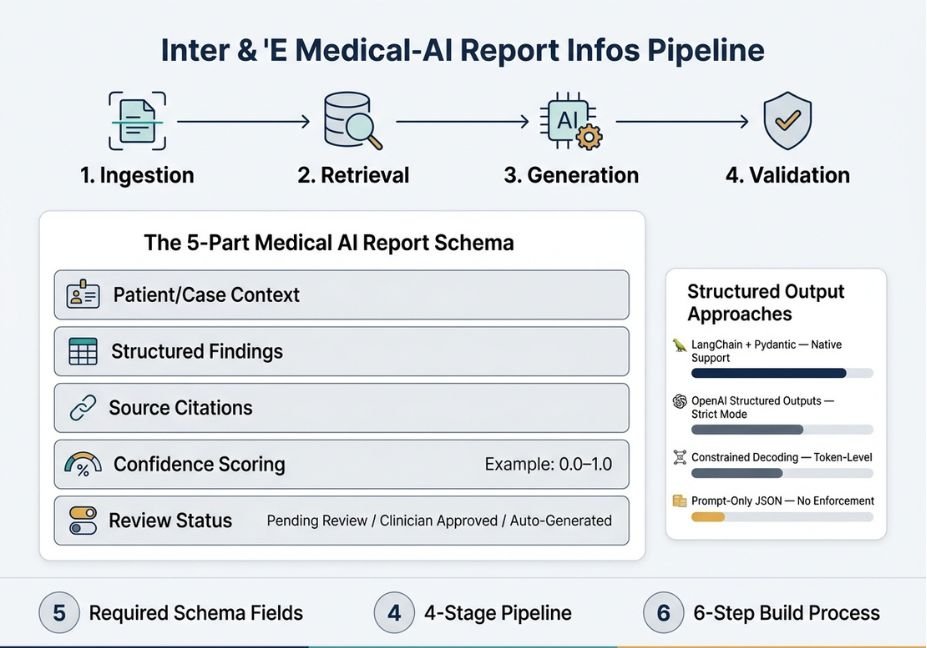
So how does an AI agent turn raw clinical input into a structured deliverable? Under the hood, most production medical report tools follow the same four-stage pipeline: ingestion, retrieval, generation, and validation.
- Ingestion normalizes input (OCR’d scans, audio transcripts, structured lab values) into one common representation
- Retrieval pulls relevant reference data via retrieval-augmented generation, so the model isn’t reasoning from memory alone
- Generation produces a draft against a fixed schema, not free text
- Validation checks the draft against both the schema and the source data before a human ever sees it
Consequently, the generation step is where most teams cut corners. Instead of prompting a model to “write a report” and parsing whatever comes back, mature pipelines use structured output handling in LangChain, or an equivalent, to force the model to populate a predefined schema typically a Pydantic model rather than open-ended prose. This one decision closes off an entire class of formatting failures before validation even runs.
Did You Know? Research on constrained generation for clinical text shows that forcing outputs through a JSON schema with a self-healing retry step whenever the model returns invalid JSON measurably increases downstream parseability compared to free-text prompting alone.
What Should a Medical AI Report Deliverable Include?
In short: a robust medical AI report deliverable includes structured findings, source citations, per-field confidence scores, and an explicit human-review status not just a summary paragraph. That’s the direct answer; here’s the detail behind it.
Specifically, a production-ready deliverable report format needs five required blocks, regardless of specialty or use case:
- Patient/case context a de-identified case ID, encounter type, and timestamp
- Structured findings key-value pairs, not paragraphs (
finding,value,unit,reference_range,flag) - Source citations which exact input chunk or document each finding was extracted from
- Confidence scoring a per-field confidence value, never one blanket score for the whole report
- Review status an explicit
pending_review/clinician_approved/auto_generatedflag
python
from pydantic import BaseModel
from typing import Literal

class Finding(BaseModel):
    label: str
    value: str
    unit: str | None = None
    reference_range: str | None = None
    flag: Literal["normal", "low", "high", "critical"] | None = None
    icd10_code: str | None = None     # optional coding-standard mapping
    source_ref: str                    # pointer back to source document/chunk
    confidence: float                  # 0.0-1.0, per-field

class MedicalReportDeliverable(BaseModel):
    case_id: str
    generated_at: str
    findings: list[Finding]
    summary: str
    review_status: Literal["pending_review", "clinician_approved", "auto_generated"]
    model_version: str
Binding a schema like this directly to the model call instead of parsing free text afterward is ultimately what separates a demo from a deployable clinical documentation tool.
Medical AI Report Deliverable Examples — Real-World Use Cases
Because “medical AI report” covers a lot of ground, here’s what the deliverable format looks like across a few common scenarios:
- Radiology triage summaries, which flag critical findings for immediate review, with each flag traceable back to a specific image region or measurement
- Discharge summary drafts, which a clinician edits and approves rather than writing from scratch
- Insurance and medico-legal reports, which must answer a specific referral question and include a formal declaration section
- Lab result interpretation, layered on top of raw values, with reference ranges preserved in the schema instead of being flattened into prose
Pro Tip: For medico-legal or insurance report formats specifically, add a required referral_question_addressed: bool field to your schema. In practice, reports that drift off the original referral question are the single most common failure mode reviewers flag.
Best Tools and Frameworks for AI-Generated Medical Reports
Which framework should you actually use to enforce structure? Here’s a quick comparison:
| Approach | Structured Output Support | Best For | Tradeoff |
|---|---|---|---|
| LangChain + Pydantic | Native, via with_structured_output() | General-purpose pipelines | Extra abstraction layer |
| OpenAI structured outputs (strict mode) | Native JSON schema enforcement | Single-model deployments | Provider lock-in |
| Constrained decoding (Outlines-style libraries) | Token-level schema enforcement | High-reliability, self-hosted models | More setup complexity |
| Prompt-only JSON mode | None — relies on instructions alone | Prototyping only | Frequent malformed output |
Overall, teams building anything beyond a prototype tend to converge on schema-bound generation rather than prompt-only JSON mode, simply because the failure rate on the latter compounds at scale.
How Do You Build a HIPAA-Aware Medical AI Report Pipeline? (Step-by-Step)
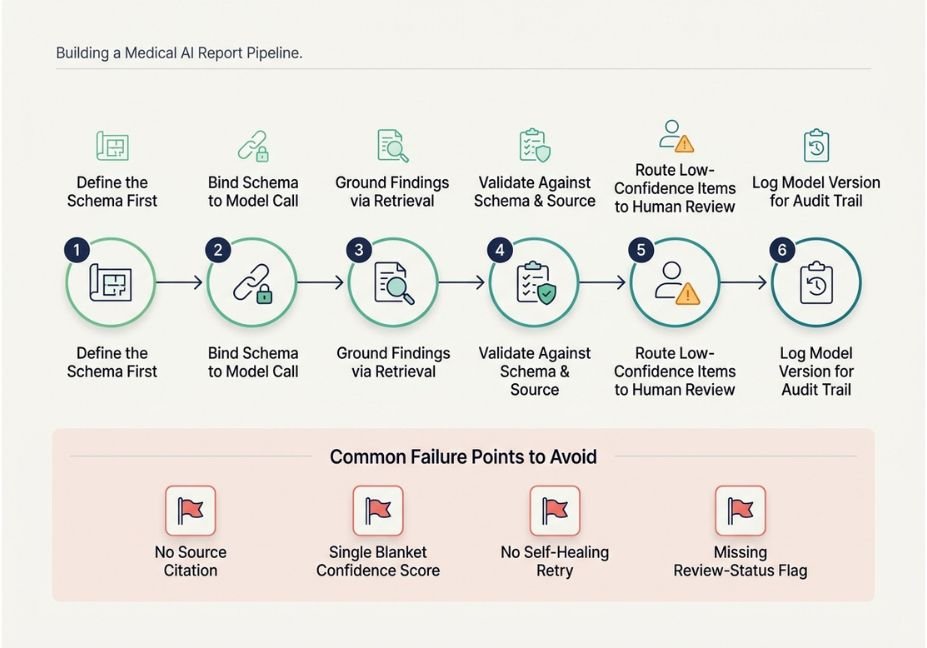
- Define your schema first as a Pydantic model or JSON schema before writing a single prompt
- Bind that schema to the model call so output is enforced, not just requested
- Add a retrieval step that grounds every generated field in a specific, citable source chunk
- Run a validation pass that checks the schema, flags any missing
source_refvalues, and rejects reports with unresolved required fields - Route anything below a confidence threshold to mandatory human review before it’s ever marked
auto_generated - Log every generated report with its
model_version, so the pipeline stays auditable which matters for HIPAA-adjacent compliance reviews, not just engineering hygiene
Technical Disclaimer: Structured-output APIs and libraries referenced here evolve quickly. Code examples reflect LangChain’s structured-output patterns and Pydantic v2 conventions as of early 2026. Always check the current framework docs, and your organization’s compliance requirements, before shipping.
Common Mistakes and How to Avoid Them
- Treating the report as prose, not data write the schema before the prompt, not after
- Skipping source citations a finding without a
source_refcan’t be audited, so it shouldn’t ship - Using a single blanket confidence score per-field confidence is what lets reviewers triage efficiently; one number for the whole report hides exactly which finding is shaky
- Skipping the self-healing retry when the model returns invalid JSON, feed the error back to it instead of failing the whole request outright; this mirrors standard practice in verifying LLM-generated clinical text against EHR data
- Leaving out a review-status field every deliverable needs an explicit flag distinguishing machine-generated from clinician-approved content, so downstream systems (and EHR vendors like Epic or Cerner integrations) never conflate the two
What Developers Are Saying
Interestingly, discussions in developer communities working on multi-agent hallucination detection frameworks keep surfacing the same lesson: reliability gains come less from a bigger model and more from tightening the output contract schema validation, grounding, and explicit uncertainty — around whatever model happens to be in use.
FAQ — People Also Ask
What should a medical AI report deliverable include?
At minimum, a medical AI report deliverable should include structured findings with units and reference ranges, a source citation per finding, a per-field confidence score, and an explicit review-status flag. A summary paragraph alone isn’t a complete deliverable.
How do you stop an AI medical report generator from hallucinating?
Ground every generated field in retrieved source text, require a source_ref for each finding, and reject or flag any output that can’t be traced back to input data. In practice, structured output combined with mandatory citation works better than prompting alone.
What format should AI-generated medical reports be in — JSON or plain text?
JSON, or another schema-validated format, internally then rendered to plain text or PDF for human consumption. Keeping the canonical version structured is what allows validation, storage, and integration with systems like EHRs and FHIR-based interoperability layers.
Can AI-generated medical reports be used without a clinician review?
Generally, only low-stakes, clearly labeled drafts should skip review, and even those still need an explicit auto_generated flag. High-stakes findings anything flagged critical should always route to mandatory human review before use.
What’s the difference between a clinical note and a medical report?
A clinical note is written for other providers who already share context, so it’s typically brief and shorthand-heavy. A medical report, by contrast, is a formal, standalone document often for insurance, legal, or referral purposes that must be complete and self-explanatory without any shared context.
Is a JSON-based medical report format compliant with HIPAA and FHIR?
Not automatically the format itself is just structure. Compliance depends on how the pipeline handles de-identification, access control, and audit logging around that structured data, alongside whether the schema maps cleanly to FHIR resources when interoperability is required.
Conclusion
Ultimately, a medical AI tool is only as trustworthy as its deliverable’s structure. Three things matter most: define the schema before you prompt the model, enforce that schema with structured output rather than parsing free text afterward, and treat source citation and confidence scoring as non-negotiable fields not afterthoughts. Get the medical AI report format right, and everything downstream review workflows, audits, EHR integration gets easier.
Bookmark this guide and explore more hands-on AI agent tutorials at agentiveaiagents.com.