
B2B support teams are discovering that AI customer support tools ROI is not determined by how many conversations an AI agent handles. It is determined by what happens financially after the conversation: Was the ticket actually resolved? Did the customer avoid another contact? Did an agent spend less time on the case? Did the account remain healthy?
That distinction matters because AI support can produce impressive automation dashboards while creating disappointing financial results.
Research from the National Bureau of Economic Research found that AI assistance increased customer-support productivity by 14% on average, with larger gains among less-experienced workers.
For B2B companies, the strongest ROI therefore comes from combining ticket deflection, agent assist, RAG-based knowledge retrieval, workflow automation, and human escalation rather than deploying a standalone chatbot.
What Is AI Customer Support ROI in B2B?
AI customer support ROI measures the financial value generated by AI support relative to the complete cost of deploying and operating it.
The basic formula is:
ROI % =
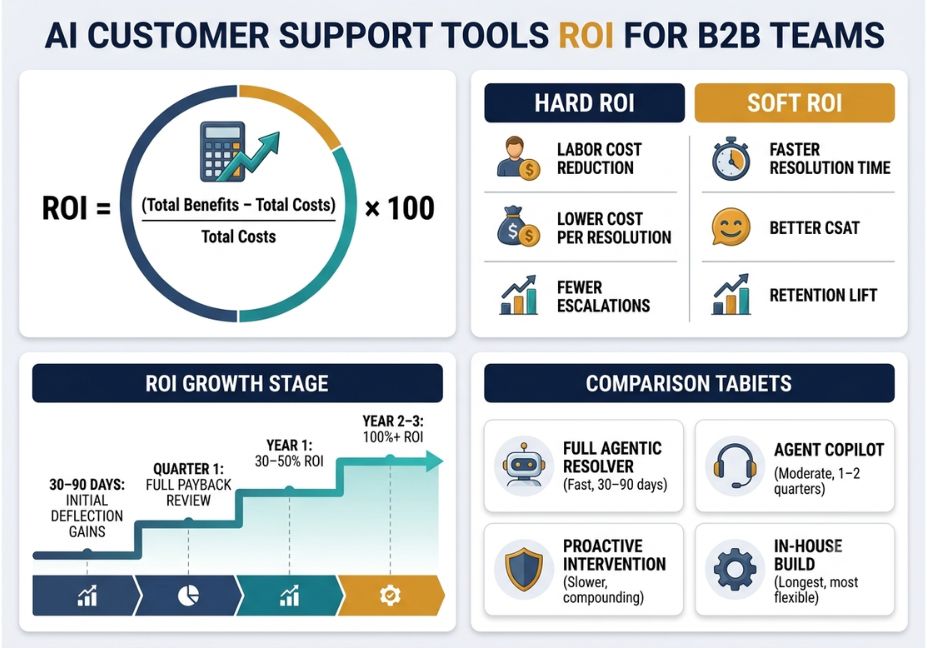
((Annual Benefits - Annual AI TCO) / Annual AI TCO) × 100
Where annual benefits can include:
- Resolved-ticket savings
- Agent productivity gains
- Avoided hiring
- Reduced escalation costs
- Faster onboarding
- Retention or churn reduction
- Support-driven expansion revenue
The critical term is total cost of ownership (TCO).
TCO includes licensing, API usage, integration engineering, knowledge-base maintenance, evaluation, monitoring, prompt/policy updates, security reviews and change management—not merely the software subscription.
IBM similarly frames AI customer service around automation, faster assistance, personalization and reduced human workload rather than chatbot volume alone.
Technical Note: A 70% automation rate can have poor ROI if the remaining 30% requires expensive escalations or if AI-generated answers increase repeat contacts.
How Do AI Customer Support Tools Generate ROI?
There are four major economic mechanisms.
1. Ticket deflection
If an AI agent completely resolves a routine issue, the company avoids the fully loaded cost of a human-handled interaction.
Deflection Savings =
AI-resolved tickets × Human cost per resolution
For example:
20,000 monthly tickets
× 50% AI resolution
× $8 human resolution cost
= $80,000 monthly gross savings
That is $960,000 in annual gross savings before AI TCO.
2. Agent assist
AI does not need to resolve a ticket autonomously to create value.
It can:
- Summarize customer history
- Retrieve relevant documentation
- Draft responses
- Classify tickets
- Recommend next actions
- Populate CRM fields
The NBER study of 5,179 customer-support agents found a 14% average productivity improvement from AI assistance, with a much larger improvement for novice and lower-skilled workers.
3. Workflow automation
The highest-value B2B systems do more than generate text.
An agent can use function calling to retrieve account information, check subscription status, create tickets, update CRM records or trigger approved workflows. OpenAI’s documentation describes function calling as a mechanism for connecting models to external tools and systems.
4. Revenue protection
Faster support can influence:
- Renewal risk
- Product adoption
- Expansion opportunities
- Trial conversion
- Customer lifetime value
This is particularly important in B2B SaaS, where one retained account can be worth far more than dozens of individual support tickets.
Pro Tip: Build your ROI model around resolved outcomes, not “AI interactions.” CFOs can finance a resolved ticket, avoided hire or protected renewal; “50,000 AI messages” is an operational metric.
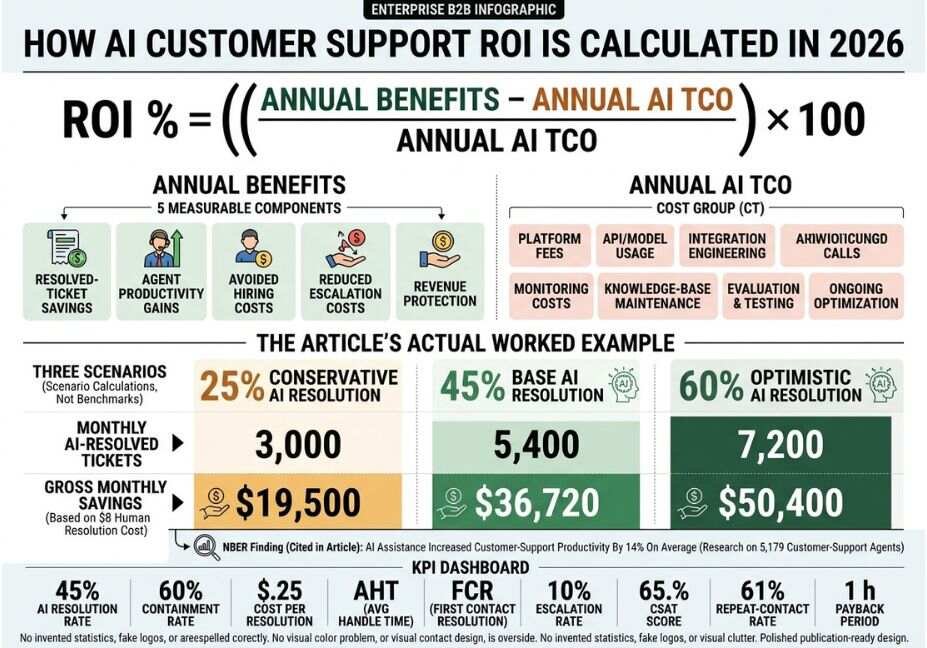
AI Customer Support ROI Metrics B2B Teams Should Track
A useful dashboard should connect technical performance to financial outcomes.
| Metric | What it measures | Why it matters for ROI |
| AI resolution rate | Tickets solved without humans | Direct automation value |
| Containment rate | Conversations completed by AI | Measures support capacity |
| Cost per resolution | Cost of each resolved case | Core financial KPI |
| AHT | Human handling time | Measures agent-assist value |
| FCR | First-contact resolution | Detects repeat-contact waste |
| Escalation rate | Cases transferred to humans | Shows automation boundaries |
| CSAT | Customer satisfaction | Protects against false savings |
| Repeat-contact rate | Customers returning for same issue | Detects poor AI answers |
| Deflection quality | Correctly resolved cases | Separates real from artificial automation |
| Payback period | Time to recover investment | Supports procurement decisions |
A key distinction is AI resolution rate versus containment rate.
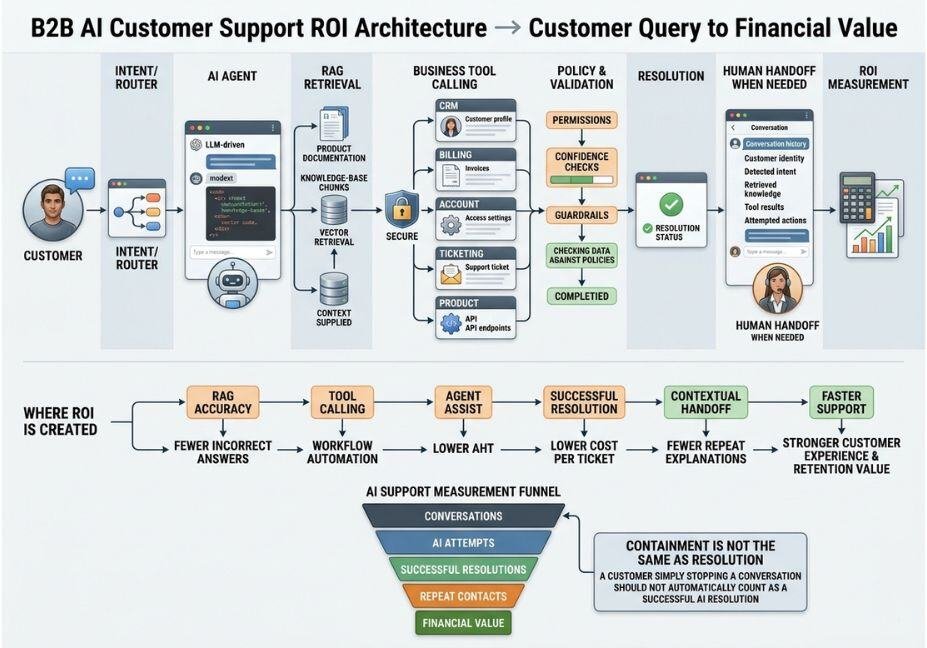
A conversation should not count as successfully automated simply because the customer stopped responding. A better measurement system requires a resolution signal such as confirmation, successful workflow completion or a validated downstream outcome.
Technical Note: Measure by intent
Do not calculate one blended AI resolution rate and stop there.
Break performance down by:
- Password/account requests
- Billing questions
- Product documentation
- Troubleshooting
- Onboarding
- Integration issues
- Security/compliance questions
- Renewal-risk conversations
A 75% overall containment rate can hide a disastrous 25% containment rate on your highest-value technical tickets.
RAG and AI Agent Architecture Directly Affect ROI
In B2B support, the quality of the knowledge layer often determines whether automation creates savings or additional work.
A typical architecture looks like:
Customer
   ↓
Intent / Router
   ↓
AI Agent
   ↓
RAG Retrieval → Product Docs / KB / Policies
   ↓
Tool Calling → CRM / Billing / Product APIs
   ↓
Policy & Validation
   ↓
Resolution
   ↓
Human Handoff if confidence is insufficient
The agent’s job is not simply to produce fluent text. It must retrieve the right context, select the right tool, execute it safely and determine whether the issue is actually resolved.
LangChain’s current agent architecture describes this as a model-and-tools loop in which the model selects tools, receives their results and continues until a stopping condition is reached.
LlamaIndex similarly defines agents around an LLM, memory and tools, with tool results fed back into the conversation so the agent can continue or finish the task.
Architect’s Note: Every unnecessary tool call adds latency, cost and another failure surface. Expose only the tools required for a particular support workflow.
Best AI Customer Support Tools for B2B ROI
There is no universal “highest ROI” platform. The correct choice depends on ticket volume, integration depth, support complexity, pricing model and how much control your engineering team requires.

| Tool / platform | Strongest B2B use case | ROI lever | Technical consideration |
| Intercom Fin | SaaS/product support | Resolution and deflection | Strong fit for Intercom-centered workflows |
| Zendesk AI | Established enterprise support | Automation + agent assist | Useful for complex ticketing environments |
| Salesforce Agentforce | CRM-centric organizations | Support + revenue workflows | Strong when Salesforce data is central |
| Freshdesk/Freddy AI | SMB/mid-market support | Cost-efficient automation | Good fit for teams already using Freshdesk |
| Custom LangChain/LangGraph stack | Engineering-led teams | Maximum workflow control | Higher implementation burden |
| LlamaIndex | Knowledge-heavy technical support | RAG and retrieval | Strong option for document-centric systems |
For B2B technical support, evaluate tools against five architectural requirements:
- RAG quality Can the system retrieve authoritative product information?
- Tool calling Can it safely access business systems?
- Human handoff Does the complete context transfer to an agent?
- Observability Can engineers inspect failures and traces?
- Evaluation Can you measure accuracy and resolution quality continuously?
Do not select a platform based on its demo conversation alone.
Step-by-Step: Calculate AI Customer Support ROI for B2B
Start with a baseline rather than a vendor benchmark.
Step 1: Calculate current support economics
Collect:
Monthly ticket volume
Average cost per resolution
Average handle time
Agent headcount
Fully loaded agent cost
Escalation rate
Repeat-contact rate
CSAT
First-contact resolution
Monthly support-driven revenue
Step 2: Separate AI use cases
Create three buckets:
Autonomous
- FAQs
- Password/account questions
- Documentation lookup
- Order/status queries
Assisted
- Technical troubleshooting
- Complex account questions
- Incident explanations
- Long customer histories
Human-only
- Security incidents
- Sensitive commercial negotiations
- High-risk account decisions
- Complex escalations
This prevents unrealistic automation assumptions.
Step 3: Model three scenarios
Suppose a B2B SaaS company receives 12,000 tickets per month.
| Variable | Conservative | Base | Optimistic |
| AI resolution | 25% | 45% | 60% |
| Human cost/resolution | $8 | $8 | $8 |
| AI cost/resolution | $1.50 | $1.20 | $1.00 |
| Monthly AI-resolved tickets | 3,000 | 5,400 | 7,200 |
| Gross monthly savings | $19,500 | $36,720 | $50,400 |
The company should then subtract:
- Platform fees
- Integration
- Engineering
- Monitoring
- Knowledge maintenance
- Human QA
- Ongoing optimization
Only after those costs are included should the company report ROI.
Step 4: Add agent-assist value
If the remaining human workload falls from 12,000 to 6,600 monthly tickets and AI reduces AHT by 20%, the support organization gains additional capacity without necessarily reducing headcount.
That capacity may translate into:
- Avoided hiring
- Faster SLA response
- More complex case coverage
- Better onboarding
- Higher customer-to-agent ratios
Pro Tip: For B2B companies, “headcount avoided” is often more defensible than “headcount eliminated.” Model the capacity that absorbs growth before assuming layoffs.
Common Mistakes That Destroy AI Support ROI
1. Counting unanswered conversations as deflections
A customer disappearing from the chat does not prove resolution.
Fix: Track downstream resolution and repeat-contact behavior.
2. Ignoring RAG quality
An AI agent with outdated product documentation can create additional tickets instead of reducing them.
Research on RAG-based customer-service systems continues to identify hallucination and business-risk challenges, reinforcing the importance of grounding and evaluation.
3. Automating high-risk intents too early
Not every ticket should be autonomous.
Start with high-volume, low-risk workflows and expand only when accuracy and escalation behavior are stable.
4. Underestimating TCO
Implementation engineering, data preparation, knowledge-base cleanup, evaluation and monitoring can materially change the business case.
5. Measuring only cost savings
If AI reduces support costs but increases churn, the apparent ROI is misleading.
Track CSAT, repeat contacts, retention and revenue alongside operational metrics.
6. Poor human handoff
A customer who spends five minutes explaining a problem to an AI and then has to repeat everything to a human has experienced automation failure.
The handoff should transfer:
- Conversation history
- Customer identity
- Detected intent
- Retrieved knowledge
- Tool results
- Actions already attempted
- Reason for escalation
What Developers Should Measure After Launch
The first 90 days should be treated as an evaluation cycle, not merely a deployment period.
Days 0–30: Baseline and failure discovery
Measure:
- Accuracy
- Retrieval quality
- Tool-call errors
- Escalation reasons
- Repeat contacts
- Customer sentiment
Days 31–60: Workflow optimization
Tune:
- Routing
- Retrieval
- Prompts
- Tool permissions
- Escalation thresholds
- Knowledge sources
Days 61–90: Financial validation
Compare:
Baseline cost per resolution
vs.
Post-AI cost per resolution
Then validate:
Net savings
+ productivity value
+ retained revenue
- total AI TCO
The important point is that ROI should improve as the system improves. A support agent is not a static software installation; it is an operational system that needs evaluation and iteration.
Which AI customer support approach fits your B2B team? (Comparison)
| Approach | Best For | Pricing Model | ROI Timeline |
|---|---|---|---|
| Full agentic resolver | High-volume, low-complexity tickets | Per-resolution or per-outcome | Fast (30–90 days) |
| Agent copilot | Dense, high-value B2B tickets (SSO, billing, integrations) | Per-seat + AI add-on | Moderate (1–2 quarters) |
| Proactive/in-product intervention | Onboarding-heavy, integration-heavy products | Platform subscription | Slower to show, compounds over time |
| Build in-house (SDK/low-code) | Teams with engineering capacity | Engineering time + API/compute costs | Longest, most customizable |
Pro Tip: Don’t select a tool based on deflection rate alone. Deflection tells you a ticket didn’t reach a human it says nothing about whether the customer actually got unblocked. Consequently, resolution rate, not deflection rate, is the metric that correlates with cost savings and satisfaction.
FAQ — People Also Ask
There is no universal average ROI because results depend heavily on ticket volume, cost per contact, automation scope, implementation cost and channel mix. Current industry guides commonly model first-year ROI in the range of several times the initial investment, but these figures should be treated as planning scenarios rather than guaranteed outcomes.
Calculate ROI by subtracting total AI support costs from measurable annual benefits, then dividing the result by total AI costs. Benefits should include ticket-resolution savings, agent productivity, avoided hiring and revenue effects, while costs should include software, integration, monitoring, knowledge maintenance and ongoing optimization.
AI customer support can be highly valuable for B2B SaaS when ticket volume is sufficient and a large portion of inquiries are repetitive or knowledge-driven. The strongest use cases combine RAG, agent assist, tool calling and human escalation rather than attempting to automate every customer interaction.
Cost per resolved ticket is one of the strongest financial metrics, but it should be combined with AI resolution rate, AHT, FCR, CSAT and repeat-contact rate. A low cost per interaction is not meaningful if the AI produces incorrect answers that generate additional support demand.
AI can reduce CSAT when answers are inaccurate, overly rigid or difficult to escalate. Conversely, fast and accurate responses can improve the experience. The safest approach is to compare AI-only, human-only and hybrid interactions while monitoring escalation and repeat-contact rates.
Payback depends on ticket volume, automation rate, implementation cost and channel mix. Chat-heavy support can generally reach economic break-even faster than complex voice or highly customized technical support. Build conservative, base and optimistic scenarios rather than relying on one vendor estimate.
Conclusion
The best way to evaluate AI customer support tools ROI B2B is to stop treating AI as a chatbot expense and start treating it as an operational system.
Three principles matter most:
- Measure resolved outcomes, not conversation volume.
- Connect technical architecture to economics—RAG accuracy, tool calls, routing and handoffs directly influence containment and cost per resolution.
- Model the complete business case, including TCO, agent productivity, avoided hiring, CSAT and revenue retention.
The NBER evidence shows that AI assistance can materially improve customer-support productivity, while modern agent frameworks make it possible to connect LLMs with real business tools and knowledge systems.
The winning B2B deployment is therefore rarely the tool promising the highest automation percentage. It is the system that can prove every automated resolution creates durable economic value without degrading customer experience.
Bookmark this framework and use it to benchmark your next AI support deployment before approving the budget.