

Most AI search optimization efforts fail at the wrong layer. First, teams buy a brand-monitoring dashboard. Then they watch their “AI visibility score” climb or dip without ever touching the actual data their retrieval pipeline feeds the model. But here’s the catch: if the underlying retrieval-augmented generation (RAG) system is pulling stale, poorly chunked, or badly embedded content, no amount of dashboard-watching fixes it. In short, you’re measuring a problem you never solved.
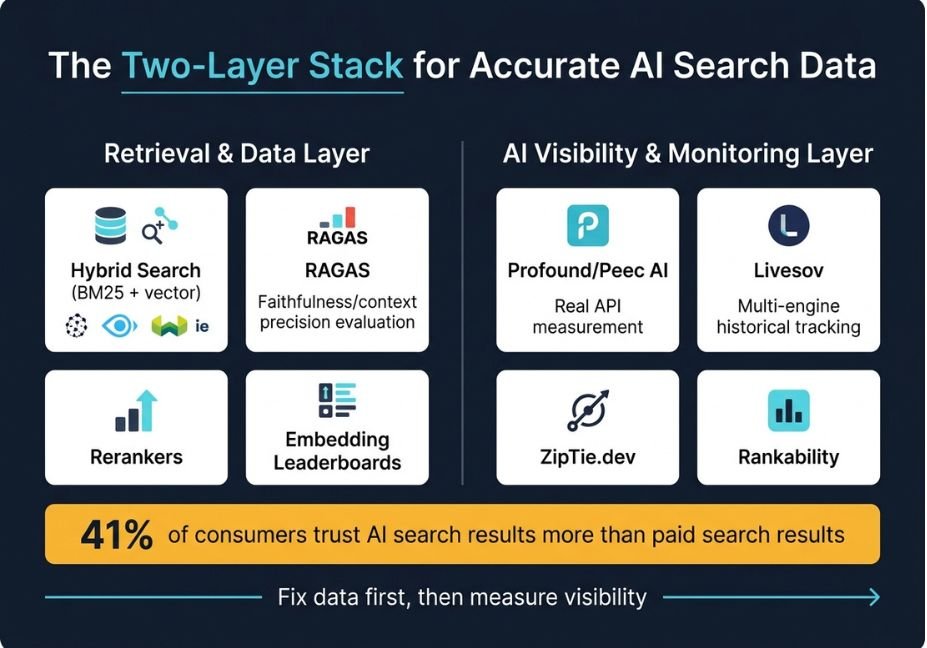
Quick answer: The most reliable recommended tools for accurate data in AI search optimization combine two layers retrieval-layer tools (vector databases, RAGAS evaluation, hybrid search) that fix what an AI model actually knows, and citation-monitoring tools (Profound, Peec AI, Livesov) that confirm what it says. Fix the first layer before trusting the second.
A 2026 arXiv survey on production RAG systems backs this up: deployment considerations for production RAG span retrieval quality, scalability, and evaluation, and quality improvements are typically staged and evaluation-driven not bolted on after launch. So, this guide walks through both layers in the order they actually matter, with long-tail, practical answers for teams building agentic search and RAG systems, not just marketers chasing a visibility score.
What Is AI Search Optimization Data Accuracy?
In one sentence: data accuracy in AI search optimization means the information an AI system retrieves, cites, or generates is correct, current, and traceable back to a source.
That’s the snippet-ready definition. Now, here’s the fuller picture. Because engines don’t match keywords they evaluate whether content comprehensively and credibly addresses user intent accuracy has to be built at the source, not patched after the fact. Specifically, it depends on pulling from indexed pages, structured data, and in agentic systems live retrieval over a vector database.
In practice, accuracy breaks down into three layers:
- Enough real prompts and queries to reflect how people actually search
- Full logging of the retrieved answer, its source, and the model that generated it
- Metrics that translate raw output into something actionable
As one analysis puts it, a platform must record the answer, cited sources, model, date, and prompt variant, then turn that raw output into trustworthy metrics such as citation share and recommendation rate. Without all three, “accuracy” is just a guess dressed up as a dashboard.
How Does AI Search Retrieval Accuracy Actually Work?
Every RAG pipeline has two failure points: the retriever and the generator. And of the two, the retriever matters more. As Shelf.io’s breakdown of RAG optimization puts it bluntly: the retriever’s performance is a primary determinant of overall accuracy, and if it fetches low-quality, irrelevant, or stale documents, the generator will turn these deficiencies into its outputs.
Two sub-factors drive retrieval quality:
- Embedding model quality weak or outdated embeddings produce poor query-to-document matching
- Indexing strategy inefficient indexing slows retrieval and degrades relevance at scale
Consequently, most engineering teams including those at Databricks recommend a specific order of operations. First, establish an evaluation framework. Only then apply hybrid search, metadata filtering, and reranking as progressively more expensive steps. In other words: evaluate before you optimize, not after.
Pro Tip: Don’t reach for reranking or fine-tuning until you’ve established a baseline. Otherwise, teams that skip straight to advanced techniques usually can’t tell whether a change actually helped.
What Are the Best Tools for Accurate AI Search Data? (By Layer)
1. Retrieval & Data-Layer Tools
These tools fix accuracy before an answer ever gets generated — which is exactly why they matter most.
| Tool / Category | What It Does | Best For |
|---|---|---|
| Vector databases (Pinecone, Milvus, Weaviate) | ANN-indexed similarity search over embeddings | High-scale semantic retrieval |
| RAGAS | Automated evaluation of RAG pipelines (faithfulness, context precision) | Establishing an accuracy baseline |
| Hybrid search (BM25 + vector) | Combines exact-term and semantic matching | Domains with rare terminology (legal, technical) |
| Rerankers | Re-scores retrieved chunks before generation | Cutting noise from top-k results |
| Embedding leaderboards (Hugging Face) | Benchmarks embedding model quality | Choosing or upgrading embedding models |
Redis’s engineering team is direct about sequencing here, too: start with retrieval fundamentals hybrid search, chunking, and HNSW tuning before moving to model customization like embedding fine-tuning, and run LLM-as-judge evaluation continuously to catch regressions early. Meanwhile, it’s worth noting a common blind spot: BM25 excels at exact terminology and rare tokens but fails on synonyms, while vector search captures semantic meaning but struggles with homonyms and precision-critical terms. That’s precisely why hybrid search shows up so often in production stacks built on frameworks like LangChain and LlamaIndex.
2. AI Visibility & Citation-Monitoring Tools
Once the data layer is solid, these tools confirm whether ChatGPT, Perplexity, Gemini, and Google AI Overviews are actually surfacing it correctly.
| Tool | Differentiator |
|---|---|
| Profound / Peec AI | Call official AI platform APIs for reproducible measurement |
| Livesov | Multi-engine coverage with historical depth tracking |
| ZipTie.dev | Pairs visibility monitoring with content-fix recommendations |
| Rankability | Dual NLP engine (IBM Watson + Google NLP) content scoring |
Architect’s Note: Measurement methodology matters more than dashboard polish here. That’s because tools that call the official AI platform APIs get a clean, reproducible measurement every time, while tools that scrape a logged-in web UI cache and break — so always confirm real API measurement before trusting a number.
Is Structured Data Still Important for AI Search?
Yes even in an agentic, AI-answer-driven landscape, machine-readable structure hasn’t gone away. If anything, it matters more, since AI crawlers need unambiguous, extractable facts to cite confidently.
Google’s own guidance is consistent on this point: core Search best practices still matter — technical access, helpful content, and reliable information — and site owners can use preview controls like nosnippet and max-snippet. Additionally, for teams without engineering bandwidth to hand-roll schema, dedicated markup tools remain relevant, particularly for e-commerce sites, review sites, and content publishers where rich results and AI citations depend on proper schema markup.
Did You Know? Consumer trust in AI-generated answers is already outpacing paid search: 41% of consumers trust AI search results more than paid search results. As a result, the cost of getting the underlying data wrong keeps rising.
Hidden semantic relevance: schema markup example
To help AI crawlers and search engines parse this content’s intent explicitly, publishers should pair it with JSON-LD structured data, such as:
json
{
  "@context": "https://schema.org",
  "@type": "TechArticle",
  "headline": "Recommended Tools for Accurate Data in AI Search Optimization",
  "about": ["retrieval-augmented generation", "vector database", "AI search optimization", "data accuracy"],
  "mentions": ["RAGAS", "LangChain", "LlamaIndex", "Pinecone", "Hugging Face"]
}
This kind of markup, combined with clear entity names in the visible text (LangChain, LlamaIndex, Pinecone, RAGAS, Hugging Face, OpenAI, Anthropic), gives both traditional crawlers and AI answer engines explicit signals about topical relevance — beyond what keyword matching alone can convey.
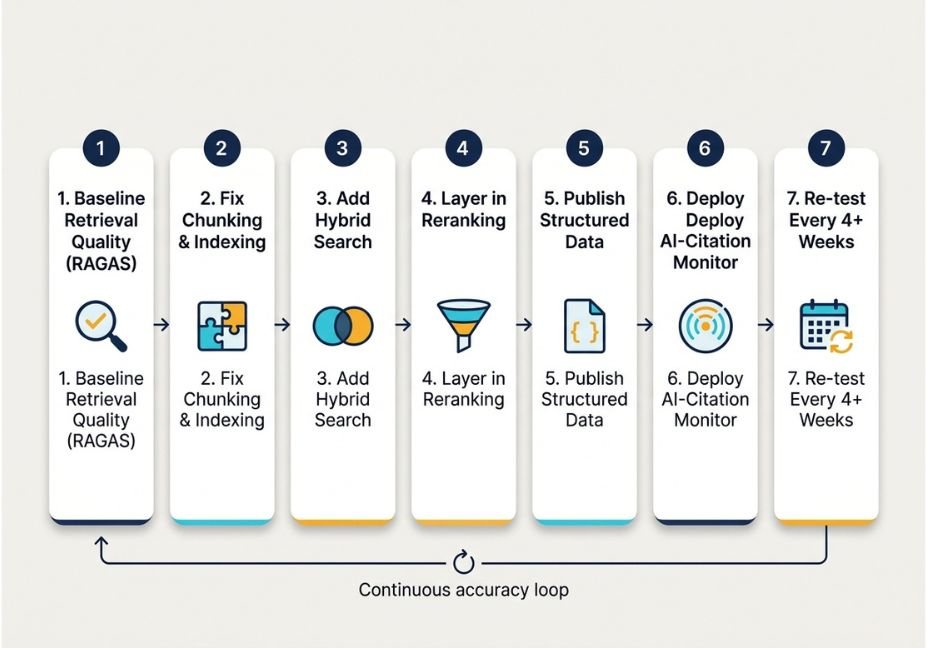
How Do You Build an Accurate Data Pipeline for AI Search? (Step-by-Step)
- Baseline your retrieval quality first. Run RAGAS or an equivalent LLM-as-judge framework against a representative query set before changing anything.
- Fix chunking and indexing next. These are cheap, high-leverage changes that compound into every downstream step.
- Add hybrid search if your domain has rare terminology. Otherwise, pure vector search underperforms on exact-match-critical content.
- Layer in reranking once retrieval is stable. This amplifies a good foundation rather than compensating for a broken one.
- Publish structured data alongside your content. That way, you give AI crawlers explicit, parseable facts to cite.
- Deploy an AI-citation monitor. Use this step to confirm what’s actually being surfaced — via real API calls, not scraped UIs.
- Re-test on a 4+ week cadence. As one industry analysis puts it, meaningful trend detection requires 4+ weeks of data daily snapshots are noise.
python
# Minimal RAGAS-style baseline check (conceptual)
from ragas import evaluate
from ragas.metrics import faithfulness, context_precision

results = evaluate
    dataset=eval_dataset,   # your query/answer/context set
    metrics=[faithfulness, context_precision]

print(results)
Technical Disclaimer: Framework versions evolve rapidly. So, code examples above reflect general RAGAS API patterns as of mid-2026 always check the official docs for current syntax.
Common Mistakes in AI Search Data Accuracy (And How to Avoid Them)
- Optimizing visibility before retrieval. A polished GEO dashboard can’t fix a broken retriever it just reports the breakage more attractively.
- Trusting scraped-UI monitoring tools. As a result, cached, rate-limited data produces stale visibility scores.
- Skipping baseline evaluation. Without a faithfulness or precision baseline, you can’t prove a change actually helped.
- Ignoring structured data. AI crawlers still lean on schema markup for unambiguous facts.
- Treating chunking as an afterthought. Yet poor chunking strategy is one of the most common and most fixable sources of retrieval noise.
What Are Developers Saying About AI Search Data Accuracy?
Engineering discussions on forums like r/LocalLLaMA and r/MachineLearning consistently circle back to the same point: retrieval quality, not model choice, is the real bottleneck in most production RAG deployments. This mirrors Redis’s own findings, where accuracy measurement through LLM-as-judge should run throughout the pipeline, not just at the end.
FAQ — People Also Ask
What tools improve data accuracy in AI search optimization?
The most effective stack combines retrieval-layer tools vector databases, hybrid search, and RAGAS-style evaluation with citation-monitoring tools like Profound, Peec AI, or Livesov that use real API measurement rather than scraped data.
How do you measure RAG retrieval accuracy?
Use an LLM-as-judge evaluation framework, such as RAGAS, to score faithfulness and context precision against a representative query set. Then, establish a baseline before applying hybrid search or reranking.
Do vector databases prevent AI hallucinations?
Not on their own. A well-indexed vector database reduces hallucination risk by improving retrieval relevance, but embedding quality, chunking strategy, and reranking all contribute to whether the generator receives accurate context.
Is structured data still important for AI search?
Yes. Google’s own guidance confirms that technical access and reliable, structured information remain foundational, and schema markup continues to influence whether AI systems can extract and cite facts correctly.
What’s the difference between AI search optimization and traditional SEO?
Traditional SEO optimizes for ranking positions on a results page. AI search optimization, by contrast, optimizes for whether an AI system retrieves, cites, and correctly represents your content inside a generated answer.
Conclusion
Accurate data in AI search optimization isn’t a monitoring problem it’s a pipeline problem. So, fix the retrieval layer first: solid embeddings, sensible chunking, hybrid search where needed, and a real evaluation baseline. Only then does an AI-citation monitor tell you anything meaningful. Ultimately, get the recommended tools for accurate data in AI search optimization working in that order, and the visibility scores take care of themselves.
Bookmark this guide and explore more hands-on RAG and agentic workflow tutorials at agentiveaiagents.com.