
Every event organizer remembers when their reg system dies on them. Big conference with 800 people and confirmation emails aren’t sending. They had to send out entire CSV of registrants the night before the doors opened because none of the sessions were synced with the CRM.
The year is 2026, and online registration systems are no longer just “ticketing.” These days’ best platforms are used as full lifecycle systems by being able to capture preferences at sign up, routing through automated onboarding after registering, integrating with CRM or marketing tools in real time, and providing formatted data into post event analytics workflow.
The cost of choosing the wrong system is high: for a 1,000 attendee pubic event the diffence in processor fees can be over $15,000; in addition to having a poorly integrated system where all data quality problems create issues in every event workflow downstream (email personalization and session capacity management).
This document will compare every major registration platform in the market, and highlight the features that are important in 2026, as well as discuss how agentic AI workflow is changing what registration looks like architecturally. The right event reg software for a small non-profit or enterprize grade hybrid event platform is here.
What Is Online Event Registration Software?
Online event registration software is a cloud-based platform that manages attendee sign-ups, payment processing, session assignments, attendee data, and post-registration workflows for in-person, virtual, and hybrid events.
In other words, it is the operational backbone of how attendees move from “interested” to “confirmed” to “checked in.” Modern platforms go well beyond a simple sign-up form. They include multi-session registration, conditional form logic, CRM integration, automated onboarding sequences, real-time analytics dashboards, and increasingly AI-powered personalization and agentic automation layers.
The key distinction to understand is this: event ticketing software handles the transaction (purchase, confirmation, entry scan). Event registration software handles the relationship from the first form field an attendee fills out through to post-event reporting and follow-up automation.
Featured Snippet Block “What is the difference between ticketing and registration software?” Event ticketing software processes the ticket purchase and entry. Event registration software adds attendee data capture, multi-session management, CRM integration, conditional form logic, and real-time reporting. For conferences, associations, and corporate events, registration software is essential. For concerts and public consumer events, ticketing tools are often enough.
How Does Online Event Registration Software Work?
Modern event registration platforms are built on four connected layers. Understanding this architecture helps you evaluate platforms more accurately and spot gaps before you commit.
The Intake Layer
The intake layer is the registration form or conversational interface the attendee sees. It captures name, contact details, custom fields, session preferences, dietary requirements, accessibility needs, and payment. Well-designed intake layers use conditional logic for example, showing different questions to speakers versus general attendees. As a result, you collect more relevant data without making the form feel overwhelming.
The Routing Layer
After sign-up, the routing layer segments registrants by attendee type, ticket tier, or custom criteria and triggers the right confirmation flow for each group. For instance, a VIP registrant might trigger a different welcome email sequence than a standard ticket holder. Similarly, a speaker registration might automatically initiate a speaker asset collection workflow. This layer is where most basic platforms fall short they confirm the registration but do nothing with the data afterward.
The Integration Layer
The integration layer connects the registration platform to your CRM (Salesforce, HubSpot), email marketing tools, event apps, and data warehouse. Consequently, registration data flows into your marketing stack without manual export. However, this is also where most teams encounter the most painful failure mode: poorly mapped field schemas that cause attendee records to land in the wrong CRM fields or create duplicate contacts.
The Analytics Layer
Finally, the analytics layer surfaces real-time dashboards showing registration velocity, revenue by ticket tier, funnel drop-off points, geographic breakdown, and session capacity. Therefore, event teams can spot problems a session filling too fast, a pricing tier underperforming while there is still time to act.
How to Choose the Right Event Registration Software
Choosing event registration software for your organization depends on three variables: event complexity, team size, and integration requirements. Here is a practical framework.
For Small Events and Nonprofits
If you run free or low-cost community events, workshops, or association meetings, you need an event registration platform with no upfront cost, simple form building, and basic email confirmation. RSVPify, Eventbrite (for free events), and Ticket Tailor are the strongest options. Furthermore, for nonprofits specifically, platforms like Wild Apricot combine membership management with event registration so you avoid paying for two separate tools.
Voice Search Answer Block “What is the best free online event registration software?” The best free online event registration software options in 2026 include Eventbrite (free for free events), RSVPify (free tier for small events), and Ticket Tailor (flat per-ticket fee with no percentage cut). Eventbrite charges no fees for free events and offers marketplace discovery. RSVPify supports up to 100 registrants on its free plan.
For Mid-Size Professional Conferences
If you run annual conferences, trade association events, or corporate training programs with 200–2,000 attendees, you need multi-session registration, conditional form logic, and CRM integration. RegFox and Swoogo both serve this tier well. RegFox charges approximately $0.99 plus 1% per registrant making it significantly cheaper than Eventbrite at scale. Swoogo offers a flat subscription model with no per-registration fees, which is particularly cost-effective for high-volume events.
For Enterprise and Global Programs
For large-scale corporate conferences, global roadshows, or multi-day trade shows, Cvent and Bizzabo are the recognized enterprise standards. Cvent handles venue sourcing, multi-session registration, budget management, badge printing, and deep CRM integrations in one platform. Bizzabo, on the other hand, combines event registration with marketing automation and analytics in an “Event Experience OS.” Both platforms require annual contracts and significant implementation investment therefore, plan for a three-month setup timeline with Cvent and approximately four to six weeks with Bizzabo.
Top Online Event Registration Platforms Compared (2026)
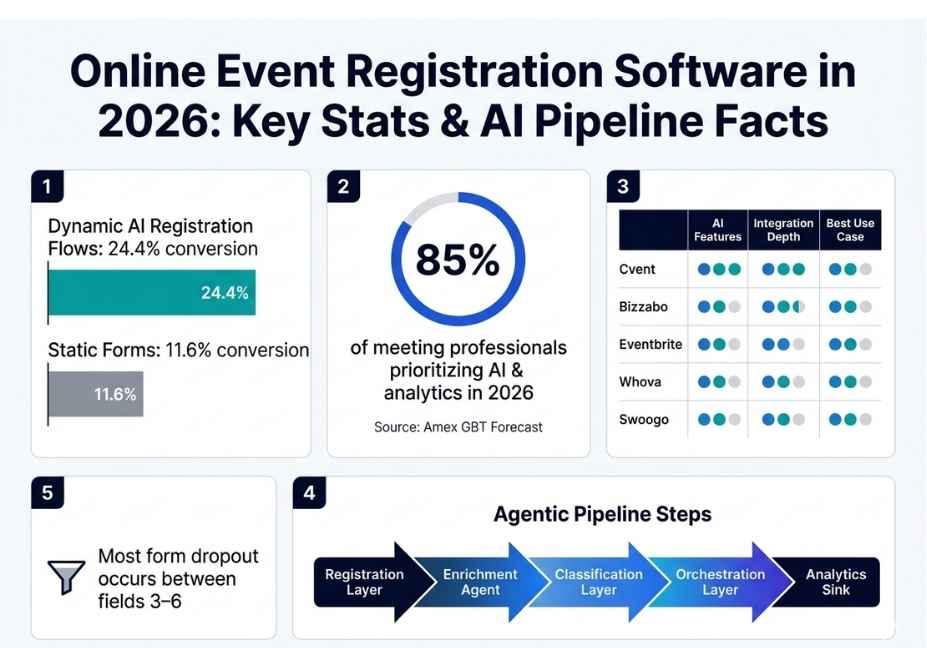
Here is a direct comparison of the seven leading platforms, organized by key decision factors:
| Platform | Best For | Pricing | AI Features | CRM Integration | Setup Time |
|---|---|---|---|---|---|
| Cvent | Enterprise, global events | Custom (~$1,000–$5,000+/mo) | AI agenda builder, content tools | Deep Salesforce/HubSpot | ~3 months |
| Eventbrite | Public consumer events | 3.7% + $1.79/ticket | Basic email automation | Limited | 1 day |
| Bizzabo | B2B marketing conferences | Custom enterprise | Event Experience OS, RFID SmartBadge | Native HubSpot & Salesforce | 4–6 weeks |
| Whova | Associations, networking events | 3.0% + $0.99/ticket | Session recommendations, engagement AI | Moderate | 1–2 weeks |
| RegFox | Mid-size conferences | $0.99 + 1%/registrant | Conditional logic, smart forms | Zapier/webhooks | 1–3 days |
| RSVPify | Corporate, private events | $39–$199/mo | Automated reminders | CRM via Zapier | 1 day |
| Swoogo | Teams needing fast, flexible setup | Flat subscription | Registration builder, reporting | HubSpot, Salesforce | 2–4 weeks |
Pro Tip: Before comparing features, compare fee structures under your specific event scenario. For example, a 500-person event with $200 tickets costs approximately $5,350 in fees on Eventbrite, versus approximately $1,495 on RegFox. That difference funds a reasonable software subscription on its own.
Key Features Every Event Registration Platform Should Have
Not all event registration tools are created equal. Therefore, before you sign a contract, verify each of the following capabilities directly not from a marketing page, but from a live demo or trial.
Conditional Form Logic Registration paths should branch based on attendee type, ticket selection, or previous answers. This feature is essential for multi-track conferences and association events where different attendee segments need different information collected.
Multi-Session Registration Attendees should be able to register for individual sessions within an event, with capacity limits and real-time waitlists per session. Cvent and Bizzabo handle this natively. Eventbrite, however, does not support multi-session management without third-party workarounds.
Webhook and API Support The platform must push registration events to your stack in real time. This is non-negotiable for agentic pipeline integration. Platforms that rely solely on Zapier introduce latency and fail silently under high registration volume.
Hybrid Event Support In-person and virtual attendee tracks need separate confirmation flows, streaming access links, and check-in modes. Consequently, a platform built for only one format will create operational gaps in a hybrid program.
PCI DSS and SOC 2 Type II Compliance Any platform processing credit card payments must be PCI DSS compliant. For enterprise programs, SOC 2 Type II certification is the minimum bar. Always verify the certification directly from the vendor’s trust page not from a sales deck.
GDPR and Data Privacy Controls For events with European attendees, the platform must support data subject access requests, consent management, and data retention policies. This is both a legal requirement and an increasing factor in attendee trust.
Mobile Check-In App On-site check-in via QR code scan or name search is now table stakes. Additionally, badge printing integration either to a direct badge printer or to a print-on-demand workflow significantly reduces check-in queue times at larger events.
AI-Powered and Agentic Workflows in Event Registration
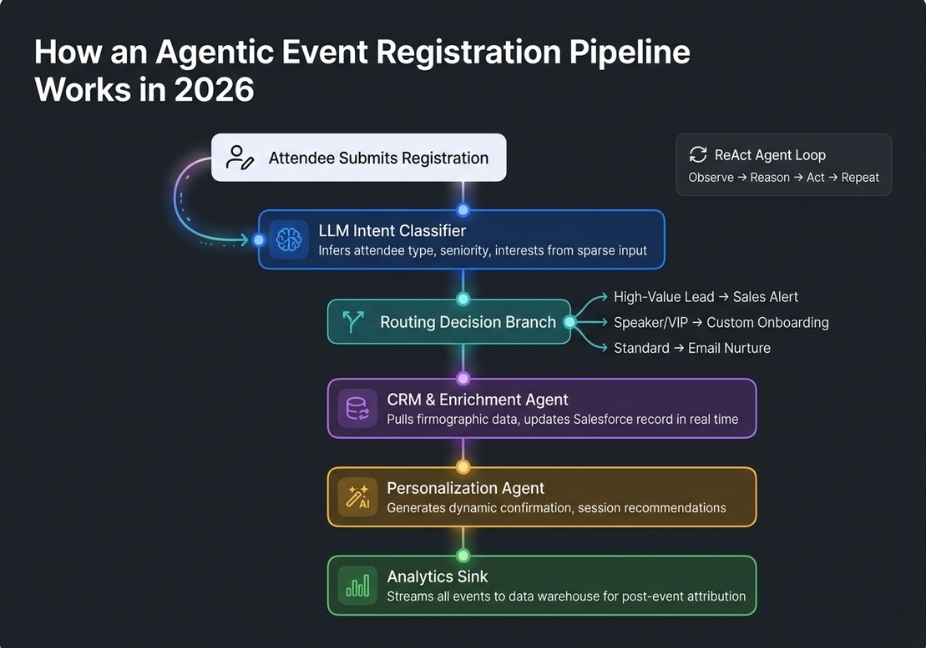
The most significant development in event registration technology in 2026 is the emergence of agentic automation layered on top of the registration pipeline. Where legacy platforms offered linear, rule-based automation (register → confirm → remind), agentic systems make branching decisions across multiple tools based on real-time attendee data.
What Agentic Event Registration Looks Like in Practice
EventMobi now ships built-in AI agents that handle attendee communications and session management automatically. For example, EventMobi’s CEO demonstrated building an agent that calls event registrants for pre-event confirmation in under ten minutes, using Lindy a no-code AI agent builder that connects calendar, email, and event management tools without requiring engineering resources.
Similarly, teams using n8n or Make are building custom multi-step registration pipelines. A typical agentic onboarding workflow branches based on attendee type triggering speaker asset collection for speakers, personalized VIP welcome sequences for sponsors, and standard session recommendation flows for general attendees. As a result, every registrant receives a contextually relevant experience without manual segmentation by the event team.
How to Build an Agentic Registration Pipeline
Here is a step-by-step implementation for teams ready to add agentic automation to their registration stack:
Step 1: Choose a platform with webhook or API support. Cvent, Bizzabo, RegFox, and Eventbrite all support this. Without real-time event triggers, agentic automation is not possible.
Step 2: Define your attendee taxonomy. Map every attendee type in your event (Speaker, Sponsor, VIP, Press, Standard) and the distinct downstream workflow each should trigger.
Step 3: Design your form schema as a data contract. Every custom field is an agent input. Therefore, use dropdowns and checkboxes for fields that will drive routing decisions. Reserve free-text fields for context that does not need to trigger automation because LLMs can parse natural language, but structured values produce more reliable routing outcomes.
Step 4: Connect your platform to your automation layer. Use n8n, Make, or a custom webhook handler. Test with a real registration, not a mock payload because webhook behavior under load differs significantly from single-record tests.
Step 5: Build your routing agents. For each attendee type, define the agent task and the tools it needs email, CRM, calendar, Slack, or document storage. Start with one workflow, validate it fully, then expand.
Step 6: Instrument your registration funnel. Track drop-off by form step, registration velocity by day, and downstream conversion (registered → confirmed → attended). These metrics identify exactly where your pipeline is losing people.
python
# Example: Agentic post-registration routing trigger
# Fires on new registrant webhook event from your event platform

def on_new_registrant(registrant: dict):
    attendee_type = registrant.get("ticket_tier")  # "VIP", "Standard", "Speaker"

    if attendee_type == "Speaker":
        agent.run_task(
            task="collect_speaker_assets",
            inputs={
                "name": registrant["name"],
                "session_title": registrant["session_title"]

            tools=["email_send", "drive_create_folder", "slack_notify"]


    elif attendee_type == "VIP":
        agent.run_task(
            task="personalized_vip_onboarding",
            inputs={"attendee": registrant},
            tools=["crm_enrichment", "email_draft", "calendar_schedule"]


    else:
        agent.run_task(
            task="standard_onboarding",
            inputs={"attendee": registrant},
            tools=["email_send", "session_recommend", "crm_update"]
Architect’s Note: The registration form is not a form it is a structured data schema. Every field you add at sign-up is an input to your downstream agentic workflows. Fields designed with automation in mind dramatically outperform fields designed purely for human readability. Use controlled vocabularies (dropdowns, radio buttons) wherever routing decisions depend on the answer. Free text is appropriate for fields that require qualitative context for example, “What do you hope to learn at this event?” because that field feeds personalization, not routing logic.
Common Mistakes in Event Registration Setup
Even experienced event teams make these errors. Consequently, understanding them in advance saves significant operational pain.
Mistake 1: Treating registration as a one-time transaction. Registration is the first data point in the attendee relationship, not the last. Platforms that confirm the sign-up but trigger no downstream workflows leave engagement, attendance rates, and post-event conversion on the table.
Mistake 2: Ignoring per-ticket fee math. Fee structures compound quickly at scale. Specifically, Eventbrite charges 3.7% plus $1.79 per ticket for paid events. RegFox charges approximately $0.99 plus 1% per registrant. Cvent and Bizzabo operate on annual contracts starting in the low five figures. For a 1,000-person event at $500 per ticket, Eventbrite fees approach $20,000. RegFox fees approach $5,000 for the same volume. That $15,000 difference is a real budget decision.
Mistake 3: Skipping the CRM field mapping audit. The most common integration failure is registration data syncing to Salesforce or HubSpot but landing in the wrong field creating duplicate records or unmapped custom properties. Furthermore, this error is invisible until a sales rep or marketing team member notices inconsistent data weeks later. Audit your field schema before the first test registration, not after.
Mistake 4: Not load-testing webhooks before launch. A registration spike for example, when an email campaign goes out will expose webhook rate limits and queue delays that never appear in single-record tests. Therefore, simulate peak volume before your registration opens publicly.
Mistake 5: Selecting an enterprise platform for a mid-size event. Cvent is a three-month implementation. If your event is in six weeks, that timeline is a problem. Match platform complexity to event complexity. Moreover, overpaying for features you will not use is a common first-year mistake that teams rarely repeat.
What Practitioners Are Saying About Event Registration in 2026
The event tech community has grown notably more precise about registration requirements. Experienced practitioners consistently flag the same gaps in platform selection discussions: static forms that do not adapt to attendee type, CRM syncs that break at scale, and platforms that advertise AI features amounting to nothing more than template-based email suggestions.
The most active conversation in 2026 centers on conversational registration replacing static forms with AI-driven intake flows that capture attendee intent, goals, and session preferences in natural language, then route that data into structured fields downstream. Perspective AI has positioned directly in this space, layering a conversational interface in front of existing platforms like Cvent and RegFox. As a result, teams can improve registration-to-attendance conversion without replacing their existing stack.
For teams looking to experiment with agentic event automation without deep technical skills, the practitioner consensus points to two starting points. First, EventMobi’s built-in agents for teams already on that platform. Second, Lindy for no-code agent experiments that connect to any existing registration tool via API or email.
FAQ People Also Ask
The best online event registration software depends on your event type and scale. Cvent leads for enterprise conferences. Bizzabo is preferred for B2B marketing programs. RegFox and Swoogo serve mid-size professional events cost-effectively. Eventbrite works best for public consumer events. RSVPify handles private and corporate events. For associations and nonprofits, Whova and Wild Apricot offer the strongest combination of registration and membership management.
Event registration software pricing ranges widely. Eventbrite charges approximately 3.7% plus $1.79 per paid ticket with no monthly fee. RegFox charges $0.99 plus 1% per registrant. RSVPify starts at $39 per month. Cvent and Bizzabo are enterprise contracts starting in the low five figures annually. Ticket Tailor charges a flat per-ticket fee with no percentage, making it cost-effective for higher-priced tickets.
The best free event registration options in 2026 include Eventbrite for free events (no fees on $0 tickets), RSVPify’s free plan for events up to 100 registrants, and Google Forms paired with a payment processor for very basic needs. However, free tools lack multi-session management, CRM integration, and automated onboarding workflows, so they are most appropriate for simple, low-stakes events.
AI improves event registration in four key ways. First, automated attendee routing directs different registrant types into distinct onboarding sequences without manual intervention. Second, LLM-powered session recommendations match attendees to sessions based on stated interests. Third, anomaly detection flags duplicate registrations and suspicious payment patterns in real time. Fourth, predictive analytics forecast registration velocity and peak sign-up windows so teams can plan capacity accordingly.
Yes and this is the most active area of event tech development in 2026. Any platform with webhook or API support can trigger agentic workflows. Tools like Lindy and n8n connect to Cvent, Bizzabo, Eventbrite, and RegFox. A new registrant record becomes the agent trigger, after which multi-step workflows handle speaker asset collection, VIP onboarding, CRM enrichment, and post-event follow-up automatically.
Hybrid event registration software must manage two parallel attendee tracks in-person and virtual with separate confirmation flows, streaming access links, session check-in modes, and engagement tools for each. Dedicated hybrid platforms like RingCentral Events and vFairs specialize in virtual-first experiences. Bizzabo and Cvent support hybrid as part of their core product. As a result, the right choice depends on whether hybrid is your primary format or a secondary track added to an in-person event.
Conclusion
Online event registration software in 2026 is not a commodity tool it is the first node in your attendee experience pipeline. The platforms that deliver real operational leverage share three characteristics: they expose clean APIs for real-time integration, they support conditional routing logic for attendee segmentation, and they connect natively to your CRM so that registration data flows cleanly into every downstream workflow.
Three takeaways to act on immediately. First, match platform complexity to event complexity do not pay enterprise pricing or absorb enterprise implementation timelines for a mid-size event. Second, design your registration form schema as a data contract, because every field you add at sign-up becomes an input to your agentic automation layer. Third, the agentic event workflow is no longer experimental tools like Lindy, n8n, and EventMobi’s built-in agents make multi-step post-registration automation accessible without an engineering team.
Explore more hands-on guides on agentic workflows, LLM integration, and real-world automation pipelines at agentiveaiagents.com.
Technical Disclaimer: Platform pricing, API capabilities, and AI features evolve rapidly. All figures and platform details in this article reflect the state of the ecosystem as of June 2026. Always verify against official platform documentation before making purchasing or implementation decisions.