

When it comes to GoHighLevel vs HubSpot, no two platforms divide marketers quite like these two. One is a flat-rate, all-in-one machine built to run multiple client accounts. The other is a modular enterprise CRM that scales with your team and your budget.
Choosing the wrong one doesn’t just cost money. It costs months of migration, lost data, and frustrated teams.
This guide cuts through the noise with real pricing math, feature-by-feature breakdowns, and honest guidance on who should use which platform whether you’re an agency in the UK, a startup in the US, or a growing SMB in Southeast Asia.
What Is GoHighLevel?
GoHighLevel (also written as GHL or HighLevel) is an all-in-one sales and marketing platform built from the ground up for marketing agencies, consultants, and service-based businesses.
A single GoHighLevel subscription gives you:
- A full CRM with pipeline management
- Email, SMS, and voice marketing
- Funnel and landing page builder
- Calendar booking and appointment scheduling
- Social media scheduling and posting
- Reputation and review management
- A unified conversation inbox
- White-label SaaS capabilities (on higher tiers)
All of this is available under one flat monthly price, with unlimited contacts and unlimited users on every tier. The platform’s defining unit is the sub-account — an isolated environment for each client — which is why agencies love it.
What Is HubSpot?
HubSpot is a modular customer platform organized into specialized “Hubs”: Marketing Hub, Sales Hub, Service Hub, Content Hub, Operations Hub, and Commerce Hub.
Each Hub can be purchased independently or bundled, and pricing is based on both seats (users) and marketing contacts — not just which features you want.
HubSpot’s core strength is its unified CRM. Every Hub shares the same contact record, making it ideal for businesses where marketing, sales, and service teams all need a single view of the customer. It’s backed by over 1,700 native integrations, a mature academy, and enterprise-grade governance tools.
GoHighLevel vs HubSpot: Pricing Breakdown (2026)
This is where the two platforms diverge most dramatically. Getting the comparison right means looking at what you’d actually pay — not just the entry-level sticker price.
GoHighLevel Pricing (2026)
| Plan | Monthly Price | Key Inclusions |
|---|---|---|
| Starter | $97/month | CRM, funnels, email/SMS, up to 3 sub-accounts |
| Unlimited | $297/month | Unlimited sub-accounts, white-label desktop app, basic API |
| Agency Pro (SaaS) | $497/month | Everything in Unlimited + SaaS Mode, rebilling, full white-label |
Important: All three tiers include the same core feature set. The differences are sub-account limits, white-labeling, and resale rights — not locked features. Usage-based fees for SMS, voice calls, and AI minutes are charged on top of the subscription.
A realistic agency on the Unlimited plan should budget $400–450/month once metered SMS, email, and call costs are factored in.
HubSpot Pricing (2026)
| Plan | Monthly Price | Key Inclusions |
|---|---|---|
| Free CRM | $0 | Unlimited users, basic pipelines, email tracking, up to 1M contacts |
| Starter | ~$20/seat/month | Basic automation, email marketing, ~1,000 marketing contacts |
| Marketing Hub Pro | ~$890/month | 3 seats, 2,000 contacts, automation, A/B testing, custom reporting |
| Enterprise (per Hub) | $1,500–$3,600/month | Custom objects, SSO, advanced permissions, predictive scoring |
| Onboarding Fee | $1,500–$7,000 (one-time) | Mandatory on Professional and Enterprise tiers |
The real comparison is not GHL’s $97 against HubSpot’s free tier. For most growing businesses, the relevant HubSpot tier is Marketing Hub Professional at $890/month — and that’s before extra seats or contact overages.
Real-World Annual Cost Comparison
For a 5-person agency managing 5,000 contacts:
- GoHighLevel Unlimited: $297/month → $3,564/year
- HubSpot Marketing Hub Pro: ~$1,240/month (base + extra seats + contacts) → $14,880/year
That’s an $11,316 annual difference — and the gap grows with every team member or client you add.
GoHighLevel vs HubSpot: Feature Comparison Table
| Feature | GoHighLevel | HubSpot |
|---|---|---|
| Pricing Model | Flat rate per account | Per seat + per contact + per Hub |
| Free Plan | No (14-day trial only) | Yes (unlimited users, basic CRM) |
| Unlimited Contacts | Yes (all tiers) | No (marketing contacts are billed) |
| Unlimited Users | Yes (all tiers) | No (seat-based pricing) |
| Sub-Accounts (Multi-Client) | Built-in | Not native; requires workarounds |
| White-Label / Resell | Yes (Unlimited & SaaS Pro) | No |
| SMS Marketing | Native 2-way SMS | Broadcast SMS only |
| WhatsApp, Instagram DM | Yes (native) | Limited |
| Funnel Builder | Yes (built-in) | Basic (landing pages only on higher tiers) |
| Email Marketing | Yes | Yes (more advanced on Pro+) |
| CRM Depth | Adequate for agencies | Best-in-class for B2B enterprise |
| Custom Objects | No | Yes (Professional & Enterprise) |
| Predictive Lead Scoring | No | Yes (Enterprise) |
| Content / SEO Tools | No | Yes (Content Hub) |
| Native Integrations | 100+ (Zapier-heavy) | 1,700+ |
| Onboarding Fee | None | $1,500–$7,000 |
| SaaS Reselling Mode | Yes (SaaS Pro tier) | No |
| AI Features | Workflow AI, Voice AI, Conversation AI | AI assistant, predictive forecasting |
| Multi-Touch Attribution | No | Yes (Pro & Enterprise) |
| Learning Curve | Moderate | Steep on higher tiers |
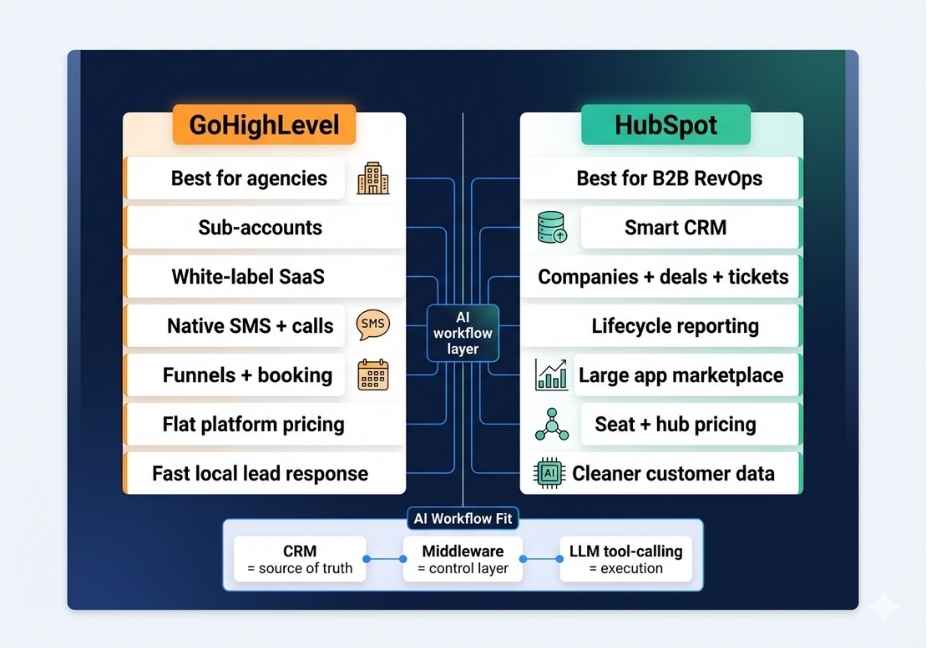
CRM Depth: Where HubSpot Wins
HubSpot’s CRM is the stronger of the two for complex, long-cycle B2B sales.
It offers custom objects, calculated properties, association labels, predictive lead scoring, and deal stages that can be tailored to match enterprise sales processes. Every marketing, sales, and service interaction is tied to a single contact timeline — no data silos, no reconciliation.
GoHighLevel’s CRM handles pipelines, contacts, tasks, notes, and communication history well. For agencies managing client funnels, it covers every operational need. But it lacks the object-level modeling required by businesses with multiple products, multi-stakeholder deals, or renewal-tracking at scale.
Winner for CRM depth: HubSpot — especially for teams running complex B2B sales cycles.
Multi-Channel Communication: Where GoHighLevel Wins
GoHighLevel was built for outreach, and it shows. Native two-way SMS, WhatsApp, Facebook Messenger, Instagram DM, Google Business Messages, ringless voicemail, and live chat are all built into every plan.
HubSpot, by contrast, supports broadcast SMS but does not match GHL’s depth of conversational, two-way messaging across channels. For service businesses that rely on SMS and phone follow-ups, this gap is significant.
Winner for communication: GoHighLevel — no contest for agencies and service businesses.
Automation and AI in 2026
Both platforms have invested heavily in AI, but in different directions.
GoHighLevel’s AI features include:
- Workflow AI Builder generates automation flows from plain-English prompts
- Voice AI handles inbound and outbound calls autonomously
- Conversation AI manages appointment scheduling via chat
- AI content generator for emails and funnels
HubSpot’s AI features include:
- AI-assisted CRM data enrichment and deduplication
- AI email and content writer (Breeze Copilot)
- Predictive lead scoring and deal forecasting
- AI-powered A/B testing recommendations
GoHighLevel’s AI is more execution-focused — designed to automate outreach and booking at speed. HubSpot’s AI is more deeply integrated into CRM workflows, reporting, and revenue intelligence. Neither has a decisive lead in 2026. The right choice depends on what kind of intelligence you need.
Content and SEO Capabilities
This category belongs to HubSpot with no debate.
HubSpot’s Content Hub provides a full CMS for building and managing websites, blogs, and landing pages complete with topic cluster strategy, content optimization recommendations, and organic traffic analytics. It’s a genuine growth tool for businesses where content marketing is a primary acquisition channel.
GoHighLevel’s page builder is functional for creating funnels and landing pages. It is not a CMS. There is no blog management, no content strategy tooling, and no native SEO features. If content-led growth is central to your strategy, GoHighLevel cannot replace HubSpot here.
Winner for content and SEO: HubSpot by a wide margin.
Integrations and Tech Stack Compatibility
HubSpot’s ecosystem includes over 1,700 native integrations covering Salesforce, Slack, Google Workspace, Shopify, and hundreds of enterprise tools. If your team depends on tight integrations across a large tech stack, HubSpot’s ecosystem is a structural advantage.
GoHighLevel’s integration library sits around 100+ native connections, with Zapier and custom API handling the gaps. For agencies that run a lean stack and don’t need deep enterprise tool connections, this is rarely a problem. For larger in-house teams, it can be a limitation.
Winner for integrations: HubSpot.
Agency Use Case: GoHighLevel Is Designed for It
GoHighLevel’s entire architecture is built around the agency model.
Each client lives in its own sub-account — an isolated CRM, funnel set, inbox, and data environment. Adding a new client doesn’t raise your monthly cost. The Unlimited plan at $297/month covers as many sub-accounts as you need.
The SaaS Pro tier ($497/month) goes further, letting agencies rebrand the entire platform — login screen, domain, mobile app — and resell it to clients as their own software, with built-in Stripe billing. This is a revenue model HubSpot simply doesn’t offer.
Running multiple client accounts on HubSpot means separate portals, which compounds costs rapidly. Enterprise-level workarounds exist but add complexity and expense.
For agencies: GoHighLevel wins clearly and decisively.
GoHighLevel vs HubSpot by Region and Business Type
The better platform depends significantly on where your business operates and how it’s structured.
United States and Canada
Agency owners and consultants in North America have driven GoHighLevel’s rapid growth. The flat-rate model, SaaS rebilling, and SMS capabilities align well with the service-business-heavy markets in these regions. HubSpot remains dominant among VC-backed startups and mid-market SaaS companies with dedicated revenue teams.
United Kingdom and Europe
HubSpot’s GDPR-compliant infrastructure, enterprise governance features, and deep Content Hub give it an edge for regulated industries and larger in-house marketing teams across Europe. GoHighLevel serves UK agencies well, but compliance considerations around SMS marketing may require additional configuration.
South Asia (India, Pakistan, Bangladesh)
For growing agencies and digital marketing consultancies in South Asia, GoHighLevel’s flat-rate pricing and unlimited contacts offer exceptional value at a significantly lower cost than HubSpot’s Professional tier. Local agencies reselling white-labeled platforms are an active use case for GHL’s SaaS Pro tier.
Southeast Asia and Australia
Both platforms are used, but GoHighLevel’s multi-channel communication tools — including WhatsApp — align well with messaging habits across Southeast Asian markets. HubSpot’s deeper reporting features suit Australian enterprise and B2B operations.
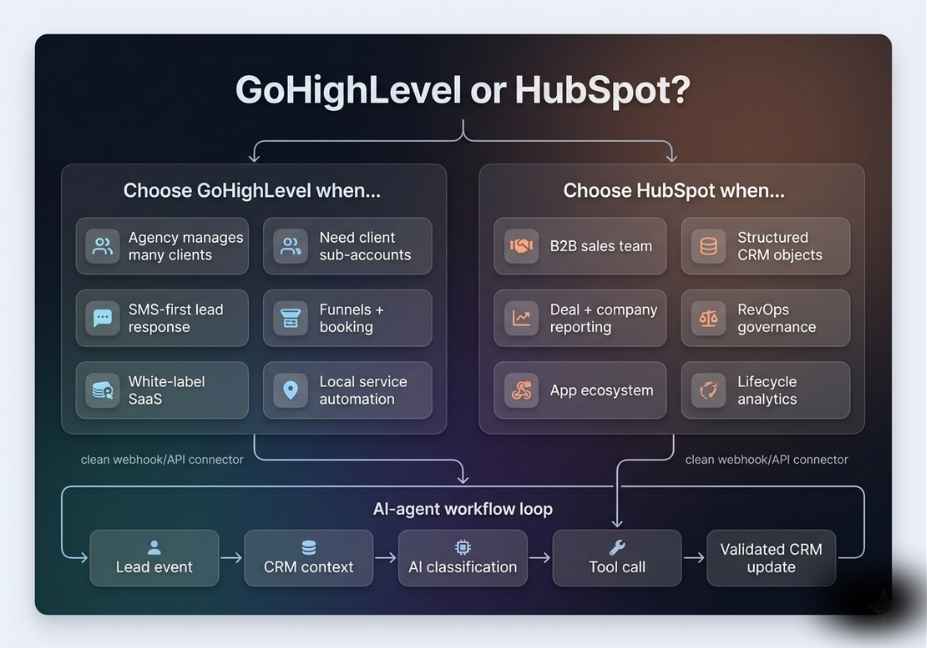
Who Should Use GoHighLevel?
GoHighLevel is the right choice if:
- You run a marketing agency managing multiple client accounts
- You are a freelance consultant or coach managing several clients from one dashboard
- You need SMS, WhatsApp, and phone follow-up built into your workflow
- You want to white-label and resell a platform under your own brand
- You manage franchise or multi-location business operations
- Your budget is under $500/month and you need a full marketing stack
Who Should Use HubSpot?
HubSpot is the right choice if:
- You are a single brand with an in-house marketing, sales, and service team
- You run complex B2B sales pipelines with long cycles and multiple stakeholders
- Content marketing and SEO are primary growth channels for your business
- You need enterprise governance: SSO, custom objects, field-level permissions, audit logs
- You have venture backing or enterprise budget to support $800–$3,600+/month spending
- Your team relies on a wide tech stack requiring 1,000+ integrations
Common Mistakes When Comparing GoHighLevel vs HubSpot
Comparing GHL’s $97 to HubSpot’s free tier. These platforms do not solve the same problem. The relevant comparison for most growing businesses is GoHighLevel Unlimited ($297/month) vs HubSpot Marketing Hub Professional (~$890/month).
Ignoring GoHighLevel’s usage fees. SMS, voice calls, email delivery, and AI minutes are metered charges on top of the subscription. Budget an additional $60–100/month for a typical agency.
Forgetting HubSpot’s mandatory onboarding fees. Professional tier onboarding starts at $1,500–$3,000. Enterprise hub onboarding runs $3,500–$7,000. Multi-hub enterprise deployments can exceed $24,000 in one-time setup costs.
Assuming HubSpot scales for agencies. It doesn’t — not natively. Running multiple client brands means separate portals or expensive Enterprise workarounds.
Assuming GoHighLevel handles enterprise CRM needs. If you need custom objects, predictive lead scoring, or complex multi-pipeline B2B processes, GHL’s CRM layer will feel limited.
How to Choose: A Step-by-Step Decision Framework
Step 1: Identify your business model. Are you managing one brand, or running marketing for multiple clients? This single question eliminates one platform for most businesses immediately.
Step 2: List your non-negotiable features. White-labeling? Predictive lead scoring? Content/SEO tools? Native SMS? Custom objects? Map features to your actual requirements, not aspirational ones.
Step 3: Price out your real usage. For HubSpot, estimate seats and contacts at the tier you’ll need in 12 months. For GoHighLevel, estimate monthly SMS, email, and call volume. Include onboarding fees.
Step 4: Check the integration requirements. Does your team depend on specific tools that need tight native integration? HubSpot’s 1,700+ integrations may matter more than the platform itself.
Step 5: Run a trial before committing. GoHighLevel offers a 14-day free trial (some partners offer up to 30 days). HubSpot’s free CRM is available indefinitely with no credit card required. Test your actual workflow before signing an annual contract.
Frequently Asked Questions
What is the main difference between GoHighLevel and HubSpot?
GoHighLevel is a flat-rate, all-in-one platform built around sub-accounts for agencies managing multiple clients. HubSpot is a modular, seat-and-contact-priced platform built around a single shared CRM for one brand’s marketing, sales, and service teams.
Is GoHighLevel cheaper than HubSpot?
For agencies and teams of 3 or more, yes — significantly. A 5-person team on GoHighLevel Unlimited pays roughly $3,564/year. The equivalent HubSpot setup can run $14,880/year or more. HubSpot’s free CRM tier is the only scenario where HubSpot is cheaper.
Can GoHighLevel replace HubSpot for an agency?
Yes, for agencies focused on managing multiple client funnels, CRMs, and campaigns under one roof. Agencies that also need deep B2B sales reporting, enterprise governance, or content/SEO tooling may still need HubSpot for those specific functions.
Does HubSpot offer a free plan?
Yes. HubSpot’s free CRM supports unlimited users, up to 1,000,000 contacts, deal pipelines, email tracking, and basic reporting. Marketing automation, custom reporting, and AI features require paid tiers.
Is there a free trial for GoHighLevel?
Yes. GoHighLevel offers a 14-day free trial directly, with some partner channels offering 30 days. A credit card is required to start.
Which is better for small businesses?
Under $200K ARR, GoHighLevel is the stronger value almost every time. Between $200K and $2M ARR, run the real cost math at your actual contact volume and channel mix. Above $2M ARR with a dedicated revenue team, HubSpot starts to justify its pricing.
Which is easier to learn?
GoHighLevel has a moderate learning curve with a Launchpad setup wizard — most users have a functional CRM and automation sequence running within a few hours. HubSpot’s free CRM is beginner-friendly, but Professional and Enterprise tiers carry a steeper learning curve and often require certified implementation partners.
Conclusion
The GoHighLevel vs HubSpot decision is not about which platform has more features. It is about which pricing model and account structure matches how your business actually operates.
GoHighLevel wins for agencies, consultants, coaches, and multi-location operators who need to run multiple client environments at a flat monthly cost — and potentially resell the platform as their own branded SaaS product.
HubSpot wins for single-brand businesses with complex sales processes, content-marketing-led growth strategies, and the budget to support a modular enterprise platform.
Map your business model to the pricing structure first. The right platform usually becomes obvious within minutes.