
Imagine an internal marketing team that briefs an AI agent on Monday and then deploys a full multi-channel marketing campaign by Tuesday without needing to touch a single prompt template. That’s the world of Jasper AI in 2026, and it’s being achieved for large enterprise teams.
The company launched as a more basic copywriting tool based on GPT-3 in 2021, but it has transitioned into a more complete agentic marketing platform as of June 2026. Since its relaunch, Jasper has introduced several purpose-built AI agents, an intelligent workspace called Jasper Canvas, and a brand context engine called Jasper IQ. Because of these new capabilities, Jasper is now in an entirely different category from ChatGPT and Copy.ai.
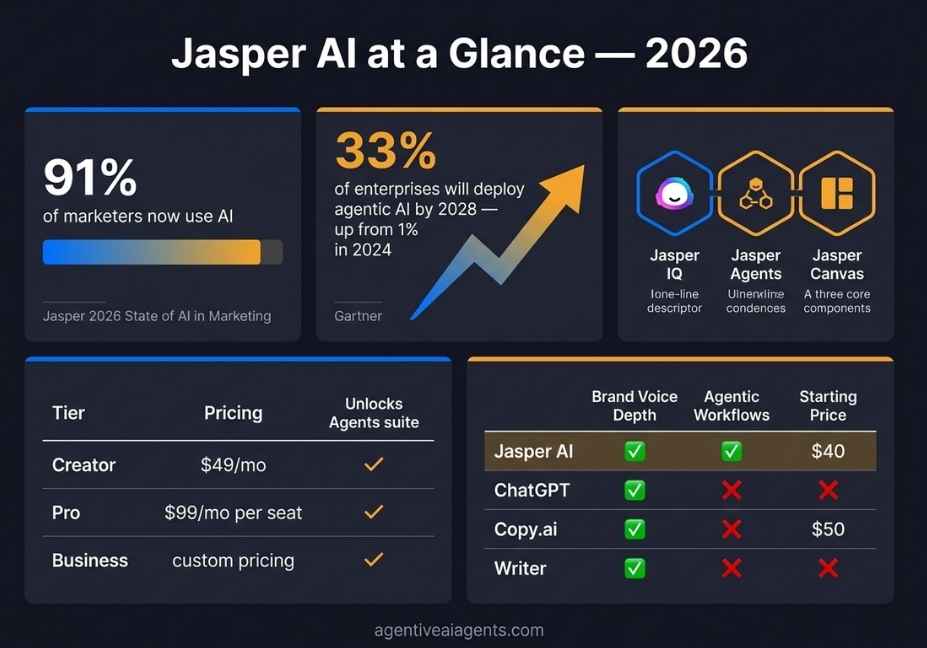
According to Jasper’s 2026 State of AI in Marketing report, 91% of marketing teams use some form of AI today; however scalability and brand governance are still the two largest barriers. Jasper is specifically built to solve both.
This review goes beyond a simple feature list to explain Jasper’s multi-agent architecture; provide context for how the Jasper IQ context layer works as a retrieval system in a RAG fashion; and identify areas where Jasper falls short for engineering teams with existing implementations using LangChain or LlamaIndex in production.
What Is Jasper AI? (And Why It Is Not Just an AI Writer)
Jasper AI is an enterprise-grade, multi-agent content automation platform built specifically for marketing teams. Furthermore, it is one of the first tools in its category to move beyond chat-based AI generation into structured agentic workflows.
At its core, Jasper AI combines three tightly integrated components. First, Jasper IQ acts as a context layer that stores your brand voice, style guides, audience personas, and approved messaging. Second, Jasper Agents are autonomous AI workers that execute multi-step marketing tasks from brief to publication. Third, Jasper Canvas provides the human workspace where marketers review, edit, and approve agent outputs before anything ships.
Importantly, Jasper runs on a large language model-agnostic backend. This means it routes tasks across GPT-4o (OpenAI), Claude (Anthropic), and Gemini (Google) depending on which model performs best for a specific content type. Therefore, it is not simply “ChatGPT with templates” it is a governed orchestration layer that sits above multiple LLMs.
Because of this architecture, Jasper is trusted by nearly 20% of the Fortune 500, including Prudential, Wayfair, and Ulta Beauty.
Featured Answer What is Jasper AI used for?
Jasper AI is used to automate marketing content workflows at scale. It generates blog posts, ad copy, email sequences, social media content, and full multi-channel campaigns using purpose-built AI agents. Its Jasper IQ system ensures every output matches your brand voice automatically.
How Does Jasper AI Work? The Architecture Explained
Understanding how Jasper works under the hood is where most reviews fall short. Consequently, most marketers underuse the platform because they treat it like a prompt box rather than an orchestration system.
Step 1: Brand Context Injection via Jasper IQ
Every content request first passes through Jasper IQ before it reaches any LLM. Think of Jasper IQ as a retrieval-augmented generation layer for your brand. Specifically, when you trigger a task, Jasper IQ automatically injects four types of context into the prompt:
- Your uploaded brand style guides and tone-of-voice documents
- Pre-defined audience personas such as “CMO Sarah” or “Developer Dave”
- Approved messaging pillars and vocabulary constraints
- Historical campaign content used as few-shot examples
As a result, the LLM generates output that already reflects your brand without you needing to re-explain your guidelines on every single request.
Architect’s Note: If you have built RAG pipelines with LlamaIndex or Pinecone, Jasper IQ operates on very similar principles. It retrieves dense brand context and appends it to the system prompt before every generation call. The key difference, however, is that Jasper governs this layer with enterprise access controls and approval workflows that most custom implementations skip entirely.
Step 2: Multi-Agent Task Decomposition
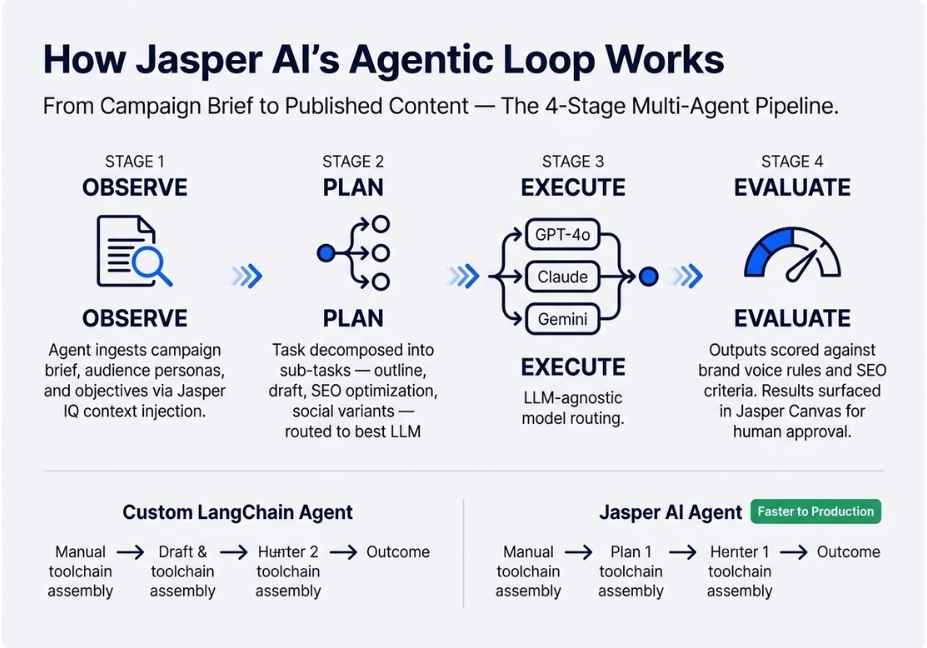
After context injection, Jasper’s agent layer takes over. Specifically, it runs a four-stage loop: observe, plan, execute, and evaluate.
First, the agent observes the brief, audience data, and campaign objectives. Then it decomposes the task into sub-tasks for example, a blog brief becomes an outline, then a full draft, then an SEO-optimized version, then social media variants. Next, specialized sub-agents handle each step while routing to the best available LLM. Finally, outputs are scored against brand voice rules and SEO criteria before they surface in Jasper Canvas for human review.
This is similar to the ReAct-style tool-use loop that LangChain popularized. However, Jasper’s agents are scoped exclusively to marketing workflows, which means they do not browse the web or write code they execute content tasks with structured inputs and governed outputs.
Did You Know? Gartner predicts that by 2028, 33% of enterprises will deploy agentic AI up from just 1% in 2024. Jasper is currently the only dedicated marketing platform architected around that shift.
Step 3: Human Review in Jasper Canvas
Because AI outputs still hallucinate and drift from brand tone, Jasper does not auto-publish. Instead, every agent output lands in Jasper Canvas, where marketers can review, edit, and approve before anything goes live. This human-in-the-loop design is what separates Jasper from fully autonomous content bots and it is the right engineering decision for production marketing systems.
Key Features of Jasper AI in 2026
Jasper Agents Specialized AI Workers for Marketing
Jasper Agents are not general-purpose assistants. Rather, each agent is purpose-built for a specific marketing workflow. Here is how they break down:
- Content Agent : produces long-form blog posts and SEO articles, with native Surfer SEO scoring built in
- Campaign Agent : generates a full suite of multi-channel assets from a single campaign brief
- Social Agent : adapts content to platform-specific formats and character limits across LinkedIn, Instagram, and X
- Localization Agent : translates and culturally adapts content across target markets
Moreover, unlike building a custom agent stack with LangChain or AutoGen, Jasper Agents come pre-wired with native integrations for HubSpot, Salesforce, Marketo, and Surfer SEO. Therefore, there is no toolchain assembly required.
Brand Voice System Deeper Than a Style Setting
Jasper’s brand voice system works differently from what most AI tools offer. Instead of relying on prompt-level instructions, it builds a persistent context profile from your actual brand materials. You simply upload your style guides, sample content, and vocabulary rules. After that, Jasper applies them automatically to every output.
Enterprise plans support multiple brand voice profiles simultaneously. Consequently, agencies managing several clients or holding companies overseeing multiple brands can switch brand contexts without manual re-prompting.
Pro Tip: For the highest brand consistency, upload a negative example set alongside your positive brand materials. Including content that violates your style guide trains the Jasper IQ context layer far more precisely than positive examples alone.
LLM-Agnostic Multi-Model Routing
This is Jasper’s least-discussed yet most technically significant feature. Rather than locking into one LLM provider, Jasper’s backend routes each task to the model most likely to produce the best output:
| Content Task | Model Typically Routed |
|---|---|
| Long-form SEO blog posts | GPT-4o (OpenAI) |
| Nuanced brand voice copy | Claude (Anthropic) |
| Research-heavy or factual content | Gemini (Google) |
| High-volume ad copy variations | Proprietary fine-tune |
Because of this multi-model architecture, Jasper also reports 99% uptime. No single provider outage takes the entire platform offline.
Jasper AI Pricing Is It Worth the Cost in 2026?
Jasper is not a budget tool. Because it targets enterprise marketing teams rather than solo creators, its pricing reflects that positioning.
The Creator plan starts at approximately $39–49 per month. It suits solo marketers and freelancers who need AI writing assistance without the full agentic layer. The Pro and Teams plans run approximately $59–99 per seat per month. These plans work well for small-to-mid-size content teams running regular SEO and campaign content. The Business plan is custom-priced and unlocks the full Jasper Agents suite, API access, SSO, multi-brand governance, and a dedicated customer success manager.
All paid plans include unlimited word generation. Additionally, a 7-day free trial is available on Creator and Pro plans.
However, there is an important caveat. The Jasper Agents and Jasper Canvas features that make the 2026 platform genuinely compelling are locked behind the Business plan. Creator and Pro plans essentially give you Jasper’s older template-based generation experience. Therefore, if you are evaluating Jasper specifically for its agentic capabilities, budget accordingly.
For solo creators or low-frequency writers, ChatGPT Plus at $20 per month delivers stronger value.
Jasper AI vs. Competitors Full Comparison
Choosing the best AI content tool for your team depends on your workflow, budget, and governance requirements. Here is how Jasper compares to the top alternatives:
| Tool | Architecture | Brand Voice | Agentic Workflows | Best For | Starting Price |
|---|---|---|---|---|---|
| Jasper AI | Multi-agent, LLM-agnostic | Deep (Jasper IQ) | Yes purpose-built | Enterprise marketing teams | ~$49/mo |
| ChatGPT | Single model (GPT-4o) | Prompt-level only | No | General-purpose tasks | $20/mo |
| Copy.ai | LLM-agnostic, workflow-first | Yes (Pro+) | Partial | Growth and GTM teams | $36/mo |
| Writer | Proprietary model | Full governance | Yes | Brand compliance teams | Custom |
| Writesonic | GPT-4-based | Basic | No | Budget SEO content | $16/mo |
| Claude (Anthropic) | Single model | Prompt-level | No | Nuanced writing, ethics | $18/mo |
The bottom line: Jasper occupies a distinct niche. It is not competing with ChatGPT on flexibility. Nor is it competing with Writesonic on price. Instead, it is building the orchestration and governance layer that sits above raw LLM access. For teams that would otherwise spend three to six months building a custom LangChain-based content pipeline, Jasper offers a significantly faster path to production.
Where Jasper AI Falls Short Honest Failure Modes
No honest review of an agentic platform should skip its failure modes. Consequently, here is where Jasper genuinely struggles.
1. Outputs still hallucinate and require human review.
Jasper’s agents automate drafting, not judgment. Brand voice drift, factual errors, and tone mismatches still occur especially on nuanced or sensitive topics. Therefore, the Jasper Canvas review step is not optional. Teams that skip human review consistently ship errors.
2. The best features are locked behind custom Business pricing.
Because the full Jasper Agents suite requires the Business plan, Creator and Pro users get a noticeably weaker experience. This pricing structure frustrates many mid-market teams that need agentic automation but cannot justify enterprise contracts.
3. No native real-time web retrieval.
Jasper agents cannot browse the web or pull live data. As a result, content requiring current statistics, recent events, or live product information must be supplied manually. This is a significant gap compared to ChatGPT with web search enabled, or a custom LangChain agent with Tavily retrieval integrated.
4. Proprietary backend creates vendor lock-in.
Although Jasper routes across multiple LLMs, you cannot bring your own models or control model selection. Therefore, organizations with on-premise LLM requirements for example, Llama 3 running locally will hit a hard architectural wall.
Technical Note: If your organization requires on-premise LLM deployment or custom model fine-tuning, open-source frameworks like AutoGen or LangChain with locally hosted models remain the only viable path. Jasper is fundamentally a cloud-hosted SaaS platform with no self-hosted option.
How to Automate Content Creation with Jasper AI Step by Step
If you are setting up Jasper for the first time, follow this workflow to get production-ready results quickly.
- Set up Jasper IQ first. Upload your brand style guide, three to five content examples, and your vocabulary rules before generating anything. This single step dramatically improves output quality.
- Define your audience personas. Add at least two personas with specific pain points, job titles, and content preferences. Jasper IQ uses these during every generation call.
- Choose the right agent for your task. Use the Content Agent for long-form SEO articles. Use the Campaign Agent when you need assets across multiple channels from one brief.
- Enable Surfer SEO integration. Connect Surfer SEO before generating blog content. This gives you real-time content scoring and keyword guidance inside the Jasper editor.
- Always review in Jasper Canvas. Never auto-publish. Use Canvas to verify brand voice, check factual claims, and make final edits before the content goes live.
- Build reusable campaign templates. After your first successful campaign run, save it as a reusable template inside Jasper. This reduces setup time on all future campaigns significantly.
What AI Engineers and Developers Are Saying
Reactions from the AI and ML practitioner community are instructive. On Reddit’s r/MachineLearning and r/LocalLLaMA, the most consistent take is straightforward: Jasper makes strong sense for marketing operations teams, but it offers limited value for engineers who already build custom agent stacks.
Specifically, developers who have evaluated Jasper as an alternative to custom LangChain pipelines point to the abstraction cost. You gain speed-to-deploy and enterprise brand governance. However, you lose granular control over prompts, tool definitions, retrieval strategies, and model parameters the kind of control that production AI systems often demand.
For mid-market marketing teams without dedicated ML engineers, that abstraction is genuinely valuable. For companies already running LlamaIndex or LangChain in production, the ROI case for Jasper is considerably weaker.
FAQ People Also Ask
What is Jasper AI and what is it used for?
Jasper AI is an agentic marketing platform that automates content creation workflows at enterprise scale. It uses purpose-built AI agents to generate blog posts, ad copy, email sequences, and multi-channel campaign assets. Its Jasper IQ system enforces brand voice consistency across every output automatically.
Is Jasper AI better than ChatGPT for marketing content?
For high-volume, brand-consistent marketing content, Jasper has a clear advantage. Its Jasper IQ context layer, multi-agent workflows, and Surfer SEO integration give it capabilities ChatGPT lacks out of the box. However, ChatGPT is far more flexible and costs significantly less at $20 per month versus $59 and above. For general writing tasks, ChatGPT wins on value.
How does Jasper AI maintain brand voice across content?
Jasper uses its Jasper IQ context layer to store your brand style guides, example content, vocabulary rules, and audience personas. Every generation call retrieves this stored context and injects it directly into the model prompt. As a result, every output automatically reflects your brand without manual re-prompting.
What are Jasper AI Agents and how do they work?
Jasper Agents are purpose-built autonomous AI workflows for specific marketing tasks. Each agent runs a four-stage loop: it observes the brief, plans the task breakdown, executes each step using the best available LLM, and evaluates outputs against brand and SEO criteria. Marketers review and approve results in Jasper Canvas before publication.
Does Jasper AI use GPT-4 or is it a different model?
Jasper runs a multi-model backend and is not exclusively powered by any single LLM. It routes tasks across GPT-4o (OpenAI), Claude (Anthropic), and Gemini (Google) depending on which model produces the best output for a given content type. This LLM-agnostic architecture is one of Jasper’s core differentiators.
Is Jasper AI worth the price for small teams or solo creators?
For solo creators or small teams with low content volume, Jasper is likely not worth the cost. ChatGPT Plus at $20 per month or Claude at $18 per month offer better value for occasional writing tasks. Jasper’s pricing makes sense primarily for marketing teams producing content at high volume who need brand governance, campaign automation, and team collaboration built into their workflow.
Conclusion
Jasper AI in 2026 is fundamentally different from the GPT-3 writing tool that launched four years ago. Because of its pivot to a multi-agent marketing platform with Jasper IQ for brand governance, Jasper Agents for autonomous execution, and a LLM-agnostic routing backend it now occupies a category that no other dedicated marketing tool has fully entered.
The core insight is this: Jasper is not replacing your LLM. Instead, it is building the orchestration and governance layer above your LLM the same layer that typically takes engineering teams three to six months to build correctly from scratch.
The limitations are real. Outputs still hallucinate, the most powerful features are Business-plan locked, and there is no native real-time retrieval. Nevertheless, for marketing teams that need production-grade, brand-safe content automation without a dedicated ML engineering team, Jasper is the most purpose-built option available today.
Explore more in-depth breakdowns of agentic AI workflows, multi-agent system design, and LLM orchestration at agentiveaiagents.com.
5 Responses