
AI patient education dental tools are software platforms most commonly FDA-cleared imaging AI like Pearl and Overjet that visually highlight diagnostic findings on a patient’s own x-ray and pair that with automated follow-up content, helping patients understand treatment plans and improving case acceptance.
Most dental practices don’t lose case acceptance because patients don’t need treatment. Instead, they lose it because patients don’t fully understand what they’re being told chairside. A rushed explanation of a periapical radiolucency rarely sticks. That’s exactly the gap AI patient education dental tools were built to close in 2024, using imaging AI, chairside overlays, and automated follow-up content to translate clinical findings into something a patient can actually act on.
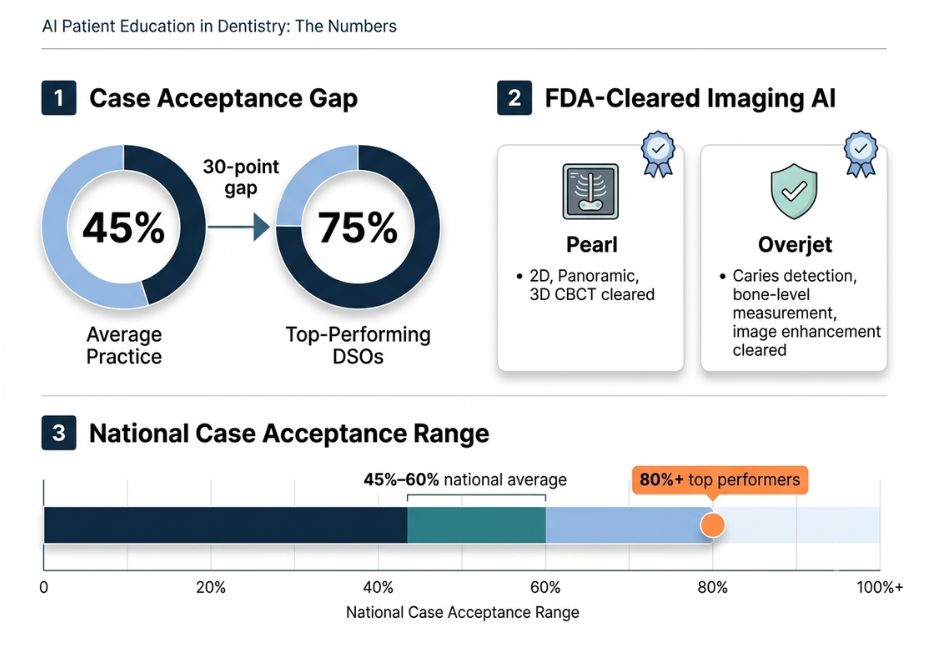
The shift matters because the numbers are stark. National average case acceptance sits around 45–60% for general dentistry, while top-performing practices push past 80%. In most cases, the gap isn’t clinical skill it’s communication. Below, we’ll cover what these tools actually do, which vendors hold real FDA clearance, and how to evaluate one for your practice without falling for marketing wrappers dressed up as diagnostic software.
What Are AI Patient Education Tools in Dentistry?
AI patient education tools use machine learning typically computer vision applied to radiographs, plus automated messaging systems to help patients understand a diagnosis and treatment plan in real time. Rather than a dentist pointing at a grainy x-ray and describing decay verbally, the software visually highlights the finding directly on the image the patient is already looking at.
The category splits into two distinct types. First, diagnostic imaging AI, such as Pearl’s FDA-cleared radiologic detection aid for dental x-rays, which doubles as a communication tool. Second, patient engagement software, which handles education content, appointment reminders, and treatment-plan summaries outside the operatory. Understanding this distinction matters, because only one of these categories carries regulatory clearance behind its claims.
How Does Chairside AI Patient Communication Work?
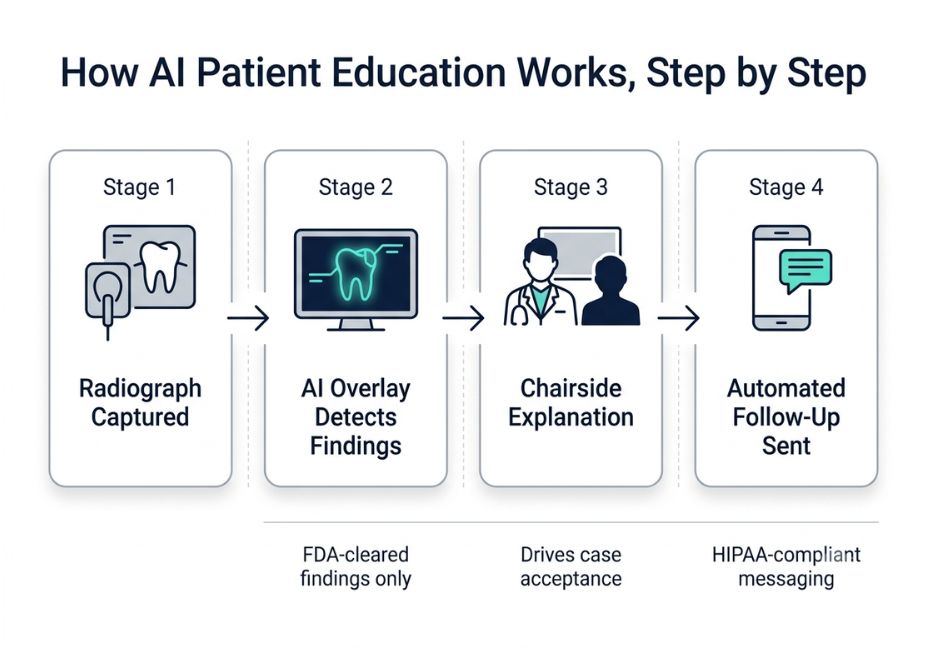
The mechanism is simpler than it sounds. A radiograph is captured as normal, then run through a trained model that flags regions of interest caries, bone loss, calculus and overlays that annotation directly on the patient’s screen. Overjet’s platform, for example, produces real-time AI overlays that highlight caries and bone loss on radiographs, turning an abstract diagnosis into something visible and concrete.
Did you know? Pearl became the first AI software cleared by the FDA to read dental x-rays, and has since expanded that clearance to cover 2D, panoramic, and 3D CBCT imaging. This regulatory milestone matters because it means the detections shown to patients have been clinically validated, not just marketed as accurate.
Meanwhile, engagement-layer tools generate personalized emails, texts, or in-app content that reinforce what was said chairside appointment reminders, home-care instructions, or a plain-language recap of the treatment plan a patient can review that evening. Because HIPAA governs how patient data moves through these systems, any platform you evaluate should confirm compliant data handling before it touches protected health information.
AI Patient Education Use Cases in Real Practices
Here’s how practices are actually using these tools day to day:
- Chairside diagnosis visualization patients see decay or bone loss highlighted directly on their own x-ray instead of taking the dentist’s word for it
- Treatment plan recaps automated summaries sent post-appointment with cost estimates, CDT codes, and next steps
- Pre-appointment education short explainer content sent before a procedure to reduce dental anxiety
- Insurance and cost clarity AI-assisted eligibility checks paired with plain-language cost breakdowns, reducing the financial-surprise objection
- Post-op follow-up automated check-ins that catch complications early and reinforce home care
Best AI Tools for Dental Patient Education
Architect’s note: Only imaging-AI vendors with FDA clearance should be treated as clinically validated. General “AI education platform” tools are useful for messaging and content, but they aren’t diagnostic aids. Don’t conflate the two categories when evaluating vendors.
| Tool | Category | FDA Clearance | Patient-Facing Strength |
|---|---|---|---|
| Pearl (Second Opinion) | Imaging AI | Yes — 2D, panoramic, and 3D CBCT | Chairside pathology overlays; broadest cleared imaging coverage |
| Overjet | Imaging AI + practice analytics | Yes — caries detection, bone-level measurement, image enhancement | Real-time overlays plus revenue-cycle and DSO-level reporting |
| Practice management add-ons | Patient engagement | Not applicable (non-diagnostic) | Automated reminders, treatment-plan recaps, personalized content |
Most cleared platforms integrate directly with practice management systems like Dentrix, Eaglesoft, and Open Dental, so adoption typically doesn’t require replacing existing imaging hardware.
Pro tip: Ask any vendor exactly which specific findings their FDA clearance covers caries, bone loss, periapical lesions, and so on rather than accepting a general “FDA-cleared” claim. Clearances are granted per finding and per imaging modality, not as a blanket approval.
Step-by-Step: How to Implement AI Patient Education in Your Practice
- Audit your current case acceptance rate by procedure type before adopting anything, so you have a real baseline to measure against
- Confirm software integrates with your existing imaging and practice management system
- Pilot with one operatory for 60–90 days rather than a practice-wide rollout
- Train the team on framing, not just the tool the software shows the finding, but how the provider talks through it still drives acceptance
- Pair imaging AI with a post-visit content system so education continues after the patient leaves the chair
- Re-measure case acceptance by procedure type and compare against your baseline
Common Mistakes and How to Avoid Them
- Treating engagement software as diagnostic a chatbot that explains gum disease isn’t a substitute for FDA-cleared imaging AI, and shouldn’t be marketed to patients as equivalent
- Skipping staff training the overlay only helps if the team can walk a patient through it without sounding like they’re reading a report
- Ignoring integration cost some platforms require imaging hardware upgrades, so get a total cost estimate rather than just the software license fee
- Assuming higher case acceptance follows automatically visual aids help patients understand what they’re deciding about, but financial conversations and scheduling friction still account for most drop-off after a patient says yes
What the Data Shows on Case Acceptance
Independent of any single vendor, the underlying case-acceptance numbers explain why practices are investing in this category at all. The 2026 Catalyst Index found the average dental practice accepts just 45% of treatment plans, while top DSOs reach 75% a 30-point gap that visual, real-time communication tools are specifically designed to close. For a deeper breakdown by procedure type, Henry Schein One’s 2026 case acceptance benchmark data is a useful reference point before setting internal targets.
Technical/regulatory disclaimer: FDA clearances and vendor feature sets change frequently. The clearance details referenced here reflect vendor announcements as of mid-2026. Confirm current clearance status directly with the vendor or the FDA’s 510(k) database before making a purchasing decision.
FAQ People Also Ask
What are AI patient education tools in dentistry?
AI patient education tools use imaging AI or automated messaging to help patients understand a diagnosis and treatment plan. The most clinically credible versions are FDA-cleared imaging platforms that overlay findings directly on a patient’s radiograph during the appointment.
How does AI improve patient understanding of dental treatment?
It replaces verbal-only explanations with visual evidence, highlighting decay or bone loss directly on the patient’s own x-ray. It also generates follow-up content the patient can review after leaving the office, reinforcing what was discussed chairside.
Are AI dental imaging tools FDA approved?
Some are. Pearl and Overjet both hold FDA 510(k) clearances for specific diagnostic findings on specific imaging types. Not all “AI patient education” software is FDA-cleared, since general engagement or messaging tools are typically non-diagnostic.
Does AI actually increase case acceptance in dental practices?
Vendors report improved case acceptance when imaging AI is used, though results vary by practice and depend heavily on how staff present the findings. It’s a communication aid, not a guaranteed acceptance-rate fix.
How much do AI patient education tools cost for a dental practice?
Pricing varies by vendor, practice size, and whether it’s bundled into existing imaging or practice management software. Most vendors quote per-location or per-provider subscription pricing, so ask for a full cost breakdown including hardware and integration fees.
Can small, independent practices afford AI patient education software?
Yes. Pricing has become more accessible as adoption has grown, and several platforms now offer single-location tiers rather than requiring DSO-scale contracts. It’s worth requesting a quote even for a solo practice.
Conclusion
AI patient education dental tools in 2024 split into two real categories: FDA-cleared imaging AI that visualizes diagnoses chairside, and engagement software that reinforces education after the visit. The clinical credibility comes from the imaging side vendors like Pearl and Overjet have real regulatory clearance behind their patient-facing overlays. Engagement tools add value too, but shouldn’t be mistaken for diagnostic aids. Since average case acceptance still sits well below top-performer benchmarks, closing that communication gap is one of the more measurable investments a practice can make. Bookmark this guide before you start vendor conversations, and confirm FDA clearance details directly before signing anything.
One Response