
A patient sits in the chair, nods along as the dentist explains a crown, a scaling, or a root canal and by the time they’re in the parking lot, most of it is gone. This isn’t a discipline problem; it’s a documented pattern in healthcare communication research. AI patient education dental communication tools exist specifically to close that gap, turning a five-minute chairside explanation into something that survives the car ride home. A 2024 literature review on AI in dental patient communication found that personalized educational materials, virtual consultations, and translation tools measurably improve patient understanding and treatment compliance. The question for most practices isn’t whether these tools work it’s which ones are worth the investment, and where the boundaries should sit.
What Are AI Patient Education Dental Communication Tools?
AI patient education dental communication tools are software systems chatbots, radiograph-annotation platforms, translation engines, and automated messaging tools that use natural language processing (NLP) and computer vision to explain dental findings, treatments, and aftercare in plain language. Unlike static brochures, they adapt content to the individual patient: their diagnosis, their language, their reading level. The underlying goal is patient comprehension, not persuasion patients who understand a treatment plan are documented to accept and follow through on it more consistently than patients who simply hear it once.
How Do AI Patient Education Tools Work in Dentistry?
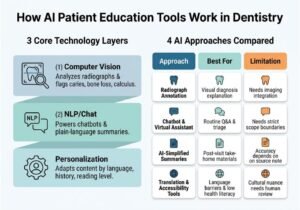
Most platforms combine three technical layers:
- Computer vision analyzes radiographs and intraoral images to flag caries, bone loss, or calculus, then overlays color-coded annotations a non-clinician can read.
- NLP / conversational AI powers chatbots and virtual assistants that answer routine questions, explain procedures, and draft plain-language summaries of clinical notes.
- Personalization logic adjusts content by patient history, reading level, and preferred language, often pulling from the practice management system.
Technical Note: Underlying model architectures shift quickly. A practice-facing chatbot today typically wraps a general-purpose LLM (like the models behind ChatGPT) in a constrained layer that limits it to pre-approved, practice-specific responses it does not diagnose independently.
A comparative study on ChatGPT-simplified radiology reports found that patients understood AI-simplified explanations of their imaging findings significantly better than the original clinical-language versions, measured using the Flesch Reading Ease score. That’s the mechanism in miniature: take clinical language, run it through an NLP layer, output something a patient can actually parse.
AI Patient Education Dental Communication Tools Real-World Use Cases
- Radiograph walkthroughs: Color-coded imaging that shows a patient exactly where decay or bone loss is occurring, in real time, during the consultation.
- 24/7 chatbot triage: Answering routine questions about pain, post-op care, or insurance after hours, so the first response doesn’t wait until the next business day.
- Multilingual translation: Real-time translation during telehealth or in-office consults, adapted to health literacy level rather than just word-for-word conversion.
- Automated aftercare follow-up: Personalized text or email sequences that reinforce post-treatment instructions over the days following a procedure, rather than relying on a single verbal recap.
Did You Know? Practices using AI-annotated imaging during consultations have reported meaningful increases in same-visit case acceptance compared to verbal-only explanations, according to vendor-reported patient survey data though independent, peer-reviewed confirmation of exact figures is still limited.
Best Tools and Approaches Comparison
| Approach | Best For | Limitation |
|---|---|---|
| Radiograph annotation (computer vision) | Visual explanation of diagnosis | Requires imaging integration; not useful for non-imaging conversations |
| Chatbot / virtual assistant (NLP) | Routine Q&A, scheduling, triage | Needs strict scope boundaries to avoid clinical overreach |
| AI-simplified written summaries | Post-visit take-home materials | Accuracy depends on the quality of the source clinical note |
| Translation / accessibility tools | Language barriers, low health literacy | Cultural nuance and idiom still require human review |
Now that you understand the mechanisms and options, let’s look at how to actually put one of these tools into practice.
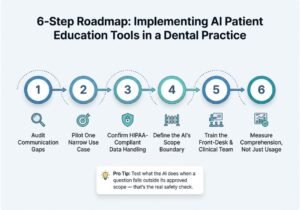
Step-by-Step: Implementing AI Patient Education Tools in Your Practice
- Audit communication gaps first. Identify where patients most often misunderstand — imaging, aftercare, or billing before choosing a tool category.
- Pick a narrow use case to pilot. Start with one workflow (e.g., radiograph annotation) rather than a full communication overhaul.
- Confirm HIPAA-compliant data handling. Verify encryption, role-based access, and audit logging before any patient data touches the system.
- Define the scope boundary. Decide explicitly what the AI tool is allowed to say, and what it must route to a human especially anything diagnostic or consent-related.
- Train the team, not just the software. Front-desk and clinical staff need to know how to hand off from AI to human seamlessly.
- Measure comprehension, not just usage. Track patient-reported understanding and treatment follow-through, not just chatbot session counts.
Pro Tip: Ask any vendor to demonstrate exactly what happens when a patient asks something outside the tool’s approved scope. That boundary behavior not the marketing demo is what tells you whether the product is safe for chairside use.
Common Mistakes and How to Avoid Them
- Treating education tools as sales tools. Content that shifts from explaining to persuading erodes the trust that makes education effective in the first place.
- Skipping the accuracy check on source data. An AI summary is only as good as the clinical note or imaging behind it verify garbage-in, garbage-out risk before rollout.
- No human fallback path. Every AI touchpoint needs a clear route back to a person for anything ambiguous, urgent, or emotionally charged.
- Ignoring accessibility. Text-only tools exclude patients with visual, hearing, or literacy barriers the global gap in assistive technology access remains substantial, and dental communication tools shouldn’t widen it.
- Overreliance without oversight. The FDI World Dental Federation’s white paper on AI governance flags overreliance and algorithmic bias as ongoing risks that require continuous evaluation, not a one-time rollout.
What the Evidence Actually Shows
Independent, peer-reviewed research is still catching up to vendor marketing claims, and that gap matters. Reviews of the literature consistently report improved comprehension and engagement from AI-assisted education, but they also flag real, unresolved concerns: accuracy variance, implementation cost, patient acceptance, and regulatory uncertainty. That’s a more honest picture than most product pages offer, and it’s worth treating as the baseline expectation rather than the exception.
FAQ — People Also Ask
What are AI patient education dental communication tools?
They are software systems chatbots, radiograph-annotation platforms, and automated messaging tools that use AI to explain dental diagnoses, treatments, and aftercare in personalized, plain language, improving patient comprehension and treatment acceptance.
How does AI improve patient communication in a dental practice?
AI improves communication by translating clinical language into plain-language summaries, annotating radiographs visually, answering routine questions instantly, and delivering personalized aftercare follow-up reducing the comprehension gap that leads to stalled treatment plans.
Are AI dental communication tools HIPAA compliant?
Compliant systems are built with encryption, role-based access control, and audit logging, but compliance depends on the specific vendor’s implementation — practices should verify this directly rather than assume it from marketing copy.
Can AI replace a dentist’s explanation of a diagnosis?
No. AI tools support and reinforce a dentist’s explanation; they don’t replace clinical judgment or the consent conversation, which remains a human, documented process.
What are the risks or limitations of AI in dental patient education?
Documented risks include overreliance on AI output, accuracy gaps when source clinical data is poor, implementation cost, patient acceptance issues, and unresolved regulatory and equity questions around access.
How much do AI patient education tools cost for a dental practice?
Pricing varies widely by category — chatbot and messaging tools are typically the least expensive to pilot, while imaging-integrated computer vision platforms carry higher upfront and integration costs. Most vendors don’t publish flat rates, so a scoped quote is necessary for real comparison.
Conclusion
AI patient education dental communication tools work best when they’re treated as a comprehension layer, not a sales layer chatbots, radiograph annotation, and plain-language summaries that help patients understand what a dentist already told them, rather than replace that conversation. The evidence base is still developing, but the direction is consistent: better comprehension correlates with better treatment follow-through. Start narrow, define the AI’s boundaries explicitly, and measure understanding not just engagement. Bookmark this guide and explore more hands-on AI implementation breakdowns before rolling out your next patient-facing tool.