The subject-line generation concerns do not severely trouble email teams in most organizations. Instead, they need to optimize their email subject line use.
An LLM can produce almost two dozen subject lines in several seconds. Nevertheless, choosing the right subject line that suits the brand, fits the audience, meets all requirements of the campaign, compliance rules, and delivery is the most challenging task.
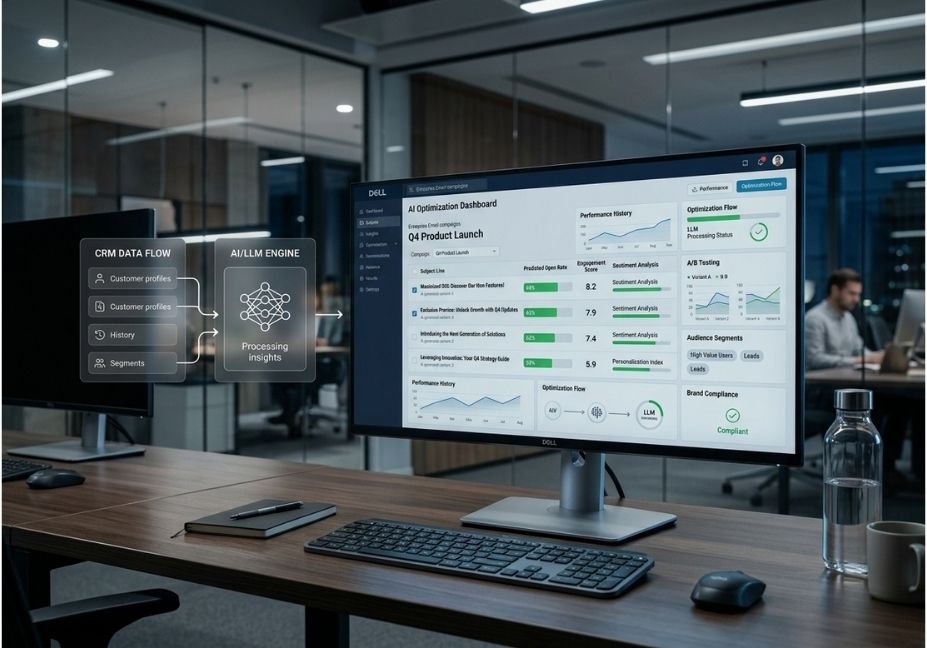
This is the main difference between AI-driven email subject-line-generation tools and ordinary text-generating AI tools. Advanced models can use the context given by the CRM system, analyze the campaign history, and apply various models to turn subject line generation into an efficient measurement process.
Modern studies have already shown that machine-learning algorithms can identify the performance of an email depending on the content and structure of the subject line.
This makes one think that instead of asking, “Can an LLM create a more engaging subject line?” the right question to ask is, “How to create a closed-loop system that can learn what works for the audience?”
What Is an Enterprise AI Email Subject Line Tool?
A business AI email subject generator is defined as software that applies machine learning techniques, large language models, past campaign data, and business strategies in order to generate, assess, customize, and improve email subject lines on an organizational level.
A simple generator may get:
Email topic: The new AI analytics dashboard
Audience: Existing SaaS clients
Tone: Professional
and provide several alternatives to choose from.
Enterprise solutions include much more context:
. Winning subject lines that have worked in the past
. Customer/account segment
. Stage of businesses cycle
. Objectives of the campaign
. Brand language
. Regulatory restrictions
. Past interaction
. Language/region
. Length of subject lines
. Deliverability
This is important because LLMs’s general knowledge is not the same as knowing about an organization’s audience.
Academic research into predicting email opening has examined the combination of characteristics of a subject line with data known about recipients.
How Does AI Optimize Enterprise Email Subject Lines?
The most effective architecture resembles an agency that helps to optimize the software better.
The average process consists of six parts.
Step 1: Gathering Context
get data about target audience, campaign and brand.
Step 2: Finding Samples
look for the historical numbers of the successful captions.
Step 3: Content Production
produce tons of variants using an LLM.
Step 4: Scoring
evaluate relevance, engagement and lawfulness.
Step 5: Authorising
check high-efficiency process of creation.
Step 6: Testing
apply some other trials and apply the obtained data back to research.
As an example, the RAG level can get the most successful captions for a certain audience.
However, it uses the previous examples that have occurred rather than improvising due to the general data of the model.
Thus, the general architecture looks in the following way.
CRM / ESP / CDP
↓
Campaign Context
↓
Historical Subject Lines
↓
Vector Detection
↓
LLM Model
↓
Structured Scoring
↓
Brand and Compliance
↓
Review
↓
Experiment
↓
Analytics
The architecture mentioned corresponds very well to the principles of the modern AI: the first stage gets the data required for the operation while the second one produces results which are checked and estimated by deterministic software.

Which Enterprise AI Email Subject Line Features Matter Most?
Not every AI subject line generator deserves to be called enterprise-grade.
The important distinction is whether the system can operate inside an existing marketing technology stack rather than simply produce text.
| Capability | Basic AI Generator | Enterprise System |
|---|---|---|
| Subject-line generation | ✓ | ✓ |
| Multiple variants | ✓ | ✓ |
| Tone control | ✓ | ✓ |
| Historical campaign learning | Limited | ✓ |
| CRM/CDP context | Rare | ✓ |
| Brand governance | Basic | Advanced |
| Predictive scoring | Sometimes | ✓ |
| Experimentation | Manual | Automated/Integrated |
| Human approval | Rare | ✓ |
| Multi-language support | Varies | Common |
| Analytics feedback loop | Limited | ✓ |
| API/workflow integration | Limited | ✓ |
Platforms in the current market illustrate this spectrum. HubSpot combines AI email generation with its CRM environment, while Klaviyo positions its Subject Line AI around brand voice, campaign context, and testing.
7 Enterprise Use Cases for AI Subject Line Optimization
The utilization of an artificial intelligence software that produces subject lines for emails can be particularly effective when companies send out a lot of emails, segment their customer base into different categories or when the entire process of sending emails becomes complicated.
1. Lifecycle campaigns
There can be several alternative approaches to coming up with subject lines for:
– onboarding
– activation
– retention
– renewal
– re-engagement
– customer education.
It is possible to change generation depending on the lifecycle stage, and this means that the same language across all subscriber categories cannot be utilized.
2. B2B account-based marketing
In the case of account-based marketing campaigns, it is possible to use subject lines that depend on the account context and are still written according to the brand language approved.
For example:
Input:
Account: Enterprise SaaS company
Segment: VP Engineering
Campaign: AI infrastructure report
Goal: Download
Output:
“AI infrastructure trends for {{company}}”,
“{{company}}: 2026 AI infrastructure benchmark”,
“What engineering leaders are changing in 2026”
The main point is not only personalization. The system should check if all variables are correct before sending the email.
3. Product launches
An LLM can quickly produce versions with different angles like:
new capability
business benefits
technical improvements
customer benefits
urgencies
4. Campaigns in multiple languages
Global businesses are able to create localized changes in the original content of their messages within the framework of brand presence and terminology.
This allows us to overcome the limitations of word-for-word translation, where a subject line is correct copy-wise but not culturally appropriate.
5. Campaigns aimed at returning customers
AI technology allows analyzing previous trends of engagement and suggesting various alternatives for segments that are currently unengaged.
In one case people may respond to an offer of a bonus but in another case a product update or individual reminder may work better.
6. Campaigns with large volume of communication
The organizations in retail and media sectors can produce many variations for many processes at once, which greatly increases the number of trials a company can conduct.
This means that nowadays automation is not just for saving copywriting time anymore, but rather for increasing the number of tests that can be done by any organization.
7. Continuous optimization
The most advanced approach allows to create a closed system:
Generate → test → evaluate → learn → generate again.
This makes it possible to have a permanent optimization in place.,
How to Build an AI Subject Line Optimizer With an LLM
It is possible to create a prototype that is lightweight by using an LLM, historical examples, structured output, and a scoring system.
The crucial thing is to compel the model to output machine-readable results rather than waiting on unforeseeable natural language.
E.g.
from pydantic import BaseModel, Field
from typing import List
class SubjectLine(BaseModel):
text: str
angle: str
personalization: str
predicted_score: float = Field(ge=0, le=100)
risk_flags: List[str]
prompt = “””
Create 5 subject lines for business emails.
Campaign: New AI analytics dashboard
Target Audience: Existing enterprise SaaS customers
Goal: Drive product demo requests
Brand Guidelines:
– Maximum professional
– No false urgency
– No excessive exclamations
– No more than 55 characters
– No unsupported claims about results
Only structured output.”””
result = llm.with_structured_output(
SubjectLine
.invoke(prompt)
The system becomes a lot more secure when the application verifies what the model outputs before it gets to the email service provider.
Langchain’s structured outputs allow Pydantic models and JSON Schema among the templates, and thus applications utilize structured outputs instead of making sense of natural language input.
An improved production pipeline
candidates = create_subject_lines(campaign_context)
validated = check_brand_guidelines(candidates)
scored = forecast_engagement
subject_lines=validated,
audience=audience_characters
ranked = organized
scored,
key=lambda x: x[“predicted_score”],
reverse=True
authorized = human_audit(ranked[:3])
initiate_experiment(authorized)
This segregation is essential.
The LLM manages language generation.
The app manages constraints and business rules.
The measurement system manages metrics.
How Should You Evaluate Enterprise AI Subject Line Tools?
Do not judge these tools only based on how many subject lines they can provide.
Rather, judge them on their overall process.
Evaluating guide:
1. Data integration
Is it able to connect with your;
CRM
ESP
CDP
analytics tool
customer data base?
2. Being able to leverage experience
Is the system able to rely on past results instead of mere text patterns?
3. Being able to filter information
Is this tool able to choose recommendations based on segment, stage of the lifecycle, customer specific features, and behavior?
4. Managing
Can the authorities set the following;
restricted information
approved words
brand voice
amount of characters allowed
fulfilling the requirements?
5. Experiments
Is it possible for the platform to carry out real A / B or multivariate experiments?
6. Measurement
Is it capable of associating changes in the subject line with:
open rates
click rates
conversion rates
revenue
unsubscribing rates?
7. Clarification
Is it possible to know why one alternative got a better score from the marketing point of view?
A product that gives you a result of 87/100 is not as useful as the one that provides you with an explanation like:
High relevance + good matching to the segment + appropriate length; lack of differentiation from previous campaigns.

Common Mistakes When Deploying AI Subject Line Tools
Some of the biggest mistakes in business take place not within LLMs.
Mistake 1: Focusing exclusively on open rates
In fact, open rates alone are just one aspect of a wider set of goals.
A subject line that captures attention may boost the percentage of emails opened but not necessarily the ones that result in actions taken.
The right metrics to reach at are as follows:
Open → Click → Qualified action → Conversion → Revenue
HubSpot also advises marketers to focus on metrics that matter and not get stuck with open rates.
Mistake 2: Training on insufficient amount of historical data
It is impossible for an AI to study business winning patterns based on few marketing campaigns.
Limited datasets may lead to the AI picking up fleeting patterns.
Mistake 3: Allowing personalization to turn into deception
For example, consider the statement generated:
“You’re about to see a 37% increase in productivity”
If there is no data in the CRM to verify the 37%, this means that the machine has taken personalization too far.
Instead of letting the LLM create new characteristics of the customer, you should rely on the actual data and schema verification.
Mistake 4: Neglecting deliverability
Even the best subject line cannot make up for the poor sending reputation.
The enterprise systems should analyze subject line creation along with:
. SPF
. DKIM
. DMARC
. unsubscribe
. spam complaints
. sending frequency
. list quality
Mistake 5: Automatically implementing all the AI winners
A statistically well-performing model can still flout legal, brand, or product criteria.
Beware of having a human approve the plan for the risky campaigns.
Enterprise AI Subject Line Tools vs. Generic LLMs
A general-purpose LLM is often enough for brainstorming.
It becomes less sufficient when the organization needs persistent data, governance, experimentation, and integration.
| Requirement | Generic LLM | Enterprise AI Tool |
|---|---|---|
| Brainstorming | Excellent | Excellent |
| Brand memory | Prompt-dependent | Persistent |
| CRM integration | Custom | Usually built-in |
| Historical performance | Manual | Integrated |
| Predictive scoring | Custom | Often included |
| Governance | Custom | Built-in controls |
| A/B experimentation | External | Often integrated |
| Auditability | Limited | Enterprise-oriented |
| Scale | High | High |
| Implementation effort | Higher for production | Lower if integrations fit |
The practical answer is not always “buy enterprise software.”
If your organization already has an LLM platform, CRM, ESP, data warehouse, and engineering team, building a focused internal optimizer may be economically attractive.
If you need governance, integrations, experimentation, and support without building the infrastructure yourself, a dedicated enterprise platform can reduce implementation time.
Frequently Asked Questions: AI Tools for Email Subject Lines in Enterprises
What does AI tool for emails subject line in enterprises mean?
AI tool for emails subject line in enterprises is a tool created using LLMs that collects campaign data from the past, predictive analytics, and business rules to produce and improve subject lines in bulk quantifies. It is not just an average generator but serves to integrate with CRM or email platforms and apply brand guidelines, audience context, provide scores for options, and analyze results through experiments.
In what ways does AI predict the performance of the email subject lines?
AI systems perform text analysis of subject lines, as well as study the history of audience engagement, sender characteristics, and the context of the campaign in which emails were sent.
Can CRM be integrated with the AI subject line tool?
Indeed, integrating with CRM is among the most essential enterprise functionalities, as it permits the generated subject lines to utilize the approved audience and lifecycle knowledge. Additionally, the integration enables way back linking of the campaign results to the optimization system.
Is RAG useful for generating email subject lines using AI?
Certainly, RAG is able to find relevant past subject lines, campaign examples, product information, and brand recommendations to use them for the generation process. This signifies that the LLM has company-specific background information without needing all the information to be included in the model itself.
Ought AI-created subject lines to undergo A/B testing?
Absolutely. AI generation should create several options, while A/B testing is called to provide proof from the real audience that one subject line is better than others, while metrics like clicks and conversion help to avoid the tendency of optimizing just for higher open rates.
Summary
An enterprise-level AI email subject line software must be evaluated as a technology for optimization rather than just as a tool for copywriting.
Three important principles must be followed:
. Context is important than generalized generation. Output from technology is much more relevant if it is based on CRM data, past campaigns, brand guidelines, and audience signal.
. Validation is more preferable than blind automation. By following rules, making the outputs structured, ensuring compliance with prescribed protocols, and using human approvals the hallucinations and governance risks can both be avoided.
. Experiments are better than mere predictions. Although predicted scores are good, actual clicks, conversions, and revenues indicate whether a subject has been working or not.
The best architecture offers the possibility of the feedback loop: gather → produce → validate → score → test → learn.