
Most “best AI content tools” roundups still treat content creation as a single-prompt problem: type an instruction, get a draft. That framing broke down in 2026. The real AI content creation tools news this year is about orchestration tools that plan, retrieve, generate, and self-check across multiple steps instead of returning one output and stopping.
AI content creation tools news in 2026 centers on agentic pipelines systems like Claude Cowork and ChatGPT Work that plan, retrieve context, and validate output across multiple steps, replacing single-prompt generators as the standard for production content workflows.
In other words, three frontier labs shipped major updates on the same day in early July, and enterprise-grade agent products followed within a week. As a result, if you’re building or buying into a content stack right now, the tool-level headlines matter less than the architecture shift underneath them and that shift is what content teams, editorial pipelines, and publishing operations actually need to plan around.
What Is Agentic Content Creation?
Agentic content creation, sometimes called an AI content agent workflow, is the practice of routing a content request through an AI agent that plans the task, pulls supporting context through retrieval-augmented generation, calls the right generation tool (text, image, video, or audio model), and validates the result before handing it back.
That’s a meaningful departure from a single-turn writing assistant. A plain generator answers one prompt. An agentic pipeline, by contrast, decomposes a brief, decides which sub-tools to invoke, and iterates closer to how a small production team actually manages an editorial calendar.
Pro Tip: If a “content AI” can’t explain what it retrieved, what it generated, and why it chose that path, it’s a generator wearing an agent’s marketing copy.
How Do Agentic Content Pipelines Work?
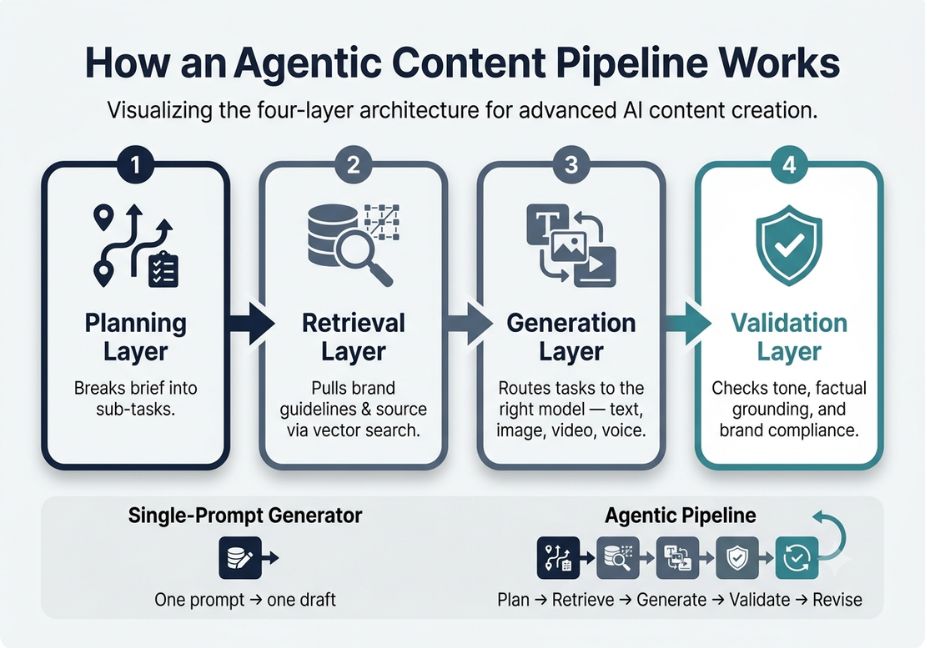
The mechanics follow a familiar agent loop: receive goal → plan steps → invoke tools → observe output → revise. When applied to content operations, that loop typically spans four layers.
- Planning layer breaks a brief into sub-tasks (research, draft, visual assets, distribution formatting)
- Retrieval layer pulls brand guidelines, past assets, or source data via vector search
- Generation layer routes each sub-task to the right model (text, image, video, voice)
- Validation layer checks tone, factual grounding, and brand compliance before output
For instance, a 2026 survey of agentic RAG architectures describes agents that plan, retrieve, and self-correct in a loop rather than following a single fixed retrieve-then-generate pass which is exactly the pattern now showing up in production-grade content pipelines and editorial automation stacks.
python
# Simplified agentic content-pipeline pseudocode
def run_content_agent(brief):
    plan = planner.decompose(brief)
    for step in plan:
        context = retriever.fetch(step.query)      # RAG layer
        draft = generator.run(step.task, context)   # text/image/video model
        validated = validator.check(draft, brand_guidelines)
        if not validated.passed:
            draft = generator.revise(draft, validated.feedback)
    return assembler.compile(plan.outputs)
AI Content Creation Tools News July 2026 Roundup
Here’s what actually shipped, ranked by relevance to day-to-day content operations:
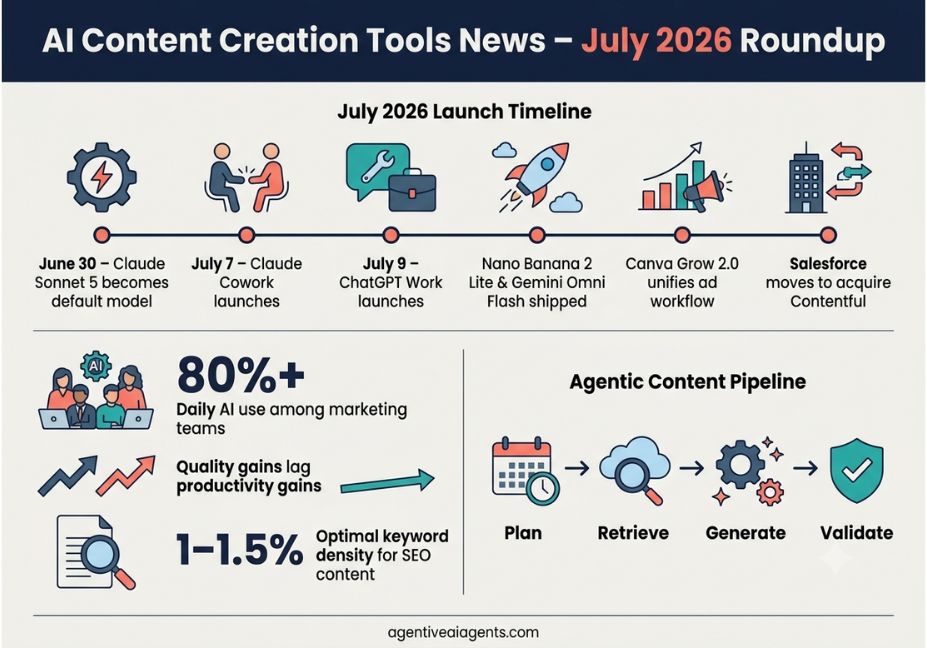
- Anthropic launched Claude Sonnet 5 on June 30, becoming the default model across Claude Free, Pro, Code, and API. Notably, it’s positioned around stronger reasoning and agent workflows rather than a raw benchmark bump.
- Claude Cowork launched July 7, letting users hand off multi-step content and document tasks that keep running even when a device goes offline. According to Anthropic, a large share of usage skews toward office and content-production work rather than software development.
- ChatGPT Work arrived July 9, pairing ChatGPT with Codex so non-engineers can generate documents, spreadsheets, and simple web apps from a single instruction.
- Google DeepMind shipped Nano Banana 2 Lite and Gemini Omni Flash, extending multimodal generation further into developer-accessible tiers.
- Canva Grow 2.0 consolidated AI ad creation, publishing, and performance reporting into one workflow spanning Meta, TikTok, and LinkedIn.
- Salesforce moved to acquire Contentful, folding an API-first content layer into Agentforce so agents can assemble and deliver personalized content without a human in the loop.
Did You Know? Industry surveys now put daily generative-AI use among marketing teams above 80%. However, self-reported content quality gains lag well behind productivity gains a gap several 2026 industry reports flag directly.
Best AI Tools and Frameworks for Content Creation Workflows
Not every “AI content tool” operates at the same layer. Therefore, it helps to separate single-purpose generators from orchestration frameworks before comparing them head-to-head.
| Layer | Examples | Best For |
|---|---|---|
| Text/reasoning model | Claude, GPT-5-series | Long-form drafting, research synthesis |
| Video/image generation | Sora, Veo, Seedream, Seedance | Social clips, product visuals, ads |
| Orchestration framework | LangChain, LlamaIndex | Chaining retrieval, tools, and generation steps |
| Enterprise agent layer | Claude Cowork, ChatGPT Work, Agentforce | Multi-step handoffs across a whole content operation |
For example, Weaviate’s breakdown of agentic RAG notes that the retrieval component becomes agentic when it can re-retrieve and validate context before generation a distinction worth checking before you commit a stack to production.
Step-by-Step: How to Evaluate a New AI Content Creation Tool Before You Adopt It
- Map it to a layer. Is this a generator, a retriever, or an orchestrator? Most vendor pages blur the line on purpose.
- Ask what it retrieves. If the tool claims brand consistency, confirm there’s an actual retrieval or fine-tuning step behind it not just a longer system prompt.
- Test the failure mode. Feed it an ambiguous brief and see whether it asks a clarifying question, guesses, or hallucinates a source.
- Check the context window. Long-form or multi-asset campaigns need enough context budget to hold brand guidelines and the working draft at the same time.
- Pilot on a low-stakes asset first. Internal newsletters and social captions surface quality gaps faster than a client-facing campaign does.
Technical Disclaimer: Tool pricing, model names, and version numbers move quickly in this space. The specifics above reflect publicly reported launches as of July 2026 so verify current pricing and availability directly with each vendor before building a workflow around them.
Common Mistakes and How to Avoid Them
- Treating a generator like an agent. A single-prompt tool that can’t retrieve or self-check isn’t going to hold brand voice across fifty assets plan a validation step around it manually.
- Skipping retrieval accuracy checks. Consequently, ungrounded generation compounds hallucination risk fast in high-volume pipelines. Microsoft’s agentic RAG architecture guide frames this as a core tradeoff between fixed retrieval and agentic planning.
- Chasing every new launch. Most July 2026 releases are incremental, so evaluate against your actual bottleneck rather than the news cycle.
- No human checkpoint. Ultimately, faster drafts without a review gate is how quality complaints climb even as output volume rises a pattern several 2026 marketing surveys already show.
Is AI-Generated Content Safe to Publish for SEO?
Yes, with review. Search engines don’t penalize content for being AI-assisted; instead, they penalize thin, ungrounded, or duplicated content which is precisely what a validation layer in an agentic pipeline is designed to catch before publish.
FAQ People Also Ask
What’s the latest AI content creation tool news in 2026?
July 2026’s biggest shifts were enterprise agent launches Claude Cowork, ChatGPT Work, and Salesforce’s move to acquire Contentful alongside new frontier models from Anthropic, OpenAI, and Google DeepMind, all leaning toward multi-step, tool-using workflows.
Are AI content creation tools replacing human writers?
Not outright. Adoption is now nearly universal on marketing teams, but reported content-quality gains trail productivity gains, which is why most teams still keep a human review step before publish.
What is agentic AI content creation?
It’s content generation routed through an AI agent that plans, retrieves supporting context, calls the right generation tool, and validates output rather than a single prompt-in, draft-out interaction.
Which AI tool is best for content creation in 2026?
It depends on the layer you need: a reasoning model for long-form drafting, a multimodal generator for video or image assets, or an orchestration framework if you’re chaining several tools into one editorial pipeline.
How do AI agents differ from AI content tools?
A content tool generates one asset from one prompt. An AI agent plans a multi-step task, decides which tools to call, and can revise its own output the orchestration layer is the difference.
Is AI content creation good for small business content operations?
Yes, when scoped narrowly. Small teams get the most value from agentic tools on repeatable formats newsletters, social captions, product descriptions where a validation step is easy to add and low-stakes to review.
Conclusion
The headline tools change every month, but the underlying trend in 2026 is stable: content creation is moving from single-prompt generation toward orchestrated, retrieval-grounded agent pipelines. Whether you adopt Claude Cowork, ChatGPT Work, or a custom LangChain stack, the question worth asking isn’t “what’s the newest AI content creation tool” it’s whether that tool sits at the generation layer or the orchestration layer, because that’s what actually determines whether it scales past a single asset.
Bookmark this guide and check back for the next AI content creation tools news roundup on agentiveaiagents.com.