
Most sellers don’t lose margin because a product is mispriced once. They lose margin because it stays mispriced. A human checks competitor listings once a day. The market moves every few minutes. That gap is exactly what an AI-powered pricing tool closes.
These systems run a simple loop, over and over: scrape competitor prices, score the situation against a demand model, and push a new price through an API often in under a minute. Researchers tested this idea directly. A widely-cited deep reinforcement learning framework was deployed in a live field experiment on a major marketplace. It showed measurable revenue lift over static, rule-based pricing. This guide breaks down how these systems are actually built. Not just which vendor to buy.
What Is an AI-Powered Pricing Tool?
An AI-powered pricing tool continuously ingests market signals. That includes competitor prices, inventory levels, and demand fluctuations. It then outputs pricing decisions without manual review.
This is different from the broader economic concept of dynamic pricing. Dynamic pricing is the strategy prices change with conditions. The AI pricing tool is the agent that executes that strategy autonomously, at SKU-level scale, across hundreds or thousands of listings at once.
Most production systems use two layers together. First, a rule-based pricing guardrail layer sets min/max thresholds and MAP compliance. Second, a repricing algorithm or reinforcement-learning policy optimizes within those bounds.
How Does Real-Time Price Optimization Work?
Direct answer for voice search: Real-time price optimization works by continuously checking competitor prices and demand data, then automatically updating your price through an API — typically every few minutes.
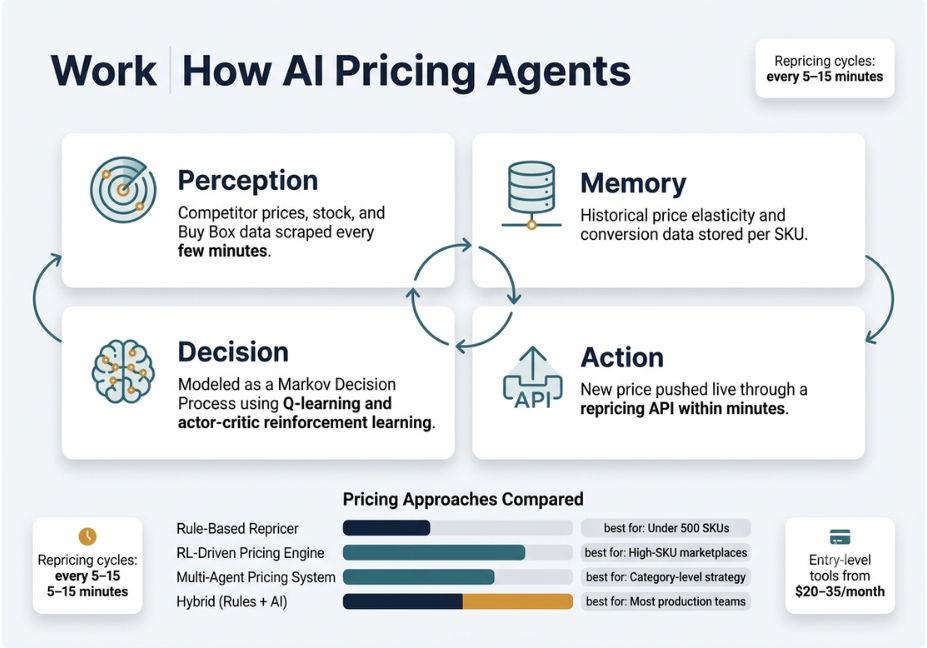
Structurally, an AI pricing tool looks like any other agentic system. It has four stages: perception, memory, decision, and action, running on a loop.
- Perception (tool-use): Scrapers or marketplace APIs pull competitor price data, stock status, and Buy Box ownership every few minutes.
- Memory: The system stores historical price elasticity and conversion-rate data per SKU. This is what lets it predict, not just react.
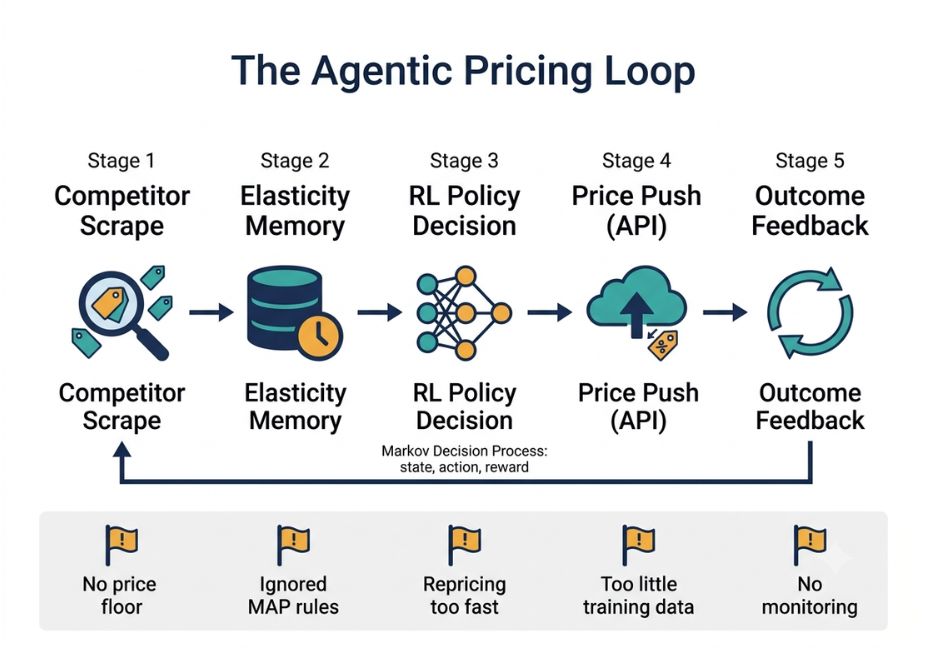
- Decision: A pricing engine scores candidate prices. Academic models frame this as a Markov Decision Process (MDP). State equals market conditions. Action equals price point. Reward equals revenue or margin. Q-learning and actor-critic methods are the most common reinforcement-learning approaches here.
- Action: The system pushes the winning price live through a repricing API, usually within the marketplace’s rate limits.
Technical Note: A simple repricer only executes step 4, based on a static rule like “beat the lowest competitor by 1%.” A true AI pricing agent closes the loop instead. It feeds outcomes back into step 2. That feedback loop is what separates a basic repricer from real reinforcement-learning-driven optimization.
Did You Know? One of the first published field experiments applying deep reinforcement learning to live e-commerce pricing modeled thousands of SKUs at once. Researchers reported measurable gains over static, rule-based baselines. That’s strong evidence the approach generalizes past lab conditions.
AI Pricing Tool Use Cases: 4 Real-World Examples
- Buy Box optimization on Amazon. Repricing engines adjust price by fractions of a cent to win the Buy Box, without triggering a race to the bottom.
- Markdown automation for perishable or seasonal inventory. The agent lowers price automatically as a sell-by window closes. No merchandiser has to notice slow velocity first.
- Cross-channel consistency. One pricing brain synchronizes prices across Amazon, Walmart, eBay, and a direct Shopify store. Meanwhile, it still respects each channel’s specific rules.
- Competitive markup capture. When a competitor goes out of stock, the agent detects it through monitoring. As a result, it raises price to protect margin instead of leaving revenue on the table.
Best Tools & Approaches Compared
| Approach | Mechanism | Best For | Tradeoff |
|---|---|---|---|
| Rule-based repricer | Static if/then logic (e.g., “beat competitor by X%”) | Sellers with under 500 SKUs | Reactive only; prone to price wars |
| RL-driven pricing engine | MDP + reward optimization | High-SKU-count sellers, marketplaces | Needs volume and data to train well |
| Multi-agent pricing system | Multiple RL agents modeling competitor behavior | Category-level strategy across many sellers | Higher complexity; harder to audit |
| Hybrid (rules + AI) | AI recommends, rules constrain (min margin, MAP) | Most production e-commerce teams | Slight ceiling on pure optimization |
Pro Tip: Start with the hybrid model. Pure RL pricing agents can technically optimize revenue while quietly eroding brand trust through constant micro-price-changes. Hard margin and price-change-frequency guardrails keep the agent honest.
Step-by-Step: Implementing an Agentic Pricing Pipeline
You can prototype a minimal agentic pricing loop with three pieces: a scraper, a decision function, and a repricing API call. Here’s a simplified Python skeleton showing the loop structure. Note: this isn’t production-ready. It skips rate-limiting, retries, and auth handling for clarity.
def pricing_agent_loop(sku, competitor_prices, elasticity_memory, min_margin):
    # 1. Perception
    market_low = min(competitor_prices)

    # 2. Decision (simplified reward-based logic; a real system
    #    would score this against a trained RL policy)
    candidate_price = max(market_low - 0.01, min_margin)
    predicted_conversion = elasticity_memory.predict(sku, candidate_price)

    # 3. Action
    if predicted_conversion > elasticity_memory.baseline(sku):
        push_price_update(sku, candidate_price)

    # 4. Feedback (update memory with the outcome next cycle)
    elasticity_memory.log(sku, candidate_price)
Run this on a scheduler, every 5–15 minutes for high-velocity SKUs. Log every decision, too. Auditability matters as much as accuracy once real margin is on the line.
Common Mistakes and How to Avoid Them
- No price floor. Without a hard minimum margin, an RL agent optimizing purely for conversion rate will race prices toward zero. So, always enforce a floor outside the model.
- Ignoring MAP violations. Automated agents can breach minimum advertised price agreements in milliseconds. Build MAP checks into the guardrail layer instead of treating them as an afterthought.
- Repricing too fast. Sub-minute price changes on customer-facing listings can look erratic and hurt trust. Throttle the change frequency, even if the model wants to move faster.
- Training on too little data. RL and elasticity models need volume. Sellers with fewer SKUs are often better served by rule-based pricing until they build enough transaction history.
- Treating it as “set and forget.” Market conditions shift constantly. A pricing agent needs the same monitoring and retraining discipline as any other production ML system.
What Sellers Are Saying
Seller-community discussion tends to be pragmatic, not hype-driven. In an active seller-community thread comparing repricing tools, one eBay seller managing close to 5,000 SKUs described manual price-checking as unsustainable. They asked for automated alternatives instead a common trigger point where sellers move from spreadsheets to a repricing engine. Overall, the recurring theme across forums is simple: sellers care less about the AI label and more about whether the tool protects margin while it competes.
FAQ People Also Ask
How does AI-powered price optimization actually work?
It runs a continuous loop that monitors competitor and demand data, scores candidate prices against a trained model, and pushes updates through an API. This usually happens every few minutes, not daily.
Is dynamic pricing legal for e-commerce sellers?
Yes. Dynamic pricing itself is legal in most jurisdictions. Legal risk comes from how it’s used price discrimination based on protected characteristics, or violating marketplace and MAP agreements not from automation itself.
What’s the difference between a repricer and a true AI pricing agent?
A repricer follows static rules, like “undercut by 1%.” An AI pricing agent adds a feedback loop instead. It learns from elasticity and conversion outcomes over time, adjusting strategy rather than just following a fixed rule.
How much can AI pricing tools improve margins?
Results vary by category and SKU volume. However, published field experiments on large marketplaces have reported measurable revenue gains over static baselines. Sellers should still test vendor ROI claims against their own data.
Can small e-commerce sellers afford AI pricing tools?
Yes. Entry-level repricing tools start around $20–35 per month for basic competitor-based repricing. True RL-driven optimization tools typically need more SKU volume to justify the cost and train effectively.
Do AI pricing tools cause price wars?
They can, if configured with aggressive undercut-only rules and no floor. Well-designed systems avoid this by including margin guardrails and change-frequency limits.
Conclusion
AI-powered pricing tools aren’t magic. They’re agentic systems built on a familiar loop: perceive market conditions, decide using a trained model, and act through an API, with memory feeding each cycle forward. The sellers who benefit most treat the repricing engine as production infrastructure, complete with margin floors, MAP guardrails, and monitoring. They don’t treat it as a black box left to run unsupervised. Bookmark this guide and explore more hands-on agentic AI tutorials at agentiveaiagents.com.