
AI-powered media buying uses autonomous software agents, not just prediction models, to plan, launch, and continuously adjust ad campaigns across platforms in real time, based on live performance data rather than scheduled manual reviews.
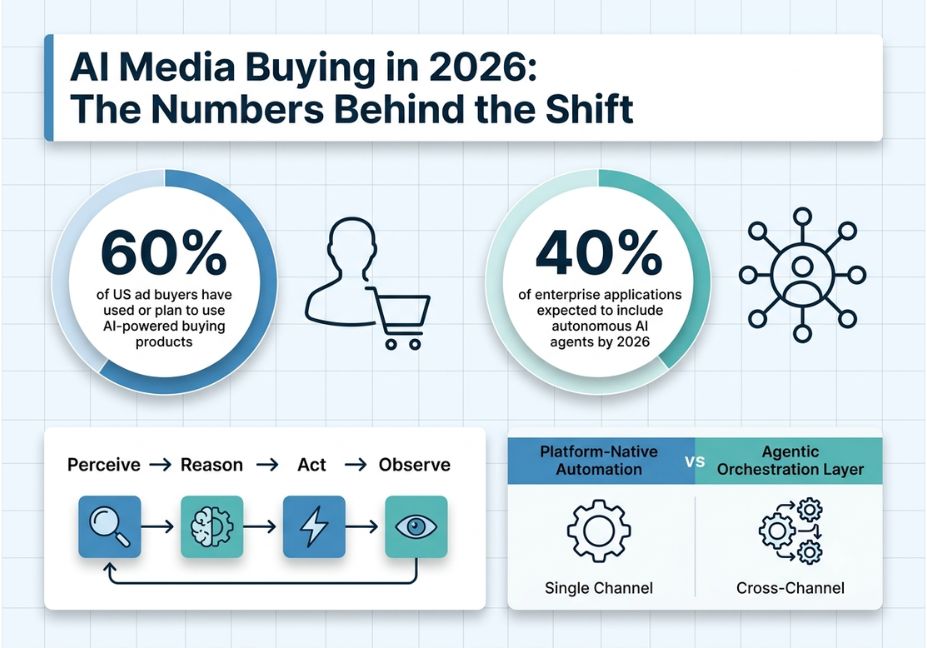
Nearly 60% of US ad buyers have used or plan to use AI-powered buying products, according to an EMARKETER survey cited in the platform’s 2026 FAQ on AI media buying. However, the real shift isn’t adoption. It’s that these systems have moved from single-step bid suggestions to closed feedback loops that plan, act, and re-plan without a human clicking “apply” each time.
This guide breaks down how that architecture actually works, where it earns real budget efficiency for small teams and enterprise agencies alike, and where it still needs a human in the loop.
What Is Agentic Media Buying?
Agentic media buying is the use of autonomous or semi-autonomous AI agents to plan, execute, and continuously adjust ad campaigns across platforms like Google Ads Manager, Meta Ads Manager, and TikTok Ads Manager. Unlike classic machine-learning bidding, which simply scores and ranks options, an agent can call tools, take multi-step actions, and revise its own plan based on what those actions return.
In other words, the agent doesn’t just recommend it acts, then checks its own work. The most effective systems pair predictive analytics (forecasting what will perform) with prescriptive optimization (automatically shifting budget and bids in response). This combination, not the AI label alone, is what separates an agentic system from a reporting dashboard.
For teams comparing AI tools for small agencies versus enterprise media buying, this distinction matters most: agentic platforms scale the combinatorics of testing, not just the reporting.
How Does the Agent Loop Actually Work?
Underneath the marketing language, most agentic ad platforms run a version of the ReAct pattern reasoning and acting interleaved in a continuous loop rather than a single upfront plan. An arXiv paper on event-driven multi-agent orchestration describes this as the default architecture for LLM-based agents: the agent receives a task, emits tool calls, observes the results, and continues until the task is complete.
Applied to media buying, the loop typically runs in four steps:
- Perceive pull spend, CPA, ROAS, and creative-level performance from connected ad accounts.
- Reason compare current performance against the campaign’s target metrics and constraints.
- Act call a tool, such as a bid API, a budget-shift endpoint, or a creative-launch endpoint, to make a change.
- Observe measure the result of that action and feed it back into the next reasoning step.
For example, here’s a minimal version of that reasoning-to-action step using OpenAI-style function calling:
tools =

        "name": "shift_budget",
        "description": "Move daily budget between two ad sets",
        "parameters":
            "from_ad_set": "string",
            "to_ad_set": "string",
            "amount": "number"


response = client.messages.create
    model="claude-sonnet-4-6",
    max_tokens=500,
    tools=tools,
    messages=[
        {"role": "user", "content":
            "Ad set A: ROAS 1.8, spend $400/day. "
            "Ad set B: ROAS 3.4, spend $150/day. "
            "Reallocate budget to improve blended ROAS."
Architect’s Note: The agent doesn’t need to know how
shift_budgetexecutes only its interface. That separation is what the Model Context Protocol formalizes: a standard way for an agent to discover and call external tools, such as a bidding API, a creative generator, or a forecasting model, through one unified interface instead of a custom integration per platform.
AI Media Buying Use Cases: 4 Real-World Applications
So where does this actually pay off? Four use cases stand out in 2026:
- Cross-platform budget reallocation an agent monitors pacing across Meta, Google, and TikTok simultaneously and shifts spend toward whichever channel is currently converting, often hourly rather than daily.
- Creative testing velocity because ad fatigue compresses faster on high-CPM placements this year, agents now generate, launch, and retire creative variants continuously instead of in scheduled batches.
- Audience segment analysis at scale a human buyer can reason that “segment A beats segment B,” but can’t efficiently cross-reference dozens of segments against hundreds of creative variations. Agents handle that combinatorics natively.
- Fragmented attribution resolution attribution agents reconcile measurement across platforms after a campaign closes, using unified data instead of per-platform reporting exports.
Did you know? By 2026, an estimated 40% of enterprise applications are expected to include AI agents capable of autonomous planning and execution, according to Amazon Ads. Advertising is one of the fastest-moving categories because campaign data is structured, frequent, and machine-readable.
Which AI Media Buying Tool Should You Use? A Comparison
| Approach | Example | Autonomy Level | Best For |
|---|---|---|---|
| Platform-native automation | Google Performance Max, Meta Advantage+ | Bounded to one platform | Teams wanting minimal setup, single-channel budgets |
| Rule-based + AI hybrid | Revealbot-style rule engines | Human-defined triggers, AI-assisted execution | Buyers who want automation but full auditability |
| Full-stack creative-to-launch agents | Multi-agent Meta-focused platforms | High plans, builds, and launches campaigns | Agencies managing high account volume |
| Cross-channel orchestration layer | Unified data + agent orchestration stacks (e.g., Databricks Agent Bricks) | Configurable, often semi-autonomous | Enterprises unifying multiple platforms and attribution |
Ultimately, governance and autonomy level matter more than raw feature count when comparing these approaches. A tool that fully automates budget shifts without an approval boundary carries a very different risk profile than one that recommends and waits for sign-off.
How Do You Implement an Agentic Optimization Workflow, Step by Step?
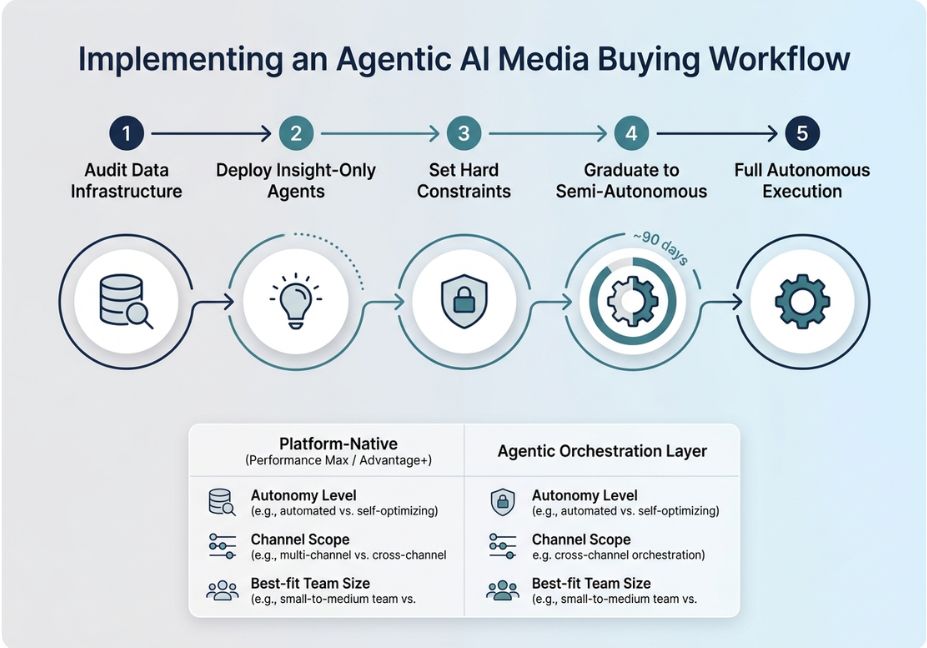
- Audit your data infrastructure first. Know which platforms you advertise on, where campaign data lives, and how clean it is mislearning from fragmented data is the most common early failure mode.
- Start with insight-only agents. Have the agent recommend budget shifts without executing them, then validate its reasoning against your own for at least a few weeks.
- Define hard constraints before granting write access. Set minimum and maximum daily spend, blocked audiences, and brand-safety rules the agent cannot override.
- Graduate to semi-autonomous execution once recommendations have tracked reliably against outcomes typically after about 90 days of validated performance.
- Reserve fully autonomous, cross-platform budget control for mature, high-scale operations that already have strong governance in place.
Common Mistakes and How to Avoid Them
- Treating agent output as ground truth. An agent reasoning over noisy or fragmented data will confidently recommend the wrong shift a classic LLM + hallucinated recommendation pattern applied to spend decisions. As a result, large reallocations should always be cross-checked before they execute.
- Skipping the human-in-the-loop stage. Teams that jump straight to full autonomy lose the ability to catch mislearning before it compounds across campaigns.
- Ignoring platform-native automation conflicts. Running a third-party agent on top of Performance Max or Advantage+ without accounting for the platform’s own internal optimization can cause both systems to compete over the same budget signal.
- Under-specifying constraints. An agent given a goal like “maximize ROAS” without spend floors or brand-safety boundaries will optimize toward that goal literally, not sensibly.
- Overlooking privacy compliance. As agents pull and act on user-level signals, they still need to operate within GDPR and platform-level consent frameworks autonomy doesn’t remove that obligation.
Technical Disclaimer: Agent orchestration frameworks and ad-platform APIs change quickly. Code and protocol references in this article reflect publicly available documentation as of mid-2026 always check current official docs before implementing in production.
What Are Practitioners Saying About Agentic Ad Buying?
Developer communities like Reddit’s r/MachineLearning are actively debating how much autonomy to grant agents operating on live budgets, particularly around observability knowing why an agent moved spend, not just that it did. Notably, the IAB Tech Lab has also begun publishing early guidance on standardizing agent-to-platform communication, which suggests auditability is becoming a bigger constraint on adoption than raw model capability.
FAQ People Also Ask
AI-powered media buying uses machine learning and automation to plan, purchase, and optimize ad placements across digital channels, evaluating hundreds of campaign inputs in real time instead of relying on manual targeting and bid management.
Increasingly, yes, within defined boundaries. Full-stack agentic platforms can plan, build, launch, and adjust campaigns with minimal manual input, but most mature deployments still keep budget ceilings and brand-safety rules outside the agent’s control.
Platform-native tools like Performance Max and Advantage+ optimize within one channel using the platform’s own closed model. Agentic third-party tools orchestrate decisions across channels, pulling multiple platforms’ data into one unified optimization loop.
An agent monitors pacing and performance metrics, reasons about which ad sets are underperforming relative to target ROAS or CPA, then calls a budget-shift tool to move spend. It observes the outcome and repeats the loop, often hourly.
The main risks are mislearning from fragmented or low-quality data, over-autonomous execution without human review, and reduced transparency into why a specific budget or targeting decision was made.
Smaller teams or single-channel advertisers generally get the most value from platform-native automation, while agencies and enterprises managing multiple channels benefit more from a cross-platform orchestration layer with staged autonomy.
Conclusion
The AI tools for media buying and ad campaign optimization that matter in 2026 aren’t the ones with the longest feature list. They’re the ones with a defensible agent loop, clear governance boundaries, and observable reasoning. Platform-native automation still wins on simplicity for single-channel budgets, while agentic orchestration layers win when you’re coordinating spend, creative, and attribution across several platforms at once. Start with insight-only agents, define your constraints before granting write access, and scale autonomy only as your data foundation earns it.
Bookmark this guide and explore more hands-on AI agent tutorials at agentiveaiagents.com.