
Most “AI marketing news” roundups treat every announcement as equally important. That’s a mistake. In short: the ai marketing sales tools news february 26-27 2026 cycle shows that revenue and marketing platforms started sharing data through a common protocol instead of custom point-to-point integrations. That’s the headline finding, and it’s the one worth remembering even if you read nothing else below.
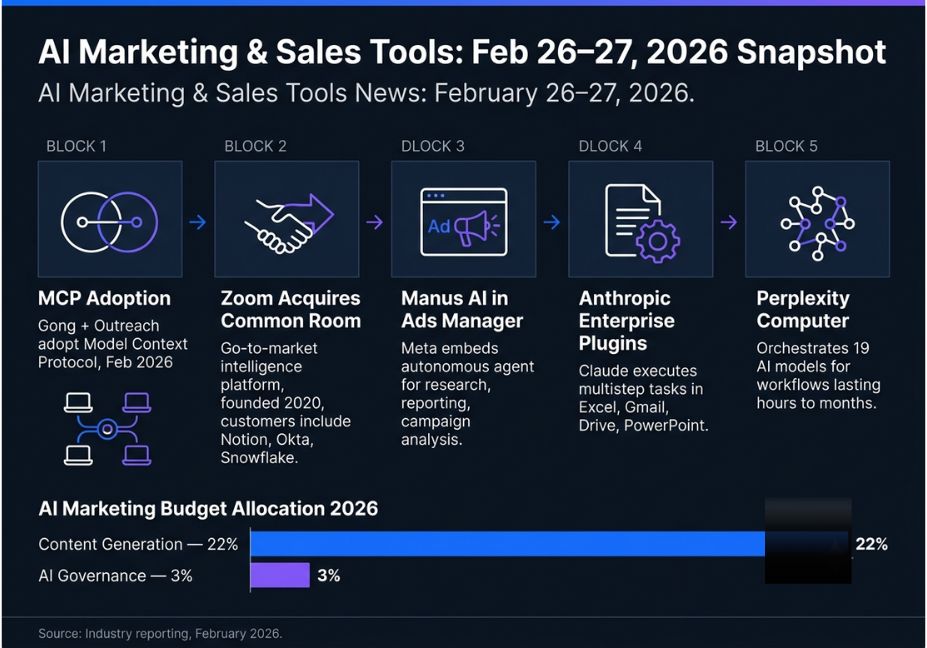
Over roughly 48 hours spanning February 26 and 27, 2026, three storylines converged. First, Zoom acquired go-to-market intelligence startup Common Room. Second, Meta embedded Manus AI directly into Ads Manager. Third, Anthropic rolled out enterprise-specific plugins for tools like Excel, Gmail, and Google Drive. Underneath all three, however, sits the same architectural bet: agentic AI, connected via Model Context Protocol (MCP), is winning out over standalone generative features.
If you’re short on time, here’s the direct answer sales and marketing leaders are searching for: the most important AI marketing and sales tools news from February 26–27, 2026 is that Gong and Outreach adopted the Model Context Protocol, Zoom bought a buyer-intelligence platform, and Meta and Anthropic pushed autonomous agents into everyday marketing tools. Everything below unpacks why that matters and what to do about it.
What Is Model Context Protocol (MCP)?
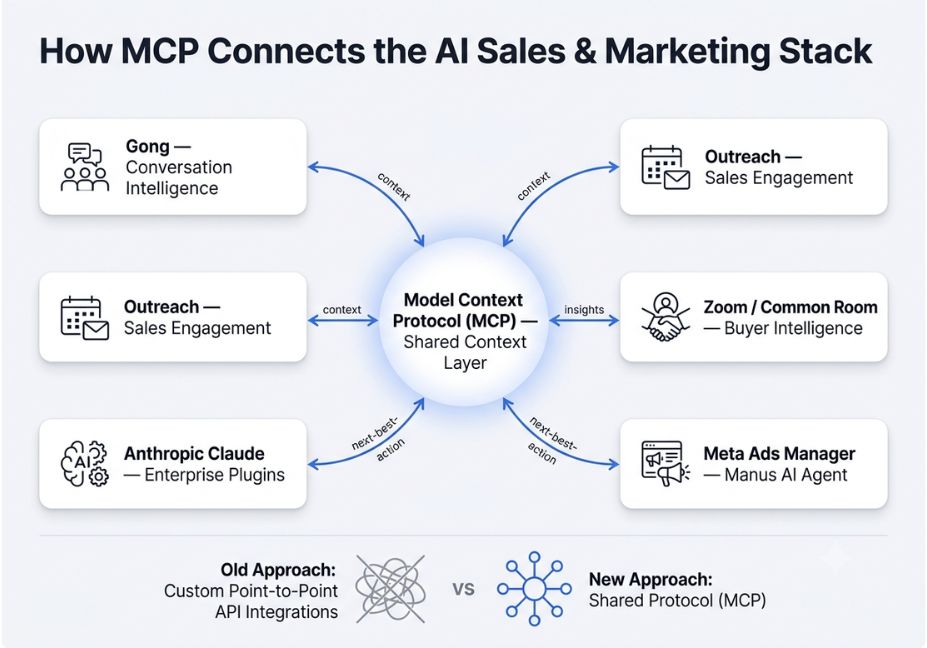
MCP is an open standard, originally released by Anthropic, that lets AI applications and agents connect to external tools and data sources without custom-built integrations for each pairing. In other words, instead of a sales platform writing bespoke code to talk to a CRM, an analytics tool, and an outreach engine separately, both sides implement the same protocol once. The official Model Context Protocol documentation (modelcontextprotocol.io) describes it as a way to give large language models standardized, secure access to context and tools.
For go-to-market teams, this is the difference between “more tools bolted together” and tools that actually share context. As a result, sales enablement platforms were among the first to adopt it at scale and marketing platforms are expected to follow through 2026 and into 2027.
Voice search answer “Is MCP better than API integrations?” Generally, yes, for teams running more than three or four connected tools: MCP replaces many custom, one-off API integrations with a single shared standard, which reduces long-term maintenance work.
How AI Agents Are Reshaping Sales Platforms
This week’s news showed the clearest evidence yet that vendors are racing to make their platforms agent-native rather than just AI-assisted. Specifically:
- Outreach and Gong both adopted MCP in February 2026, allowing their context, insights, and next-best-action recommendations to flow into external AI systems without custom integration work.
- Gong Enable, also released in February 2026, unified coaching and conversation intelligence in a single platform, following the company’s recognition as a Leader in Gartner’s inaugural Magic Quadrant for Revenue Action Orchestration.
- Outreach’s Meeting Prep Agent (in beta) auto-generates briefs with talking points and account context before a call even starts, while its Deal Agent can now apply AI-recommended methodology updates without rep intervention.
Consequently, revenue teams evaluating a new platform in 2026 need to ask a different question than they did in 2024: not “what can this tool generate?” but “what can this tool see and act on across my stack?”
Pro Tip: If you’re evaluating a sales intelligence platform right now, ask the vendor directly whether they support MCP or an equivalent open interoperability layer. Otherwise, platforms still relying on one-off API integrations will cost more to maintain as your stack grows.
Technical Note: MCP adoption doesn’t eliminate the need for data governance. Instead, it changes where governance needs to live at the protocol and permissions layer rather than inside each individual integration.
Zoom’s Common Room Acquisition: Go-to-Market Intelligence Meets Video
Zoom’s acquisition of Common Room was, arguably, the single biggest sales-tech story of the window. Common Room combines CRM data, product usage signals, and other buying indicators to build person-level profiles of prospective customers, with AI agents that research accounts and generate personalized outreach automatically a category often called buyer intent intelligence or predictive lead intelligence.
The deal complements Zoom Revenue Accelerator, which analyzes sales calls after they happen, by adding tools that help teams identify and engage buyers earlier — before the first conversation even occurs. Common Room’s customer base, which reportedly includes Notion, Okta, Snowflake, and Anthropic, signals this wasn’t a fringe acquisition; rather, it’s a bet that video-conferencing vendors need to own more of the pipeline, not just the meeting.
Did You Know? Common Room was founded in Seattle in 2020, meaning Zoom’s deal folded roughly six years of go-to-market intelligence tooling directly into a platform many sales teams already have open all day.
Long-tail angle: For teams asking “what is the best AI tool for identifying sales prospects before outreach in 2026,” Common Room’s approach now backed by Zoom’s distribution is one of the more direct answers to emerge from this news cycle.
Meta and Perplexity Push Agentic Workflows Into Daily Tools
Two other announcements from the same window show agentic AI moving from standalone products into the tools marketers already use every day.
Meta embedded Manus AI the autonomous agent technology it acquired in late 2025 directly into the Ads Manager navigation interface. Rather than positioning Manus as a separate product, Meta built it into daily advertiser workflows, where it can execute multistep tasks like market research, report building, and campaign analysis.
Perplexity, meanwhile, introduced Perplexity Computer, a system that orchestrates 19 specialized AI models to run complex workflows lasting hours or even months, breaking objectives into subtasks and coordinating asynchronous execution inside isolated computing environments. Together, these two launches suggest that agentic advertising and multi-agent orchestration are becoming default expectations rather than premium add-ons.
| Tool | What Changed (Feb 26–27, 2026) | Category |
|---|---|---|
| Manus AI (Meta) | Embedded natively into Ads Manager for research, reporting, campaign analysis | Advertising agent |
| Perplexity Computer | Orchestrates 19 models for long-running autonomous workflows | Multi-agent orchestration |
| Anthropic enterprise plugins | Job-specific plugins execute multistep tasks in Excel, Gmail, Drive, PowerPoint | Enterprise productivity |
| Gong + Outreach | Adopted MCP for cross-platform context sharing | Sales interoperability |
| Zoom / Common Room | Acquired go-to-market intelligence and buyer-signal platform | Prospecting & intelligence |
Anthropic’s Enterprise Plugins: Marketing’s New Execution Layer
Anthropic introduced job-specific plugins that let Claude act directly inside business software Excel, PowerPoint, Google Drive, Gmail, and other connected systems completing multistep actions autonomously rather than just returning instructions. Additionally, power users inside organizations can design and train plugins tailored to specific business units, extending advanced functionality to broader teams without engineering support.
For marketing operations specifically, this matters because reporting, forecasting, and content generation increasingly live inside the same tools teams already use daily, rather than in a separate AI chat window. Moreover, it puts Anthropic in more direct competition with OpenAI’s emerging corporate agent platform a rivalry likely to shape enterprise AI marketing tooling for the rest of 2026.
Common Mistakes Teams Are Making With This News Cycle
- Chasing every new agent launch instead of auditing the stack. Not every AI marketing tool update requires action; instead, prioritize changes that affect data flow, like MCP adoption, over feature announcements.
- Ignoring governance while adopting agentic tools. Industry data shows organizations allocate roughly 22% of AI marketing budgets to content generation but only about 3% to governance a mismatch that, over time, creates compliance and brand-risk exposure as agents gain more autonomy.
- Assuming “AI agent” means “no human review.” On the contrary, vendors shipping audit trails and spend limits a maturity signal several platforms now include suggest production agent deployments need more oversight infrastructure, not less.
What Sales and Marketing Teams Are Saying
Developer and practitioner discussion around this news cycle has focused less on individual launches and more on stack consolidation. The consistent theme across sales-ops communities: fewer point tools that share context beats more tools stitched together with brittle integrations, which is exactly the problem MCP adoption is meant to solve. For teams building or evaluating MCP-based integrations, Anthropic’s reference server implementations on GitHub (github.com/modelcontextprotocol/servers) offer working examples worth reviewing before committing engineering time.
Technical Disclaimer: Product names, pricing, and beta features referenced above reflect their status as of February 2026. Because agentic AI tools ship updates frequently, always verify current capabilities directly with each vendor before making purchasing decisions.
FAQ People Also Ask
What AI marketing tools launched in late February 2026?
The most significant items from February 26–27, 2026 were Zoom’s acquisition of Common Room, Meta’s integration of Manus AI into Ads Manager, Anthropic’s enterprise plugin rollout, and Perplexity Computer’s launch for long-running autonomous workflows.
What is Model Context Protocol (MCP) and why does it matter for sales tools?
MCP is an open standard that lets AI applications share context and tools without custom integrations. Sales platforms like Gong and Outreach adopted it in February 2026 so their data and AI agents can interoperate with other systems.
Why did Zoom acquire Common Room?
Zoom acquired Common Room to expand beyond video meetings into go-to-market intelligence, helping revenue teams identify and research potential buyers using CRM and product-usage signals before sales conversations begin.
Are AI sales agents replacing human sales reps in 2026?
Not yet, and not entirely. Current agentic sales tools automate research, meeting prep, and follow-up sequencing, but relationship-building, negotiation, and complex buying-committee navigation remain human-led functions across the platforms covered this week.
How do I choose an AI sales tool with good interoperability?
Ask whether the vendor supports Model Context Protocol or a similar open standard. Tools that share context natively cost less to maintain long-term than platforms requiring custom, one-off API integrations for every connection.
Conclusion
The ai marketing sales tools news february 26-27 2026 cycle wasn’t defined by one blockbuster launch it was defined by a pattern. Zoom bought its way into buyer intelligence, Meta and Anthropic embedded agents into tools people already use, and Gong and Outreach adopted a shared protocol instead of more custom code. Therefore, the practical takeaway is simple: evaluate new tools by how well they share context with what you already have, not just by their standalone feature list. Bookmark this guide and explore more hands-on AI agent tutorials at agentiveaiagents.com.