
Most creators who try AI music generation tools don’t fail because the audio sounds bad Suno’s v5.5 model and Udio’s 48kHz instrumentals have both closed the gap with human-produced tracks. They fail because they generate a track, fall in love with it, and then discover they can’t legally release it. In 2026, picking the right best AI music generation tool isn’t just a sound-quality decision it’s a rights-and-export decision shaped by an active wave of licensing settlements and litigation across the industry.
This guide breaks down the top platforms by architecture, editing capability, and critically what you’re actually allowed to do with the output, drawing on the broader field of AI-driven composition and how these systems are built.
How Does AI Music Generation Work?
Modern text-to-music generation tools convert a text prompt into audio using one of two dominant architectures: autoregressive transformers or diffusion models. Autoregressive systems generate audio tokens sequentially, conditioned on the prompt embedding, while diffusion-based systems iteratively denoise a latent audio representation into a finished waveform.
Google’s MusicLM research helped popularize the transformer approach it’s a text-to-music transformer trained to map language directly onto audio tokens, and it’s part of the lineage behind many consumer products today. Commercial platforms build heavily customized, much larger versions of this same idea, fine-tuned on proprietary datasets and paired with vocal synthesis layers for full songs with lyrics.
Technical Note: Two systems can share a similar architecture and still sound completely different the training data, the vocoder quality, and the post-processing chain matter as much as the base model.
Best AI Music Generation Tools Compared
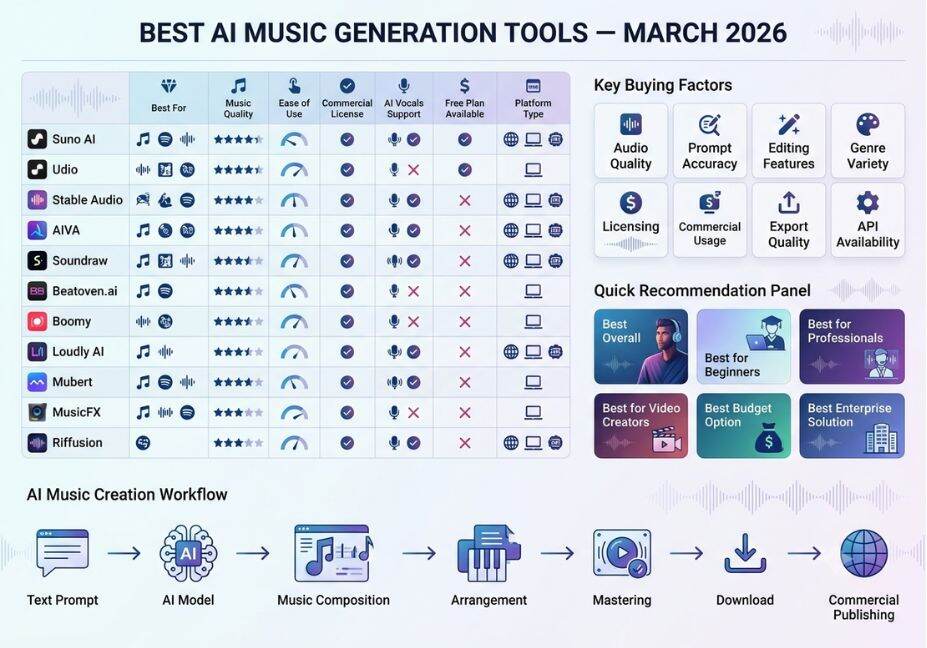
For most creators, the decision comes down to five platforms, each optimized for a different job.
| Tool | Best For | Vocals | Commercial Rights | Export/Stems |
|---|---|---|---|---|
| Suno (v5.5) | Full songs with vocals, fastest path to a releasable track | Strong, natural | Yes, from the $10/mo Pro tier | Yes, downloadable |
| Udio | Studio-grade instrumentals, section-level editing | Good | Reserved for $30/mo Pro tier | Disabled streaming-only after its UMG settlement |
| MusicGPT | Editing existing generations (remix, voice swap, extend) | Strong | Varies by plan | Yes |
| AIVA | Cinematic/orchestral scores for film and games | N/A (instrumental) | Yes, paid tiers | Yes |
| Beatoven.ai | Video-synced background music, royalty-free b-roll tracks | N/A (instrumental) | Yes | Yes |
Did You Know? Udio disabled audio, video, and stem downloads platform-wide in 2026 following its settlement with Universal Music Group, turning it into what several reviewers now describe as a “walled garden” you can stream and remix inside Udio, but you cannot export the file. If your workflow ends in a DAW, that single fact may decide the tool for you.
Pro Tip: Before subscribing to any platform, check whether commercial rights are gated behind a specific tier. Suno grants commercial rights and downloads starting at its $10/month Pro plan; Udio reserves commercial use for its $30/month Pro tier, and even there, files remain locked inside the platform.
Suno vs. Udio: The Core Trade-off in 2026
This is the comparison most readers actually want, so here it is directly: Suno wins on usability and export; Udio wins on raw instrumental fidelity and editing precision.
- Suno’s v5/v5.5 upgrade improved vocal naturalness and added stem export, making it the stronger pick for arrangement-led genres like country, rock, and indie.
- Udio’s inpainting feature lets you regenerate a specific section of a track a chorus, a bridge while leaving the rest untouched, an editing capability Suno still lacks. It also tends to edge out Suno on groove-led genres like lo-fi and hip-hop.
- Pricing is close at the entry tier (roughly $10/month each), but Suno’s top tier delivers more raw credit volume per dollar.
Architect’s Note: Treat these platforms like you’d treat two LLM vendors with different context windows and rate limits the “better” model depends entirely on your downstream pipeline, not just benchmark quality.
The Licensing Problem Nobody’s Listicle Mentions
This is the gap in almost every “best AI music tools” roundup, and it’s the single biggest risk factor for commercial creators in 2026.
- Human authorship still gates copyright. The U.S. Copyright Office maintains guidance on human authorship requirements for AI-assisted works, and prompting alone generally isn’t considered sufficient authorship meaning a track generated purely from a text prompt may not be protectable by copyright at all.
- Platform-level litigation is still unresolved. Sony Music litigation against Suno was headed toward a summary-judgment hearing in mid-2026, while Udio and Warner Music have both settled with terms that materially changed what users can download.
- Indemnification clauses shift risk to you. Several platforms’ terms of service place liability for claims arising from generated output on the user, not the company a detail worth reading before you use a generated track in a paid ad campaign.
Technical Disclaimer: Platform pricing, licensing terms, and feature availability change rapidly in this category. The figures in this article reflect publicly available pricing and terms as of mid-2026. Always verify current terms directly on each platform before publishing or monetizing generated tracks.
Step-by-Step: Generating a Release-Ready Track
- Draft a structured prompt. Specify genre, tempo, mood, instrumentation, and vocal style rather than a single adjective “moody 90 BPM synthwave with a female alto lead vocal” outperforms “sad synth song.”
- Generate multiple variations. Most platforms return 2–4 takes per prompt; treat this like sampling temperature in an LLM more samples, more usable output.
- Use inpainting or section regeneration if the platform supports it, rather than regenerating the whole track when only the bridge is weak.
- Export stems, if your tier allows it, and route them through a dedicated mastering tool AI generators are not mastering engines.
- Confirm commercial rights on your specific plan before publishing, and keep a record of your subscription tier and generation date in case licensing terms shift.
Code Note: If you’re building an AI agent or automation pipeline around a music generation API rather than the consumer UI, treat the endpoint like any other LLM tool call validate the response schema, cache generation IDs, and build a retry/regeneration branch for failed or low-confidence outputs, the same pattern you’d use around a RAG retrieval call.
Common Mistakes and How to Avoid Them
- Assuming “AI-generated” means “royalty-free.” Royalty-free and AI-generated are not synonyms check the platform’s specific commercial license, not just its marketing copy.
- Skipping the export check before subscribing. Confirm download and stem-export permissions on your exact tier before you commit a workflow to a platform, especially given Udio’s 2026 download changes.
- Over-relying on one-shot generation. Full song generation from a single vague prompt rarely produces a release-ready track; iterative regeneration and section-level editing consistently produce better results.
- Ignoring open-source alternatives entirely. For developers building custom pipelines, an open-source alternative built on a single-stage transformer architecture, such as MusicGen, offers more control (and no subscription lock-in) at the cost of consumer-grade polish.
What Developers Are Saying
Community sentiment on platforms like r/LocalLLaMA and r/MachineLearning tends to split along the same axis as this article: casual creators favor Suno for speed and reliability of output, while technically minded users increasingly experiment with open weights like MusicGen for full pipeline control, citing licensing certainty as the deciding factor over raw audio quality.
FAQ People Also Ask
What is the best AI music generator in 2026?
There’s no single winner Suno is the strongest choice for full songs with vocals and commercial release, while Udio produces higher-fidelity instrumentals but currently blocks file downloads for most users.
Is AI-generated music copyrighted?
Generally, no U.S. Copyright Office guidance holds that works generated from a prompt alone lack sufficient human authorship to qualify for copyright protection, though edited or heavily human-modified output may qualify.
Can I use AI-generated music commercially?
Only if your specific subscription tier grants commercial rights; both Suno and Udio gate commercial use behind paid plans, and terms vary by platform and have changed multiple times in 2026.
What’s the difference between Suno and Udio?
Suno offers stronger vocal synthesis, stem export, and commercial rights at a lower price point, while Udio offers higher-fidelity instrumentals and section-level inpainting but has disabled downloads for most users.
Is AI music generation free?
Most platforms offer a limited free tier Suno’s free plan gives roughly 50 daily credits (about 10 songs) but free tiers typically exclude commercial rights and downloads.
Can AI music generators create vocals?
Yes platforms like Suno and MusicGPT generate synthesized vocals directly from lyric and style prompts, while instrumental-focused tools like AIVA and Beatoven.ai do not include vocals at all.
Conclusion
The best AI music generation tools in March 2026 aren’t defined by sound quality alone anymore Suno, Udio, and their peers have all crossed a quality threshold where the real differentiator is what you’re legally allowed to do with the output. Suno remains the fastest path to a releasable, commercially licensed track; Udio still wins on instrumental fidelity and editing control but comes with real export restrictions; and open-source options like MusicGen are worth a serious look for anyone building custom pipelines. Check licensing terms before you build a workflow around any of them, and revisit this guide as the legal landscape continues to shift.
Bookmark this guide and explore more hands-on AI tooling breakdowns at agentiveaiagents.com.