
Inside the Big Four, “AI tool development” isn’t one line item. It spans three distinct offerings: productized agent platforms (Deloitte’s Zora AI, PwC’s Agent OS), managed services where the firm operates a client’s AI-augmented back office under a multi-year contract, and traditional time-and-materials consulting billed by the hour or day. Consulting still produces close to half of global revenue at EY, KPMG, and PwC, and nearly two-thirds of Deloitte’s fees, so AI work is layered on top of an existing partner-track billing structure rather than replacing it. Firms are already restructuring how they price engagements as this broader mix of services takes hold, since a fixed-fee managed-services deal doesn’t fit the old hourly model.
How Big Four AI Pricing Actually Works
Hourly and Day Rates
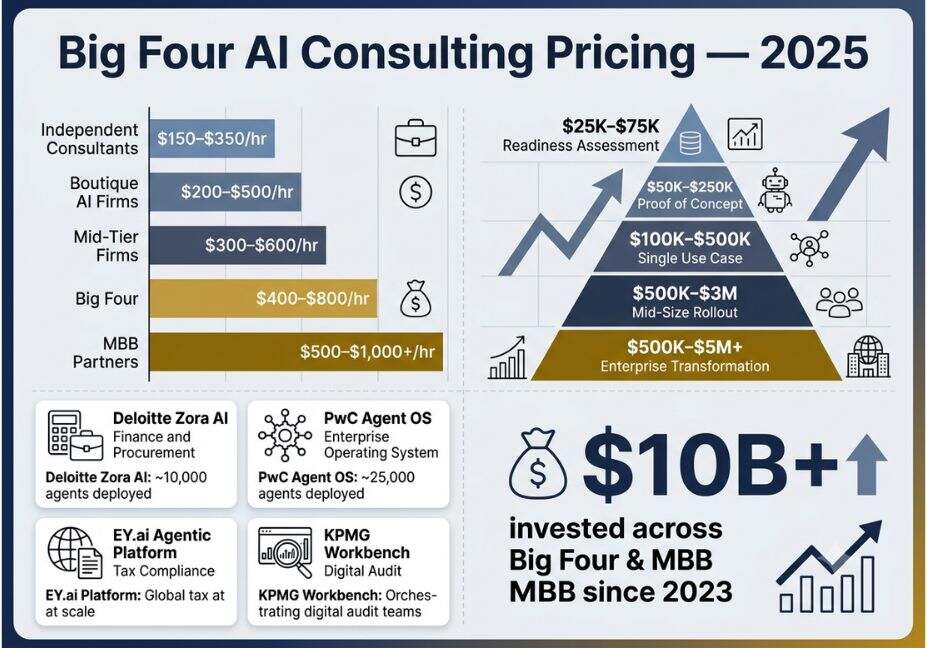
Time-and-materials work is the most transparent tier, and it’s still expensive. Standard partner-track consulting sits around $300–$500 per hour, and dedicated AI engagements at Deloitte and PwC commonly run $2,000–$3,500+ per consultant per day. Industry-wide benchmarking across firm tiers puts the Big Four at $400–$800/hour for AI-specific work, well above boutique AI firms ($200–$500/hour) and independent consultants ($150–$350/hour), though below MBB partners ($500–$1,000+/hour).
Pro Tip: If a Big Four proposal quotes a blended rate across a project team, ask for the level breakdown (partner, senior manager, analyst). Blended rates hide how much of your budget is going to junior staff running prompts you could write yourself.
Project and Platform Pricing
Nobody publishes a rate card for their agent platforms, but analyst estimates give a usable floor:
| Engagement type | Typical range |
|---|---|
| AI readiness assessment | $25,000 – $75,000 |
| Proof of concept | $50,000 – $250,000 |
| Single use-case deployment | $100,000 – $500,000 |
| Mid-sized Zora AI / Agent OS rollout (first year) | $500,000 – $3,000,000 |
| Enterprise-wide agentic transformation | $500,000 – $5,000,000+ |
That $500K floor is structural, not arbitrary. The Big Four built their platforms around an enterprise sales motion global delivery infrastructure, compliance overhead, and a systems-integrator-grade implementation team that only clears its own unit economics above a six-figure annual commitment. Below that line, companies in the $5M–$200M revenue band routinely get quoted out of the conversation entirely.
How Does the Underlying Architecture Work?
Strip away the sales layer and each firm’s platform is a variation on the same agentic AI pattern this site covers every week: a planning/orchestration layer, tool-use calls, memory or retrieval, and a feedback loop back to the model. Deloitte’s Zora AI runs on NVIDIA infrastructure including Llama Nemotron reasoning models and deploys autonomous agents across finance, procurement, and supply chain. PwC’s Agent OS, built with Salesforce, CrewAI, and AWS, orchestrates roughly 25,000 agents across client operations rather than shipping pre-built agents of its own. KPMG’s Workbench, developed with Microsoft, connects agents through a multi-agent coordination model designed to mirror how human audit teams divide work. EY.ai has pushed agents into tax workflows for tens of thousands of staff, with a stated goal of scaling to 100,000 agents by 2028.
None of that requires proprietary technology a competent engineering team can’t reproduce. A lightweight version of the same reasoning-and-acting pattern sometimes called a ReAct-style tool-use loop is a few hundred lines of orchestration code:
python
from langchain.agents import initialize_agent, Tool
from langchain_openai import ChatOpenAI

def lookup_invoice(query: str) -> str:
    # replace with a real ERP / vector-store lookup
    return f"Invoice data for: {query}"

tools =
    Tool
        name="InvoiceLookup",
        func=lookup_invoice,
        description="Look up invoice records by vendor or PO number",


llm = ChatOpenAI(model="gpt-4.1", temperature=0)
agent = initialize_agent(tools, llm, agent="zero-shot-react-description")

agent.run("Find the latest invoice from Acme Corp and flag anomalies")
That’s the same architectural shape as a “$500K Zora engagement” scoped to a single finance use case — minus the compliance wrapper, change management, and partner oversight the Big Four bill for.
Technical Disclaimer: Framework versions move fast. The snippet above targets LangChain’s current agent API as of mid-2026 check LangChain’s own docs before shipping it, since agent initialization patterns have already changed once this year.
Big Four AI Platforms Compared
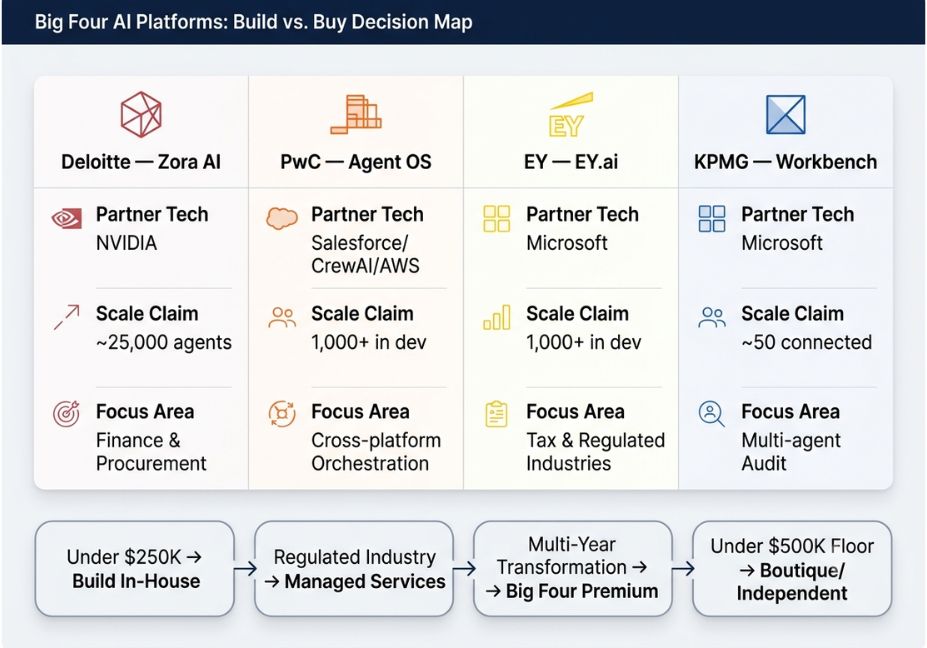
| Firm | Platform | Partner tech | Public scale claim | Notable focus |
|---|---|---|---|---|
| Deloitte | Zora AI | NVIDIA (Llama Nemotron) | Enterprise rollout across 7 functions | Productized, pre-built agents |
| PwC | Agent OS | Salesforce, CrewAI, AWS | ~25,000 agents deployed | Orchestration across existing agents |
| EY | EY.ai | Microsoft / internal | 1,000+ agents in dev or production | Tax and regulated-industry AI |
| KPMG | Workbench | Microsoft | ~50 agents connected, ~1,000 in pipeline | Multi-agent audit coordination |
Deloitte and EY have leaned hardest into published numbered frameworks (Deloitte’s Trustworthy AI dimensions, EY’s tax-agent roadmap), which matters if you’re trying to separate a firm’s actual methodology from its marketing. KPMG has a numbered governance taxonomy but not a numbered transformation methodology, which is a smaller but real distinction for buyers doing diligence.
Why Big Four AI Consulting Costs So Much
Three factors drive the premium over boutique or independent AI engineering shops:
- Brand and boardroom credibility a Deloitte or EY signature on an AI roadmap carries internal political weight that a freelance consultant’s doesn’t.
- Regulatory and compliance infrastructure audit trails, industry-specific controls, and global delivery footprints that mid-market vendors haven’t built.
- Risk transfer clients are partly paying to have someone else accountable if the agent gets something wrong.
That last point isn’t hypothetical: in late 2025, Deloitte had to issue a partial refund to an Australian government client after an AI-assisted report contained errors a reminder that “enterprise-grade” doesn’t mean error-free, just insured.
Did You Know? Big Four and MBB firms have collectively poured more than $10 billion into AI initiatives since 2023, and market-wide AI consulting rates still rose 10–15% year-over-year through 2026 despite that spend.
Build vs. Buy: A Decision Framework
Most readers here aren’t choosing between Deloitte and PwC they’re choosing between hiring one of them and building the agent themselves. A rough framework:
- Under $250K budget, single well-defined use case → build in-house with LangChain, LlamaIndex, or direct OpenAI function calling. The engineering lift is real but well within reach of a small team.
- Regulated industry, audit trail required, board-level sign-off needed → a Big Four managed-services contract buys compliance infrastructure you’d otherwise have to build from scratch.
- Multi-year, cross-functional transformation touching finance, HR, and procurement simultaneously → the coordination overhead alone often justifies the premium, since someone has to own change management across departments.
- Fast-moving startup or mid-market company under the $500K floor → the Big Four largely won’t take the meeting; boutique AI firms and independent consultants at $150–$600/hour are the realistic market.
Common Mistakes When Evaluating Big Four AI Pricing
- Comparing hourly rates without comparing scope. A $400/hour Big Four rate with a fixed six-month timeline can cost less than a $150/hour freelancer with no delivery deadline.
- Ignoring the managed-services trap. Multi-year contracts that hand over ownership of a workflow can be hard to unwind if the relationship sours.
- Assuming platform names mean proprietary technology. Zora, Agent OS, EY.ai, and Workbench are largely orchestration layers over commercially available models and frameworks not moats.
- Skipping a proof of concept. Jumping straight to a $500K+ rollout without a $50K–$250K pilot is the single most common way these engagements go over budget.
What Developers Are Saying
Technical discussion of these platforms tends to be more skeptical than the firms’ own press releases threads on r/LocalLLaMA and r/MachineLearning regularly question whether “50,000 AI professionals” or “25,000 deployed agents” reflect production systems doing real work, or dashboards counting configured-but-idle bots. Worth checking before treating any vendor’s scale claim as an engineering benchmark.
FAQ
How much do the Big Four charge for AI consulting in 2025?
Hourly rates run $400–$800 for Big Four AI-specific consulting, with dedicated engagements often billed at $2,000–$3,500+ per consultant per day. Full platform rollouts (Zora AI, Agent OS) typically start around $500,000 for a mid-sized first-year deployment.
Is there a minimum project size for Deloitte or PwC AI engagements?
Yes, in practice. Both firms’ agentic platforms are built around enterprise sales economics that require roughly a six-figure annual commitment to be viable, which effectively excludes companies below the $5M–$200M revenue range from a direct engagement.
What’s the difference between Deloitte Zora AI and PwC Agent OS?
Zora AI ships pre-built, productized agents for specific finance and procurement tasks. Agent OS is more of an orchestration layer that coordinates agents across a client’s existing tools and platforms rather than shipping fixed agent products.
Can a smaller company build an equivalent AI agent for less?
Often, yes — for a single well-scoped use case. The underlying pattern (tool-use loop, retrieval, orchestration) is the same one covered in open-source frameworks like LangChain and LlamaIndex; what the Big Four premium buys is compliance infrastructure and risk transfer, not unreplicable technology.
Are AI consulting rates rising or falling in 2025–2026?
Rising. Market-wide rates across firm tiers climbed 10–15% year-over-year into 2026, driven by generative and agentic AI demand even as underlying model costs have fallen.
Conclusion
Big Four AI tool development pricing in 2025 breaks into three tiers: $400–$800/hour for direct consulting time, $500K–$3M for a mid-sized productized agent rollout, and $500K–$5M+ for full enterprise transformation with a real six-figure floor below which the firms mostly won’t engage. The platforms themselves aren’t magic: they’re the same orchestration-and-tool-use architecture available in open-source frameworks today, wrapped in compliance infrastructure and brand risk transfer. Whether that wrapper is worth the premium depends on your regulatory exposure, not your engineering capability.