

Most teams still evaluate AI writing tools the way they did in 2023: by asking which model drafts the cleanest paragraph. That framing no longer holds. The AI writing tools updates released in February 2026 weren’t primarily about sentence quality they were about orchestration, governance, and multi-model routing. This is the same architectural shift that has already reshaped agentic workflows in coding and customer support, and it’s now arriving in content production.
Consequently, Jasper shipped an orchestration layer called Jasper Grid. Meanwhile, Sudowrite added two new frontier models, including Claude Sonnet 4.6, to its fiction-writing stack. Grammarly, for its part, kept pushing real-time tone adaptation deeper into the browser. None of these moves are cosmetic. In fact, they signal that AI writing tools are converging with the broader agentic AI stack that agentiveaiagents.com covers every week.
This guide breaks down exactly what changed in the February 2026 AI writing tool updates, why the shift toward orchestration matters for content teams, and how to decide whether these updates are worth adjusting your stack for.
Related reading: see our guide to agentic AI workflows for background on the orchestration and tool-use patterns referenced throughout this article.
What Are AI Writing Tools?
AI writing tools are software applications that use large language models to draft, edit, or optimize written content from a prompt or brief. In short: they combine a generative model with workflow logic templates, brand voice settings, and SEO scoring so the output is usable, not just generated.
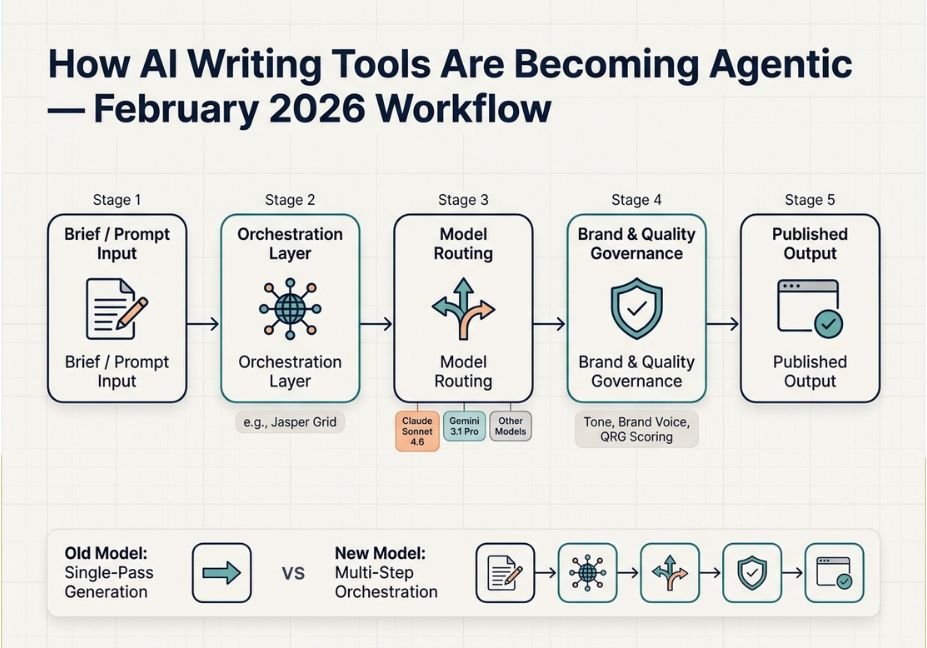
Early versions of AI writing software functioned as simple autocomplete or grammar checkers. However, the current generation increasingly resembles a lightweight agentic workflow, chaining prompt input, brand context, tool calls, and multi-step review into a single pipeline. This distinction matters because a standalone large language model generates text from a prompt, whereas a writing tool wraps that model in process: templates, governance, and now, orchestration.
How Did AI Writing Tools Change in February 2026?
Direct answer: In February 2026, AI writing tools shifted from single-pass content generation toward multi-step orchestration and multi-model routing, led by Jasper’s new Grid platform and Sudowrite’s expanded model lineup.
The clearest signal came from Jasper. In its official February 2026 product update, the company introduced Jasper Grid, described as an orchestration layer that turns strategy and brand intelligence into a repeatable workflow running across teams, regions, and channels. As a result, Jasper is no longer positioning itself purely as a content generator it’s positioning itself as a content pipeline coordinator.
Specifically, three changes stand out:
- Jasper Grid lets teams operationalize campaigns as systems rather than one-off generation tasks.
- A new Content Engineering certification teaches marketers how to govern agent-driven production at scale.
- The Optimization Agent’s URL scoring was rebuilt around Google’s own evaluation framework instead of a proprietary score.
Technical Note: Jasper’s Optimization Agent now scores URLs against Google’s Search Quality Rater Guidelines rather than an internal heuristic. This is a meaningful move toward aligning AI writing tools with how Google’s human evaluators actually judge page quality though, importantly, it’s not a guaranteed ranking signal, just a more transparent one.
Meanwhile, Sudowrite’s February update took a different approach: model choice. On February 24, the platform added Gemini 3.1 Pro and Claude Sonnet 4.6 to its Write, Draft, and Plugins tools, giving fiction writers a wider range of creative “voices” and a larger context window for long-running story projects. This is model routing the same pattern agentic frameworks use to send different tasks to different models now applied to creative writing rather than software development.
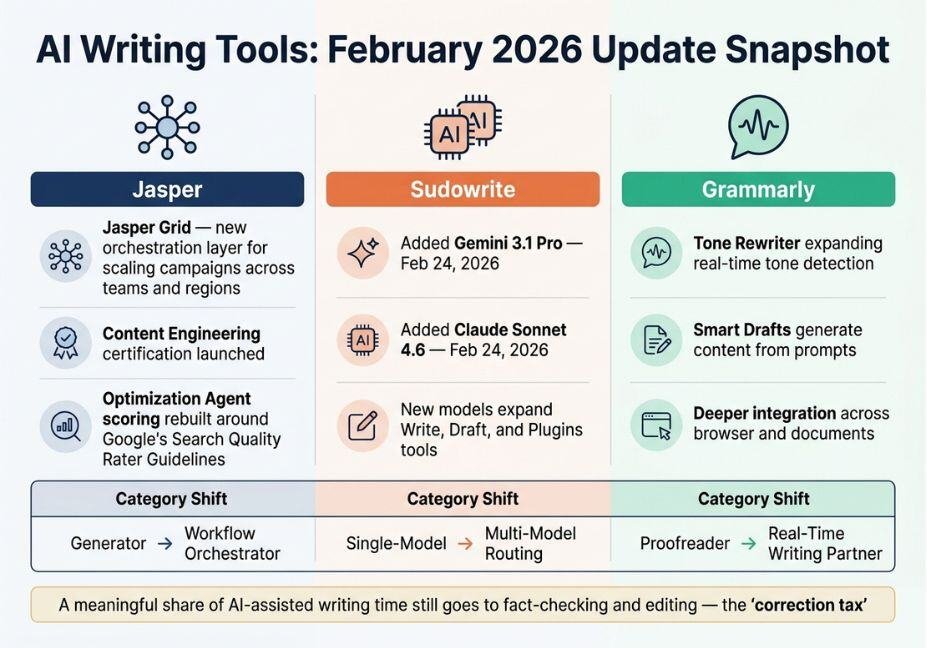
Jasper vs. Sudowrite vs. Grammarly: February 2026 Update Comparison
| Tool | Core February 2026 Update | Primary Audience | Category Shift |
|---|---|---|---|
| Jasper | Jasper Grid orchestration layer, Content Engineering certification, QRG-aligned scoring | Enterprise marketing teams | Generator → workflow orchestrator |
| Sudowrite | Added Gemini 3.1 Pro and Claude Sonnet 4.6 to Write, Draft, and Plugins | Fiction and long-form authors | Single-model → multi-model routing |
| Grammarly | Continued rollout of Tone Rewriter, Smart Drafts, and expanded multilingual tone detection | Individual writers and teams | Proofreader → real-time writing partner |
Did You Know? Content teams using AI-assisted workflows report saving several hours per week compared with fully manual production. That said, industry surveys also find a meaningful share of that time gets reinvested into fact-checking and editing AI output so the net time savings are real but smaller than headline figures suggest.
Real-World Use Cases for the New AI Writing Tool Features
- Enterprise content scaling. A marketing org running campaigns across a dozen regional sites can use Jasper Grid to enforce one brand-intelligence source of truth, rather than letting each region maintain its own prompt library.
- Long-form fiction with model flexibility. A novelist drafting a series can route emotionally dense scenes to a model tuned for creative range, then route continuity-heavy chapters to a model with a larger context window.
- Tone-sensitive customer communication. Support and sales teams use real-time tone detection to shift a reply from apologetic to confident, without rewriting it from scratch.
- SEO content governance at scale. Teams publishing frequently use QRG-aligned scoring to catch pages likely to read as low-quality to a human rater, before those pages ever show up in a search console report.
These use cases illustrate why “best AI writing tool for enterprise content teams” and “best AI writing tool for fiction writers” increasingly have different answers the right tool depends on whether governance or creative range is the bottleneck.
Best AI Writing Tools and Frameworks by Job-to-Be-Done
Not every February 2026 update matters equally, depending on what you’re producing. A useful mental model, drawn from how the LangChain documentation frames orchestration for agentic applications, is to separate the model from the workflow layer that governs it.
- Workflow-native tools (Jasper Grid, Copy.ai) win when governance and repeatability matter more than any single output.
- Model-flexible creative tools (Sudowrite) win when voice and range matter more than process.
- Document-embedded assistants (Grammarly, Google Workspace and Microsoft 365 writing features) win when the job is fast, in-line editing rather than long-form generation.
Pro Tip: Before adopting a new orchestration feature, audit how many separate prompt templates your team currently maintains. If that number is in the double digits, an orchestration layer like Jasper Grid will likely save more time than a marginally better base model would.
How to Evaluate an AI Writing Tool Update Before You Adopt It
- Read the primary changelog, not a secondary roundup. Vendors often bury pricing or seat-tier restrictions in the fine print of their own release notes.
- Map the update to a real bottleneck. Ask whether it addresses drafting speed, governance, tone consistency, or model quality, since these are different problems with different solutions.
- Pilot with one workflow, not your whole content operation, for two to four weeks.
- Track correction time, not just draft time. The hidden cost of AI-assisted writing is the editing pass, not the generation step.
- Reassess brand-voice consistency across at least ten published pieces before rolling the update out organization-wide.
Common Mistakes and How to Avoid Them
- Treating orchestration features as generation features. Jasper Grid doesn’t write better copy on its own; instead, it standardizes how existing prompts and brand context get applied. Skipping the setup work defeats the purpose.
- Chasing the newest model without matching it to the task. Claude Sonnet 4.6 landing in Sudowrite is useful for writers who want a different voice, not a universal upgrade over whatever model was already working.
- Ignoring the “correction tax.” Multiple 2026 industry surveys report that employees using AI writing tools still spend regular time fixing inaccurate or generic AI output. Therefore, plan editorial time accordingly rather than assuming first-draft output is publish-ready.
- Publishing AI Overview–optimized content without E-E-A-T signals. Google’s own Search Quality Rater Guidelines still anchor page quality to demonstrated experience and expertise, not generation method.
Technical Disclaimer: Feature names, pricing tiers, and model availability in this article reflect vendor changelogs as of February–March 2026. Since AI writing platforms ship updates weekly, confirm current feature sets against each vendor’s official release notes before making a purchasing decision.
What Content Teams Are Saying About the February 2026 Updates
Discussion threads on r/MachineLearning and similar developer communities increasingly frame AI writing tools as a subset of agentic software, rather than a separate category. The same orchestration, routing, and evaluation patterns showing up in coding agents from companies like OpenAI, Anthropic, and Google are now showing up in content pipelines too. This convergence is worth watching if your team already uses agent frameworks elsewhere in the organization, since the prompt libraries and governance patterns may be reusable across both. For a deeper technical breakdown, see our related coverage of RAG pipelines and vector search.
FAQ — People Also Ask
What is the biggest AI writing tool update in February 2026?
Jasper Grid was the biggest update an orchestration layer that turns Jasper from a content generator into a scalable content workflow platform.
Are AI writing tools becoming agentic?
Yes. February 2026’s updates from Jasper and Sudowrite both reflect agentic design patterns, including orchestration layers and multi-model routing.
Which AI writing tool added new models in February 2026?
Sudowrite added Gemini 3.1 Pro and Claude Sonnet 4.6 on February 24, 2026, expanding its range of AI “voices” for fiction writing.
Is Jasper Grid an AI agent?
Not exactly. Jasper Grid is an orchestration layer that coordinates briefs, brand data, and outputs across a repeatable workflow, rather than acting fully autonomously.
Do AI writing tool updates affect SEO rankings directly?
No. Google’s Search Quality Rater Guidelines inform how human raters judge quality, but ratings alone don’t move individual pages up or down in rankings.
What’s the difference between an AI writing assistant and an AI agent?
A writing assistant generates text from a prompt. An AI agent plans multi-step tasks and calls tools with some autonomy February’s orchestration features sit in between.
Conclusion
The AI writing tools updates from February 2026 mark a shift that’s easy to miss if you’re only tracking output quality: the category is converging with agentic AI. Jasper Grid brings orchestration and governance to content production at scale. Sudowrite’s new model options bring multi-model routing to creative writing. And Grammarly keeps closing the gap between editing and generation in real time.
That said, none of this replaces editorial judgment correction time and E-E-A-T still separate publishable content from generic output. Ultimately, teams evaluating their stack this quarter should judge these AI writing tools updates by workflow fit, not just draft quality.
Bookmark this guide and explore more breakdowns of agentic workflows and AI tooling at agentiveaiagents.com.