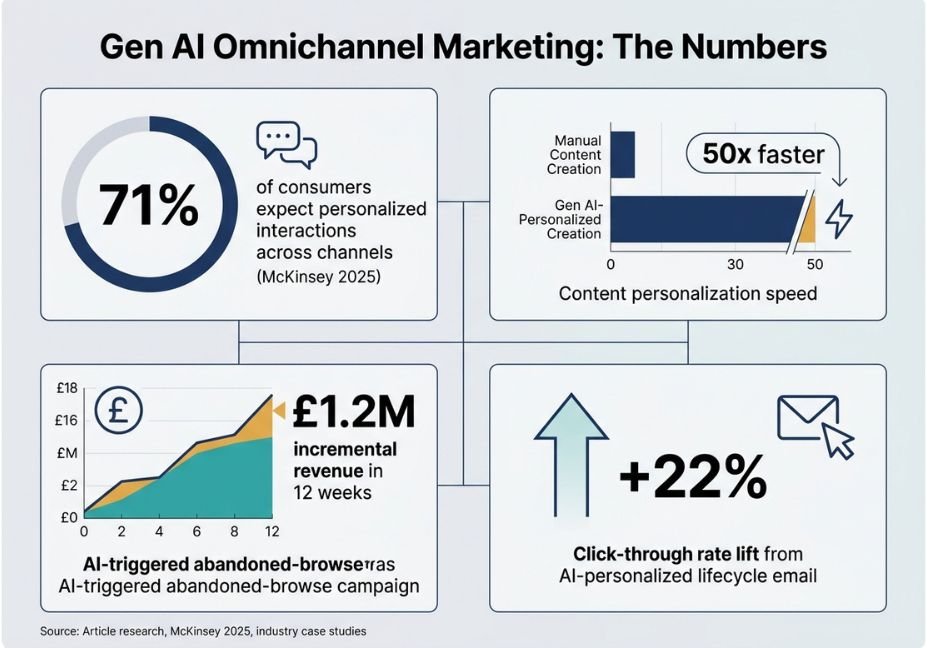
Most omnichannel campaigns don’t fail because the copy is bad. Instead, they fail because the system generating that copy has no idea what happened on the last channel five minutes ago. A gen AI omnichannel marketing tool is supposed to fix that: one loop that reads unified customer data, generates on-brand content, and pushes it to the right channel at the right moment. For context, McKinsey’s 2025 personalization research found that 71% of consumers now expect personalized interactions. Many get frustrated when they don’t get them, which is exactly the gap these tools are built to close. However, “gen AI omnichannel” gets used loosely it can mean anything from a simple email-subject-line generator to a fully agentic system that plans and executes its own campaigns. So here’s how to tell the difference, how the real ones are architected, and where they still fall apart in production.
Quick answer: A gen AI omnichannel marketing tool is software that generates personalized content and automatically delivers it across channels (email, SMS, push, WhatsApp) by combining generative AI with unified customer data and journey orchestration as opposed to a template-based tool that just sequences pre-written messages.
What Is a Gen AI Omnichannel Marketing Tool?
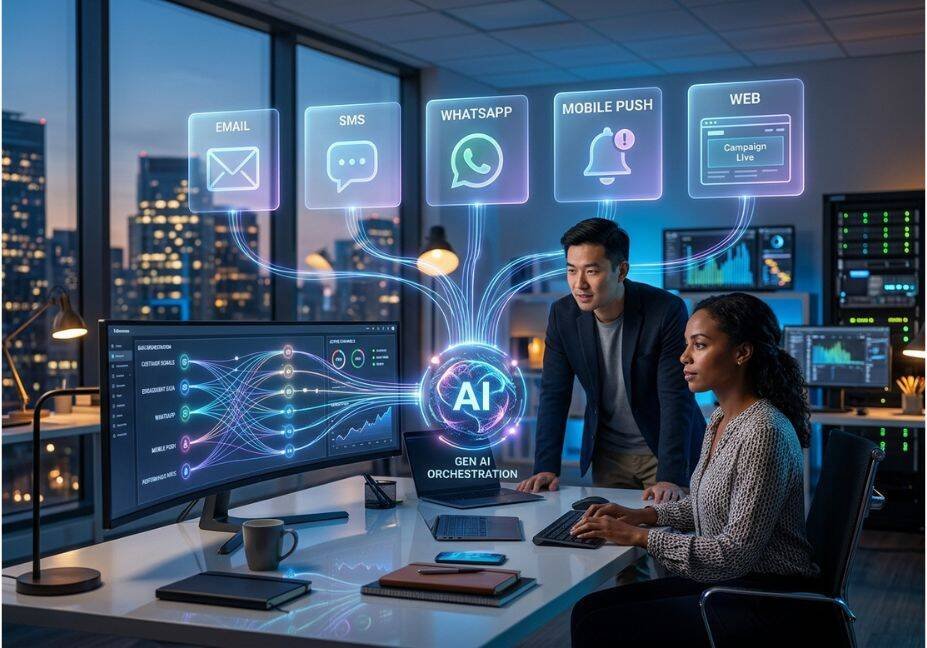
A gen AI omnichannel marketing tool is software that combines generative AI content creation with omnichannel orchestration, automatically generating and delivering personalized messages across email, SMS, push, WhatsApp, and web from one unified system.
That’s the short version. Here’s the longer one: instead of a marketer writing three versions of a campaign for three channels, the tool generates and adapts content per channel automatically, using customer data platform (CDP) signals to decide who sees what and when. It builds on the older idea of a connected omnichannel experience, but adds a generation and decision layer on top of static journey maps. So the distinction that matters: a multichannel tool blasts the same message everywhere, while an omnichannel one adapts the message to context and a gen AI omnichannel tool writes that adapted message itself. This is also why people searching for the best gen AI omnichannel marketing tool for small business teams usually mean something narrower: a platform that can do this without a dedicated data-engineering team behind it.
How Does a Gen AI Omnichannel Marketing Tool Work?
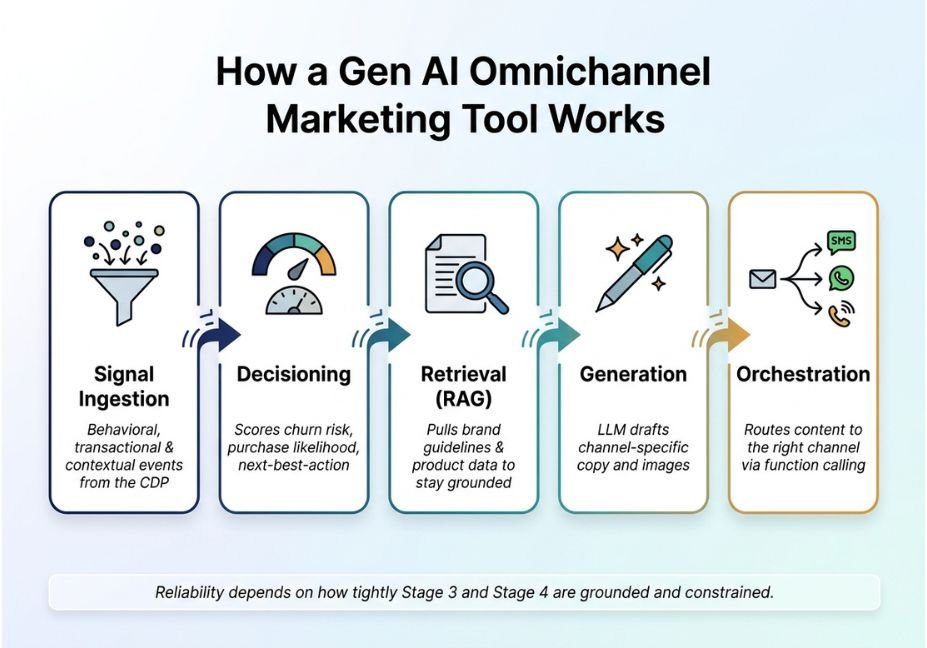
Under the hood, most of these platforms run a loop that looks a lot like an AI agent, not a template engine:
- Signal ingestion behavioral, transactional, and contextual events flow in from the CDP in near real time.
- Decisioning a model or rules engine scores intent (churn risk, purchase likelihood, next-best-action).
- Retrieval brand guidelines, product data, and past-performing copy are pulled via retrieval-augmented generation so outputs stay grounded instead of hallucinated.
- Generation the LLM drafts channel-specific copy and, increasingly, images.
- Orchestration content is routed to the right channel connector, often coordinated through structured function calling like OpenAI’s, which lets the model reliably trigger a “send email” or “push notification” action instead of just describing one.
Technical Note: The reliability of step 5 depends entirely on how tightly the generation step is constrained. Ungrounded generation plus loosely-typed function calls is the most common source of off-brand or factually wrong sends.
Did You Know? McKinsey reports that some marketing teams have used generative AI to personalize content development up to 50x faster than manual production but only when the generation layer is wired directly into decisioning and measurement, not run as a standalone copy tool.
Gen AI Omnichannel Marketing Tool Use Cases
- Abandoned-browse recovery a travel brand generated £1.2M in incremental revenue in 12 weeks from an AI-triggered “abandon browse” journey with real-time personalization.
- Lifecycle email at scale a UK retailer used a fine-tuned model to run an entire segment’s email journey, dynamically writing subject lines and picking product images based on browsing behavior and even local weather, reportedly lifting click-through rate 22%.
- Conversational commerce agentic platforms now generate full WhatsApp/Instagram chat campaign workflows, including copy, media, and branching logic, from a single campaign goal.
- Franchise-level personalization enterprise CRMs let hundreds of local business units run autonomous, personalized email and lead-capture campaigns from one shared content and data layer.
Best Tools and Frameworks for Gen AI Omnichannel Marketing
| Platform type | Example | Strongest at | Watch out for |
|---|---|---|---|
| Enterprise CRM + AI layer | Salesforce (Einstein) | Deep CRM data, predictive scoring | Effectiveness drops fast once data lives outside Salesforce |
| Inbound marketing suite | HubSpot (Breeze) | Unified CRM + content + SEO | Less depth on real-time behavioral triggers than CDP-native tools |
| B2C lifecycle marketing | Klaviyo | E-commerce personalization, segmentation | Narrower outside retail/DTC |
| Conversational/social commerce | Omnichat-style agentic platforms | WhatsApp/IG/FB campaign generation | Newer category, less enterprise track record |
| Build-your-own agent stack | LLM + CDP + vector DB | Full control, custom brand voice | Requires real engineering investment |
If you’re building rather than buying, most teams reach for an orchestration framework like LangChain to manage the agent loop between retrieval, generation, and channel-send actions, paired with a CDP and a vector store for customer-attribute search.
Pro Tip: Before comparing pricing tiers, ask any vendor exactly what their generation layer is grounded on. “Generative AI” without a retrieval or fine-tuning story on your own brand data is a copy generator, not a personalization engine.
Step-by-Step: How to Implement a Gen AI Omnichannel Strategy
- Consolidate data first. A gen AI layer amplifies whatever data quality you already have — garbage in, personalized garbage out.
- Pick your grounding source. Decide whether content generation pulls from a product catalog, brand style guide, or past-campaign performance data via retrieval-augmented generation.
- Define channel connectors. Map exactly which actions (send email, trigger push, post to WhatsApp) the system is allowed to take autonomously versus queue for review.
- Set decisioning thresholds. Define the intent-score cutoffs that trigger a journey, so the model isn’t generating content for every user on every event.
- Pilot on one segment. Run the full loop on a single, low-risk audience segment before letting it manage full lifecycle campaigns.
- Instrument attribution. Track engagement and conversion by channel and by generated-variant, not just by campaign, so you can see which AI-written content actually works.
Common Mistakes and How to Avoid Them
- Treating it as a copy tool, not a decisioning system. Bolting generative AI onto a static journey map just produces faster off-brand content, not better personalization.
- Skipping human review during rollout. Full autonomy on day one, before you trust the grounding data, is how off-brand or factually wrong messages ship at scale.
- Ignoring channel-specific constraints. A generated WhatsApp message and a generated email need different length, tone, and compliance handling — one prompt template rarely covers both well.
- Under-investing in the CDP layer. The generation model gets all the attention, but weak identity resolution across channels is the more common root cause of “personalization” that feels generic.
- No attribution loop back into the model. Without measurement feeding back into decisioning, the system can’t learn which generated variants actually convert.
What Practitioners Are Saying
The shift practitioners are discussing right now isn’t generation quality it’s autonomy. Vendors are increasingly shipping agents that act without being prompted, firing entire campaign playbooks the moment a triggering event occurs rather than waiting on a marketer to launch a send. That raises the same governance question every marketing team is now working through: how much of the loop decisioning, generation, and the actual send should run without a human in it, and where does review still belong?
Technical Disclaimer: Framework and platform capabilities in this space change fast. Specifics on any named vendor (feature sets, pricing, autonomy controls) should be verified against current documentation before you evaluate or buy.
FAQ — People Also Ask
What is a gen AI omnichannel marketing tool?
It’s a platform that combines generative AI content creation with omnichannel journey orchestration, using unified customer data to generate and deliver personalized messages across email, SMS, push, and social channels automatically.
How is it different from a regular marketing automation platform?
Traditional automation triggers pre-written templates based on rules. A gen AI omnichannel tool generates the content itself in real time, adapting message and channel choice to each customer’s current context rather than a fixed template.
Can small businesses use a gen AI omnichannel marketing tool?
Yes platforms like HubSpot and Klaviyo offer scaled-down versions with generative content features, so smaller teams get automation and personalization without needing a custom-built agent stack.
How do you measure ROI from a gen AI omnichannel marketing tool?
Track conversion rate, customer lifetime value, and revenue attributed to specific generated variants and channels, alongside efficiency gains like time saved and reduced manual campaign work, then compare against total platform cost.
What causes gen AI marketing tools to fail in production?
The most common causes are ungrounded generation (no retrieval or brand-data grounding), weak identity resolution across channels, and full autonomy enabled before the underlying data quality is trusted.
Is agentic AI the same as generative AI in marketing?
No. Generative AI creates content; agentic AI adds planning and autonomous action deciding when to generate, which channel to use, and executing the send without a human triggering each step.
Conclusion
A gen AI omnichannel marketing tool is only as good as three things: the data it’s grounded on, how tightly its generation is constrained, and how much autonomy you’re actually ready to hand it. The platforms winning in 2026 aren’t the ones with the flashiest copy generator they’re the ones that treat generation as one step in a full decisioning loop, from CDP signal to measured outcome. Start with data consolidation, pilot on a narrow segment, and expand autonomy only as your attribution loop proves it out. Bookmark this guide and explore more hands-on agentic AI tutorials at agentiveaiagents.com.