

The majority of AI agent failure is not due to the models themselves, but instead the result of a failure to plan for failure. For example, an improperly formatted JSON API call or a rate limited API could silently cause a multi-step workflow to fail, and the agent may never know. Error Handling in AI agents is the practice of capturing those errors before they cascade. It is the largest gap between an impressive demo and a production-quality system that your team can trust.
AI agents can experience non-deterministic (random) failure. A prompt that worked perfectly the first time may fail to work the second time due to something like model drift, changing context windows, or a tool returning an unexpected data structure. This difference of working vs. not working can be mitigated by using frameworks such as LangChain or design patterns like the ReAct pattern (which intersperses reasoning with action). These frameworks/methods provide the structure an AI agent needs to perform, but they do not ensure that the structure is resilient. Engineers must make this design decision.
To gain some understanding of best practices for constructing your production quality AI agent error handling solutions and how to avoid producing unreliable AI agents, this guide breaks the overall error handling issue down into seven distinct layers that will actually support your implementation in actual use cases.
What Is AI Agent Error Handling?
AI agent error handling is the set of strategies an agent uses to detect, recover from, and learn from failures during autonomous execution. It differs from classic try/except programming because agent errors . are often semantic, not just structural. In other words, a tool call can be syntactically valid JSON and still be logically wrong like calling a weather API with a city that doesn’t exist.
Effective error handling treats every failure as information the agent, or a human, can act on. It’s not a dead end that kills the run. A foundational paper on LLM agents describes how interleaving reasoning traces with actions helps a model track and update its plan while handling exceptions along the way a core justification for building recovery logic into the agent loop itself, not bolting it on afterward.
How Does AI Agent Error Handling Work?
Under the hood, an agent’s execution loop typically follows: plan → call tool → observe result → decide next step. Error handling inserts checkpoints at each stage:
- Before the call : input validation against a schema (Pydantic is the standard choice in Python agent stacks)
- During the call : timeouts, retries, and circuit breakers around the tool or API
- After the call : output validation, so a malformed response never reaches the reasoning step unchecked
- Across the run : state checkpointing, so a crash mid-task doesn’t mean starting over
Pro Tip: Feed errors back to the model as structured observations, not raw stack traces. An agent can usually self-correct a ToolException: invalid date format, expected YYYY-MM-DD. It generally can’t do anything useful with a bare Traceback (most recent call last).
Input Validation: Catching Errors Before They Happen
Most production incidents trace back to unvalidated input reaching the model or a tool. Validating against a schema before execution catches malformed dates, missing fields, and type mismatches and it does so at the cheapest possible point in the pipeline.
- Use Pydantic models to define expected tool arguments
- Reject and re-prompt on schema violations instead of silently coercing values
- Normalize free-text inputs (dates, currencies, units) before they hit an API
Architect’s Note: One team that applied strict Pydantic validation on date parameters, guiding the agent to reformat instead of failing outright, cut their overall error rate by roughly 60%. As a result, fewer failures ever reached the tool-call layer at all.
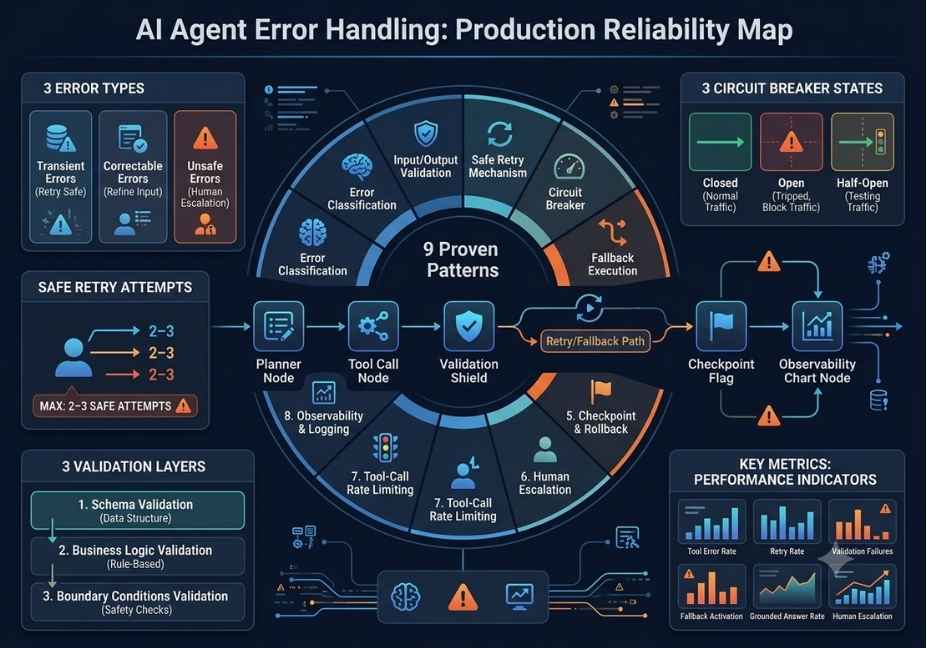
AI Agent Retry Logic and Exponential Backoff
Not every failure deserves a retry. Blind, immediate retries can actually make things worse by spiking load on a service that’s already struggling. Exponential backoff waiting progressively longer between attempts spreads out that load and gives transient issues room to resolve.
from tenacity import retry, stop_after_attempt, wait_exponential_jitter
import httpx

@retry(
    stop=stop_after_attempt(3),
    wait=wait_exponential_jitter(initial=0.2, max=2.0),
)
def call_weather_api(city: str) -> dict:
    resp = httpx.get("https://api.example.com/weather", params={"city": city}, timeout=1.5)
    resp.raise_for_status()
    return resp.json()
If you’re building on LangChain, you don’t need to hand-roll this. LangChain’s tool-retry middleware lets you configure max retries, backoff factor, and jitter directly, and it lets you choose whether a failure returns a message to the model or re-raises the exception.
Did You Know? Even well-prompted, structured tasks on GPT-4-class models show a task failure rate in the single-to-low-double digits. At scale, that’s dozens to hundreds of failures a day for a busy agent.
AI Agent Retry Safety: A Comparison Table
Not all operations are equally safe to retry. Classify failures before deciding on a retry policy this is one of the most common AI agent error handling best practices teams skip.
| Failure type | Retry-safe? | Recommended strategy |
|---|---|---|
| Idempotent read (status check, lookup) | Yes | Retry aggressively, up to 3–5 attempts |
| Rate limit (HTTP 429) | Yes | Exponential backoff with jitter |
| Non-idempotent write (payment, email send) | No unless deduplicated | Idempotency key + single attempt |
| Malformed tool arguments | No, not blindly | Re-prompt with structured error, don’t retry same input |
| Auth failure (401/403) | No | Escalate immediately, don’t retry |
Circuit Breakers: Stopping Cascading Failures
When a downstream service is consistently failing, retrying it over and over just burns tokens and time. This is exactly the problem the circuit breaker design pattern was built to solve. It proactively detects unresponsive services and stops repeated attempts, instead of relying on delayed timeouts.
- Closed state: requests flow normally
- Open state: the circuit trips after repeated failures; calls fail fast without hitting the service
- Half-open state: after a cooldown, a limited number of test requests check whether the service has recovered
Pairing circuit breakers with retry logic and graceful degradation for example, falling back to cached data or a simpler tool keeps one flaky dependency from taking down an entire agent workflow. This matters whether your agents run on AWS Lambda, Kubernetes, or a managed orchestration platform, since the failure mode is the same regardless of infrastructure.
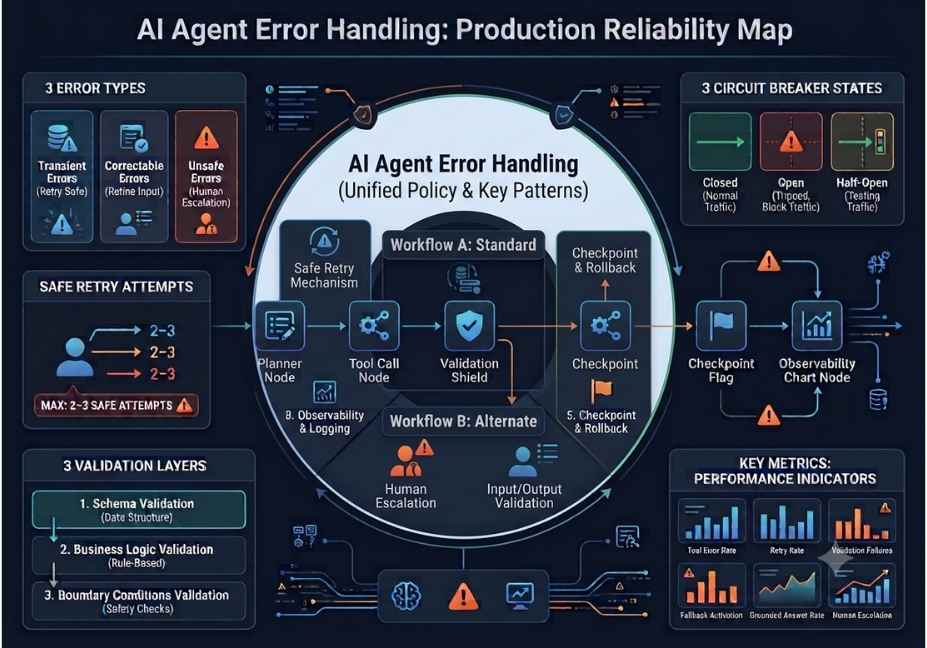
State Checkpointing and Recovery
Long-running, multi-step agent tasks are expensive to restart from scratch after a crash. State checkpointing means persisting the agent’s memory context, completed steps, intermediate variables after every major action. As a result, recovery resumes from the last known-good point instead of step one.
Technical Disclaimer: Framework versions evolve rapidly. Code examples in this article use LangChain’s current middleware API as of mid-2026. Always check the official docs for the latest interface before shipping.
Human-in-the-Loop for Unrecoverable Errors
Some errors shouldn’t be auto-resolved: a payment dispute, an ambiguous customer request, or a tool failure with no safe fallback. Configure the agent to recognize unrecoverable states, pause execution, and notify a human operator via Slack, email, or a ticketing queue rather than looping indefinitely or guessing.
- Define explicit “escalate” conditions in your agent’s system prompt
- Cap
max_iterationsso a confused agent can’t spiral into an expensive retry loop - Log the full context so the human doesn’t have to reconstruct what happened
Agent-facing error handling works best when every error message tells the agent what to try next. In other words, the design should shift from describing what went wrong to prescribing a next action. The same principle applies to messages surfaced to a human reviewer.
Structured Logging and Monitoring
You can’t fix what you can’t see. Structured logs timestamps, agent ID, input snippets, error codes turn scattered failures into patterns you can actually act on.
- Track error rate, latency, and failure type distribution on a dashboard
- Alert when a specific tool’s failure rate crosses a threshold
- Review logs weekly to find which prompts or tool combinations are error-prone
Common Mistakes and How to Avoid Them
- Retrying non-idempotent writes blindly : always check for an idempotency key first
- Returning raw stack traces to the model : reformat as structured, actionable observations instead
- No cap on retries or iterations : a runaway loop can burn through your token budget in minutes
- Skipping output validation : a malformed tool response can poison every downstream reasoning step
What Developers Are Saying
Practitioners building production agents consistently flag the same pain point: traditional error handling assumes failures are obvious, but agents can fail silently while still returning a 200 OK. That gap, between “technically succeeded” and “actually did the right thing,” is why validation gates and output checks matter just as much as retry logic.
For a deeper reference on how to structure tool-calling and error responses at the API level, see OpenAI’s function-calling documentation, which walks through how a model requests a tool call and how your application should return the result back into the conversation.
FAQ People Also Ask
What is the most common cause of AI agent failure?
Context window overflows and malformed output formats are the top causes. Agents often lose track of instructions in long conversations, or generate JSON that fails schema validation downstream.
How do I implement human-in-the-loop error handling?
Configure your agent to detect unrecoverable errors and pause execution instead of retrying. It should notify a human operator via Slack or email, who can supply the correct input or decision to resume the workflow.
Why is exponential backoff better than simple retries?
Exponential backoff avoids the “thundering herd” problem, where repeated immediate retries overwhelm an already struggling server. Spreading out attempts, especially with added jitter, increases the odds of eventual success.
Can AI agents self-heal from errors?
Yes, to an extent. Agents can feed a stack trace or error message back into their own reasoning loop and attempt a corrected tool call. This works best for semantic errors, like bad arguments, rather than for services that are simply unavailable.
What is the difference between a retry and a circuit breaker?
A retry assumes an operation will eventually succeed and tries again. A circuit breaker assumes an operation is likely to keep failing and stops attempting it entirely until a cooldown period passes.
Conclusion
Production-grade AI agent error handling comes down to three things: validate input before it reaches your tools, classify failures so you only retry what’s safe, and give the agent or a human a structured way to recover instead of guessing. Layering input validation, exponential backoff, circuit breakers, and checkpointing turns a fragile demo into a system that fails gracefully instead of failing silently.
Bookmark this guide and explore more hands-on AI agent tutorials at agentiveaiagents.com.