
In production, most AI agents are sometimes not reliable. The issue however does not always stem from the LLM itself, but nearly always results from a suboptimal orchestration layer, a linear memory retrieval strategy, and/or a brittle tool-use loop which was never validated in a real-world environment.
According to a benchmark study conducted by Stanford CRFM in 2024, deployed agents that experienced failure during deployment stated that they did so due to tool-call loops and context window overflow as the two main problems and not due to the underlying model quality. This gap has not resolved itself and is only being addressed by a newer cohort of frameworks designed for durable execution, multi-agent coordination, and permanent memory.
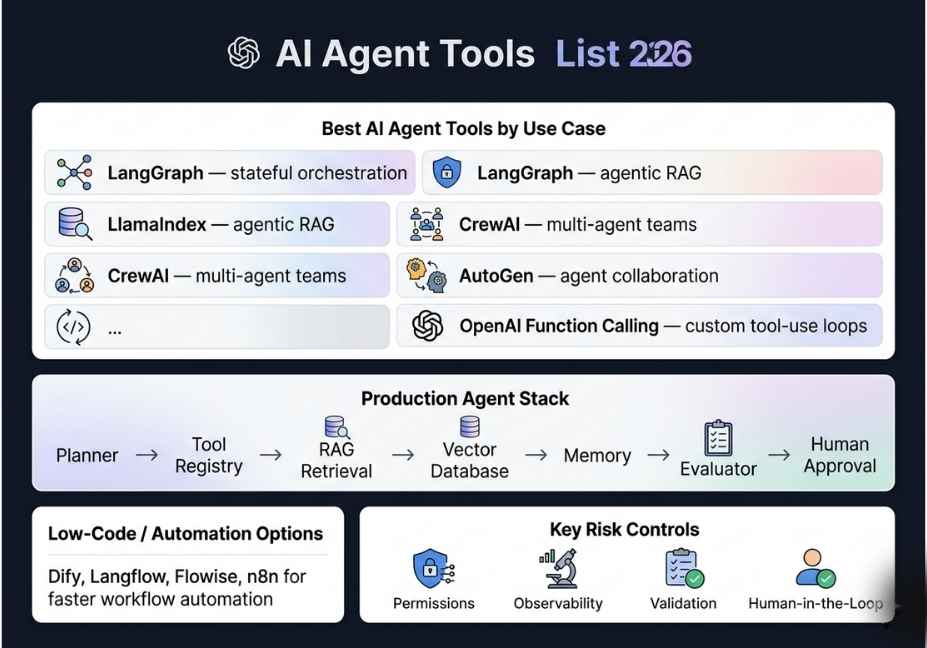
So what actually works in 2026? Here’s the AI agent tool list that has been production-tested (orchestration frameworks, memory systems, and tool infrastructure). You will find a summary table of comparisons, a working Python code sample, and the failure modes that many guides never cover.
What Is an AI Agent Tool Stack? (And Why It Matters)
An AI agent tool stack is the combination of three distinct layers that allow an LLM to act in the world.
First, there is the orchestration framework. This layer manages the agentic workflow, task decomposition, and multi-agent coordination. Second, there is the memory system. This layer handles retrieval across sessions and gives agents contextual awareness. Third, there is the tool infrastructure layer APIs, code execution environments, and vector stores the agent can invoke mid-loop.
Think of it this way: the language model generates tokens. The stack, however, makes it act.
The ReAct paper (Yao et al., 2023) formalized the reason → act → observe cycle that sits at the heart of every modern agent framework. According to that paper, combining reasoning traces with action steps significantly improves both task performance and interpretability. If you have not read it yet, it is 15 pages and worth every minute.
Did You Know? As of mid-2026, there are over 40 open-source AI agent frameworks on GitHub. However, fewer than 10 have crossed meaningful production adoption signals 10,000+ GitHub stars, active PyPI/npm downloads, and documented enterprise deployments.
Layer 1 : Best Orchestration Frameworks for AI Agents in 2026
The orchestration layer is where your planning module, task decomposition logic, and multi-agent system live. Therefore, choosing the right framework here is the single most important architectural decision you will make.
Below is a ranked comparison of the eight frameworks that matter most in 2026.
AI Agent Orchestration Frameworks Compared
| Framework | Language | Best For | GitHub Stars | Key Failure Mode |
|---|---|---|---|---|
| LangGraph | Python | Complex stateful workflows, HITL | 33,900+ | Over-engineering simple tasks |
| CrewAI | Python | Role-based multi-agent prototypes | 41,871 | Poor state persistence in long runs |
| AutoGen / AG2 | Python | Research, conversational agents | 40,000+ | v0.4 / AG2 API fragmentation |
| Mastra | TypeScript | Full-stack TypeScript teams | 22,000+ | Younger ecosystem, fewer integrations |
| OpenAI Agents SDK | Python / TS | OpenAI-native, fast setup | — | Vendor lock-in |
| Claude Agent SDK | Python / TS | Anthropic-native, MCP-first | — | Less tested outside Claude |
| Pydantic AI | Python | Type-safe, structured outputs | 12,000+ | Not built for heavy multi-agent use |
| Smolagents | Python | Single-agent scripts, research tasks | 15,000+ | Not built for enterprise orchestration |
LangGraph’s stateful graph-based orchestration ships with first-class checkpointing and human-in-the-loop (HITL) support. Those two features, specifically, separate prototype frameworks from production-grade ones.
Architect’s Note: If your workflow involves more than three sequential tool calls — or requires durable execution across failures LangGraph is the most battle-tested choice as of mid-2026. For role-based prototyping (a researcher → writer → reviewer pipeline, for example), CrewAI gets you to a working demo significantly faster.
LangGraph vs CrewAI Which Should You Choose?
This is the most common question developers ask in 2026. Here is the short answer.
LangGraph uses a stateful graph model. You define nodes (agents or functions) and edges (transitions), which gives you fine-grained control over the entire agentic workflow. As a result, it scales better for complex orchestration.
CrewAI, on the other hand, uses a role-based crew abstraction. You define agents by role researcher, writer, reviewer and CrewAI handles coordination automatically. Consequently, it is the faster path from idea to working prototype.
In short: choose LangGraph for production complexity. Choose CrewAI for speed-to-demo.
A Note on the AutoGen / AG2 Split
Microsoft rewrote AutoGen as v0.4+ with a completely different API. However, the original v0.2 community continued under the AG2 name at ag2.ai. They are related but no longer the same project. Therefore, if you started on AutoGen v0.2, AG2 is the safer continuity path. If you are starting fresh, choose LangGraph or CrewAI instead.
Layer 2 : AI Agent Memory Systems: What Most Guides Skip
Memory retrieval is the most under-discussed part of any AI agent tools list. Without persistent memory, every session starts cold. As a result, your agent re-reads the same documents, re-learns user preferences, and burns tokens doing it.
The Three Types of Agent Memory You Need to Understand
There are three memory types that every production agent must account for. Understanding these, furthermore, helps you pick the right tool for each job.
- Episodic memory stores conversation history and past interactions across sessions
- Semantic memory stores facts, domain knowledge, and user preferences that persist over time
- Procedural memory stores learned tool-use patterns and workflow shortcuts the agent develops
Best AI Agent Memory Tools in 2026 — Compared
| Tool | Storage Backend | Retrieval Type | MCP Support | Best For |
|---|---|---|---|---|
| Mem0 | pgvector / Pinecone | Semantic + metadata filtering | Yes | Personalization, user-scoped memory |
| Zep / Graphiti | Knowledge graph | Temporal + semantic | Partial | Time-aware fact reasoning |
| LangGraph Store | PostgreSQL | Semantic + structured | Via LangChain | LangGraph-native state persistence |
| LlamaIndex | Any vector store | RAG-optimized retrieval | Yes | Document retrieval pipelines |
| Fastio | File system | Hybrid (file + RAG) | Yes — 19 tools | Artifact-generating agents |
Mem0’s open-source memory layer supports multi-LLM backends OpenAI, Anthropic, Gemini, and Groq and integrates natively with Claude Code via MCP. Its key limitation, however, is the absence of a temporal model. Memories are stored and retrieved, but they are not modeled as time-bounded facts that can be superseded.
Zep, by contrast, stores every fact as a knowledge graph node with a validity window. For example, “User prefers Python (as of March 2026)” is a fact with a temporal bound not just a stored string. Therefore, for agents that need to reason about how facts change over time, Zep is the stronger choice.
Pro Tip: If you are already using Pinecone for document chunk retrieval and also need user-scoped personalization, layer Mem0 on top. They solve different problems and compose cleanly. Pinecone handles document retrieval. Mem0, additionally, handles user-specific context across sessions.
AI Agent Memory vs RAG What Is the Difference?
This is a distinction many developers miss. RAG (Retrieval-Augmented Generation) retrieves chunks from a document corpus at query time. Agent memory, however, stores and retrieves information that the agent itself has generated or observed including user preferences, past decisions, and conversation history.
In most production systems, you need both. RAG handles external knowledge. Memory, additionally, handles agent-specific context.
Layer 3 : Tool Infrastructure: MCP and the Agentic Tool Ecosystem
The tool-use loop is precisely where most agents break. A tool call returns an unexpected schema, the agent hallucinates a retry, and you end up in an infinite loop burning tokens until a timeout fires.
Fortunately, Anthropic’s Model Context Protocol (MCP) has emerged as the standard for connecting agents to external tools file systems, APIs, databases, and browser automation without writing bespoke integration code for each connector. By mid-2026, moreover, most major frameworks including LangGraph, CrewAI, Pydantic AI, and Mastra have native or community MCP support.
Five Tool Categories Every Production Agent Needs
Every production AI agent, regardless of framework, needs tools from each of these five categories. Otherwise, you will hit capability ceilings quickly.
- Code execution : sandboxed Python/JS environments (E2B, Modal, Claude Code’s execution loop)
- Web retrieval : search APIs built for agent consumption (Tavily, Serper, Brave Search API)
- File I/O : MCP file servers, Fastio, or S3-backed stores for persistent artifact storage
- Structured data access : SQL agents, Pandas DataFrame tools, database connectors
- Browser automation : Playwright-backed browser tools such as Stagehand and Browser Use
Did You Know? The ToolACE-MCP research paper (2026) demonstrated that history-aware routing across large MCP tool ecosystems using dependency graphs and multi-turn trajectory synthesis significantly improves tool selection accuracy in multi-agent collaboration scenarios.
How to Build a Minimal ReAct Agent Loop in Python
Here is a working example using the OpenAI Agents SDK. Furthermore, the same pattern maps directly to LangGraph or the Claude Agent SDK with only minor changes.
python
from agents import Agent, Runner, function_tool
import httpx

# Step 1: Define a tool the agent can invoke mid-loop
@function_tool
def search_web(query: str) -> str:
    """Search the web and return a short summary."""
    resp = httpx.get(
        "https://api.tavily.com/search",
        params={"query": query, "max_results": 3},
        headers={"Authorization": "Bearer YOUR_TAVILY_KEY"},

   ( results = resp.json().get("results", [])
    return "\n".join(r["content"] for r in results[:3])

# Step 2: Build the agent with a system prompt and tool access
agent = Agent(
    name="ResearchAgent",
    instructions=(
        "You are a research assistant. Use the search_web tool to find "
        "current information before answering. Always cite your sources." ),
    tools=[search_web])

# Step 3: Run the ReAct loop — reason, act, observe, repeat
result = Runner.run_sync
    (agent,
    "What are the top AI agent frameworks in 2026?")

print(result.final_output)
Technical Disclaimer: This example uses the
openai-agentsPython SDK as of June 2026. Because the API surface evolves quickly, always check the official OpenAI Agents SDK documentation before deploying to production.
The loop works as follows: the LLM reasons about the task → decides to call search_web → receives the results → reasons again → produces a final output. That is the ReAct pattern expressed in three lines of visible logic.
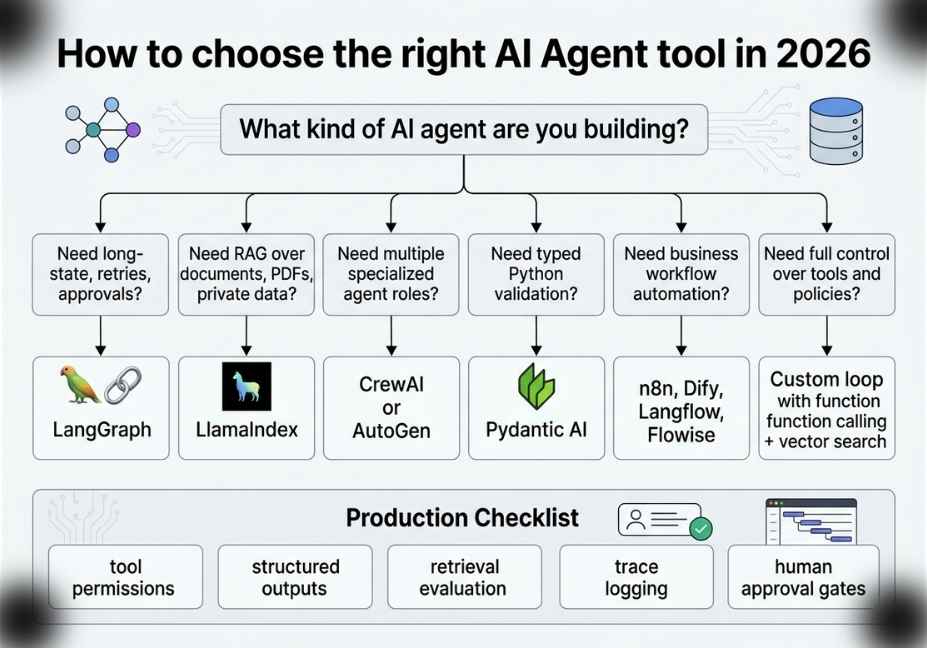
How to Choose an AI Agent Framework A Step-by-Step Decision Guide
Choosing the wrong framework is one of the most expensive mistakes a team can make. Therefore, use this decision flow before committing.
- What is your team’s primary language? If TypeScript, start with Mastra. If Python, continue below.
- How complex is your workflow? For simple, single-agent tasks, Smolagents or Pydantic AI are sufficient. For multi-step, stateful workflows, choose LangGraph.
- Do you need multi-agent coordination? If yes, choose LangGraph (for fine-grained control) or CrewAI (for role-based speed).
- Are you OpenAI-native or model-agnostic? If you want to lock to OpenAI, the OpenAI Agents SDK is the fastest setup. If model-agnostic, LangGraph is the better long-term choice.
- Do you need production observability? Add LangSmith (for LangGraph) or Arize Phoenix (model-agnostic) on top of whichever framework you choose. Observability is not optional at production scale.
Pro Tip: Pick your observability layer before you build, not after. Debugging a stateful agent graph without traces is significantly harder than debugging one with full observability from day one.
5 Common Mistakes That Break AI Agents in Production
This section is what most AI agent tools lists skip entirely. However, these mistakes are the reason most production agents fail.
Mistake 1: No checkpointing on long-running tasks. If your agent fails at step 8 of a 10-step workflow and restarts from scratch, you burn both budget and trust. Therefore, use LangGraph’s built-in checkpointing from the very beginning not as an afterthought.
Mistake 2: A flat, undifferentiated memory architecture. Shoving everything into a single vector store and hoping cosine similarity retrieves the right chunk is not a memory strategy. Instead, separate episodic memory from semantic memory. Use metadata filters. Retrieval accuracy degrades fast when memory is undifferentiated.
Mistake 3: Missing tool schema validation. Agents hallucinate tool arguments when schemas are ambiguous. Consequently, use Pydantic models for every tool input. Type safety is not a nice-to-have in a production tool-use loop it is a hard requirement.
Mistake 4: No fallback logic on tool failure. A tool that returns a 429 status code or malformed JSON should trigger a retry with exponential backoff not a hallucinated answer. Therefore, build failure handling into your tool infrastructure explicitly, at the tool layer, not inside the prompt.
Mistake 5: Over-trusting the model’s task decomposition. Complex tasks need an explicit planning module prompt not implicit reasoning. A well-structured planning prompt, specifically, cuts failure rates significantly on multi-step agentic workflows. Tell the model exactly how to decompose the task. Never assume it will figure it out on its own.
Open Source AI Agent Tools Worth Watching in 2026
Beyond the major frameworks, several open-source AI agent tools have emerged as strong options for specific use cases.
- Google ADK (Agent Development Kit) : Google’s first-party agent framework, optimized for Gemini models and Google Cloud infrastructure
- Agno : A multi-agent framework with a runtime and control plane for managing agent deployments at scale (36,000+ GitHub stars)
- Haystack by deepset : Production-ready orchestration focused on RAG pipelines and document-heavy AI applications (23,700+ stars)
- Semantic Kernel : Microsoft’s enterprise-oriented framework with first-class support for C#, Python, and Java : the only major framework with strong .NET coverage
- Vercel AI SDK : The TypeScript toolkit from the creators of Next.js, designed for AI-powered web applications (20,400+ stars)
FAQ People Also Ask About AI Agent Tools
LangGraph is the most production-hardened choice for complex, stateful workflows. It offers checkpointing, HITL approvals, and durable execution. CrewAI, however, is the fastest path to a working role-based multi-agent prototype. For TypeScript teams, Mastra is the strongest native option. Match the framework to your orchestration complexity and team language not to whichever name appears most in newsletters.
For beginners, CrewAI is the most accessible starting point. You define agents by role researcher, writer, reviewer and the framework handles coordination. Additionally, the OpenAI Agents SDK is simple to set up and works well for straightforward use cases. Avoid LangGraph as your first framework because its graph model has a steeper learning curve.
AI agents use tools through a structured tool-use loop. First, the LLM reasons about the task. Then, it decides which tool to call and generates schema-validated arguments. Next, it receives the tool output. Finally, it incorporates that output into the next reasoning step. This cycle reason, act, observe is defined by the ReAct pattern (Yao et al., 2023) and is built into every major framework on this list.
Yes but only for bounded, well-defined tasks. For example, web research, code generation, and data extraction work well without human input. However, for high-stakes decisions, irreversible actions, or ambiguous goals, human-in-the-loop (HITL) checkpoints are essential. Therefore, most production systems use a hybrid model: autonomous for routine steps, with HITL gating for actions above a defined risk threshold.
RAG (Retrieval-Augmented Generation) retrieves chunks from a document corpus at query time using a vector store. Agent memory, by contrast, stores and retrieves information the agent itself has generated or observed including user preferences, past decisions, and conversation history. In production systems, you typically need both. RAG handles external knowledge retrieval. Agent memory, additionally, handles agent-specific context and personalization.
The most widely used web retrieval tools for AI agents in 2026 are Tavily, Serper, and the Brave Search API. These are purpose-built for agent consumption they return structured, token-efficient results rather than raw HTML. Furthermore, Tavily specifically optimizes responses for LLM context windows, which makes it the top choice among developers building research agents.
Conclusion
Building a production AI agent in 2026 requires three distinct architectural decisions. First, choose your orchestration framework LangGraph, CrewAI, or Mastra, depending on your complexity and language. Second, choose your memory system Mem0, Zep, or LlamaIndex, depending on whether you need personalization, temporal reasoning, or document retrieval. Third, define your tool infrastructure MCP connectors, code execution environments, and search APIs.
Each layer, furthermore, has its own specific failure modes. The tools that handle those failure modes best are the ones worth building on.
The fastest path to a broken agent is picking the most hyped framework and ignoring memory and tooling entirely. The fastest path to a working one, however, is matching each layer to your actual requirements then adding observability from day one.
Bookmark this guide and explore more hands-on AI agent tutorials at agentiveaiagents.com.