
Prompt to app tools are generally code completers and can only produce the file that finishes what you have inputted. Bolt AI takes it one step further and provides the first end-to-end execution loop using only one single complete code execution by running all components required to create a complete project as per the full requirement. Such components include writing code, starting the server, installing packages/runners, and iterating upon each run. All of the above operations are done in a single sandboxed browser tab.
This configuration cannot be considered code write generated as this is using the tool with input from the user.
Within 5 months of its initial rollout in March 2026, Bolt had produced over 1 million websites created/deployed by way of its deployment partner Netlify. By May 2026, Bolt was experiencing over 9 million unique website visitors a month; however, this represented a viral growth in the use and also, an insight into the execution experience that results when an experience with an LLM can access a sandboxed environment and through the use of the execution loop complete the generation of code in the execution loop using the execution loop feedback to provide an accurate output.
This guide will provide you with all the information you need to fully understand how Bolt’s agentic architecture operates, as well as where the technology excels and, most importantly, to
What Is Bolt AI? (Quick Answer)
Bolt AI is a browser-based AI development agent built by StackBlitz. You describe an app in natural language. Bolt then generates the code, boots a local Node.js server inside your browser using WebContainers, and returns a live preview with no local setup, no cloud VM, and no terminal access required.
Under the hood, Bolt.new is powered by Anthropic’s Claude models. Claude orchestrates a sequence of tool calls: it creates files, runs npm install, starts a dev server, reads error output, and revises the code. Therefore, the LLM is not just outputting text it is actively driving a real runtime environment.
Unlike traditional IDEs or AI code assistants like GitHub Copilot, Bolt gives the AI agent full control over WebContainers, StackBlitz’s browser-native VM technology a sandboxed Node.js environment that runs entirely via WebAssembly inside a browser tab.
Featured Snippet Answer “What is Bolt AI?”
Bolt AI (bolt.new) is an AI-powered full-stack development agent by StackBlitz. It uses Anthropic’s Claude to generate complete web applications from natural-language prompts, then runs them live inside a browser using WebContainers a sandboxed Node.js environment powered by WebAssembly. No local setup is needed.
How Does Bolt.new’s Agentic Loop Work?
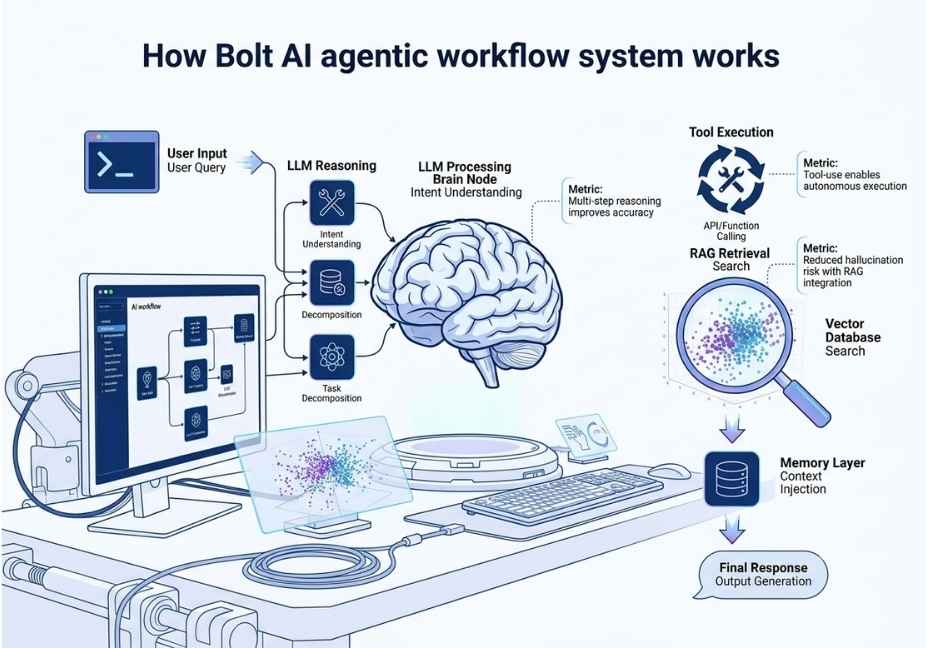
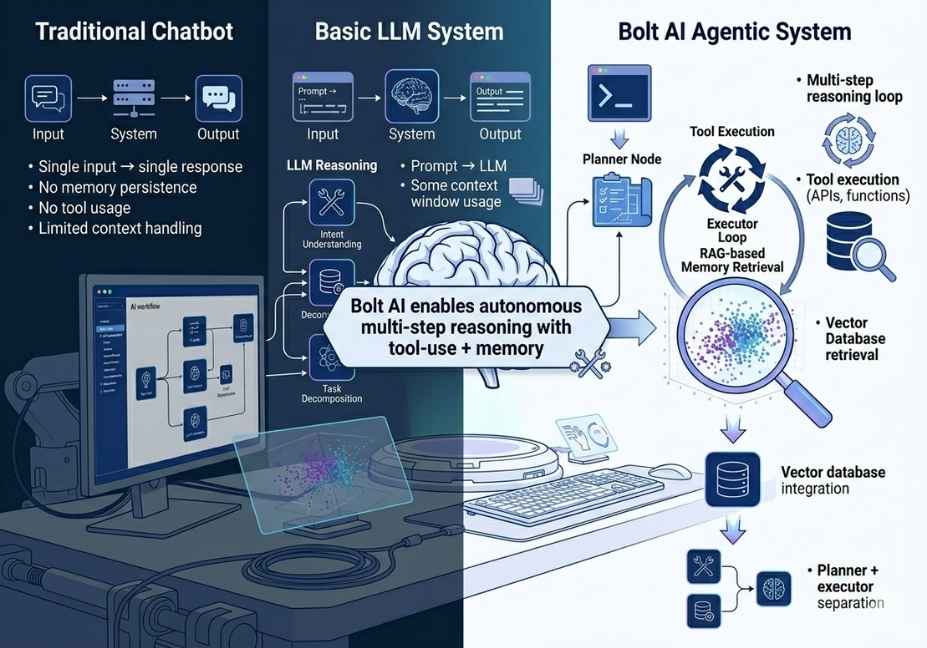
This is the section most reviews skip entirely. Bolt is not running a chain of LLM calls or a complex multi-agent orchestration graph. According to StackBlitz CTO Albert Pai, the entire app generation springs from a single, carefully engineered system prompt. However, what makes Bolt genuinely agentic is what happens after that prompt fires.
Here is the complete tool-use loop, step by step:
- You submit a natural-language prompt for example, “Build a SaaS dashboard with user auth and Stripe payments.”
- Claude receives the prompt and generates a full project plan, file structure, and code in one pass.
- WebContainer boots in parallel the browser-native VM initializes a sandboxed Node.js environment inside your tab.
- The agent executes scaffold commands
npm install, file writes, and server startup commands all run inside the VM. - Runtime feedback closes the loop if the server throws an error, Bolt reads the terminal output and feeds it back to Claude for an automatic fix attempt.
- The live preview renders as a result, you see a running app, not just a code dump.
Architect’s Note: This is a classic ReAct-style agent pattern (Reason + Act) without heavy multi-step planning overhead. The single-prompt scaffold works well at small scale. Moreover, the runtime feedback loop handles common errors automatically. That said, the architecture’s elegant simplicity is also its core limitation at large project scale.
Why WebContainers Are the Real Innovation
Most people focus on the AI layer. However, the more important piece of engineering here is WebContainers. Because WebContainers run Node.js entirely via WebAssembly inside a browser tab, Bolt eliminates the server-side VM overhead that makes other cloud IDEs slow and expensive. In other words, as CTO Albert Pai explained, “the server is your browser.” That design decision is why Bolt reached $40M ARR with an engineering team of just 15 people.
Bolt AI Use Cases 4 Real-World Examples That Actually Work
Bolt.new fits a specific class of projects extremely well. Therefore, before you commit tokens to a build, check your use case against these proven scenarios.
1. Rapid MVP Prototyping
A two-person agency needed a branded landing page with Stripe payments, user authentication, and a client portal all within 48 hours. Specifically, they used Bolt with Claude Sonnet and had a working version with a live database, auth, and payments within one hour of the first prompt. The remaining time went toward UI polish, not infrastructure plumbing. That is the real value of the tool.
2. React Component Scaffolding
Bolt handles React component generation reliably. Consequently, you can feed it a Figma screenshot or a plain description, and it will generate typed TypeScript components with Tailwind styling. This is especially useful for design-to-code handoff acceleration on fast-moving teams.
3. Internal Tools for Non-Technical Teams
Product managers and designers who need a quick admin panel, data visualization dashboard, or internal form without waiting for an engineering sprint are arguably Bolt’s strongest non-technical use case. Because the tool runs entirely in the browser, there is no setup friction for non-developers.
4. AI Agent Wrapper Apps
Developers building proof-of-concept apps that include AI agent pipelines can scaffold the wrapper application in Bolt quickly. For instance, an app with a Claude-powered chat interface or an OpenAI tool-calling demo can be bootstrapped in minutes, so you can focus your effort on the agent logic rather than the surrounding app shell.
Pro Tip: Write your first Bolt prompt like a product spec, not a casual request. Include your stack (React + Vite, or Next.js), your auth provider (Supabase or Clerk), your deployment target (Netlify), and the core user flows. The richer your initial context, the fewer token-burning revision cycles you will need.
Bolt.new vs. Lovable vs. v0 vs. Replit Full Comparison (2026)
All four platforms generate working code from prompts. However, they differ significantly in who they are built for and what “production-ready” actually means on each platform.
| Feature | Bolt.new | Lovable | v0 (Vercel) | Replit Agent |
|---|---|---|---|---|
| Primary strength | Zero-setup full-stack | Polished UI, fast MVPs | React UI components | Autonomous multi-language |
| Execution environment | In-browser WebContainer | Cloud VM | Vercel preview | Cloud IDE |
| Code visibility | Full, real-time | Partial | Full export | Full |
| Auth and DB setup | Supabase (manual config) | Supabase (guided) | External required | Built-in (Agent v2) |
| Time to working prototype | ~28 min (benchmark) | ~35 min | Component-only | ~45 min |
| Production-readiness | Medium | Medium | High (UI layer only) | High (full-stack) |
| Pricing model | Token-based, burnout risk | Credit-based | Token-based | Subscription |
| Best for | Technical founders | Non-technical founders | Design systems and UI | Full-stack MVPs |
The bottom line: If you want the fastest path to a working full-stack prototype and you can read code, Bolt.new wins. If you need polished UI and you are non-technical, Lovable is better. For React component generation specifically, v0 by Vercel is the strongest option. Finally, for production-grade autonomous builds across multiple languages, Replit Agent v2 leads.
How to Build Your First App With Bolt AI Step-by-Step Guide
Step 1: Write a Strong First Prompt
Do not start with “build me a todo app.” Instead, write a prompt that reads like a product spec:
Build a task management app using React + Vite + TypeScript.
Use Tailwind CSS for styling.
Include the following:
- User authentication via Supabase
- A kanban board view with drag-and-drop
- The ability to create, edit, and delete tasks
- A one-click Netlify deploy button
This level of specificity matters because Bolt makes most architectural decisions on the first pass. Changing them later costs significant tokens.
Step 2: Use the Enhance Prompt Feature First
Before you hit submit, use Bolt’s built-in Enhance Prompt feature. It expands your spec with sensible framework defaults and fills in configuration gaps. In practice, this step reduces early-revision token burn by a meaningful margin.
Step 3: Review the Scaffold Before Iterating
Once Bolt generates the initial project, scan the file tree and live preview before making any follow-up prompts. Identify structural issues early. Specifically, check whether the component architecture matches what you planned. Because fixing structure after 10 iterations is exponentially more expensive in tokens than fixing it at the start.
Step 4: Use Discussion Mode for Debugging
When something breaks, switch to Discussion Mode immediately. This mode lets you query Claude about the error without consuming generation tokens. It will not resolve deep architectural bugs, but it stops the token-drain loop for common issues like missing imports or misrouted API calls.
Step 5: Export and Push to GitHub Early
As soon as the scaffold is stable, push to GitHub. After that, you can use Cursor, VS Code, or Claude Code for complex logic and return to Bolt only for UI iterations. This hybrid workflow is how senior engineers get the best productivity-to-cost ratio from the tool.
Pro Tip: Treat Bolt as the scaffolding layer, not the finishing layer. Export at 60–70% completion and close the gap with a traditional IDE. That is currently the most cost-effective Bolt.new workflow for serious projects.
5 Common Bolt AI Mistakes and How to Avoid Them
Most Bolt.new project failures follow a predictable pattern. Fortunately, once you recognize the traps, they are easy to avoid.
Mistake 1: Iterating Without a Structural Review
Bolt synchronizes the entire project file tree on every prompt. As a result, token consumption scales non-linearly as your component count grows. Users have reported spending over 20 million tokens trying to fix a single authentication bug a spiral that starts when you iterate on top of a broken architectural foundation.
Fix: Review the project structure after every 5–10 prompts. If the architecture is drifting, issue a refactor prompt before adding new features.
Mistake 2: Treating Bolt Like a Local IDE
Bolt is cloud-only. Specifically, you cannot run your project locally for debugging. There is no built-in CI/CD pipeline, no unit testing framework, and no staging environment by default.
Fix: Export early, set up GitHub Actions for automated tests, and use Netlify’s preview deployment pipeline for staging. Do not rely on Bolt’s preview URL as your only runtime environment.
Mistake 3: Attempting Complex Auth on the First Pass
Authentication with Supabase is, by far, the most token-expensive operation in Bolt. One well-documented user case involved spending 3–8 million tokens on a basic auth implementation that still did not work correctly.
Fix: Start with mock auth a hardcoded login screen and defer real authentication to a post-export refactor. Validate the rest of your app logic first, then layer in real auth after you have exported clean code.
Mistake 4: Building Past 15–20 Components Without a Checkpoint
Bolt’s effective context window degrades at scale. Consequently, projects with more than 15 screens experience layout drift the AI progressively forgets spacing decisions, navigation patterns, and component architecture choices made earlier in the session.
Fix: Use Bolt’s checkpoint and rollback feature aggressively. For larger projects, consider splitting into separate Bolt sessions (one for frontend scaffold, one for backend logic) and integrating post-export.
Mistake 5: Ignoring Token Economics Until It’s Too Late
Token costs in Bolt are not like subscription credits. Because every prompt re-synchronizes the full project file tree, token consumption functions more like a tax on architectural uncertainty. The larger and messier the project, the more each prompt costs.
Fix: Budget your tokens like a resource, not an afterthought. Keep a rough count of tokens spent per major feature. If one feature is consuming more than 20% of your monthly allocation, stop iterating in Bolt and move that feature to a manual IDE workflow.
Technical Disclaimer: Bolt.new evolves rapidly. Token pricing, rollover policies (token rollover was introduced in July 2026), and infrastructure features described here reflect the platform as of mid-2026. Always verify current plan details at bolt.new before budgeting your project.
What Are Developers Actually Saying About Bolt AI?
Developer sentiment on Bolt.new is genuinely split. However, the split follows a clear pattern based on use case.
The positive camp indie hackers, solo founders, and non-technical product managers consistently reports dramatic productivity gains for prototyping. Andrej Karpathy coined the term “vibe coding” in February 2026 to describe exactly this pattern: building by intent, letting AI handle the implementation, and not reading the generated code. Bolt.new is the tool that best embodies that philosophy.
The critical camp senior engineers and teams targeting production deployments identifies the same failure modes repeatedly: token economics that punish iteration, context degradation at scale, and an architecture that handles the first 70% of an app brilliantly but becomes fragile in the final stretch.
One growth figure puts the tradeoff in context. Bolt went from $0 to $40M ARR in under six months, with an engineering team of just 15 people. Therefore, a large number of users are clearly getting real, immediate value from the platform even if that value is front-loaded toward the prototyping phase rather than production delivery.
Furthermore, Bolt v2 ships enterprise-grade infrastructure directly in the browser, including built-in databases, authentication, and hosting a direct response to the most common production complaints. So the gap between prototype and production is actively closing.
FAQ People Also Ask About Bolt AI
What is Bolt AI and how does it work?
Bolt AI (bolt.new) is a browser-based AI development agent by StackBlitz. It uses Anthropic’s Claude to generate full-stack web applications from natural-language prompts. The code runs inside WebContainers a browser-native Node.js VM built on WebAssembly so Claude can install packages, boot servers, and fix runtime errors automatically, all without leaving your browser tab.
Is Bolt.new good for building production apps?
Bolt.new is excellent for prototypes and MVPs. However, it has well-documented limitations at production scale. Projects with more than 15–20 components experience context degradation. Additionally, authentication setup is notoriously token-expensive, and the platform lacks built-in CI/CD, unit testing, or local development support. Bolt v2 added built-in databases and auth in 2026, which helps significantly. That said, most experienced practitioners recommend exporting and finishing in a traditional IDE before any production deployment.
What is the difference between Bolt.new and Lovable?
Both tools generate React apps from natural-language prompts. However, they serve different users. Bolt.new shows the code as it is generated, offering full transparency and edit control therefore it is better for developers. Lovable hides the code layer and produces more polished UIs with less technical friction consequently it is better for non-developers and designers. In head-to-head benchmarks, Bolt.new reaches a working prototype in approximately 28 minutes versus Lovable’s 35 minutes.
How does Bolt.new use Claude AI as its agent?
Bolt.new uses Anthropic’s Claude models as its core agent. Claude interprets your prompt, plans the project architecture, generates all project files, writes the shell commands for the WebContainer runtime, reads terminal error output, and generates revision passes when errors occur. In other words, the entire generation-and-fix cycle flows through Claude. Bolt’s WebContainer infrastructure simply provides the sandboxed execution environment where Claude’s instructions run.
What are the token limits for Bolt.new in 2026?
As of mid-2026, Bolt.new’s free tier provides approximately 100,000–200,000 daily tokens, with public-only projects. The Pro plan at $25 per month includes 10 million monthly tokens, with rollover for up to two months a feature added in July 2025. Complex applications typically consume 80,000–150,000 tokens per generation cycle. Importantly, debugging loops can burn millions of tokens on a single bug. Always check bolt.new for current pricing before starting a large project.
Can non-developers use Bolt AI to build a real app?
Yes, for simple to medium-complexity apps. Non-developers have successfully built landing pages, internal dashboards, portfolio sites, and lightweight SaaS prototypes with Bolt. The friction point arrives when debugging is required. Bolt’s Discussion Mode helps considerably. However, deep architectural bugs require code-level intervention. For non-technical users, Bolt.new works best when a developer is available to review the exported code and handle the final 30% of production readiness.
Conclusion
Bolt.new is the most technically significant thing to happen to browser-based development in years. Its importance does not come from generating code. Instead, it comes from giving an LLM a live runtime feedback loop. The WebContainer sandbox, the Claude-powered tool-use layer, and the single-prompt scaffolding architecture together make Bolt a legitimate agentic system in a way that most “AI coding tools” simply are not.
Use it for what it is designed to do: rapid scaffolding, prototype validation, and empowering non-developers on simple to medium-complexity builds. Write your first prompt like a product spec, export before you hit context degradation, and treat the token budget as an architecture metric rather than a usage credit.
In short, Bolt gets you 70% there, fast. The remaining 30% is still yours to build. That is not a flaw it is the current frontier of agentic code generation. As the tool matures, that frontier keeps moving forward.
For more deep-dives on agentic AI systems, LLM tool-use patterns, and real-world deployment workflows, explore agentiveaiagents.com.
15 Responses