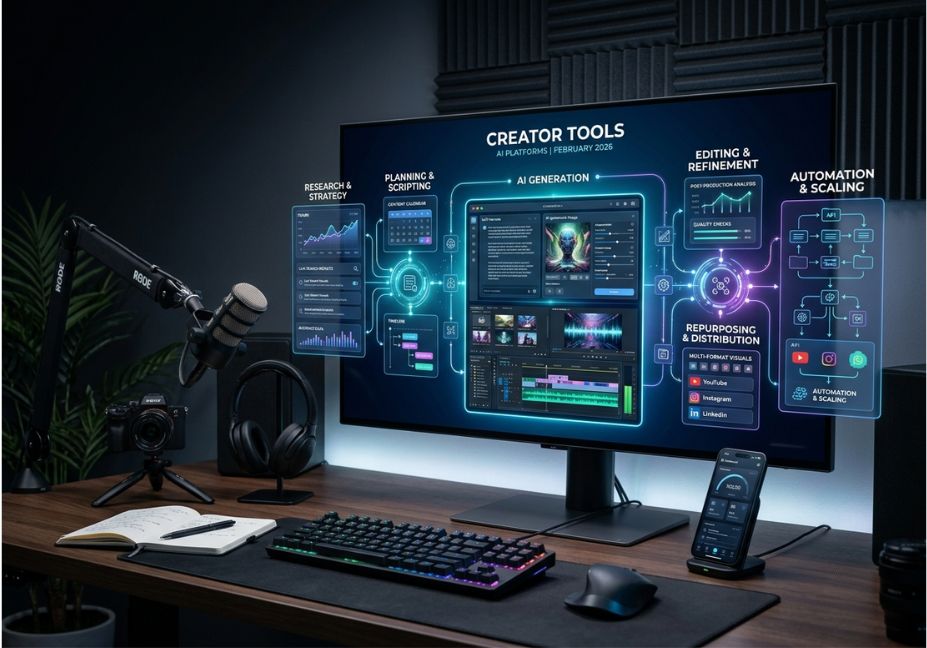
Most “AI creator tool” comparisons fail creators for the same reason agent demos fail in production: they focus on the model’s writing sample instead of the tool-use loop that decides what gets researched, drafted, and published. A single-shot prompt to a chatbot is not a content pipeline it has no memory, no retrieval step, and no way to check its own output against a brief. By February 2026, the platforms actually saving creators time aren’t bigger chatbots; they’re agentic AI systems that plan a task, call tools, retrieve context, and only then generate. Understanding that architecture not just the feature list is how you pick a platform that survives contact with a real editorial workflow.
What Is an Agentic AI Creator Platform?
An agentic AI creator platform is software that pairs a large language model with memory, tool access, and an orchestration layer so it can complete a content task end-to-end research, draft, format, and often publish rather than just returning text for a human to copy and paste. The distinction matters because a plain writing assistant stops at generation; an agent decides which actions to take next.
How Does an Agentic Creator Workflow Work?
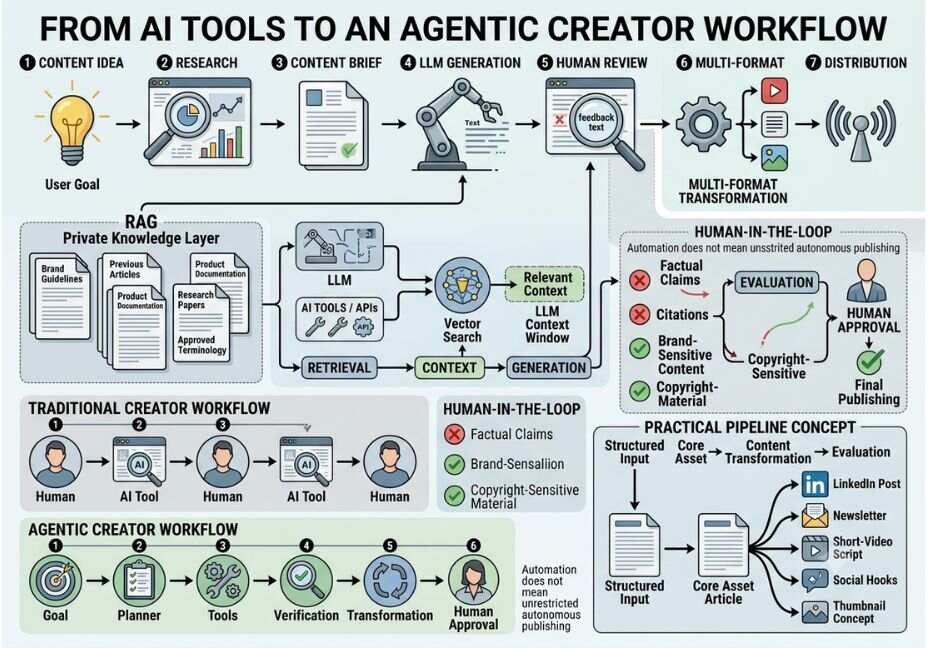
Under the hood, most 2026-era creator agents follow a loop popularized by the original ReAct paper (Yao et al.): reason about the goal, select a tool, observe the result, and repeat until the task is done.
- Planning module decomposes “write a product launch blog” into subtasks: research competitors, pull brand voice guidelines, draft, format for CMS.
- Tool-use loop the agent calls external tools (web search, a CMS API, an image generator) and feeds results back into its own context.
- Memory retrieval a RAG layer pulls relevant brand documents or past posts from a vector store so output stays on-brand instead of generic.
- Orchestration layer coordinates multiple agents (a researcher, a writer, an editor) when the task is too complex for a single model call.
Interoperability got a real standard in this cycle: Anthropic’s Model Context Protocol specification now lets creator agents connect to CMS platforms, design tools, and analytics dashboards through one consistent interface instead of a custom integration per tool which is why you’re seeing MCP-native plugins ship inside WordPress and Webflow builders this year.
Technical Note: Co-occurrence to watch for: context window + chunking strategy. Agents pulling from a large brand knowledge base need a retrieval step that chunks documents sensibly dump too much raw text into the context window and quality drops even with a capable model.
python
# Simplified tool-use loop for a content agent
def run_content_agent(brief, tools, memory_store):
    context = memory_store.retrieve(brief.topic, k=5)  # RAG step
    plan = planner.decompose(brief, context)
    for step in plan:
        result = tools[step.tool_name].call(step.args)
        context = context + result
    draft = writer.generate(brief, context)
    return editor.review(draft)  # human-in-the-loop checkpoint
AI Creator Platform Use Cases in February 2026
- Solo creators: a single agent researches a topic, drafts a post, and generates matching social captions in one pass.
- Agencies: multi-agent crews split research, drafting, and brand-voice QA across specialized agents running in parallel.
- Enterprise marketing teams: agents connect to internal knowledge bases via RAG so output reflects proprietary data instead of generic web knowledge.
- YouTube/video creators: agents handle the non-creative grunt work transcript cleanup, chapter markers, thumbnail variant generation while a human keeps editorial control of the story.
Best Agentic Tools and Frameworks Compared
| Platform | Best For | Orchestration Style | Notable Limitation |
|---|---|---|---|
| LangGraph | Developer teams building custom pipelines | Graph-based, stateful multi-step agents | Requires Python/dev resources |
| CrewAI | Role-based agent “crews” (researcher, writer, editor) | Multi-agent, task-delegated | Less mature ecosystem than LangGraph |
| Claude-based writing agents | Long-form, nuance-heavy content with brand-voice consistency | Single agent, large context window | Needs external tools for publishing actions |
| No-code builders (Gumloop-style) | Non-developers automating a repeatable content workflow | Visual, node-based | Less flexible for edge-case logic |
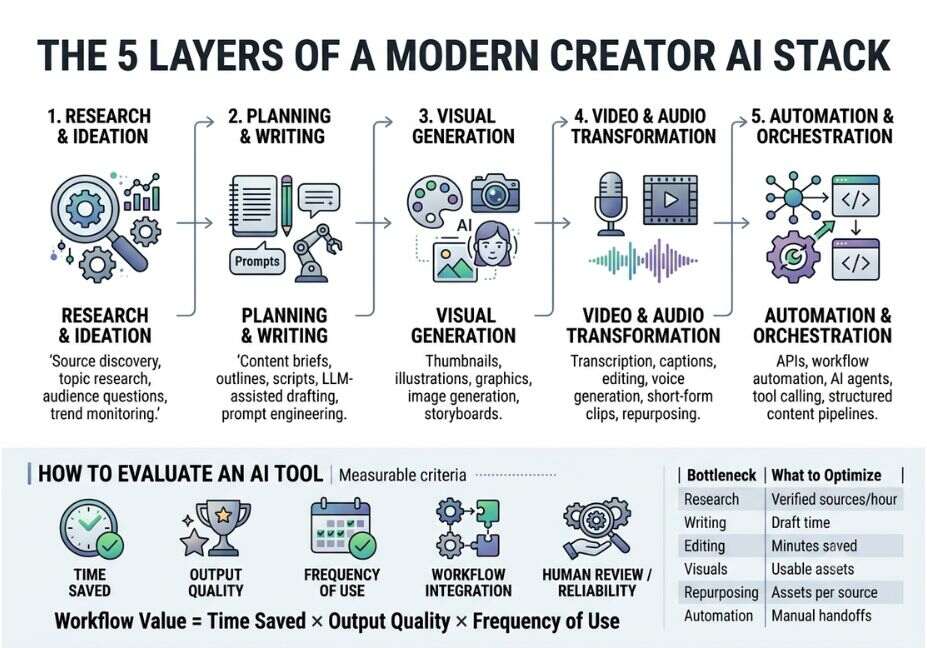
Pro Tip: Don’t pick a platform by feature count. Pick by where your bottleneck actually is research, drafting, or distribution and choose the narrowest agent that fixes that one link in the chain first.
Step-by-Step: Implementing an Agentic Content Pipeline
- Define the brief as structured data audience, tone, target keyword, and format, not a vague prompt.
- Connect a retrieval layer index brand docs and past content into a vector store so the agent has ground truth to cite.
- Give the agent scoped tool access a search tool, a CMS-publish tool, an image tool via MCP or a framework’s native tool interface.
- Add a human-in-the-loop checkpoint require approval before the agent publishes, not just before it drafts.
- Log every tool call you need an audit trail to debug hallucinations or bad tool outputs after the fact.
Technical Disclaimer: Framework APIs in this space evolve quickly. Code and integration details in this article reflect LangGraph and MCP specifications current as of February 2026. Always check the official documentation for the latest version before shipping.
Common Mistakes and How to Avoid Them
- Skipping retrieval accuracy checks an agent with a stale or poorly chunked vector store will confidently cite outdated brand facts.
- No human-in-the-loop gate before publish autonomous publishing without review is how agent teams end up with off-brand or hallucinated claims live on a site.
- Over-scoping a single agent one agent trying to research, write, design, and publish tends to underperform a small crew of narrower agents with clear handoffs.
- Ignoring tool failure handling a tool-use loop with no retry or fallback logic breaks silently when an API call times out mid-task.
What Developers Are Saying
Builder communities on r/LocalLLaMA have been actively comparing open-source orchestration frameworks against closed platforms this cycle, with recurring threads on where multi-agent setups add real value versus where a single well-prompted agent with good retrieval outperforms a complex crew a useful reality check before you over-engineer a pipeline.
FAQ People Also Ask
What is an agentic AI creator platform?
It’s a system that pairs an LLM with memory, tools, and an orchestration layer so it can research, draft, and often publish content autonomously, rather than just returning text for a human to edit.
How do AI agents differ from AI writing tools?
Writing tools generate text from a prompt and stop. Agents plan a task, call external tools, retrieve context via RAG, and take multiple actions toward a goal without a new prompt at each step.
Can AI agents publish content without human review?
Technically yes, but most production pipelines keep a human-in-the-loop checkpoint before publish to catch hallucinations, off-brand tone, or factual errors the agent’s tools didn’t verify.
What is the Model Context Protocol and why does it matter for creators?
MCP is an open standard that lets AI agents connect to external tools CMS platforms, design apps, analytics through one consistent interface instead of custom integrations for each tool.
Are agentic AI tools worth it for solo creators?
For creators publishing regularly across formats, yes even a single agent with retrieval and one or two tool connections removes real research and formatting time. Full multi-agent crews are usually overkill until you’re managing a team’s output.
Conclusion
The AI creator tooling landscape in February 2026 has split into two tiers: single-shot writing assistants, and true agentic platforms that plan, retrieve, and act. The tools worth adopting are the ones built around a clear tool-use loop, a retrieval layer grounded in your own content, and a human-in-the-loop checkpoint before anything goes live. Start narrow fix your actual bottleneck with one well-scoped agent before reaching for a full multi-agent crew. Explore more hands-on breakdowns of agent architecture and RAG pipelines at agentiveaiagents.com.