
Most teams still check rankings the way they did in 2019 a keyword, a position number, a green-or-red arrow. However, that model breaks the moment a query routes into Google’s AI Mode, where there’s no position 1 to hold. Instead, the system runs several background sub-searches, synthesizes an answer, and cites a handful of sources by claim, not by rank. As a result, an AI mode rank tracker tool is now the instrumentation layer that tells you whether your content actually made that cut.
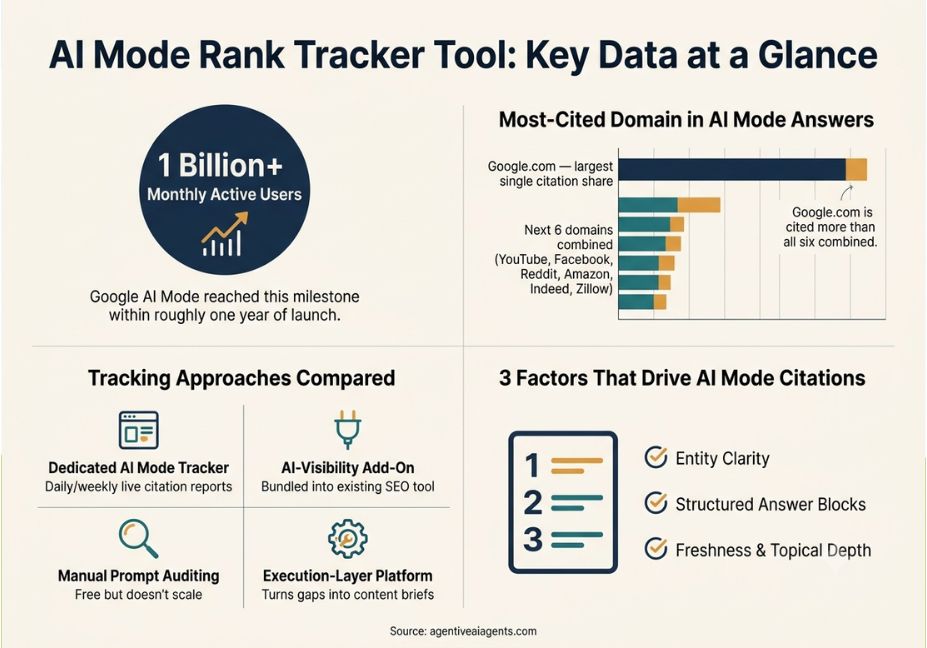
This isn’t a cosmetic shift. In fact, Google’s AI Mode passed roughly a billion monthly active users within about a year of launch, and it now activates for a growing share of queries rather than a narrow trigger set. So if your monitoring stack still only watches the ten blue links, you’re blind to where a large and growing slice of visibility now happens whether you’re running an in-house SEO team, an agency reporting on client accounts, or a solo founder trying to track AI Mode rankings for free with a handful of manual prompts.
Quick Answer: An AI mode rank tracker tool monitors whether your website gets cited inside Google AI Mode’s generated answers, not just where it ranks in traditional search. It works by running a set list of prompts through AI Mode on a schedule, then logging which domains and pages get cited, how often, and against which competitors.
What Is an AI Mode Rank Tracker Tool?
An AI mode rank tracker tool is software that runs target prompts through Google’s AI Mode on a schedule, captures the generated response, and extracts which domains and URLs were cited then reports that as a citation count or a share-of-voice metric relative to competitors.
Unlike classic rank tracking, there’s no fixed ten-slot list to scrape. Instead, the tool has to parse a conversational, multi-turn answer and identify structured citation data inside it a process closer to how a retrieval-augmented generation pipeline itself selects and cites sources. This distinction is exactly what you should filter for if you’re comparing an AI mode rank tracker tool for agencies versus a lightweight option for a single site.
How Does AI Mode Ranking Actually Work?
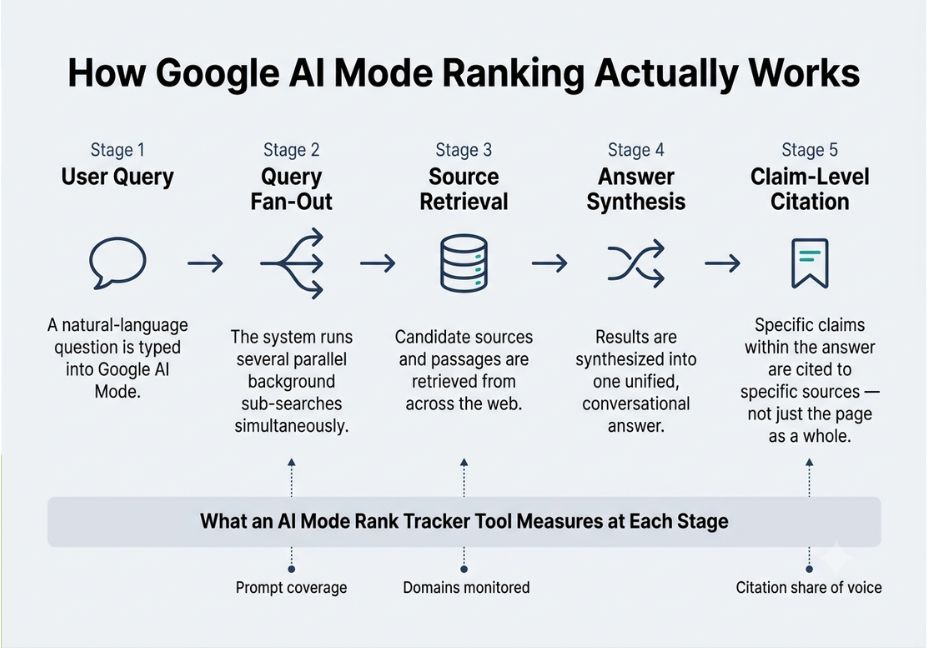
AI Mode doesn’t rank pages it retrieves passages. First, a single user question can trigger multiple parallel sub-searches (often called query fan-out), each pulling candidate sources. Then the system synthesizes one unified answer and attaches citations at the claim level rather than the page level.
That architecture is functionally close to what researchers described in the original RAG paper: retrieve a set of relevant passages, then condition generation on them. Consequently, for SEO teams, entity consistency, structured content, and topical depth now matter more than exact-match keyword density. You won’t see this reflected in Google Search Console or the Knowledge Graph directly, either which is precisely why a dedicated AI mode rank tracker tool has become necessary rather than optional.
Technical Note: AI Mode citations are delivered as structured fragments tied to the specific claim they support, not to the page as a whole. A tool that only checks “was my domain mentioned anywhere” misses which specific claim earned the citation and that’s the detail that tells you what content actually worked.
Three factors consistently show up across teams studying AI Mode citation selection:
- Entity clarity consistent brand facts across your site, Wikipedia, and third-party directories
- Structured, self-contained answer blocks content written so a single paragraph can be lifted and cited independently
- Freshness and topical depth pages that cover a query’s full context, not just the primary keyword
AI Mode vs. AI Overviews: Why Tracking Both Matters
AI Overviews are the shorter, generated summaries that sometimes appear above traditional results for a subset of queries. AI Mode is a separate, full-screen conversational interface closer to Gemini than to a SERP snippet that appears across a much broader set of queries and supports multi-turn follow-ups. Because the two surfaces pull from different source-selection logic, a brand can be well-cited in one and absent from the other, so tracking only one gives an incomplete picture of AI visibility.
Comparison:
- Traditional SERP Format: 10 ranked links. Trigger rate: nearly all queries. Personalization: low.
- AI Overviews Format: short generated summary above results. Trigger rate: subset of queries. Personalization: moderate.
- AI Mode Format: full conversational, multi-turn answer. Trigger rate: broad, expanding. Personalization: high.
AI Mode Rank Tracker Tool Use Cases
1. Brand visibility monitoring. First, track whether your brand gets cited even when there’s no backlink useful for measuring awareness in answer-based search.
2. Competitive share of voice. Next, compare how often your domain is cited against named competitors for the same prompt set, and track the trend over weeks rather than a single snapshot.
3. Content gap detection. Similarly, identify prompts where a competitor is cited and you aren’t, then treat that gap as your next content brief.
4. Agency reporting. Finally, for agencies specifically searching for the best AI mode rank tracker tool for multiple clients, multi-client dashboards separate AI Mode citation counts from traditional keyword rankings, so reports reflect where visibility is actually shifting.
Did You Know? One large-scale citation study found Google.com itself was the single most-cited domain across AI Mode answers cited more often than the next six domains combined, including YouTube and Reddit. That’s a structural bias worth accounting for when you benchmark your own citation share against “everyone else.”
Best Tools and Approaches: Comparison
| Approach | What It Tracks | Best Fit | Limitation |
|---|---|---|---|
| Dedicated AI Mode tracker (e.g., prompt-based SaaS platforms) | Live AI Mode citations, position within answer, competitor overlap | Teams needing daily/weekly AI visibility reports | Personalization means results vary by user context; no single tool sees “the” answer |
| AI-visibility add-on inside existing rank tracker | AI Mode + AI Overviews + traditional SERP, one dashboard | Teams that don’t want a second tool/login | Often an upsell tier; AI Mode coverage may lag standalone tools |
| Manual prompt auditing | Whatever you type in manually | Small sites, occasional spot-checks | Doesn’t scale, no historical trend data, easy to miss volatility |
| Execution-layer platforms | Citation gaps mapped directly to content briefs | Teams that want insight turned into action, not just a dashboard | Higher price point; still requires a content team to execute |
Pro Tip: Before paying for any tool, run the same 10–15 prompts manually in AI Mode over three separate days. If your manual citation count and the tool’s reported count diverge by more than a small margin, treat that gap as a sampling/personalization artifact, not a tool error and factor it into how much weight you give any single week’s report.
Free AI Mode Rank Tracking Tools Worth Using
So, which tools actually let you check AI Mode rankings without paying anything? Here’s what’s genuinely usable at $0 right now:
| Tool | Free Tier | Best For | Catch |
|---|---|---|---|
| Teun.ai AI Rank Tracker | Unlimited single checks, no signup | Quick spot-checks by keyword + location | No built-in historical logging |
| AI Overviews Checker | 3 checks/day | Small sites tracking a handful of core terms | Built for AI Overviews, not AI Mode specifically |
| Google Search Console | Free, unlimited | Confirming whether AI-surfaced traffic reaches your site | Doesn’t show AI Mode citations directly, only downstream clicks/impressions |
| SE Ranking / Otterly.ai trials | 10–14 day trial | Testing enterprise-style dashboards before buying | Reverts to paid after the trial not a lasting free option |
Did you know? At least one free checker returns a result in about 15 seconds per query fast enough for manual spot-checks across a keyword list in one sitting, but not a substitute for scheduled monitoring at scale.
Pro tip: Pair a free single-query checker with Google Search Console’s Performance report filtered by query. If Search Console shows impressions on a question-style query with near-zero clicks, that’s often a sign AI Mode is answering the query directly above your listing.
Free Tools vs. Paid Platforms Where the Line Actually Sits
Free tools are built for occasional spot-checks. Paid platforms exist because agencies and larger sites need three things free tools rarely offer: historical trend lines, multi-brand comparison, and scheduled automation. Some newer entrants have even moved to wallet-based, pay-per-check pricing specifically because freelancers and small teams don’t want a flat monthly fee for checks they run irregularly which is itself a signal that the market treats “free/occasional” and “paid/scheduled” as genuinely different use cases, not a lesser and greater version of the same product.
If your actual need is “check three keywords twice a month,” a free tool is genuinely sufficient. If it’s “track fifty keywords daily across four competitors,” you’ll hit the free-tier wall fast and that gap is what the next section addresses.
Step-by-Step: Setting Up AI Mode Tracking
- Build a prompt list, not a keyword list. To start, AI Mode responds to natural questions, so write 20–50 prompts the way a real user would type them, including follow-up-style phrasing.
- Segment prompts by funnel stage. After that, group informational, comparison, and transactional prompts separately, since citation behavior differs across each.
- Connect the tracker and set a refresh cadence. Generally, daily is ideal for volatile categories, while weekly is workable for stable, low-competition niches.
- Map citations back to specific pages, not just the domain, so you know which content is actually earning the mention.
- Finally, cross-check against Google’s own guidance on AI features in Search to confirm your structured data and content formatting align with current best practice.
python
# Minimal example: fan out a prompt list and log citation domains
# (pseudocode — swap in your chosen AI Mode tracking API/vendor SDK)

prompts = load_prompt_list("prompts.csv")
results =

for prompt in prompts:
    response = ai_mode_client.query(prompt)          # vendor API call
    citations = extract_citations(response)            # parse cited domains/URLs
    results.append({"prompt": prompt, "citations": citations})

save_report(results, "ai_mode_visibility_report.csv")
Technical Disclaimer: AI Mode’s underlying retrieval behavior changes frequently and isn’t publicly documented by Google in full. Treat any specific mechanic described here including citation formatting and fan-out behavior as accurate as of mid-2026, and verify against current vendor documentation before building automation around it.
How Do You Validate an AI Mode Tracker Before You Buy?
In short, don’t take a vendor’s dashboard at face value run this check yourself first.
- Pick 5 queries your brand should realistically be cited for.
- Run each query manually in AI Mode, logged out, from your primary market, and note whether your domain appears.
- Ask the vendor to run the same 5 queries through their tool and compare results.
- Repeat from a second country to confirm geo-localization actually changes the citations returned identical output across markets is a red flag.
- Check citation parsing accuracy, not just inclusion does the tool correctly attribute the domain and position, or just flag a keyword match?
For teams comfortable writing their own lightweight checks, a minimal Python skeleton using Playwright looks like this:
from playwright.sync_api import sync_playwright

def check_ai_mode_citation(query: str, target_domain: str):
    with sync_playwright() as p:
        browser = p.chromium.launch(headless=True)
        context = browser.new_context(locale="en-US")  # set geo/locale explicitly
        page = context.new_page()
        page.goto(f"https://www.google.com/search?q={query}&udm=50")  # AI Mode param
        page.wait_for_selector("[data-attrid='AIMode']", timeout=15000)
        content = page.content()
        cited = target_domain in content
        browser.close()
        return {"query": query, "cited": cited}

result = check_ai_mode_citation("best project management software", "yoursite.com")
print(result)
This won’t replace a production-grade tracker Google’s markup shifts constantly and this needs error handling, retries, and proxy rotation to run reliably at scale but it’s enough to sanity-check a vendor’s claims against ground truth.
Common Mistakes and How to Avoid Them
- Treating AI Mode like AI Overviews. They select and display sources differently, so a tool built only for Overviews will misreport your AI Mode standing. For comparison, look at how a traditional search engine results page is structured to see just how far AI Mode has moved from that layout.
- Chasing one-day spikes. Because of personalization and the sheer number of concurrent experiments Google runs on AI Mode, single-day citation counts are noisy. Track a rolling average instead.
- Ignoring uncited traffic value. Even so, a citation with no click still signals topical authority Google’s system trusts don’t discard it just because it didn’t drive a session.
- Skipping entity cleanup. Ultimately, inconsistent brand details across your site, directories, and Wikipedia create friction that measurably reduces citation odds.
Google Discover Note: Discover surfaces content based on entity relevance to a reader’s interests rather than a search query, and it strongly favors a large, high-quality hero image (min. 1200px wide), a clear author byline with real credentials, and a headline that states the topic plainly rather than teasing it. For this article, pair it with a labeled diagram image, attribute it to a named author with an “AI search / SEO” bio line, and avoid punctuation-heavy or clickbait framing in the title Discover’s systems downrank exaggerated headlines.
What Practitioners Are Saying
SEO and growth practitioners tracking this space have converged on a shared theme: organic rank and AI Mode citation are increasingly separate games. Teams report cases where a page ranks well organically but never gets cited in AI Mode, and vice versa reinforcing that these need distinct tracking, not a single repurposed dashboard.
Structured Data & Hidden Semantic Signals (Implementation Notes)
Text alone doesn’t fully cover semantic SEO the markup around it matters just as much for AI search engines and featured snippets. Add the following when this article is published:
- FAQPage schema wrapping the FAQ section, using the exact question/answer text above so AI Overviews, AI Mode, and voice assistants can extract it directly.
- Article schema with
author,datePublished,dateModified, andpublisherfields this is also an E-E-A-T signal Google Discover weighs. - HowTo schema on the “Step-by-Step: Setting Up AI Mode Tracking” section, since it’s a numbered procedural list.
- BreadcrumbList schema so the URL path reinforces topical hierarchy (e.g., Blog > AI Search > AI Mode Rank Tracker Tool).
- Descriptive, keyword-natural alt text on every image for example,
alt="AI Mode rank tracker tool dashboard showing citation share of voice"rather than a generic filename. - Internal links to any existing agentiveaiagents.com content on RAG, agentic workflows, or prompt engineering, so this page sits inside a clearly connected topic cluster rather than as an orphan post this is what actually builds topical authority over time, more than any single page’s optimization.
How do I check if my website shows up in Google AI Mode? (Voice search)
You can check manually by running your target queries in AI Mode yourself and scanning the citation chips for your domain. However, for consistent, repeatable tracking, most teams use a dedicated tool because manual checks miss session-to-session volatility.
What is the best AI mode rank tracker for small businesses? (Long-tail / voice search)
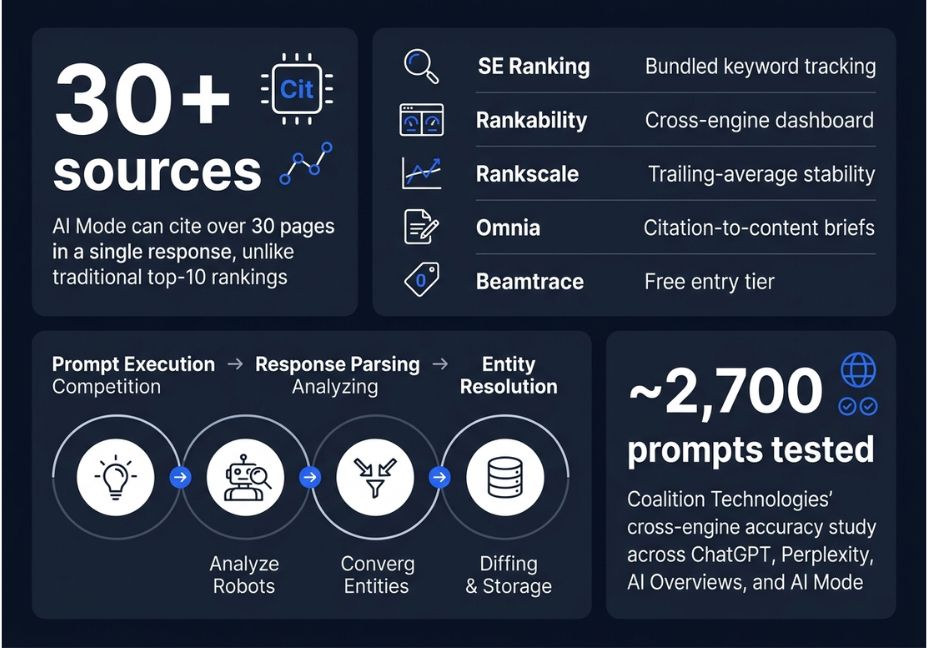
For small businesses on a limited budget, Beamtrace’s free tier is a reasonable starting point since it requires no credit card. That said, agencies and larger brands generally need a paid, multi-engine tool like Rankability or Rankscale for competitor-level reporting.
FAQ People Also Ask
It’s a monitoring tool that runs target prompts through Google’s AI Mode on a schedule and reports which domains and URLs get cited in the generated answers, giving you a citation-based visibility metric instead of a fixed SERP position.
AI Mode is a dedicated, full-page conversational search experience supporting multi-turn follow-ups, while AI Overviews are a summary block embedded at the top of standard search results. AI Mode tracking has to account for conversation depth, not just a single summary.
Yes. Most AI mode rank tracker tools detect unlinked brand mentions inside a generated answer, which matters because AI Mode frequently paraphrases and cites without always hyperlinking every source.
Traditional ranking assigns your page a fixed position among ten results. AI Mode instead decides whether a claim in a synthesized answer cites your content at all — position becomes secondary to citation-worthiness.
Daily tracking suits competitive or fast-moving categories; weekly is reasonable for stable niches. Because Google runs many concurrent experiments on AI Mode, a single check gives you a snapshot, not a trend track a rolling average instead.
Yes, though citation volume will naturally be lower. Smaller sites benefit most from prompt-level tracking that shows exactly which questions surface them, rather than an aggregate score that hides the detail.
Use a dedicated AI mode rank tracker tool that runs your target prompts on a schedule and reports citations by page, not just by domain. That’s the fastest way to see what’s actually working.
Conclusion
An AI mode rank tracker tool exists because the unit of visibility changed from “position on a page” to “cited inside an answer.” The teams getting real value from these tools aren’t the ones with the biggest dashboard; they’re the ones treating citation data as a feedback loop into their content process: entity cleanup, structured answer blocks, and prompt-level gap analysis, checked on a cadence that accounts for AI Mode’s inherent volatility. Choosing an AI mode rank tracker tool is really a decision about how seriously you want to take that feedback loop. Bookmark this guide and explore more hands-on AI agent and search-infrastructure tutorials at agentiveaiagents.com.