
An AI deep research tool is an autonomous agent that plans, searches, reads, and synthesizes information from dozens or hundreds of sources into a cited report. Common use cases include market research, investment due diligence, literature reviews, and policy research but outputs still need human review because these agents can hallucinate.
Most teams evaluating an AI deep research tool treat it like a faster search engine. That’s the wrong mental model, and it’s why so many pilots stall after week two. A deep research agent isn’t retrieving one answer. Instead, it runs a multi-step tool-use loop: planning a research strategy, dispatching sub-agents to search and read, and synthesizing findings into a cited report. For example, Deep Research Bench, a benchmark that evaluates AI web research agents across 89 multi-step tasks spanning eight categories, shows just how much variance exists between systems that all claim to do “deep research.”
That gap between marketing copy and actual agent behavior is exactly what this guide closes. Below, we break down how these systems are architected, the use cases where they deliver real ROI, and the failure modes your team needs to guard against before shipping a deep research workflow into production.
What Is an AI Deep Research Tool? (Featured Snippet Target)
An AI deep research tool is an autonomous AI agent that decomposes a broad query into a research plan, executes dozens or hundreds of searches and page reads, and compiles the findings into a structured, citation-backed report. In short, it relies on retrieval-augmented generation (RAG) layered with iterative reasoning, rather than a single lookup.
This is the core distinction from ordinary AI search: depth over speed, synthesis over retrieval. As a result, a deep research agent builds a tailored research plan, navigates hundreds of web pages, and compiles everything into a structured report with inline citations — closer to a junior analyst than a search box.
How Does a Deep Research Agent Work? (Voice Search Target: “How does AI deep research work?”)
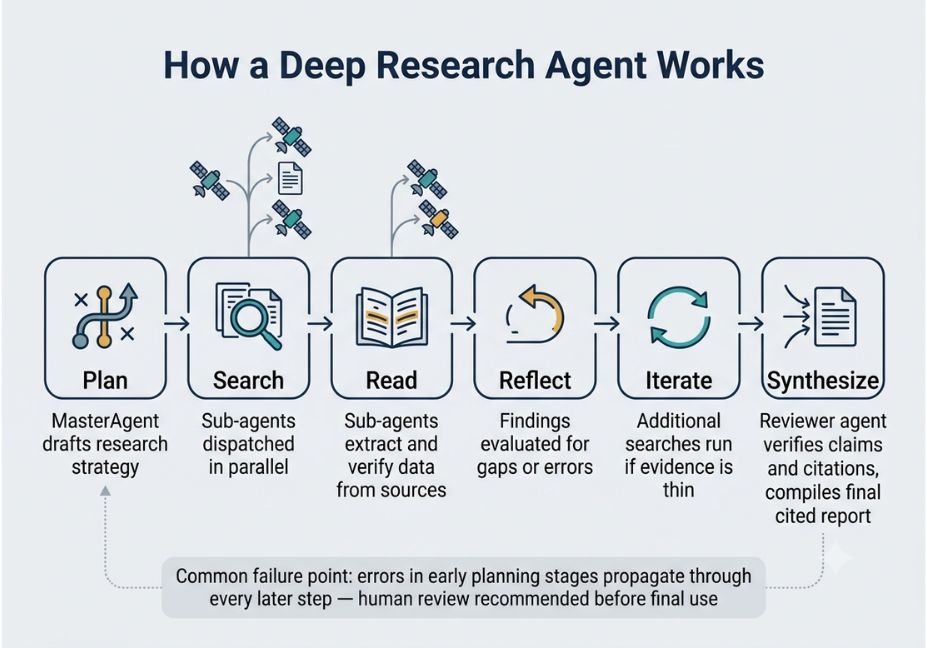
The dominant architectural pattern recurs across nearly every mature implementation: plan, search, read, reflect, iterate, and synthesize. These systems decompose vague queries into structured research plans, then fan out across dozens to hundreds of web sources over 10 minutes to 2 hours, maintaining evidence state across context windows that would otherwise overflow.
Most production systems have also moved past a single-agent ReAct loop, the reasoning pattern first introduced by researchers Yao and colleagues in 2022. Plain ReAct is tactical rather than strategic. It’s good at picking the next best action but lacks the foresight to build a high-level, multi-stage plan, and it can’t delegate tasks or explore multiple lines of inquiry in parallel.
Because of this limitation, the current generation of tools layers a planning module on top. A MasterAgent, for instance, drafts the strategy, spins up specialized sub-agents for parallel search tracks, and hands off to a separate reviewer pass that checks whether claims trace back to real sources. This pattern greater autonomy, dynamic task planning, and continual reasoning is what separates deep research agents from traditional RAG and tool-use systems, according to recent agent-architecture research.
Architect’s Note: If you’re prototyping this pattern yourself, LangChain’s orchestration layer and graph-based agent frameworks are the fastest path to a working planner/sub-agent split. Anthropic, OpenAI, and DeepMind have each published their own variations on this multi-agent research pattern, so it’s worth comparing a few before committing to one architecture.
AI Deep Research Tool Use Cases 7 Real-World Examples
Here’s where deep research tools are actually earning their keep in production, not just in demos.
- Market and competitive research. Market research, competitive analysis, and industry trend reports are among the most common applications. The multi-source fan-out is what makes this faster than a human analyst doing the same sweep manually a common long-tail need for teams searching “AI tools for competitive analysis.”
- Investment and financial due diligence. Scanning financial documents and news for investment risk analysis is a widely cited use case. Deep research adds automation and analytical depth to that workflow, which matters for anyone researching “best AI deep research tools for finance teams.”
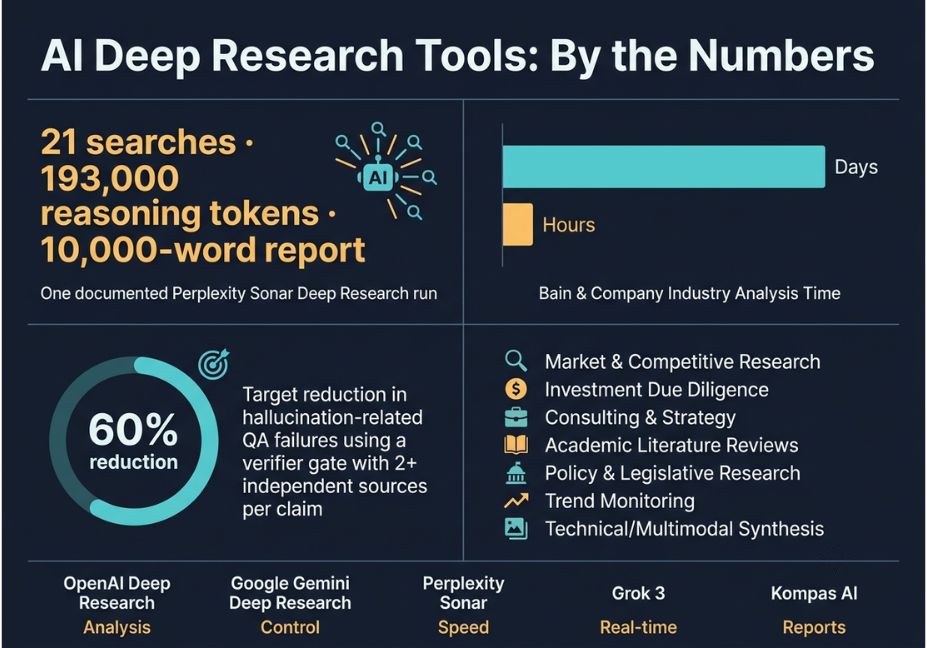
- Consulting and strategy work. At Bain & Company, deep research has reportedly cut industry analysis time from days to hours. Consequently, individual consultants can process hundreds of reports while focusing their own expertise on interpretation and strategy.
- Academic literature reviews. Deep research systems are particularly effective for systematic literature reviews that require exhaustive coverage of existing research. However, see the Common Mistakes section below before trusting citations blindly.
- Policy and legislative research. These tools can be configured to prioritize specific source types, such as academic databases or government repositories, rather than an open web crawl. This matters for legislative and policy staff who need defensible sourcing.
- Trend monitoring and general business research. Google Gemini’s Deep Research, for example, lets users refine the research plan before execution and integrates with Google Search and Workspace, making it effective for general business research.
- Technical documentation and multimodal synthesis. Deep research agents can also process images, video, and audio analyzing charts in PDFs, transcribing interviews, and cross-referencing data across media types. This extends the use case list well past plain-text research.
Did You Know? One documented Perplexity Sonar Deep Research run executed 21 searches, generated over 193,000 reasoning tokens, and produced a 10,000-word report a scale of synthesis no single chatbot turn can match.
Best AI Deep Research Tools and Frameworks Compared
Not every tool uses the same planner-plus-retriever split, and the differences matter for which use case fits best.
| Tool | Core Strength | Best Fit |
|---|---|---|
| OpenAI Deep Research | Deep financial/document analysis | Investment & risk research |
| Google Gemini Deep Research | Plan-before-execute control, Workspace integration | Business & trend research |
| Perplexity Sonar Deep Research | Fast, citation-backed synthesis | Quick multi-source summaries |
| Grok 3 (xAI) | Real-time X data integration | Breaking news, live events |
| Kompas AI | Evidence-rich professional reports | Academic & professional writing |
Perplexity delivers quick, citation-backed summaries but struggles with complex reasoning. Meanwhile, Kompas AI excels at generating professional-grade, evidence-rich reports for academic and professional applications. In other words, pick based on whether you need speed or depth.
Pro Tip: Match the tool to the source constraint, not just the topic. If your research needs to stay inside vetted repositories, such as legal, policy, or clinical sources, choose a tool that supports scoped source lists rather than a general open-web crawler.
How to Use an AI Deep Research Tool: Step-by-Step
- Scope the query narrowly. Vague prompts produce vague plans, so specify the decision the research needs to support, not just the topic.
- Set source constraints upfront if you need government, academic, or proprietary-only sourcing.
- Let the tool show its plan before it runs, if the interface allows it (Gemini Deep Research supports this).
- Review the trajectory, not just the final report. Check which sources were used per claim, not only the summary.
- Spot-check citations against originals. Treat every number and quote as unverified until you’ve clicked through.
- Re-run ambiguous sub-claims as targeted follow-up queries rather than trusting a single pass.
Common Mistakes and How to Avoid Them
The single biggest mistake teams make is treating a deep research report as ground truth simply because it has citations. Current deep research agents still show substantial weaknesses in grounding, intent satisfaction, and long-horizon error control. Consequently, hallucination propagation and cognitive biases, such as the anchor effect, remain systemic causes of unreliable output.
For a rigorous breakdown of where these errors originate, one process-aware evaluation framework audits the full plan-search-summarize trajectory rather than just the end output a more useful mental model than “did the final report look polished.” Other recurring failure patterns include:
- Chronological or anchor errors. Some tools return citations published after the target document for example, returning 2022 papers when a 2018 paper was used as the anchor.
- Stopping-criteria failures. Agents show failure modes ranging from premature stopping (under-retrieval) to hedging, where they cast an overly wide net of low-confidence answers to inflate recall.
- Error propagation from flawed early plans. An error in an early planning stage can negatively impact all subsequent steps, which is why human-in-the-loop validation remains critical to this architecture.
Technical Disclaimer: Deep research product behavior evolves fast. Feature availability, source scoping options, and reasoning-token limits referenced here reflect the state of major tools as of mid-2026. Always confirm current capabilities in the vendor’s own documentation before committing a workflow to production.
What Developers Are Saying
Builder discussion on this pattern has shifted from “can it search” to “can it be trusted at scale.” Practitioners tracking production deep research pipelines report targeting a 60% reduction in hallucination-related QA failures by adding a verifier gate. Specifically, that gate checks citation freshness and requires at least two independent sources per key claim a pattern worth borrowing if you’re building your own research agent rather than using an off-the-shelf product. Threads on r/LocalLLaMA and GitHub Discussions around open-source deep research clones consistently converge on the same fix: add a review agent, don’t just trust the synthesizer.
FAQ People Also Ask
An AI deep research tool is an autonomous agent that plans, searches, reads, and synthesizes information from many sources into a structured, cited report going well beyond a single-turn chatbot answer.
A chatbot search returns one answer from a handful of results. Deep research, on the other hand, runs a multi-step tool-use loop planning, parallel search, reflection, and synthesis often across dozens or hundreds of sources.
Yes. Research shows these agents still exhibit grounding and long-horizon error-control weaknesses, including hallucination propagation across steps. Therefore, citations should always be spot-checked, not assumed accurate.
Finance, consulting, academic research, and policy work see the clearest ROI, since these fields already depend on multi-source synthesis and citation-backed reporting.
Yes. Best practice is to review the research trajectory and verify key citations, not just read the final summary, since early planning errors can propagate through the entire report.
Often, yes especially for due diligence and competitive research, since a single query can replace hours of manual multi-source searching. That said, the output still needs a human review pass before it drives a decision.
Conclusion
AI deep research tools are genuinely different from chatbot search. The planning module, sub-agent delegation, and synthesis loop are what make them useful for due diligence, literature reviews, and competitive research at a scale manual work can’t match. But the same architecture that makes them powerful also makes hallucination propagation a real risk across long research trajectories. Treat every report as a well-organized first draft, not a verified deliverable, and you’ll get the productivity gain without the credibility risk.
Bookmark this guide and explore more hands-on AI agent tutorials at agentiveaiagents.com.