In 2026, AI music tools changed in two ways at once. First, models got dramatically better Google Lyria 3 Pro, ElevenLabs Music v2, and Stable Audio 3.0 all launched with structured, section-level song generation. Second, Suno and Udio settled their copyright lawsuits with Warner and Universal, which means the legal rules for commercial use are now tool-specific, not industry-wide.
Six months ago, using AI-generated music commercially meant real legal risk. The platforms behind the most popular tools were being sued for over $3 billion. So what changed? In short, the labels stopped suing and started licensing. Warner Music settled with both Suno and Udio. Universal followed with Udio. Meanwhile, a wave of new models Lyria 3 Pro, ElevenLabs Music v2, and Stable Audio 3.0 launched using licensed training data from day one. As a result, the tools got better and the legal ground shifted underneath them, often in the same quarter.
That combination is why 2026 looks different from every earlier “best AI music tools” roundup. Below, we’ll cover both halves of the story: what the newest models can actually do, and what you’re legally allowed to do with the output.
KEY TAKEAWAYS
- Licensing status now matters more than audio quality when picking a tool for commercial work.
- Udio’s 2026 platform is a “walled garden” you can create inside it, but you can’t export or distribute what you make.
- Suno is phasing out its older, unlicensed models in favor of new ones trained on licensed content.
- Independent artists whose music trained these systems were largely left out of the major-label settlements.
What Is Changing in AI Music Right Now?
AI music generation relies on text-to-music generation models. In practice, that means typing a prompt genre, mood, instrumentation, lyrics and getting back a finished audio track. This is similar in concept to the underlying text-to-music generation techniques used across today’s diffusion- and transformer-based audio models.
However, what’s actually new in 2026 isn’t the basic capability. It’s who owns the training data, and what you’re allowed to do with what comes out of it. Two shifts happened at once: audio quality crossed a threshold where AI vocals can pass for human ones, and the major labels moved from litigation to AI music licensing deals that reshape commercial usage rights for everyday creators.
How Do AI Music Generators Work in 2026?
The generation pipeline has converged on a few shared building blocks: a text encoder, a generative core, and an audio decoder. However, what’s actually changed in 2026 is length, control, and provenance — not the basic pipeline shape.
- Length: Stable Audio 3 Small jumped from 11 seconds of usable output to up to two minutes, a tenfold increase over the previous version. Meanwhile, the Medium variant handles longer, more complex tracks up to 6 minutes 20 seconds.
- Control: Suno’s newer models now allow tempo and key locking, and Udio’s editing tools support audio inpainting reworking one section of a track without regenerating the whole thing.
- Provenance: Stability AI trained its 2026 models entirely on licensed data from partnerships with Universal Music Group and Warner Music Group. As a result, the training-data question that dogs some competitors doesn’t apply in the same way here.
Pro Tip: If you’re prototyping a product that generates background music at scale, check whether the model runs locally before you architect around an API. Stability AI’s 3.0 Small and Medium models are available on Hugging Face for direct download, which changes your cost model entirely compared to paying per generation. This is also where LoRA fine-tuning becomes useful: instead of retraining a model from scratch, LoRA lets you adapt Stable Audio 3 to a specific sound library with far less compute.
How Did the AI Music Model Landscape Shift in 2026?
Early 2026 brought the fastest run of major model releases this space has seen. Google Lyria 3 Pro launched in March, generating tracks up to three minutes long with section-level control over intros, bridges, and choruses. It rolled out simultaneously across Gemini, Vertex AI, and AI Studio, and every output carries a SynthID watermark for provenance.
Shortly after, ElevenLabs Music v2 introduced genre-switching mid-track, inpainting for regenerating specific sections, and expanded multilingual support. Just days before that, Stability AI released Stable Audio 3.0, shipping four model sizes three of them open-weight with the largest producing tracks past six minutes.
Pro Tip: If commercial licensing certainty matters more to you than raw vocal quality, ElevenLabs Music v2, Lyria 3 Pro, and Stable Audio 3.0 were all trained on licensed or synthetic data from launch. That’s a meaningfully lower risk profile than Suno or Udio’s pre-2026 catalogs.
This shift connects to a broader wave of generative audio modeling research on controllable, structure-aware music synthesis which explains why newer models can now target specific song sections instead of generating one undifferentiated block of audio.

What Is the Best AI Music Generator for Commercial Use in 2026?
There isn’t one universal answer, because “best” depends on what you’re licensed to do with the output. Here’s how the major tools compare:
Suno v5.5 Best for vocal realism and full songs from lyrics. Max length: 4+ minutes. Licensing status: new licensed models are replacing older ones under the Warner deal.
Udio (2026 platform) Best for remixing and in-platform editing. Max length: platform-dependent. Licensing status: walled garden outputs can’t leave the platform.
ElevenLabs Music v2 Best for genre-switching, section editing, and API access. Max length: ~3 minutes. Licensing status: licensed and synthetic training data.
Google Lyria 3 Pro Best for ecosystem integration and structured prompting. Max length: 3 minutes. Licensing status: licensed, SynthID-watermarked.
Stable Audio 3.0 Best for open-weight, local, or offline use. Max length: up to 6:20. Licensing status: open weights on three of four models.
Did You Know? Reports suggest a significant share of new streaming-platform uploads are now AI-generated. That’s a big part of why every major model released in 2026 ships with some form of watermarking or provenance tagging.
What Actually Changed in AI Music Licensing?
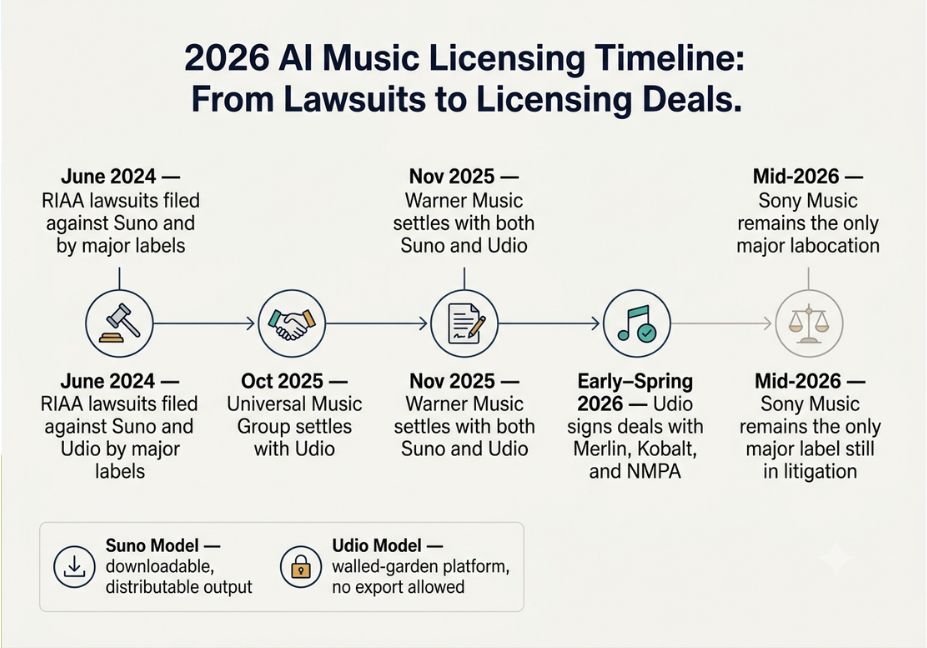
This is the part most “best tools” articles skip entirely. In November 2025, Warner Music settled its suit against Suno. In exchange, Suno agreed to phase out its current models in favor of ones trained on licensed content, and to add download limits even for paid users. Around the same time, Warner and Universal separately settled with Udio but Udio’s deal works differently. It converts the platform into a walled-garden model, where AI creations using licensed catalogs can be remixed and shared, but not exported or distributed outside Udio itself.
Meanwhile, Udio also reached separate agreements with music publisher Kobalt, the independent-label group Merlin, and the National Music Publishers’ Association the NMPA’s first industry-wide AI licensing agreement. Even so, Sony Music remained the lone major label still litigating against both companies through mid-2026. And independent artists and session musicians whose recordings were also used in the original unlicensed training runs were left out of the label-level settlements entirely.
That distinction matters if you’re publishing AI-generated tracks commercially. A license covering major-label catalogs doesn’t automatically cover the millions of independent recordings that also trained the same models. For ongoing coverage as terms are disclosed, outlets like Billboard and Music Business Worldwide have been tracking each settlement in detail.
How Do You Choose the Right AI Music Tool for Your Project?
- Define your output need first. Full vocal songs, background instrumentals, and sound effects each call for a different model.
- Check the training-data licensing status for your specific use case personal, YouTube, paid ad, or commercial release each carry different risk.
- Test section-level control if you need structured songs. Lyria 3 Pro and ElevenLabs Music v2 both support this well; older Suno versions handle it less precisely.
- Confirm export and download rights before you commit. Udio’s walled-garden model blocks export entirely, which rules it out if you need a downloadable master file.
- Budget API costs separately from consumer app costs if you’re building a product. Per-track API pricing from ElevenLabs and Lyria differs sharply from flat consumer subscriptions.
Example (conceptual) API call for generating a track:
POST /v1/music/generate
{ “prompt”: “mid-tempo indie pop, warm vocals, hopeful chorus”, “duration_seconds”: 180, “licensing_tier”: “commercial” }
Technical Disclaimer: Model versions and licensing terms in AI music are changing on a near-monthly basis as of mid-2026. Always confirm current terms directly with the provider before commercial release. Details here reflect the landscape as of July 2026.
What Common Mistakes Should You Avoid?
- Don’t assume “AI-generated” automatically means royalty-free. Licensing status depends entirely on what data trained the model, not on the fact that a human didn’t perform it.
- Avoid publishing tracks made on soon-to-be-deprecated models without checking whether the platform’s terms retroactively apply new restrictions.
- Don’t ignore watermarking requirements like SynthID. Disclosure of AI-generated content is becoming a real compliance issue for advertisers and distributors.
- Never treat Suno and Udio as interchangeable. Their 2026 licensing structures diverge enough that a workflow built for one may not be legal to replicate on the other.
What Are Creators Saying About AI Music in 2026?
Independent musicians and producers remain split. Some see licensed AI models as a legitimate production tool especially for scratch tracks, background scoring, and rapid prototyping. Others point out that the settlements compensated major labels while leaving independent artists uncompensated, even though their work also trained the same systems. That tension shows up regularly in producer discussions comparing output quality across Suno, Udio, and the newer licensed entrants, where opinions on audio fidelity versus licensing ethics rarely align.
Step-by-Step: How to Build an AI-Generated Music Pipeline
- Define the deliverable. A single royalty-free background bed needs a different tool than a full song with lead vocals.
- Choose architecture based on hosting needs. If you need on-device or offline generation, an open-weight model is the only option, since closed platforms are API- or browser-only.
- Prompt with structure, not just adjectives. Specify genre, mood, instrumentation, and tempo separately instead of one long sentence.
- Iterate with editing tools, not full regenerations. Use inpainting or section-based re-rolls to fix a bridge or verse instead of restarting.
- Export stems if you plan to mix. Paid tiers on consumer platforms typically unlock separated vocal, drum, bass, and instrumental stems for use in a DAW.
- Confirm the commercial license before shipping. Read the plan’s terms of use see the licensing section below before you publish or monetize output.
python
# Example: calling a text-to-music API (illustrative — check current docs for your chosen provider)
import requests

response = requests.post
    "https://api.example-music-model.com/v1/generate",
    json=
        "prompt": "lo-fi hip hop, mellow, rain sounds, 80 BPM, 2 minutes",
        "duration_seconds": 120,
        "format": "wav"

    headers={"Authorization": "Bearer YOUR_API_KEY"}

audio_url = response.json()["output_url"]
Technical Disclaimer: Framework versions evolve rapidly. Model names, endpoints, and licensing terms referenced here (Suno v5.5, Udio, Stable Audio 3) are current as of mid-2026. Always check the official docs and current licensing terms before shipping a commercial product.
How Do You Integrate AI Music Generation into an Agent Workflow?
If you’re building on top of an orchestration layer LangChain, a custom ReAct-style loop, or OpenAI’s function-calling interface (https://platform.openai.com/docs/guides/function-calling) a music-generation call is simply another tool the planner can invoke.
python
# Simplified tool-use pattern: agent decides to call music generation
def generate_track_tool(prompt: str, instrumental: bool = False):
    response = music_api.generate(
        prompt=prompt,
        make_instrumental=instrumental,
        wait_audio=False

    track_id = response["id"]
    return poll_for_completion(track_id)  # async job, poll until "streaming"
Importantly, the generation call is asynchronous in every current provider the agent submits a prompt, gets a job ID back, and polls (or listens for a webhook) until the track streams. For that reason, design your agent’s tool-use loop to handle that latency explicitly; otherwise, a naive synchronous call will simply time out.
Frequently Asked Questions
Is AI-generated music legal to use commercially in 2026?
It depends on the model. Tracks from tools trained on licensed data ElevenLabs Music v2, Google Lyria 3 Pro, Stable Audio 3.0 carry cleaner commercial usage rights than output from platforms still transitioning off unlicensed training sets.
What is the best AI music generator in 2026?
There’s no single winner. Suno leads on vocal realism and song structure, Udio leads on in-platform editing, and ElevenLabs and Lyria 3 Pro lead on licensing clarity and API access for commercial products.
What’s the difference between Suno and Udio now?
Suno lets users download and distribute tracks under its new licensed-model terms. Udio’s 2026 platform, by contrast, is a walled garden remixes and creations stay inside the app and can’t be exported.
Do AI music platforms pay artists whose work they trained on?
Only in a limited way. Major-label settlements included revenue-sharing provisions for participating labels and artists, but independent musicians and session players outside those deals generally received no compensation.
Will Suno’s older models be shut down?
Yes, eventually. Suno confirmed its pre-settlement models will be phased out and replaced with new ones trained on licensed content, though a firm shutdown date hadn’t been finalized as of mid-2026.
Can I use AI-generated music on YouTube or in ads?
Generally, yes, for licensed-model output. That said, platform monetization policies and disclosure requirements for AI-generated content are tightening, so check both the model’s licensing terms and the distribution platform’s current AI-content policy.
Conclusion
In short, 2026 turned AI music into infrastructure rather than a novelty. Model quality jumped with Lyria 3 Pro, ElevenLabs Music v2, and Stable Audio 3.0, while the Suno and Udio licensing settlements redrew what’s actually safe to publish commercially. The practical takeaway: pick your tool based on licensing status first and audio quality second, because the legal ground under this category is still moving. Bookmark this guide and check back as the remaining Sony Music litigation and Suno’s licensed-model rollout continue to develop through the rest of 2026.