

Most AI risk assessment tools were built for a world where the worst thing a model could do was say something wrong. However, that world is gone. When an autonomous agent hallucinates, it doesn’t just generate a bad sentence instead, it can call the wrong API, move the wrong dollar amount, or delete a production record.
For example, NIST’s own request for information on agent security drew 937 public comments last year, which signals that existing GRC checklists don’t map cleanly onto systems that plan, use tools, and act with discretion. Because of this gap, this guide walks through what an AI risk assessment tool actually needs to measure for agentic AI, why the old model-only approach falls short, and how you can build a working scoring rubric your team can use today.
What Is an AI Risk Assessment Tool? (Voice search: “What is an AI risk assessment tool?”)
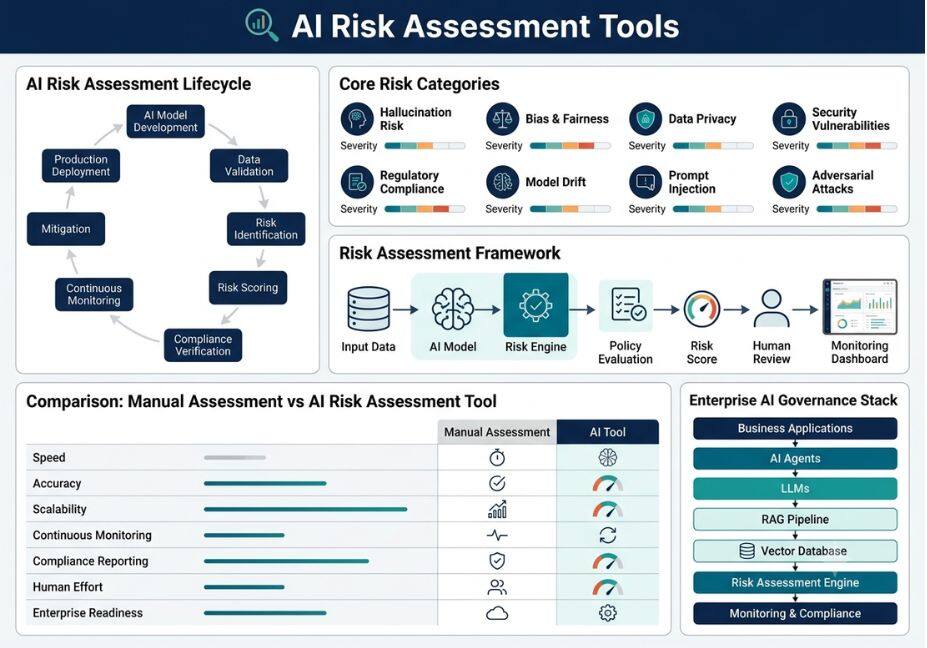
An AI risk assessment tool is a structured method sometimes a questionnaire, sometimes software for identifying, scoring, and prioritizing the risks a given AI system introduces before and during deployment. For traditional models, that typically means bias, drift, and output accuracy.
For agents, though, the scope expands considerably. Risk lives in behavior, not just output: what the agent touches, what permissions it inherits, and what it triggers autonomously. The NIST AI Risk Management Framework remains the most widely referenced baseline, organized around four functions Govern, Map, Measure, Manage. Still, it assumes a human stays in the loop by default, an assumption agentic systems routinely break.
Beyond NIST, the EU AI Act’s risk-tiering approach and ISO/IEC 42001 management-system standard both influence how enterprise teams now classify agent risk, especially for regulated industries.
How Does Agent Risk Assessment Work? (Voice search: “How do you assess risk in an AI agent?”)
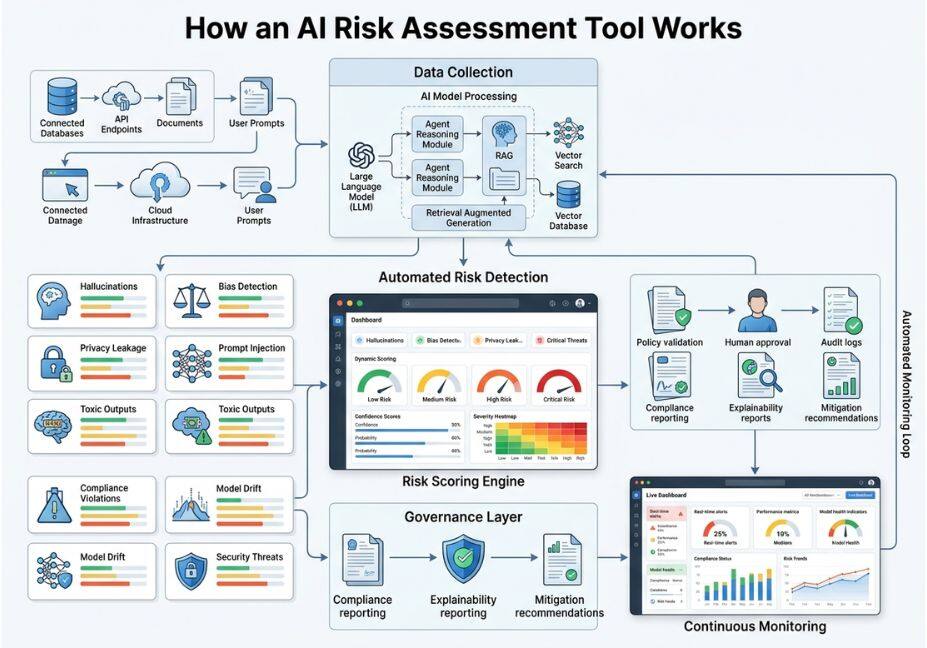
Agent-native risk assessment extends each RMF function to cover action space, not just model outputs. In practice, that means mapping every tool an agent can call, every credential it inherits, and every downstream system it can reach.
The Cloud Security Alliance’s proposed extension frames this as four capabilities layered onto existing programs: formal autonomy tier classification with matching oversight obligations, systematic tool-use risk modeling, runtime behavioral metrics with delegation chain monitoring, and structured incident response for agent compromise. As a result, teams get autonomy tier classification with runtime oversight obligations instead of a static, one-time review.
Analysts at Gartner and MITRE’s ATLAS framework for adversarial AI similarly point to runtime behavior not pre-launch testing alone as the real center of gravity for agent risk. Consequently, most mature programs now treat assessment as continuous rather than a launch gate.
Technical Note: A model’s risk is mostly contained in its outputs. An agent’s risk, on the other hand, lives in its behavior what it does, what it touches, and what it triggers, often continuously and without a review step.
AI Risk Assessment Tool Use Cases 4 Real-World Examples
- Financial services agents approving refunds or reclassifying transactions here, risk centers on irreversible actions and audit trails.
- DevOps agents with repository or infrastructure access in this case, risk centers on privilege escalation and unreviewed deploys.
- Customer-facing support agents using function calling to modify account data risk centers on hallucinated policy application. For instance, an airline chatbot once quoted a fake discount policy that regulators required the company to honor.
- Multi-agent research pipelines where one agent’s output feeds another’s tool calls risk centers on error propagation across the delegation chain.
Each of these scenarios also maps to the OWASP Top 10 for LLM Applications, which now includes excessive agency and insecure plugin design as named risk categories useful shorthand when briefing a security team unfamiliar with agent-specific threats.
Best Tools and Frameworks for AI Risk Assessment
No single product covers every layer. Instead, most teams combine a governance framework with a runtime enforcement layer.
| Framework / Tool | Primary Focus | Agent-Specific? | Best For |
|---|---|---|---|
| NIST AI RMF + Generative AI Profile | Governance lifecycle | Partial | Enterprise governance baseline |
| ISO/IEC 42001 | AI management system certification | No | Audit-defensible documentation |
| Google SAIF Risk Assessment | Security posture questionnaire | Partial | Quick self-assessment |
| CSA Agentic AI Controls Matrix (AICM) | Runtime agent controls | Yes | Tool-use and identity risk |
| NIST AI 100-2 E2025 | Adversarial ML taxonomy | Yes | Prompt injection, poisoning |
| MITRE ATLAS | Adversarial threat matrix | Partial | Red-teaming agent behavior |
Teams evaluating security posture broadly can start with Google’s SAIF Risk Assessment questionnaire, then layer agent-specific controls on top once autonomous tool use enters the picture. Microsoft’s Responsible AI Impact Assessment template is another useful starting point if your organization already runs on the Microsoft stack.
Step-by-Step: Building an Agent Risk Scoring Rubric (Voice search: “How do I build an AI agent risk scoring system?”)
A minimal, practical rubric scores each agent on five dimensions before it ships to production. Below is the exact process:
- Autonomy tier Can the agent act without human approval? Score higher for irreversible, unsupervised actions.
- Tool surface How many tools or APIs can it call, and how destructive is each one?
- Data sensitivity What’s the blast radius if the agent mishandles PII or financial data?
- Prompt injection exposure Does it ingest untrusted content, such as web pages, emails, or documents, that could hijack its instructions?
- Observability Can you reconstruct exactly what the agent did and why, after the fact?
python
def agent_risk_score(autonomy_tier, tool_destructiveness,
                      data_sensitivity, injection_exposure,
                      observability_gap):
    """
    Each input scored 1 (low risk) to 5 (high risk).
    observability_gap: 5 = no logging, 1 = full trace.
    Returns a weighted risk score, 0-100.
    """
    weights = {
        "autonomy": 0.30,
        "tools": 0.25,
        "data": 0.20,
        "injection": 0.15,
        "observability": 0.10,

    raw =
        autonomy_tier * weights["autonomy"]
        + tool_destructiveness * weights["tools"]
        + data_sensitivity * weights["data"]
        + injection_exposure * weights["injection"]
        + observability_gap * weights["observability"]

    return round((raw / 5) * 100, 1)

# Example: high-autonomy finance agent, weak logging
print(agent_risk_score(5, 4, 5, 3, 4))  # -> 85.0 (high risk, gate before launch)
Pro Tip: Set a hard gate. Specifically, any agent scoring above ~70 should require human-in-the-loop approval on its top three highest-destructiveness tool calls before it goes live, regardless of how well it performed in testing.
Notably, both Anthropic and OpenAI document function calling as the mechanism that turns model output into action. That boundary is exactly where a risk assessment tool should attach its controls, since it functions as the single choke point between “the model said” and “the system did.”
Common Mistakes and How to Avoid Them
- Treating agents like chatbots. A chatbot hallucination costs embarrassment; an agent hallucination, however, costs a wrong action. Therefore, assess accordingly the adversarial ML taxonomy in NIST AI 100-2 E2025 explicitly separates these categories.
- Skipping the delegation chain. In multi-agent setups, one agent’s hallucinated output becomes another agent’s trusted input. So, score the whole chain, not each agent in isolation.
- No kill switch. If you can’t interrupt an agent mid-task, your risk score means little, since you have no manage-phase control only a map-phase document.
- Ignoring tool-use hallucination. Agents don’t just fabricate facts; they also fabricate actions calling tools that don’t exist, malforming arguments, or bypassing tools entirely to answer from stale training data.
- One-time assessment. Because of behavioral drift, a low-risk agent today can become high-risk after a prompt update or a new tool integration next quarter.
Recent academic work on adversarial ML taxonomy for generative and agentic systems documents indirect prompt injection and multi-agent “prompt worm” propagation as emerging attack classes most teams haven’t scored for yet.
What Developers Are Saying
Engineering teams building with LangChain-style orchestration report that the hardest part isn’t scoring risk once rather, it’s keeping the score current as agents gain new tools and permissions week over week. That operational reality explains why runtime monitoring, not a static intake form, is becoming the center of gravity for agent risk assessment tools in 2026.
Technical Disclaimer: Frameworks and standards referenced here (NIST AI RMF, CSA’s Agentic Profile, Google SAIF) evolve rapidly. Details in this article reflect published guidance as of mid-2026. Always check the primary source for the current version before building compliance documentation on top of it.
FAQ People Also Ask
What is an AI risk assessment tool?
It’s a structured method a questionnaire, scoring rubric, or software platform used to identify, score, and prioritize the risks an AI system introduces across its lifecycle, from data handling to autonomous action.
How is risk assessment different for AI agents vs. traditional models?
Traditional model risk lives mostly in outputs, such as bias or inaccuracy. Agent risk, by contrast, lives in behavior what tools it calls, what data it touches, and what actions it takes autonomously, often without a human reviewing each step.
What is the NIST AI Risk Management Framework?
It’s a voluntary framework organized around four functions Govern, Map, Measure, Manage that helps organizations identify and manage risks across the AI system lifecycle. A Generative AI Profile extends it further for GenAI-specific risks like confabulation.
Can AI agents operate without human oversight?
Technically, yes. However, risk assessment frameworks increasingly recommend tiered autonomy: full autonomy only for low-destructiveness, easily reversible actions, with human-in-the-loop gates for anything irreversible or high-value.
What is tool-use hallucination?
It’s when an agent fabricates, misapplies, or incorrectly invokes a tool call for example, selecting the wrong tool, malforming arguments, or acting on a task it incorrectly believes is solvable turning a factual error into a real-world action.
How much does an AI risk assessment tool cost?
Costs vary widely: free frameworks like NIST AI RMF and Google SAIF cost nothing to use, while commercial platforms with runtime monitoring and automated scoring typically range from a few hundred to several thousand dollars per month, depending on agent volume.
Conclusion
Assessing risk in agentic systems means moving past checklists built for single-turn chatbots. The teams getting this right score five things autonomy tier, tool surface, data sensitivity, injection exposure, and observability and treat the result as a living number, not a one-time form. Ultimately, pairing a governance baseline like the NIST AI RMF with agent-specific runtime controls closes the gap that generic AI risk assessment tools leave open.
Bookmark this guide and explore more hands-on AI agent tutorials at agentiveaiagents.com.