

Most brands that vanish from ChatGPT and Perplexity answers aren’t being penalized they’re simply never being retrieved. A generative engine doesn’t rank your page against ten blue links; it pulls a handful of passages from an index, reads them, and decides which ones are worth citing. If your content isn’t structured for that retrieval step, it doesn’t matter how well it ranks on Google.
That’s the problem AI optimization tools for visibility exist to solve. They monitor which prompts trigger a mention of your brand, which competitors get cited instead, and increasingly they help you restructure content so retrieval systems can actually use it. This guide breaks down how the underlying retrieval mechanics work, which tools actually move the needle, and how to implement changes using the same RAG concepts you’d apply to any agentic pipeline.
What Is AI Visibility Optimization?
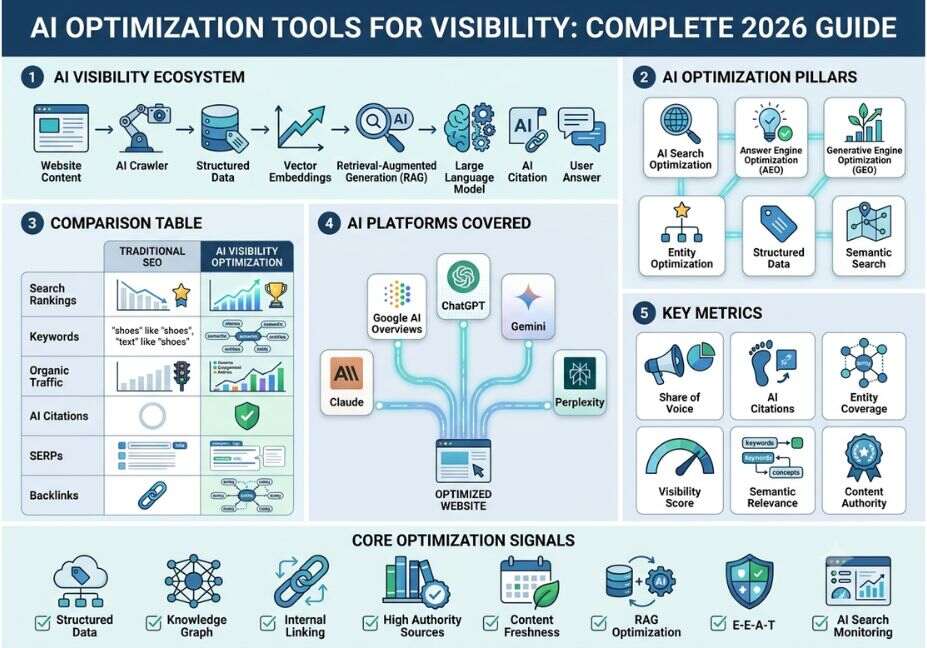
AI visibility optimization also called generative engine optimization (GEO) or answer engine optimization (AEO) is the practice of structuring content so that AI systems can retrieve, verify, and cite it when synthesizing an answer. Unlike traditional SEO, which optimizes for a ranked list, GEO optimizes for inclusion in a much smaller citation set, typically two to seven sources per generated answer.
The core shift: search engines index and rank documents; generative engines retrieve passages and select which ones support a claim. That’s a retrieval-and-scoring problem, not a ranking problem which is exactly why AI optimization tools for visibility increasingly look like RAG observability platforms rather than classic SEO dashboards.
How Does AI Visibility Optimization Work?
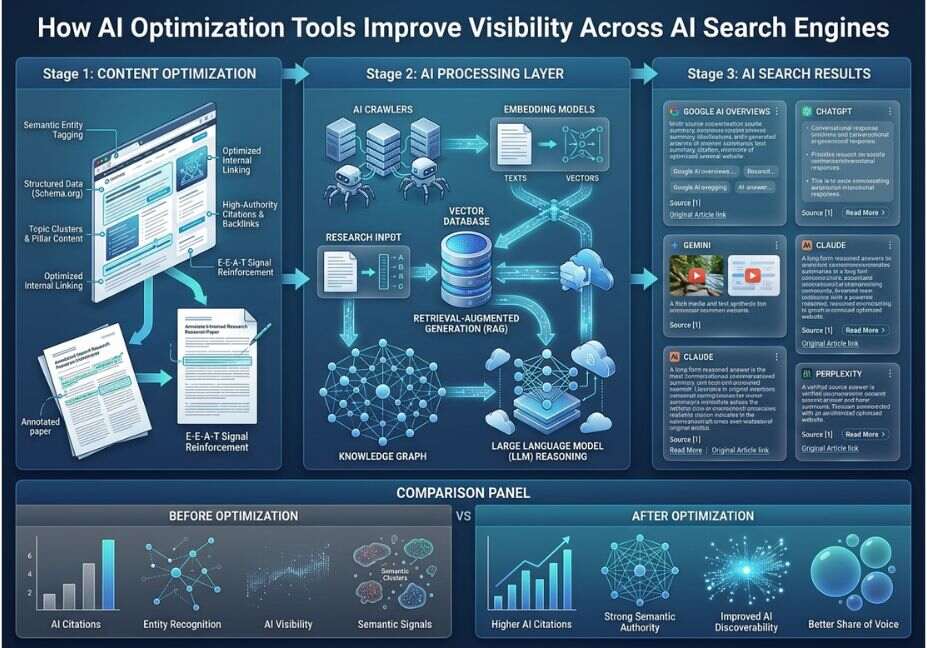
Generative engines follow a retrieve-then-synthesize loop that should look familiar to anyone who has built an agentic RAG pipeline:
- Decomposition the engine breaks a user’s question into smaller sub-queries.
- Retrieval each sub-query pulls candidate passages from a live index or crawl.
- Scoring the model evaluates relevance, factual support, and uniqueness for each candidate.
- Synthesis it drafts an answer and selects a small subset of passages to cite.
A recent multi-objective study on citation visibility found that citation inclusion, not rank position, is what determines whether content gets surfaced at all sources that aren’t selected receive effectively zero exposure regardless of how relevant they were during retrieval, according to citation-based visibility research from 2026.
Did You Know? Independent GEO benchmarking has found that content with cited statistics and self-contained factual statements sees measurably higher visibility in generative answers than content optimized purely for keyword density.
This is exactly why chunk-level structure matters as much as page-level SEO. If a paragraph can’t stand alone as a retrievable unit, the retriever may never surface it the same failure mode that causes weak RAG pipelines to underperform in production.
AI Optimization Tools for Visibility Real-World Use Cases
- A SaaS company audits which prompts (“best CRM for startups”) surface competitors instead of them, then republishes gap pages targeting those exact sub-queries.
- An enterprise brand tracks sentiment and factual accuracy of its citations across ChatGPT, Gemini, and Copilot to catch hallucinated claims early.
- An agency benchmarks a client’s AI visibility against three competitors before a pitch, using historical citation trend data instead of guesswork.
- A publisher uses schema markup and structured FAQ blocks to make individual passages easier for a retriever to lift cleanly.
Best Tools and Frameworks for AI Visibility
Tool categories break down into three tiers: pure monitoring, monitoring plus recommendations, and full monitor-to-publish loops. Recent reporting on AI visibility platforms highlights this split clearly some tools stop at dashboards, others close the loop by suggesting or generating fixes.
| Tool type | Example capability | Best for |
|---|---|---|
| Monitoring-only | Prompt-level tracking across ChatGPT, Perplexity, Gemini | Teams that just need visibility data |
| Monitoring + gap analysis | Competitive benchmarking, citation-loss alerts | Agencies managing multiple brands |
| Monitor-to-publish | Content generation/optimization tied to detected gaps | Teams that want the fix, not just the finding |
| SEO-suite add-ons | AI visibility folded into existing rank tracking | Practitioners who want one dashboard for organic + AI |
Pro Tip: Don’t evaluate a tool on engine coverage alone. Ask whether it ties citation gaps back to a specific structural or authority deficit “you lost this citation” is far less useful than “you lost this citation because the passage isn’t self-contained.”
Step-by-Step: Implementing AI Visibility Optimization
- Baseline your current citations. Run your target prompts through ChatGPT, Perplexity, and Google AI Overviews manually before buying any tool.
- Restructure content for chunk-level retrieval. Each paragraph should answer one question completely, in 2–3 sentences, without depending on surrounding context.
- Add structured data. FAQ schema, Organization schema, and Review schema all help AI crawlers extract and verify facts.
- Cite your own sources. Content with quantified claims and named studies gets selected more often than unsupported assertions.
- Monitor and iterate. Because generative engines are non-deterministic, track visibility as a frequency trend over weeks, not a single snapshot.
python
# Simplified relevance-and-citation scoring pattern
# similar to what generative engines apply during synthesis

def score_passage(passage, query_embedding, embed_fn):
    passage_embedding = embed_fn(passage.text)
    relevance = cosine_similarity(query_embedding, passage_embedding)
    has_stat = contains_quantified_claim(passage.text)
    self_contained = is_self_contained(passage.text)
    return relevance + (0.15 * has_stat) + (0.15 * self_contained)
Technical Disclaimer: Engine-specific ranking and citation logic changes frequently and is not publicly documented by any provider. The scoring pattern above is illustrative of published GEO research trends, not a reverse-engineered algorithm for any single platform.
Common Mistakes and How to Avoid Them
- Treating GEO like keyword SEO. Keyword stuffing has little to no measurable effect on generative citation rates.
- Writing chunks that need surrounding context. If a paragraph can’t be lifted and understood on its own, follow the same discipline used in chunking strategy documentation for RAG pipelines — split by idea, not by arbitrary length.
- Ignoring third-party mentions. Co-citations across independent sites carry more weight than owned-media claims alone.
- Chasing every engine at once. Prioritize the two or three answer engines your actual audience uses before expanding coverage.
What Developers Are Saying
Discussion threads on citation behavior in retrieval-augmented systems — including ongoing conversations in r/LocalLLaMA about how self-hosted and commercial retrievers select passages — consistently point to the same finding: passages with clear, standalone factual statements outperform narrative-style writing when a model has to choose what to cite, regardless of the underlying vector store or embedding model.
FAQ People Also Ask
What are AI optimization tools for visibility?
AI optimization tools for visibility track how often and how accurately a brand is mentioned in AI-generated answers from tools like ChatGPT, Perplexity, and Google AI Overviews, then help identify and fix content gaps causing missed citations.
How is GEO different from traditional SEO?
Traditional SEO optimizes for rank position in a list of links. Generative engine optimization optimizes for inclusion in a small citation set — typically two to seven sources — selected during answer synthesis rather than ranked retrieval.
Can you track how often your brand is cited by ChatGPT or Perplexity?
Yes. Prompt-level monitoring tools run a fixed set of queries against major answer engines on a recurring basis and log whether, how, and in what context your brand appears.
Do AI visibility tools only monitor, or can they help fix content too?
Both exist. Monitoring-only tools report gaps; monitor-to-publish tools connect those gaps to content generation or optimization workflows so teams can act on the data directly.
Do AI agents care about visibility optimization the same way search engines do?
Agentic systems that rely on retrieval-augmented generation use the same relevance-and-citation-selection logic as consumer answer engines, so content structured for GEO also performs better inside agent-driven retrieval pipelines.
Conclusion
AI optimization tools for visibility exist because generative engines don’t rank content — they select a small set of passages to cite, and everything outside that set gets effectively no exposure. The teams winning this shift aren’t gaming an algorithm; they’re structuring content the way any well-built RAG pipeline expects to consume it: self-contained, factually dense, and backed by real sources. Start by baselining your current citations, fix chunk-level structure before chasing new tools, and track visibility as an ongoing trend rather than a one-time audit.
Bookmark this guide and explore more hands-on AI agent and RAG tutorials at agentiveaiagents.com.