If you searched for “NINJIO AI safety tools” expecting to find an alignment or agent-oversight product, you’ve hit a category error worth unpacking. The confusion between AI safety and AI security is one of the most common terminology mistakes in the industry today, and it matters a lot to anyone building or evaluating agentic systems.
NINJIO is a security awareness training and human-risk-management vendor. It teaches people to recognize phishing and social engineering, and it layers machine learning on top of that training to personalize content. That’s a legitimate, increasingly AI-assisted product category. However, it is not an AI safety tool in the sense that term is used in the AI research community alignment, robustness, and oversight of AI systems themselves. This article evaluates what NINJIO’s AI components actually do, and draws the line clearly so you’re not shopping in the wrong aisle.
What “AI Safety” Actually Means
According to the field’s own definition, AI safety is an interdisciplinary field focused on preventing accidents, misuse, or other harmful consequences arising from artificial intelligence systems, encompassing AI alignment and monitoring of AI systems for risk. In other words, it’s a field about controlling what AI systems do not about training humans to spot phishing emails.
Meanwhile, recent research distinguishes AI safety from AI security by noting they target fundamentally different classes of threats: unintentional system failures versus intentional adversarial actions, each requiring a distinct methodological toolbox. As a result, NINJIO sits almost entirely on the security/human-risk side of that line it exists to reduce the odds that a human clicks a malicious link, not to constrain the behavior of an autonomous model.
Frameworks like the NIST AI Risk Management Framework, MITRE ATLAS, and the OWASP Top 10 for LLM Applications are the reference points practitioners actually use when building out an AI safety program for agentic systems. None of them overlap meaningfully with what NINJIO offers.
Did You Know? A more recent industry framing goes further: as agentic systems that can listen, reason, and act autonomously proliferate, accountability requires mechanisms ensuring their actions remain transparent, auditable, and controllable. That’s the actual job description of an AI safety tool for agent builders and NINJIO doesn’t do this, nor does it claim to.
What NINJIO’s AI Actually Does
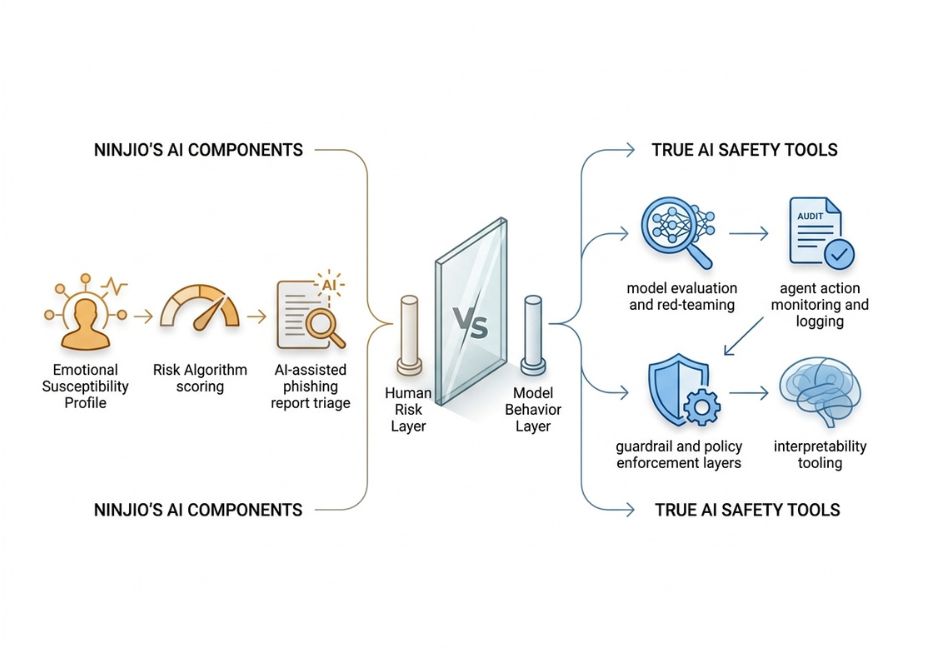
NINJIO’s product is built around three AI-touched components. Specifically:
- Personalization/coaching engine. Coaching and simulated phishing tools build an Emotional Susceptibility Profile for each user to identify which social engineering tactics are most likely to work on them, and training content adapts accordingly.
- Risk scoring. A proprietary Risk Algorithm identifies users’ social engineering vulnerabilities based on phishing simulation data and informs content delivery for a personalized experience.
- Report triage. The company also offers a one-click phishing-report add-in, plus an AI model that analyzes those reports to accelerate incident-response triage.
Pro Tip: When evaluating vendors in this space for a real deployment, ask specifically which “AI” claims are (a) supervised classification on user behavior data, versus (b) generative content. The two require very different scrutiny and data-handling review.
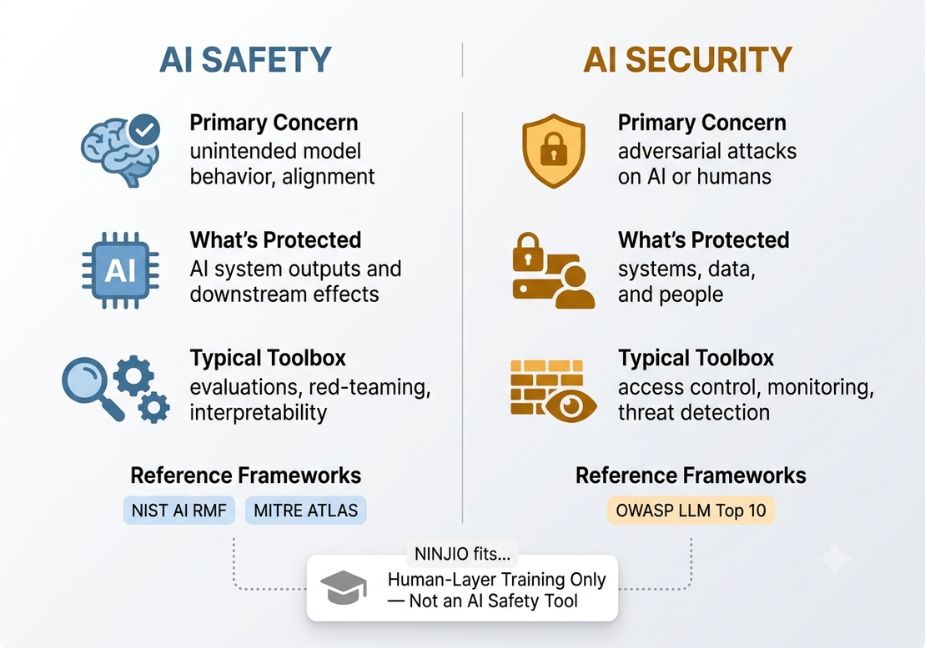
AI Safety vs. AI Security: A Quick Comparison
| AI Safety | AI Security | NINJIO | |
|---|---|---|---|
| Primary concern | Unintended model behavior, alignment | Adversarial attacks on/via AI or humans | Human susceptibility to social engineering |
| Who/what is protected | The AI system’s outputs and downstream effects | Systems, data, and people from attackers | Employees and their organizations |
| Typical toolbox | Evaluations, red-teaming, oversight, interpretability | Access control, monitoring, threat detection | Training videos, phishing simulations, coaching |
| Reference frameworks | NIST AI RMF, MITRE ATLAS | OWASP LLM Top 10, traditional infosec controls | Gartner Peer Insights category ratings |
| Does NINJIO fit here? | No | Partially (human layer only) | No |
Where This Actually Matters for Agent Builders
If your team is building or deploying LLM-based agents, the vendor category you actually need for “AI safety tools for agentic AI systems” looks nothing like NINJIO’s product. Instead, you’d be looking at:
- Model evaluation and red-teaming tools
- Agent action monitoring and audit logging
- Guardrail and policy-enforcement layers around tool calls
- Interpretability tooling
That said, NINJIO is still worth knowing about if your risk model includes humans being socially engineered into approving a malicious agent action, granting an attacker credentials, or leaking a system prompt through a phishing lure. This is a real and growing risk as agentic workflows get more autonomous. Even so, it’s a training platform, not infrastructure that constrains what your models or agents can do.
Technical Disclaimer: NINJIO’s product features described here reflect publicly available marketing and FAQ content as of mid-2026. Vendor feature sets change frequently, so verify current capabilities directly with the vendor before making a purchasing decision.
Common Mistakes When Evaluating This Category
- Assuming “AI-powered” means “AI safety.” Marketing copy uses “AI” broadly; always ask what the model actually does.
- Treating awareness training as a substitute for technical AI safety controls. Training employees not to click phishing links doesn’t constrain what an autonomous agent can do with the permissions it’s already been granted.
- Ignoring the human layer entirely. On the other hand, teams building agentic systems sometimes over-index on model-level controls and forget that a socially engineered employee can bypass all of them in one step.
FAQ
What is the difference between AI safety and AI security?
AI safety concerns unintended or harmful behavior from AI systems themselves alignment, robustness, oversight. AI security concerns protecting systems, data, and people from intentional attacks, which may or may not involve AI. The two need different tools and expertise.
Is NINJIO an AI safety company?
No. NINJIO is a cybersecurity awareness training and human-risk-management company that uses machine learning for personalization and phishing-report triage. It is not an AI safety or AI alignment vendor.
What tools actually address AI agent safety?
Model evaluation and red-teaming frameworks, agent action monitoring, guardrail and policy layers around tool use, and interpretability research a different category than employee security-awareness training.
Does training employees reduce risk to AI agent deployments?
Yes, indirectly. Social engineering is a real vector for compromising credentials or approvals that control agent permissions, though it addresses the human layer rather than the model or agent behavior itself.
Conclusion
NINJIO is a well-regarded human-risk-management platform with real AI-assisted personalization and triage features. Still, it isn’t an AI safety tool, and evaluating it as one sets the wrong expectations. If you’re securing an organization’s people against social engineering, it’s a reasonable category to shop in. But if you’re trying to keep an autonomous agent’s behavior aligned, auditable, and controllable, you need a different toolbox entirely and it’s worth being precise about which problem you’re actually solving before you buy anything.