
Brand visibility tracking tools for AI search are platforms that repeatedly prompt engines like ChatGPT, Perplexity, and Gemini, then measure whether your brand is mentioned, cited, or recommended in the generated answer. They report this as share of voice and citation rate, since these engines don’t produce a ranked list of links the way Google does.
Your rank tracker can show a #1 position on Google, and yet your brand may never once get mentioned by ChatGPT. That’s not a hypothetical. Audits of AI-cited URLs have repeatedly found that most pages large language models cite never appear in the top 20 organic results for the same query. Because of that gap, brand visibility tracking tools for AI search exist: they sample prompts across ChatGPT, Perplexity, Gemini, and Google AI Overviews and check whether, how, and how often your brand shows up.
This guide skips the affiliate-listicle approach that dominates the current search results. Instead, it grounds the buying decision in the actual research behind generative engine optimization (GEO), and it gives you a free way to start measuring this yourself before you commit budget to a platform.
Key Takeaways
- AI search visibility tools track mentions and citations separately these are different signals, not interchangeable ones.
- Citation overlap between ChatGPT, Perplexity, and Gemini is low, so single-engine tools miss a large share of buyer conversations.
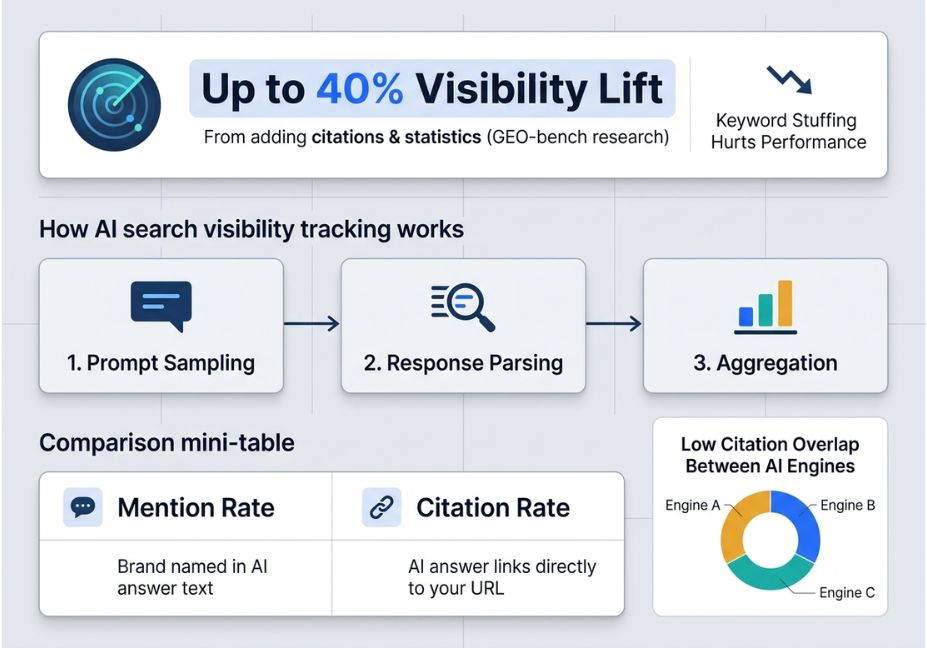
- The research behind GEO shows that statistics and quotations lift AI visibility by up to 40%, while keyword stuffing hurts it.
- You can approximate a basic tracker for free using an LLM API and a fixed prompt list before paying for a platform.
What Is an AI Search Visibility Tracking Tool?
An AI search visibility tracking tool is software that runs a defined set of prompts against multiple AI engines on a schedule. It then parses each response to detect brand mentions, citation links, sentiment, and competitive share of voice.
Unlike a traditional rank tracker, which watches fixed SERP positions, these tools have to deal with non-deterministic output. In other words, the same prompt can return a different answer, with different sources, just hours later.
The underlying discipline is generative engine optimization (source: Wikipedia, “Generative engine optimization”). This term entered the literature through the “GEO: Generative Engine Optimization” paper, and it now covers the broader practice of structuring content so generative systems retrieve, cite, and recommend it. Related terms you’ll see used interchangeably include answer engine optimization (AEO) and AI search optimization (AIO).
How Does AI Search Visibility Tracking Actually Work?
Generative engines don’t rank pages. Instead, they retrieve a handful of sources, summarize them, and synthesize an answer with citations woven directly into the text. As a result, visibility tracking has to operate at the passage level, not the page level.
The Three-Stage Retrieval Loop
Most platforms follow the same underlying loop:
- Prompt sampling a bank of representative buyer questions is sent to each AI engine on a recurring cadence.
- Response parsing the tool extracts brand mentions, cited URLs, and sentiment from the generated text.
- Aggregation results roll up into share-of-voice and citation-rate metrics, benchmarked against named competitors.
Pro tip: If you want to understand why a page gets pulled into an answer in the first place, it helps to understand the retrieval-augmented generation pipeline (source: Pinecone, “Retrieval-Augmented Generation”) that sits underneath most generative engines. Retrieval, augmentation, and generation are the same three steps AI search visibility tools are indirectly measuring.
Did You Know? The original GEO-bench research (source: arXiv 2311.09735, Aggarwal et al., with authors affiliated to Princeton, Georgia Tech, and IIT Delhi) found that adding cited statistics and direct quotations to a page lifted its visibility in generative-engine responses by up to 40%. Keyword stuffing, by contrast, actually hurt performance a finding echoed by SEO analyst Kevin Indig’s independent research on AI citation patterns.
Why This Matters: Real-World Use Cases
Tracking AI search visibility isn’t just a vanity metric. Specifically, it solves five practical problems for marketing and product teams:
- Competitive displacement detection catching the exact week a competitor starts winning citations for your category’s defining questions.
- Zero-click brand protection since more research now ends in an AI answer instead of a click, being cited (or misquoted) shapes brand perception before a user ever visits your site.
- Fact-checking AI knowledge several tools flag when an engine states something inaccurate about your product, so you can correct the source it pulled from.
- Content prioritization surfacing which pages already get cited, so teams know what to refresh instead of guessing.
- Cross-engine gap analysis because engines like OpenAI’s ChatGPT, Anthropic’s Claude, and Google’s Gemini pull from different pools of sources, a brand can dominate one and stay invisible in another.
Best AI Search Visibility Tools Compared
There’s no single tool that checks every box in this still-maturing category. That said, here’s how the major approaches differ:
| Category | Examples | Best For | Watch For |
|---|---|---|---|
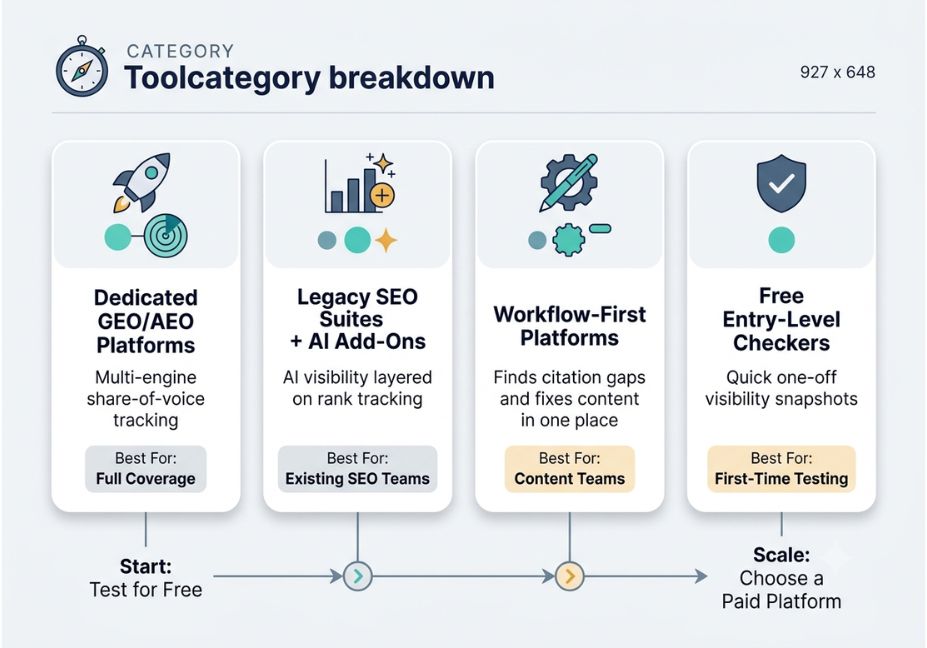
| Dedicated GEO/AEO platforms | Profound, Otterly, Scrunch AI, Peec | Teams that need multi-engine share-of-voice and citation-level detail out of the box | Pricing scales with prompt volume; coverage varies by engine |
| Legacy SEO suites with AI bolt-ons | Ahrefs Brand Radar, Semrush AI Toolkit | Teams already embedded in one of these platforms who want AI visibility alongside classic rank tracking | Core metric model is still link-based; AI features are newer additions |
| Workflow-first platforms | Frase | Teams that want the finding and the content fix in one place, not just a dashboard | Best suited to content teams, less to pure measurement |
| Free / entry-level checkers | Ubersuggest AI Brand Visibility, SE Ranking’s free checker | Quick one-off snapshots before committing budget | Limited prompt volume and history on free tiers |
How to Choose the Right Tool
Before subscribing to anything, confirm which AI engines a tool actually samples. A platform that only covers ChatGPT will systematically miss whatever your buyers are asking Perplexity or Gemini, since coverage overlap between engines is lower than most teams assume. In addition, check whether the tool separates mention rate from citation rate many dashboards blend the two, which quietly inflates the numbers.
Step-by-Step: How to Track AI Search Visibility for Free
You don’t need a paid platform to get a first read on visibility. Instead, a simple script using an LLM API can approximate what these tools do:
import anthropic

client = anthropic.Anthropic()

prompts =
    "What are the best brand visibility tracking tools for AI search?",
    "Compare tools for monitoring brand mentions in ChatGPT and Perplexity",


results =
for prompt in prompts:
    response = client.messages.create(
        model="claude-sonnet-4-6",
        max_tokens=800,
        messages=[{"role": "user", "content": prompt}]

    text = response.content[0].text
    mentioned = "your_brand_name" in text.lower()
    results.append({"prompt": prompt, "mentioned": mentioned, "response": text})

for r in results:
    print(r["prompt"], "-> mentioned:", r["mentioned"])
Run this weekly against a fixed list of 20–30 buyer-intent prompts. Then log whether your brand and named competitors appear, and you’ll have a rough share-of-voice baseline before evaluating paid platforms.
Technical Disclaimer: API responses from generative engines are non-deterministic and will vary between runs. Therefore, treat single-run results as directional, not authoritative, and sample repeatedly before drawing conclusions.
How to Track Brand Mentions in ChatGPT: Step-by-Step GEO Workflow
- Define your prompt set. Pull 30–50 real queries from sales calls, support tickets, and competitor comparisons, rather than guessed keywords.
- Baseline your visibility. Run the prompt set through your chosen tool, or manually, across at least three engines before making any content changes.
- Audit citation-worthy pages. Structure content with clear definitions, named entities, and data points up front. This mirrors the same signals an orchestration layer like LangChain or LlamaIndex would extract when chunking a document for retrieval.
- Add schema and structured data. Machine-parseable structure, such as FAQ schema and HowTo schema, increases the odds that a retrieval step surfaces the right passage.
- Re-run and compare. Track position and sentiment changes weekly, rather than daily, since AI answers are volatile enough that daily noise obscures the real trend.
python
# Minimal example: fanning a prompt set out to a model via the API
# and flagging brand mentions (simplified illustration, not production code)
import requests

prompts = ["best ai search visibility tool", "top GEO platforms 2026"]
brand = "agentiveaiagents"

for prompt in prompts:
    response = requests.post(
        "https://api.anthropic.com/v1/messages",
        headers={"content-type": "application/json"},
        json={
            "model": "claude-sonnet-4-6",
            "max_tokens": 500,
            "messages": [{"role": "user", "content": prompt}],


    text = response.json()["content"][0]["text"]
    print(prompt, "->", brand.lower() in text.lower())
Technical Disclaimer: Framework versions and API behaviors evolve rapidly. This snippet is illustrative as of mid-2026, so always check the current Anthropic API documentation before deploying a similar monitoring script.
Common Mistakes to Avoid When Tracking AI Search Visibility
- Tracking only one AI engine. Citation overlap between engines is typically low, so single-engine coverage creates a false sense of completeness.
- Confusing mention rate with citation rate. A brand can be mentioned in generated text without being cited with a link, so these should be tracked separately.
- Ignoring third-party sources. Community platforms like Reddit and LinkedIn are cited heavily across engines. Consequently, influencing brand mentions there often moves the needle more than editing your own site.
- Treating a single snapshot as ground truth. Given how volatile citations are week to week, one-time audits are far less useful than a recurring cadence.
- Chasing keyword density instead of evidence. As noted above, GEO-bench research found that statistics and quotations outperform keyword-focused tactics for generative-engine visibility.
Frequently Asked Questions
It’s software that repeatedly prompts AI engines like ChatGPT, Perplexity, and Gemini, then measures whether and how often your brand appears in the generated answers, including citation links and sentiment.
They send a bank of representative prompts to the model on a schedule, parse the returned text for brand names and cited URLs, and aggregate the results into share-of-voice and citation-rate metrics over time.
Share of voice is the percentage of AI answers mentioning your brand versus total answers sampled for a query set. Citation rate, on the other hand, tracks how often a response links to a URL you own, which is a narrower and more actionable signal.
Yes, at a basic level. Several vendors offer limited free checkers, and you can build a rough DIY version using an LLM API and a fixed prompt list, though free tiers cap the prompt volume and history you get.
Ubersuggest’s AI Brand Visibility tool and SE Ranking’s free checker both offer a limited number of daily checks, which is enough for a quick snapshot before you commit to a paid plan.
Pricing generally scales with prompt volume rather than seats. Entry-level plans often start in the tens of dollars per month, while enterprise multi-engine coverage can run into the hundreds, depending on how many prompts and competitors you track.
No. SEO optimizes for ranked positions in a list of links, while GEO optimizes for being retrieved, synthesized, and cited inside a generated answer. Because of this, the two disciplines reward different content signals.
Conclusion
Brand visibility tracking tools for AI search exist because the assumptions behind classic rank tracking no longer hold once an LLM is synthesizing the answer instead of listing links. Ultimately, the most useful platforms combine multi-engine coverage, separate mention and citation metrics, and a cadence that accounts for how quickly these answers shift. Whether you start with a free checker, a full GEO platform, or the DIY script above, the goal stays the same: know whether AI engines recommend you before your competitors find out first. Bookmark this guide and explore more hands-on AI agent tutorials at agentiveaiagents.com.