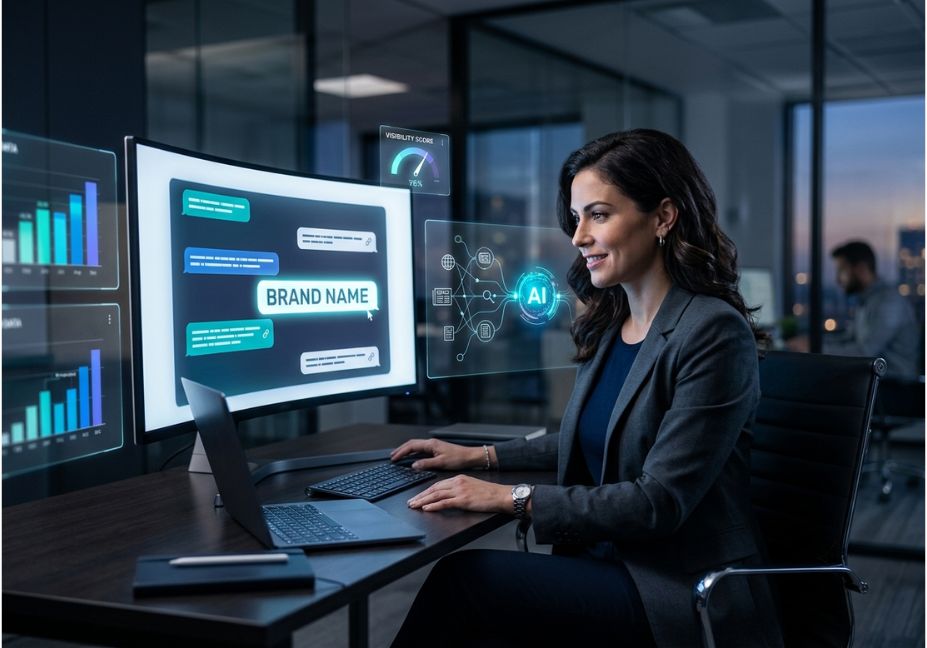
Traditional rank trackers can’t tell you whether ChatGPT just recommended your competitor by name. That’s the gap a new category of AI SEO tools for brand visibility in ChatGPT exists to close. Search engine volume is projected to keep shrinking as more buyers route discovery questions through conversational agents instead of a ten-blue-links results page, and that shift is what’s pulling AI visibility and answer engine optimization (AEO) out of niche marketing Slack channels and into core growth strategy.
These platforms don’t crawl and rank pages the way Google’s index does. They probe generative engines ChatGPT, Perplexity, Gemini, Google AI Overviews with realistic buyer prompts, then parse the responses for brand mentions, citations, and sentiment. Some of this instrumentation traces directly back to the original generative engine optimization research, which showed that generative engines synthesize and summarize information from multiple sources rather than simply ranking web pages. Understanding that pipeline, therefore, is the fastest way to pick a tool that actually matches how your buyers are querying AI today.
Quick answer: AI SEO tools for brand visibility in ChatGPT are platforms such as Semrush AI Visibility Toolkit, Ahrefs Brand Radar, and Profound that sample real buyer prompts against ChatGPT and other AI search engines, then measure how often, and how favorably, your brand is mentioned or cited in the responses.
What Is AI Brand Visibility?
AI brand visibility is a measurement of how often, and how favorably, a brand or domain is surfaced inside AI-generated answers as a named mention, a cited source link, or both. It’s distinct from a Google ranking: a page can rank #1 organically and still never get pulled into a ChatGPT answer, because the generative engine is retrieving and re-synthesizing content rather than displaying a page directly.
This concept sits on top of retrieval-augmented generation architecture the process wraps an LLM around a retrieval step so responses can be grounded in fetched content instead of purely the model’s training data. AI visibility tools essentially reverse-engineer that retrieval-and-synthesis loop by running large batches of prompts and logging what comes back.
How Do AI Visibility Tools Actually Work?
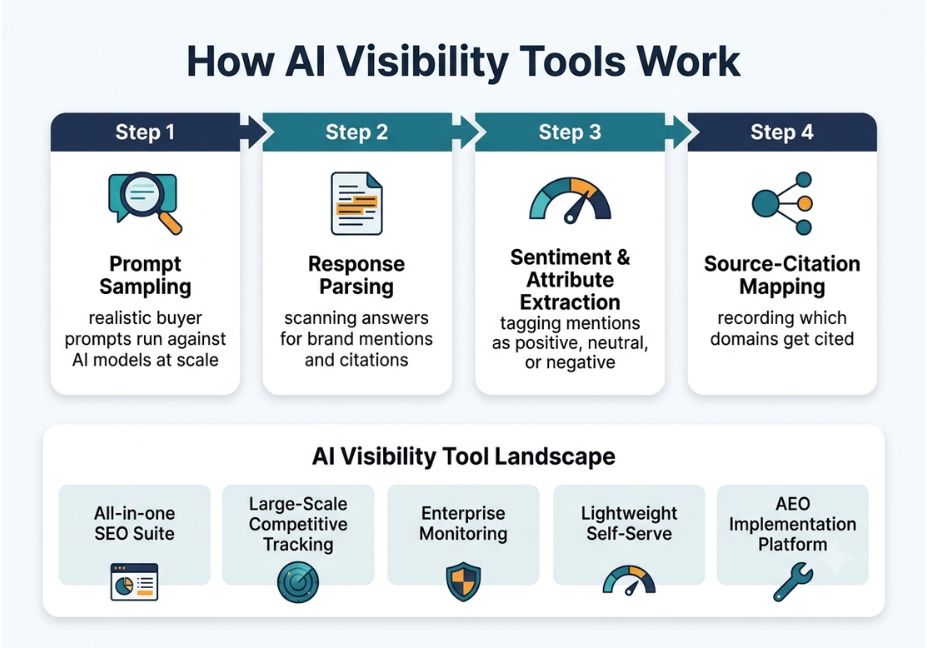
Under the hood, most tools in this category run the same basic loop:
- Prompt sampling a bank of realistic, buyer-style prompts is run against target LLMs at scale, in a way that mirrors how ChatGPT retrieves and cites live web sources during a browsing-enabled response.
- Response parsing each answer is scanned for direct brand mentions, linked citations, and competitor names.
- Sentiment and attribute extraction the tool tags whether the mention was positive, neutral, or negative, and what attributes were associated with the brand.
- Source-citation mapping where an answer includes a link, the tool records which domain got cited, so you can see which content is actually influencing the model.
Technical Note: Because generative engines don’t expose a public ranking algorithm, every vendor in this space is doing black-box estimation from sampled prompts not a guaranteed, exhaustive count of every conversation involving your brand. Sample size and prompt design materially affect how reliable the numbers are.
Semrush’s AI Visibility Toolkit, for example, works by running industry-relevant prompts across AI models and tracking both linked citations and unlinked brand mentions, then rolling that up into visibility and share-of-voice scores.
Best Tools and Frameworks for AI Search Visibility
| Tool | Best for | Core strength | Entry point |
|---|---|---|---|
| Semrush AI Visibility Toolkit | Teams already on Semrush | Unifies prompt tracking, citation monitoring, and traditional SEO data in one dashboard | Paid add-on |
| Ahrefs Brand Radar | Data-heavy competitive tracking | Very large prompt database and multi-index monitoring (ChatGPT, Perplexity, Gemini, Copilot, AI Overviews, plus social platforms) | Paid |
| Profound | Enterprise AI visibility | Advanced prompt monitoring and competitive intelligence built for large brands | Enterprise pricing |
| Peec AI / Otterly | Small teams, self-serve monitoring | Lightweight share-of-voice reporting without a full SEO suite | Budget-friendly |
| LovedByAI | WordPress sites, agencies | Combines visibility tracking with hands-on AEO/GEO implementation (structured data, entity optimization) | Mid-tier |
Pro Tip: Don’t pick a tool by feature list alone. Pick by which platforms it actually samples if your buyers live in ChatGPT and Perplexity but a tool only tracks Google AI Overviews, you’re measuring the wrong surface.
AI SEO Tools for Brand Visibility in ChatGPT Real-World Use Cases
For example, here’s how teams actually put these tools to work:
- Competitive benchmarking: A SaaS company runs a batch of “best [category] tools” prompts weekly to see whether it’s named alongside or instead of its top three competitors.
- Content gap discovery: A visibility tool flags that a competitor’s comparison page is the source ChatGPT keeps citing. As a result, the content format is worth building in-house too.
- Reputation monitoring: Sentiment tagging catches when an LLM answer misstates a product feature or pricing tier, before it spreads across more conversations.
- PR and citation building: Teams identify which domains generative engines already trust for instance, industry publications, GitHub repos, and Wikipedia and pursue coverage there specifically because those sources get cited more often. Meanwhile, similar logic applies to Bing Copilot and Google’s AI-driven Search Generative features, both of which lean on comparable trusted-source signals.
Step-by-Step: How to Improve Brand Visibility in ChatGPT and Other AI Search Engines
If you’re specifically trying to figure out how to track brand mentions in ChatGPT or which free tools to check ChatGPT brand visibility with before committing budget this sequence works for teams of any size, including small businesses running the process manually before investing in a paid AI visibility tool.
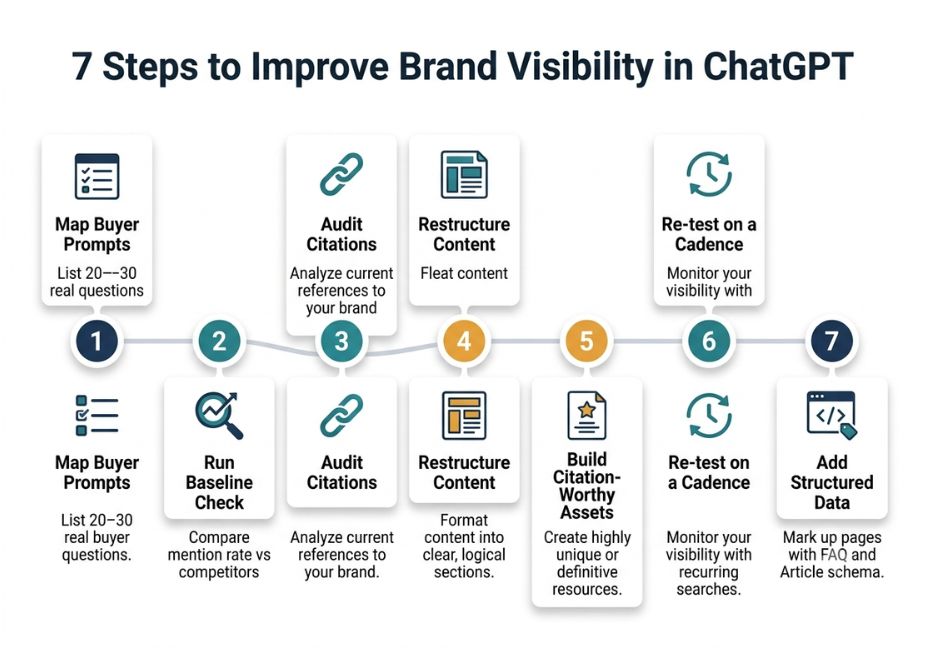
- Map your buyer prompts. List the 20–30 questions real prospects would plausibly type into ChatGPT during research, not just your target keywords.
- Run a baseline visibility check. Use a free checker or a paid platform’s trial to see your current mention and citation rate against competitors.
- Audit what’s actually getting cited. Pull the source URLs the AI is pulling from often third-party comparison sites, not your own homepage.
- Restructure content for extraction. Write direct, structured answers near the top of the page; generative engines favor clear factual statements and well-labeled tables over long narrative copy.
- Build citation-worthy assets. Original data, benchmarks, and comparison tables get cited more often than generic feature pages.
- Re-test on a cadence. Because model behavior shifts with retraining and retrieval-index updates, monthly or weekly re-runs matter more than a single snapshot.
- Add structured data. Marking up the page with FAQPage and Article schema gives both Google and AI crawlers an unambiguous, machine-readable version of your content — this is the legitimate way to boost machine parsing and extraction odds; invisible or hidden text does not work for this and can trigger a manual penalty.
python
# Simplified illustration of a prompt-sampling visibility check
prompts = ["best project management tools for startups", "top CRM software 2026"]

for prompt in prompts:
    response = query_llm(prompt)  # call to a hosted LLM API
    mentioned = "your_brand" in response.lower()
    cited_domains = extract_citations(response)
    log_result(prompt, mentioned, cited_domains)
Technical Disclaimer: Tool pricing, prompt-sampling methodology, and platform coverage change frequently in this category. Always confirm current capabilities directly with the vendor before purchasing.
Common Mistakes and How to Avoid Them
- Treating AI visibility as a replacement for SEO. In reality, it’s additive organic rankings still feed the pages generative engines retrieve from.
- Trusting a single free checker as ground truth. Instead, treat one-off, no-login tools as a quick gut check, not a system for tracking trends over time.
- Ignoring unlinked mentions. Even without a citation link, a brand name still shapes buyer perception and should be tracked.
- Optimizing for keyword density instead of extractability. After all, generative engines favor clear, structured, evidence-backed passages over keyword-stuffed copy.
- Skipping re-measurement. Because LLM outputs are non-deterministic and shift with index and model updates, a single audit goes stale fast.
What Developers and Marketers Are Saying
Discussion threads in developer forums (r/SEO) frequently point out that citation behavior is inconsistent across models and even across repeated runs of the same prompt reinforcing why most vendors sample at scale rather than relying on a single query.
FAQ People Also Ask
They’re platforms that run buyer-style prompts against ChatGPT and other generative engines, then track whether and how your brand is mentioned, cited, and framed in the responses similar in spirit to a rank tracker, but built for AI-generated answers instead of search result pages.
Traditional SEO measures page rankings for specific queries; AI visibility measures whether a brand is named or cited inside a synthesized AI answer, which may draw from several sources at once rather than displaying any single page.
They sample a large bank of realistic prompts against target LLMs, parse the returned text for brand names and linked citations, and aggregate results into visibility and share-of-voice metrics.
Yes, indirectly by publishing clear, structured, evidence-backed content, earning citations from domains generative engines already trust, and monitoring which of your pages actually get pulled into answers.
They’re useful for a quick directional snapshot, but most run a small, fixed set of prompts, so they shouldn’t be treated as a comprehensive or statistically reliable measurement.
Yes generative engines still retrieve heavily from the indexed, ranked web, so strong organic SEO foundations remain a prerequisite for AI visibility, not a substitute for it.
Conclusion
AI SEO tools for brand visibility in ChatGPT exist because generative engines retrieve and synthesize content instead of ranking pages, which makes traditional rank tracking blind to a growing share of buyer discovery. The strongest programs treat this as measurement plus content engineering: track prompts and citations with a tool that actually covers the platforms your buyers use, then rebuild content to be structured and evidence-rich enough for generative engines to extract and cite. Start with a baseline visibility check, fix what’s actually getting cited against you, and re-test on a regular cadence bookmark this guide and explore more hands-on AI agent tutorials at agentiveaiagents.com.