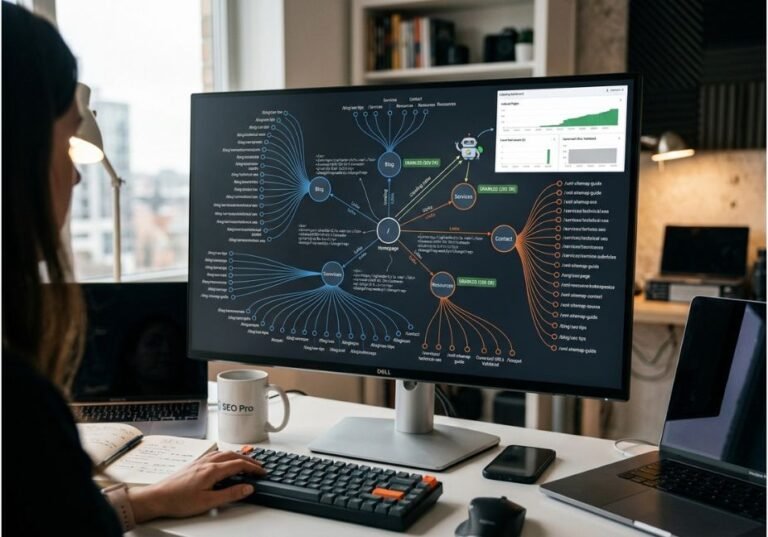
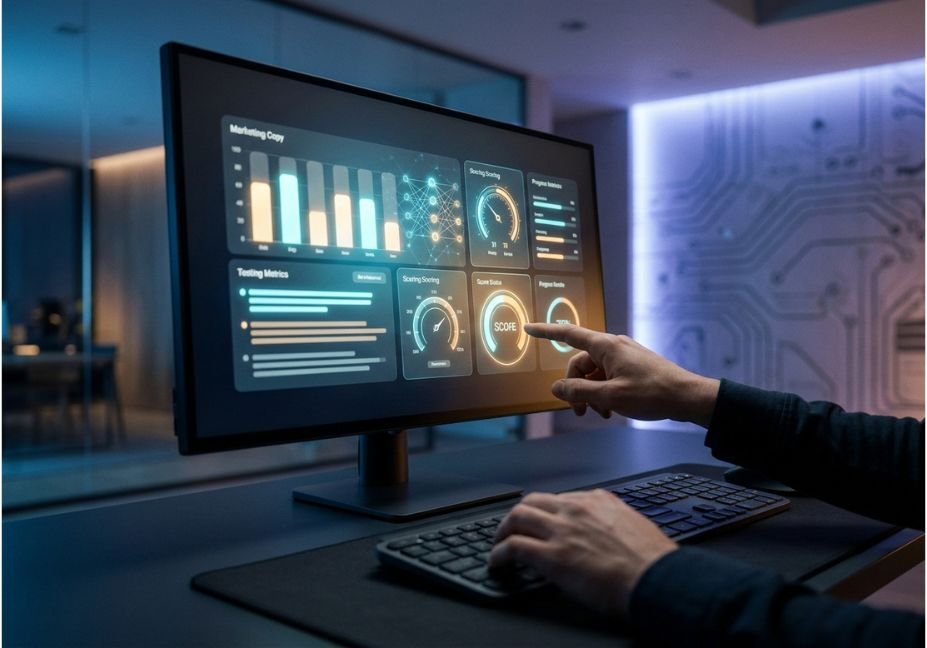
Most copy doesn’t fail because the writing is bad it fails because nobody scored it against anything before it shipped. Marketing teams have run heatmap tools that show where users click and scroll for years, but that data arrives after the campaign is live. The more useful shift in 2026 is agentic: an LLM-as-judge pipeline that scores copy against a rubric, retrieves comparable high-performers, and flags weak lines before a single dollar is spent on media.
This guide breaks down how an AI tool for analyzing copy effectiveness actually works under the hood not another “best 10 tools” roundup, but the architecture, the scoring math, and where these systems still get it wrong.
What Is Copy-Effectiveness Analysis?
Copy-effectiveness analysis is the process of scoring written marketing content headlines, ad copy, landing pages, email subject lines against measurable criteria like clarity, persuasion, tone alignment, and predicted conversion. Traditionally this meant A/B testing in production. Modern tools front-load the work with an evaluator model that predicts performance before launch, similar to how predictive-analytics tools score multiple copy variations and forecast performance before a test even begins. The technique borrows directly from LLM evaluation research: a rubric-based scoring model judges output quality the same way you’d judge a chatbot response or a RAG pipeline’s retrieval accuracy.
How Does an AI Copy-Analysis Agent Work?
At its core, the system is a tool-use loop, not a single API call. A typical architecture:
- Ingestion the copy is chunked and passed to the judge model along with brand voice guidelines and target audience metadata.
- Rubric scoring the model scores the copy on weighted dimensions (clarity, CTA strength, emotional resonance, readability). Research on LLM-as-judge evaluation methods shows that score-based tuning trains models to predict judgment scores against specific evaluation criteria, and that scoring reliability improves substantially when the judge is given a structured rubric rather than a vague “rate this 1-10” prompt.
- Retrieval the agent pulls comparable, historically high-converting copy from a vector store to ground the score in real examples rather than the model’s untethered opinion.
- Revision loop low-scoring dimensions trigger a rewrite pass, and the cycle repeats until the copy clears a threshold.
Technical Note: This is functionally identical to the evaluation harnesses used for grading LLM outputs. Hugging Face’s cookbook demonstrates an additive scoring rubric where points are awarded per criterion relevance, clarity, precision rather than one holistic number, and this pattern transfers cleanly to marketing copy scoring.
Did You Know? Industry benchmarking on LLM-as-judge systems finds agreement rates with human reviewers in the 80–90% range for well-designed rubrics comparable to how much two human reviewers agree with each other.
AI Copy-Effectiveness Analysis — Real-World Use Cases
- Pre-flight ad copy screening: An e-commerce team runs every generated headline through a judge agent before it reaches a human editor, cutting review time significantly. This mirrors production systems where teams run rigorous offline evaluations combining human assessment with LLM-as-a-Judge before launching online A/B tests, catching low-quality ad copy before it damages brand reputation.
- Landing page variant ranking: Instead of manually A/B testing five headline options, an agent ranks them by predicted conversion likelihood, and only the top two go into a live test.
- Cross-market localization QA: A judge agent flags copy that scores well in English but loses persuasive force after translation, catching tone drift before publication.
- Brand voice drift detection: Recurring content email sequences, product descriptions gets scored against a brand-voice rubric to catch gradual drift over months of AI-assisted drafting.

Best Tools, Frameworks, and Approaches
| Approach | What It Measures | Best For | Limitation |
|---|---|---|---|
| Predictive scoring platforms (e.g., Anyword-style) | Conversion likelihood from historical ad data | High-volume paid ad copy | Score reflects the training data’s audience, not yours |
| Custom LLM-as-judge pipeline | Rubric-defined dimensions (clarity, tone, CTA strength) | Teams needing brand-specific criteria | Requires prompt engineering and calibration |
| Heatmap + analytics tools | Actual on-page user behavior | Post-launch optimization | Only works after copy is live |
| Readability/grammar checkers | Sentence-level mechanics | Editing pass, not strategy | Doesn’t predict conversion at all |
Pro Tip: Don’t rely on a single holistic score. Splitting evaluation into an additive rubric one point per criterion produces far more consistent, actionable output than asking a model for one number out of ten.
Step-by-Step: Building a Copy-Effectiveness Judge Agent
A minimal implementation using a tool-calling agent loop pattern:
from openai import OpenAI

client = OpenAI()

RUBRIC = """
Score the copy 0-2 on each dimension. Return JSON only.
1. Clarity: is the core message unambiguous?
2. CTA strength: is the next action obvious and compelling?
3. Audience fit: does tone match the target persona?
4. Differentiation: does it avoid generic marketing language?
"""

def score_copy(copy_text, persona):
    response = client.chat.completions.create(
        model="gpt-4o",
        messages=
            {"role": "system", "content": RUBRIC},
            {"role": "user", "content": f"Persona: {persona}\n\nCopy: {copy_text}"}
    response_format={"type": "json_object"}
return response.choices[0].message.content- Define the rubric first weight each dimension based on what actually correlates with your conversion data, not intuition.
- Ground scores with retrieval pull 3–5 historically strong examples from a vector store into the prompt context so the judge has a reference point.
- Calibrate against human review score 30–50 real pieces with both the agent and a human editor, then adjust the rubric weighting until scores align.
- Add a re-write loop feed low-scoring dimensions back into a generation call with targeted instructions (“strengthen the CTA”) rather than a full rewrite.
- Log every score treat the rubric outputs as training data for a lightweight regression model down the line, once you have enough real conversion outcomes to validate against.
Common Mistakes and How to Avoid Them
- Trusting a single number. A holistic 1–10 score hides why copy scored low. Use additive, per-dimension rubrics instead.
- Skipping human calibration. An uncalibrated judge model will confidently score generic copy highly if it’s grammatically clean. Always validate against real outcomes.
- No retrieval grounding. Judging copy in isolation, without comparable high-performers in context, produces scores that reflect the model’s training-data bias rather than your brand’s actual audience.
- Ignoring evaluation drift. Model providers update underlying weights regularly; a rubric calibrated against one model version can silently drift out of alignment after an update. Re-calibrate quarterly.
- Conflating prediction with proof. A high judge score is a hypothesis about performance, not a guarantee — it still needs a real controlled A/B testing pass before you commit budget.
What Developers Are Saying
Discussion threads on evaluation reliability echo the same theme: judge models are useful but not infallible. Reports on LLM-as-judge evaluation methods research note that scoring consistency improves with structured, criteria-based prompts and degrades with vague, holistic ones — a pattern developers on forums like r/MachineLearning frequently confirm when comparing pairwise versus single-output judging setups for their own evaluation pipelines.
Technical Disclaimer
Framework versions and model behavior evolve rapidly. Code examples in this article use the OpenAI Python SDK as of mid-2026. Always check official provider documentation for current API syntax before deploying to production.

FAQ — People Also Ask
What is an AI tool for analyzing copy effectiveness?
It’s a system often an LLM-as-judge agent that scores marketing copy against defined criteria like clarity, persuasion, and predicted conversion, before the copy goes live.
How do AI agents evaluate marketing copy?
They typically use a rubric-scoring loop: the judge model rates the copy on weighted dimensions, sometimes retrieves comparable historical examples via RAG, and can trigger a revision pass for weak scores.
Can AI predict conversion rates before launch?
It can produce a predictive score correlated with likely performance, but this is a hypothesis, not a guarantee real conversion data from live testing remains the ground truth.
What’s the difference between LLM-as-judge and A/B testing?
LLM-as-judge scores copy pre-launch using a model’s evaluation; A/B testing measures actual user behavior post-launch. They’re complementary, not interchangeable.
Are AI copy-effectiveness scores reliable?
Reliability depends heavily on rubric design and calibration against human review — well-calibrated judges can reach human-level agreement rates, but uncalibrated ones will confidently misjudge generic copy.
Conclusion
Analyzing copy effectiveness with AI isn’t about finding one tool that spits out a magic score it’s about building (or choosing) a system with a structured rubric, retrieval grounding, and a calibration loop against real human judgment. Teams that skip calibration end up trusting a number that doesn’t actually track conversion. Teams that build the judge-agent loop properly get a fast, defensible pre-flight check before copy ever reaches a live audience.
Bookmark this guide and explore more hands-on AI agent tutorials at agentiveaiagents.com.