
Most content gap tools still work like it’s 2019. They scrape a SERP, diff two keyword lists, and hand you a spreadsheet. However, that approach misses the gaps that matter most in 2026: the ones between what your content says and what an LLM agent needs to retrieve in order to cite you.
AI content analysis tools for topic gaps have shifted from keyword diffing toward something closer to retrieval-augmented generation. First, you embed your content. Then you embed the competitive landscape. Finally, a reasoning agent surfaces what’s structurally missing.
This shift matters because AI Overviews and chat-based answer engines don’t rank pages they retrieve chunks. As a result, a page can be perfectly optimized for classic SEO and still have zero entity coverage for the sub-topics a retrieval system scores against. Below, you’ll learn how these tools work, where they break down, and how to build one yourself.
What Is a Content Gap Analysis?
A content gap analysis identifies topics, sub-topics, or entities that competing content covers but your content doesn’t. In other words, it’s a map of what your audience needs that you haven’t written yet.
Historically, this meant comparing ranked keyword sets. Today, a more useful version compares semantic coverage whether your content contains the concepts, definitions, and entity relationships a reader (or an AI system) actually needs, regardless of exact wording.
This is essentially the same problem that retrieval-augmented generation solves for question-answering: matching a query’s meaning to a document’s meaning through vector similarity rather than string matching. A gap analysis agent is, structurally, a RAG pipeline pointed at your competitors instead of your own knowledge base. (See Wikipedia’s overview of retrieval-augmented generation: en.wikipedia.org/wiki/Retrieval-augmented_generation)
How Do AI Agents Detect Topic Gaps?
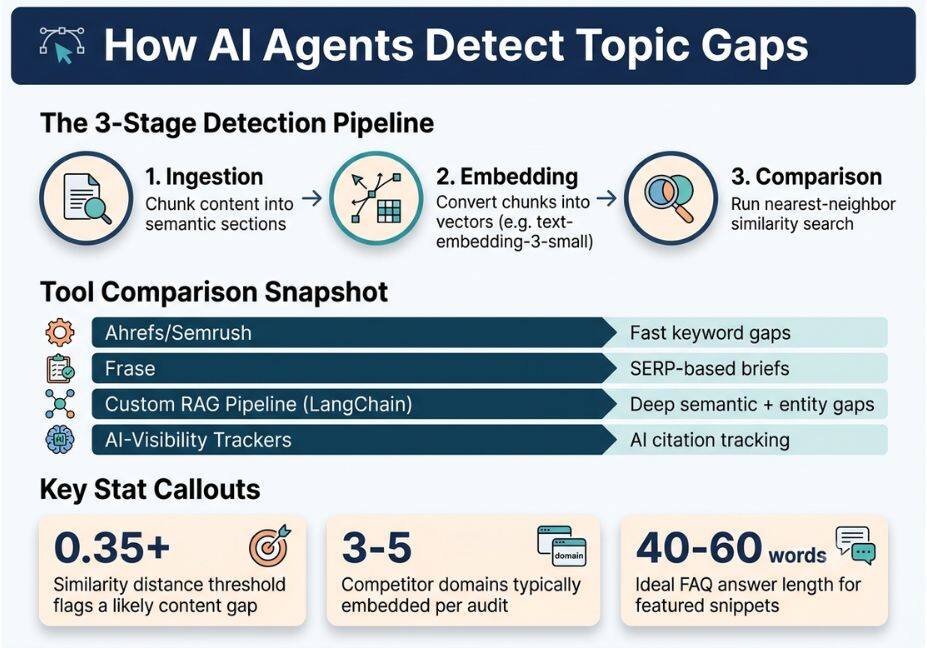
An AI-driven gap detector runs three stages: ingestion, embedding, and comparison.
- Ingestion. Pull your content and competitor content, then chunk each page into semantically coherent sections instead of fixed character counts.
- Embedding. Convert each chunk into a vector using an embedding model for example, OpenAI’s
text-embedding-3, or an open-source option through Hugging Face’s sentence-transformers library. Similar meanings land near each other in vector space. - Comparison. For each competitor chunk, run a nearest-neighbor search against your own embedded chunks. Low similarity across the board signals a topic you don’t cover at all. Moderate similarity paired with thin content signals a depth gap instead.
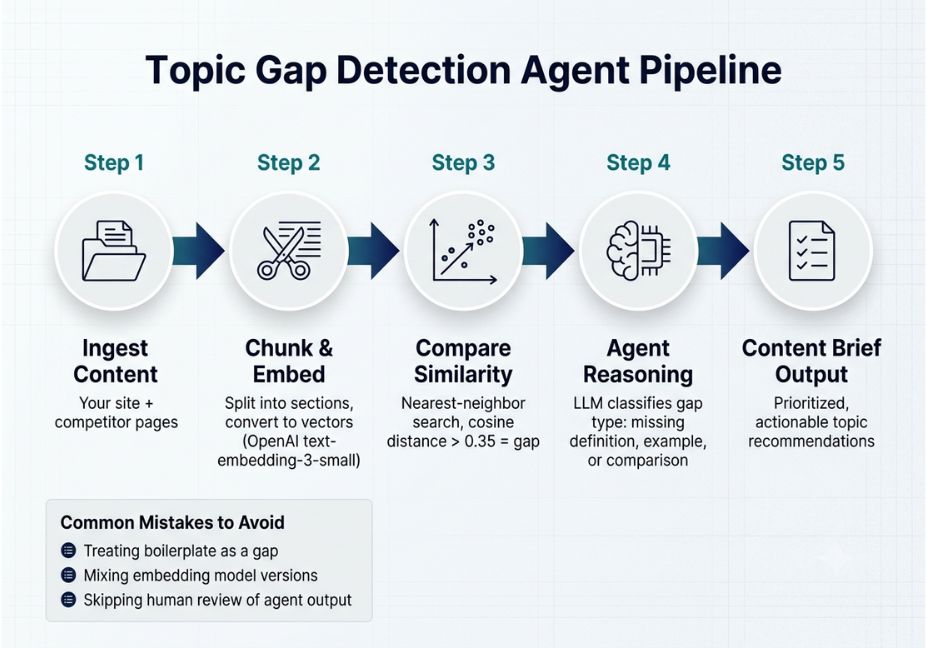
Pro Tip: Don’t stop at similarity scores alone. Feed the low-similarity chunks to an LLM agent and ask it to classify why the gap exists a missing definition, a missing example, a missing comparison, or a missing recent data point. The similarity score tells you that something’s missing; the agent’s reasoning tells you what kind of content to write.
This is where the agentic layer earns its keep. A pure embedding comparison flags gaps, but it can’t prioritize them by business value or reader intent on its own. Wrapping the comparison step in a ReAct-style reasoning loop (Yao et al., 2023 arxiv.org/abs/2210.03629) lets the agent alternate between retrieving evidence and reasoning about which gaps justify a new article versus a section addition.
Did You Know? Traditional gap tools built on SERP scraping only capture what ranks in the top 10–20 organic results. Consequently, they’re structurally blind to gaps in AI Overviews and chat answers, because those surfaces synthesize from a much wider retrieval set than the visible SERP.
What Are Real-World Use Cases for AI Content Gap Analysis?
- Competitive content audits. Embed your entire blog against 3–5 competitor domains to surface systemic thin spots entire topic clusters, not single articles.
- AI citation gap detection. Track which prompts a rival gets cited for in ChatGPT, Perplexity, or Google AI Overviews, then reverse-engineer the entity coverage on their cited pages.
- Documentation and knowledge base gaps. Apply the same pipeline internally: compare support tickets against your docs to catch unanswered questions before they become churn.
- Editorial refresh prioritization. Instead of guessing which old posts to update, rank them by semantic distance from current top-ranking competitor content.
This is also where how to find content gaps with AI becomes a repeatable workflow rather than a one-off audit once the pipeline exists, you can re-run it monthly.
What Are the Best AI Tools for Topic Gap Detection?
| Tool / Framework | Approach | Best For | Limitation |
|---|---|---|---|
| Ahrefs / Semrush | Keyword-set diffing against SERPs | Fast, broad keyword gaps | Blind to AI Overview / LLM citation gaps |
| Frase | SERP-based content briefs | Question-level gaps from top 20 results | Still SERP-anchored, not embedding-based |
| Custom RAG pipeline (LangChain + vector store) | Embedding similarity plus agent reasoning | Deep, explainable topic and entity gaps | Requires engineering setup and upkeep |
| AI-visibility trackers (Sight AI–style tools) | Monitors brand mentions across LLM answer engines like Perplexity and Google’s AI Overviews | AI citation and prompt-level gaps | Newer category; coverage still maturing |
LangChain’s agent framework (python.langchain.com/docs/introduction/) is the most common foundation for the custom-pipeline route. It provides text splitters for chunking, a unified interface across embedding models, and vector store integrations Chroma, Pinecone, Weaviate so you’re not locked into one vendor.
How Do You Build a Topic Gap Detection Agent? (Step-by-Step)
Here’s a minimal, working pattern using LangChain and Chroma. It embeds your content and a competitor’s, then surfaces the lowest-similarity competitor chunks as candidate gaps.
python
from langchain_openai import OpenAIEmbeddings
from langchain_community.vectorstores import Chroma
from langchain_text_splitters import RecursiveCharacterTextSplitter

splitter = RecursiveCharacterTextSplitter(chunk_size=500, chunk_overlap=50)
embeddings = OpenAIEmbeddings(model="text-embedding-3-small")

own_chunks = splitter.split_text(own_site_text)
own_store = Chroma.from_texts(own_chunks, embeddings)

competitor_chunks = splitter.split_text(competitor_text)

gaps = []
for chunk in competitor_chunks:
    results = own_store.similarity_search_with_score(chunk, k=1)
    _, score = results[0]
    if score > 0.35:  # higher distance = weaker match = likely gap
        gaps.append(chunk)

print(f"Found {len(gaps)} candidate topic gaps")
Next, feed the resulting gaps list to an LLM call asking it to cluster the chunks into distinct sub-topics and draft one-line content briefs for each. That step turns raw similarity scores into an actionable editorial plan.
Technical Disclaimer: These examples use LangChain’s current Python API and OpenAI’s text-embedding-3-small model as of mid-2026. Because chunking parameters and model names change between framework versions, check the official docs before shipping this in production.
What Mistakes Should You Avoid?
- Treating every low-similarity chunk as a gap. Boilerplate, navigation text, and disclaimers score low against everything. Filter chunks before comparison, not after.
- Using one embedding model across a long time window. Embedding models get updated or deprecated, so comparisons across model versions aren’t reliable. Re-embed both corpora together whenever you switch models.
- Ignoring depth gaps. A chunk can match at 0.9 similarity and still be shallower than the competitor’s version — similarity measures topical overlap, not quality.
- Skipping human review. LLM agents can hallucinate a plausible-sounding “gap” that’s already covered elsewhere on your site. Spot-check before greenlighting new content.
What Are Developers Saying About This Approach?
Developers discussing embedding-based gap detection on r/LocalLLaMA (reddit.com/r/LocalLLaMA/) consistently raise the same tradeoff: open-source embedding models work fine for internal audits, but teams benchmarking against AI Overview citations still lean on hosted embedding APIs for consistency across large competitor corpora. Interestingly, the recurring theme is that chunking strategy affects accuracy more than the embedding model choice itself.
Related Topics You Should Also Cover
To build full topical authority around this subject, pair this guide with related pieces on:
- How AI agents use tool-calling loops (internal link: /what-is-an-ai-agent-tool-use-loop)
- Choosing a vector database for RAG pipelines (internal link: /vector-database-comparison-rag)
- How AI Overviews select which pages to cite (internal link: /ai-overviews-citation-guide)
FAQ People Also Ask
What is a content gap analysis?
A content gap analysis identifies topics or entities that competing content covers but yours doesn’t. Modern versions compare semantic meaning via embeddings rather than exact keyword overlap, catching gaps that traditional keyword tools miss.
How do AI agents detect topic gaps?
They embed your content and competitor content into vectors, then compare them for similarity. Low-overlap chunks flag potential gaps. An LLM agent then reasons about why each gap exists before recommending action.
What’s the difference between keyword gaps and topic gaps?
Keyword gaps are missing search terms. Topic gaps are missing concepts or entities, regardless of wording. A page can rank for the right keywords and still have a real topic gap in explanatory depth.
Can AI agents detect gaps in AI Overviews or LLM citations?
Yes. This requires tracking which prompts return citations to competitors, then reverse-engineering the entity coverage on their cited pages a different workflow than SERP-based gap tools.
Do I need a vector database for content gap analysis?
Not for a handful of pages you can compare embeddings in memory. Past a few hundred pages, a vector store like Chroma or Pinecone makes repeated similarity search practical.
How much does AI content gap analysis cost to run?
Embedding costs are usually the main expense, and they’re typically fractions of a cent per page using models like text-embedding-3-small. The larger cost is engineering time to build and maintain the pipeline.
Conclusion
Topic gap detection has moved past keyword diffing. Embedding-based comparison catches semantic gaps that string matching can’t see, and wrapping that comparison in an LLM agent turns raw similarity scores into prioritized, explainable content briefs. Ultimately, the tools that matter most going forward are the ones built to find gaps in AI-generated answers, not just the visible SERP. Bookmark this guide and explore more hands-on AI agent tutorials at agentiveaiagents.com.