
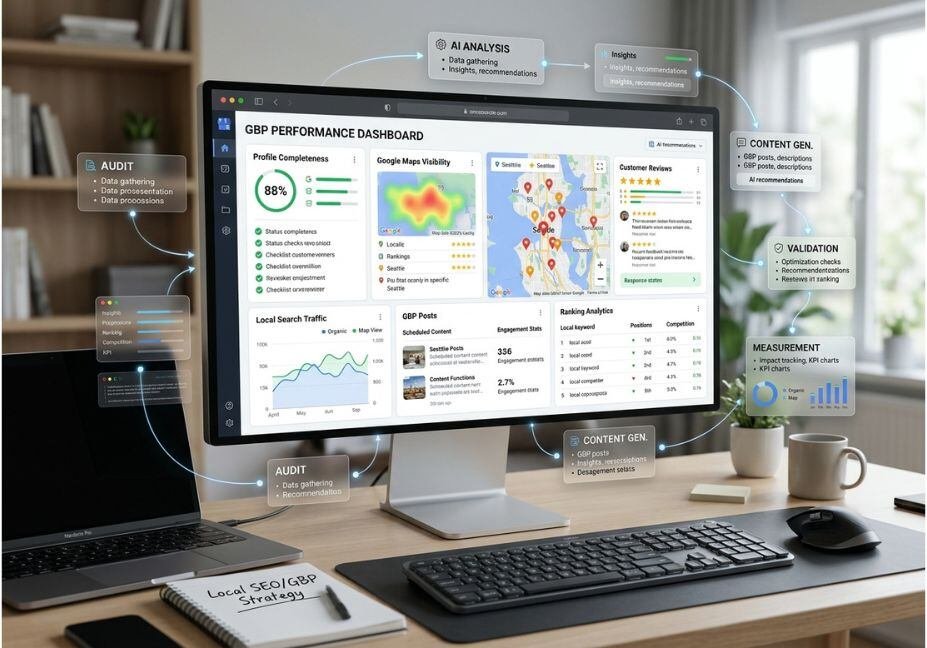
In case a google business profile is completely filled out with information that is old, vague, inconsistent or does not match the local search intent, the profile may still fail to perform well. In this case the main challenge is not about filling out the fields once, but about constantly thinking of what information should be updated and whether it actually made any positive impact.
This is the point where the tools aimed at Google Business profile optimization become extremely useful.
Contemporary AI can gather information on services, reviews, competitors, search queries and profile data, process all the information and make feasible recommendations.
With the agentic workflow in place, this will not be limited to getting information. The modern systems can also retrieve information, choose the right tools to apply, conduct optimization and validate the obtained result against the business facts.
As stated by Google, the quality of local results depends on the relevance, distance and prominence.
What Are AI Tools for Google Business Profile Optimization?
Tools powered by artificial intelligence for optimizing Google Business Profile are computer programs that utilize artificial intelligence and algorithms to perform different functions such as auditing profiles, drafting content, evaluating reviews, conducting competitor analysis, and tracking regional rankings.
There is, however, a key difference between AI assistants and AI agents.
An AI assistant can create a Google Business Profile post once the instructions are given. Meanwhile, an AI agent should be able to:
1 Get the updates of a business profile.
2 Check them against the set parameters of optimization.
3 Point out absent or inconsistent data.
4 Suggest modification(s) that are necessary.
5 Confirm if changes already have been implemented of the approved ones.
The mentioned architecture fits naturally into modern systems of application of tools. The development of artificial intelligence called LangChain defines agents as software that includes media of language and technologies. It is highly important if we talk about local search engine optimization since in this case the large language model serves as reasoning system but does not replace the system of optimization.
How Does AI Optimize a Google Business Profile?
Optimizing the use of AI is most effective when considered as a process, rather than just a single set of instructions carried out over one stage.
1 Profile Audit
The first part of the process is the analysis of your Business Profile. The system will undertake the following steps of business analysis:
1 Identifying primary and secondary categories
2 Analyzing the company description
3 Defining services and products
4 Investigating the hours of activity
5 Gathering website address and contact details
6 Collecting additional information such as pictures,
7 Client ratings
Questions and Answers in the Q&A section
Analyzing the current posts
Information regarding the place of business and service area provided (Google recommends companies to have their business information presented completely and accurately and makes a point of the importance of relevance, distance, and prominence as the main factors for local rankings).
2 Local keyword and Competitore Analysis
The next step in the process is to conduct local keyword research and analysis of competitors. AI can perform research to determine the language that is most often used in your locality, as well as to create a comparison with your competitors.
Moreover, instead of taking the words “the best plumber” literally, a system can tack the relationships between different keywords.
3 Validation
This is a layer that many simple AI tools don’t go through.
Before publishing, the agent should ask:
. Is the claim correct?
. Is the service being provided?
. Is the location correct?
. Is the tone good?
. Is sensitive information disclosed?
. Is the content redundant?
. Is it compliant with rules?
Architect’s Note: Never allow an LLM to directly publish unrestricted changes to GBP. Always put a validation and approval step after generation and before execution.

7 Best AI Tools for Optimizing Google Business Profiles
No single platform is best for every workflow. The useful question is which tool handles the specific job you need.
| Tool | Strongest Use | Best Fit | AI/Automation Role |
|---|---|---|---|
| ChatGPT | Content and analysis | SMBs, marketers | Drafting, analysis, prompts |
| Localo | GBP-focused optimization | SMBs/agencies | Recommendations, posts, tracking |
| BrightLocal | Local SEO management | Agencies/SMBs | Audits, reviews, tracking |
| Semrush Local | Multi-location SEO | Agencies/brands | Listings, reviews, rank tracking |
| GMB Everywhere | Competitor research | Local SEOs | GBP audits and comparisons |
| Jasper | Brand-consistent content | Marketing teams | Content generation |
| Custom AI Agent | End-to-end workflow | Developers | Audit → reason → validate → act |
Competitor research shows that existing roundups generally emphasize content generation, reviews, local rank tracking, and listing management.
The better approach is to combine tools according to the workflow.
AI Use Cases for Google Business Profile Optimization
The business posts generated by AI
When in possession of legitimate information but with no time to sort it into short posts, AI could be helpful.
Some good premises are those such as:
. A project that has just concluded
. The opening of the new service
. The seasonal event
. The actual offer
. A customer query
. A local great education advice
Google allows one to publish the news and offers.
It is significant to remember to utilize the AI to compress the information and come up with variations rather than fictive ideas.
AI capability for answering the reviews
The generation of the responses could be one of the greatest opportunities to use it.
An AI can categorize the reviews as:
. Good
. Neutral
. Bad
. Request
. Price
. Use
. Policy
After that, it can prepare the response for the review.
AI competitor analysis
Competitors have many profiles in:
. Categories
. Services
. Reviews
. Topics
. Images
. Completeness
. Positioning
Important to note is that the purpose of competitor analysis is not to copy them but to find the areas of opportunity.
Performance analysis
AI can help summarize that information into useful decisions.
For example, instead of saying:
“Website clicks have dropped by 12%.”
A good solution would say:
“Website clicks have dropped by 12%, but profile views have stayed the same. You should check if any new posts, service page content, or converting elements have changed.”
Step-by-Step: Build an AI Agent for GBP Optimization
For developers, the entertaining method of GBP optimization can be regarded as a functional workflow.
Step 1: Identify the tools.
Expose narrowly focused methods that can be as follows:
from langchain.tools import tool
@tool
def audit_profile(profile_data: dict) -> dict:
“””Audit GBP completeness and search for optimization holes.”””
return {
“missing_fields”: [],
“category_issues”: [],
“service_gaps”: [],
“review_issues”: []
}
@tool
def generate_post(topic: str, location: str, facts: list[str]) -> str:
“””Develop factual GBP content using the accurate business information.”””
return f”Written content about {topic} for {location}.”
@tool
def validate_content(content: str, approved_facts: list[str]) -> dict:
“””Examine created content with the necessary business facts.”””
return
“approved”: True,
“issues”:
The important idea of the design is that the model does not have the truth. The truth is given to you by your application.
Step 2: Set up an agent loop
LangChain’s present agency structure lets models use tools and do it iteratively with the help of a middleware used for validation, state processing, and error solving.
A simplified scheme may involve the following actions:
GBP data
↓
Audit tool
↓
LLM reasoning
↓
Choose optimization
↓
Draft creation
↓
Validation tool
↓
Human approval
↓
Publication
↓
Results measurement
↓
Memory/next optimization process
Step 3: Include Memory
Put together the needed details which include:
. Brand voice
. Service offerings
. Business location
. Hours of operation
. Approved claims
. Previous posts
. Review-response patterns
Or history of performance and optimization
This will help avoid content repetition.
Step 4: Include Evaluation
Instead of evaluating the agent on the basis of just how well the final output sounds, make sure to evaluate it on:
. Accuracy
. SoP compliance
. Rate of repeated content usage
. Rate of effective tool being used for generation
. Peer approval
. Input relevance
. Actions taken by the brand
. Ranking on local search engines
Research proves that this is important. As LocalSearchBench states, even a well-established market player faces serious challenges in terms of fulfilling the requirements for the correct and complete execution of complex local service tasks.
Technical note: A local SEO agent is a tool, not a copywriter. Quality and correctness take precedence over eloquence.

Common AI GBP Mistakes and How to Avoid Them
1. Keyword stuffing
Simply repeating the same keyword relating to both the city and the type of service being provided in a profile does not enhance the profile’s value as a local resource.
Do not stuff keywords into the local resource; instead, focus on utilizing the language that describes the actual services offered.
2. Publishing without verification.
The models can make claims regarding the services offered, the pricing, experience, or the location. It is important to have an approval gate.
3. Treating posts as the ultimate method of getting a high ranking
Although the posts in GBP keep the customers informed and facilitate engagement, they cannot be regarded as the way of achieving a high ranking in search engines.
As noted on r/localseo by practitioners discussing AI-generated GBP posts, the importance of the relevance and originality of the material leaves no place for mass spamming.
4 Disregarding NAP consistency
It is important to note that there should be uniformity in the name, address, and phone numbers of any business through its listing.
5 Focusing solely on the profile
Your business profile is not an isolated item.
Your website, reviews, local citations, structured data, etc., should work in favor of establishing the same business entity.
6 Failing to measure conversions along with rankings
The change of your position should not be regarded as the ultimate business result
You need to track the following metrics:
. Calls
. Clicks
. Requests for directions
. Reservations
. New reviews
The “profile” of Google My Business offers the complete picture of customer interactions.
FAQ — Questions Most Commonly Asked
In which way AI can help in improvement of Google Business Profile?
AI can be useful in notifying the company about its profile entries, checking for missing services, verifying local search terms, composing GBP postings, studying reviews, preparing answer drafts, contrasting competitors, updating company records.
What is the most effective AI app for optimization of the Google Business Profile?
There cannot be the definite answer to that question. ChatGPT is helpful for content and analysis plans; meanwhile, Localo, BrightLocal and Semrush Local programs are easy to use for local SEO. An agency should not only focus on AI writing features but pay attention to auditing, ranking, and review management.
Is it possible for AI to produce texts for the Google Business Profile.
Yes, it is true. AI may write texts for the GBP posts including news and updates; still the user has to double-check factual information, place, services, date and content, since Google approves posts prepared by AI.
Can Artificial Intelligence generate replies to Google reviews?
The answer is affirmative as Artificial Intelligence can sort and formulate replies to reviews in an organized manner. However, it is not a good idea to post all the replies just like that, especially when some reviews are negative, related to medicine, law, privacy, or possibly fraudulent.
Does Artificial Intelligence enhance ranking in Google Maps?
Although AI enhances processes related to local SEO, it does not guarantee Google Maps rankings. Google claims that local ranking relies on relevance, distance, and prominence. AI is most effective to ensure that data is accurate, research competitors, write better content, and understand performance.
Is Artificial Intelligence content safe in terms of local SEO?
In the case of accurate, relevant, unique artificial intelligence content, it can be very beneficial. However, there are certain risks like unclear statements, plagiarism, and misuse of keywords. It is always important to keep in mind that artificial intelligence output is just a draft of verified business data.
Conclusion
The most effective AI tools for succeeding with Google Business Profiles are not the most prolific content creators. The most effective AI tools transform trustworthy business information into measurable improvements in local search.
Three key principles are:
Using AI for reasoning and repetitive tasks instead of just as a source of truth
Embedding validation and human validation into the tool-use loop
Tracking business results along with rankings and profile performance
For creators, the next step is to go beyond prompt-based GBP management and develop an agency-like framework based on data retrieval, tool calls, memory, validation, and assessment.
This method corresponds to the trend of improving the structure of business information, retrieval methods, facilitation of automation, and active feedback in modern local search.
Save this article for your reference and find more practical AI agents and local search workflows at agentiveaiagents.com.