
One of your best-performing pages just lost 60% of its organic traffic. It didn’t drop in rankings. Instead, Google’s AI Overview answered the query before anyone clicked through. This is exactly what independent traffic data on AI Overviews’ impact on publishers has been documenting since mid-2025. As a result, teams everywhere are now trying to figure out how to compare AI search optimization tools instead of simply buying whichever vendor has the shiniest dashboard.
The category is young, and, frankly, confusing. Vendors call themselves GEO (Generative Engine Optimization) tools, AEO (Answer Engine Optimization) platforms, or just “AI SEO software” often describing overlapping capabilities with completely different vocabulary. So, if you evaluate them the way you’d evaluate a traditional rank tracker, you’ll likely pick the wrong one.
For example, an enterprise SEO team might need an AI visibility tracking tool for large content libraries, while a solo ecommerce brand really just needs a lightweight structured-data auditor for product pages. Because the right tool depends entirely on your bottleneck, this guide treats every candidate as an interface into one shared system: the retrieval pipeline that generative engines run before they ever produce a word. Once you understand that pipeline, comparing vendors becomes a technical evaluation instead of a features-page beauty contest.
What Is an AI Search Optimization Tool?
An AI search optimization tool is software that measures and improves how a brand’s content is retrieved, synthesized, and cited inside generated answers for example, in Google AI Overviews, ChatGPT Search, Perplexity, or Bing Copilot rather than how it ranks in a list of blue links.
According to the foundational generative engine optimization benchmark, these engines don’t actually rank pages at all. Instead, they synthesize an answer from multiple retrieved sources and decide, sentence by sentence, which source earns a citation. In other words, the key shift to understand before comparing any vendor is this: retrieval and synthesis replace ranking as the core mechanic.
Quick definition for voice search: “What is an AI search optimization tool?” It’s a tool that tracks and improves whether your content gets cited inside AI-generated answers, instead of tracking your position in traditional search results.
How Do AI Search Optimization Tools Actually Work?
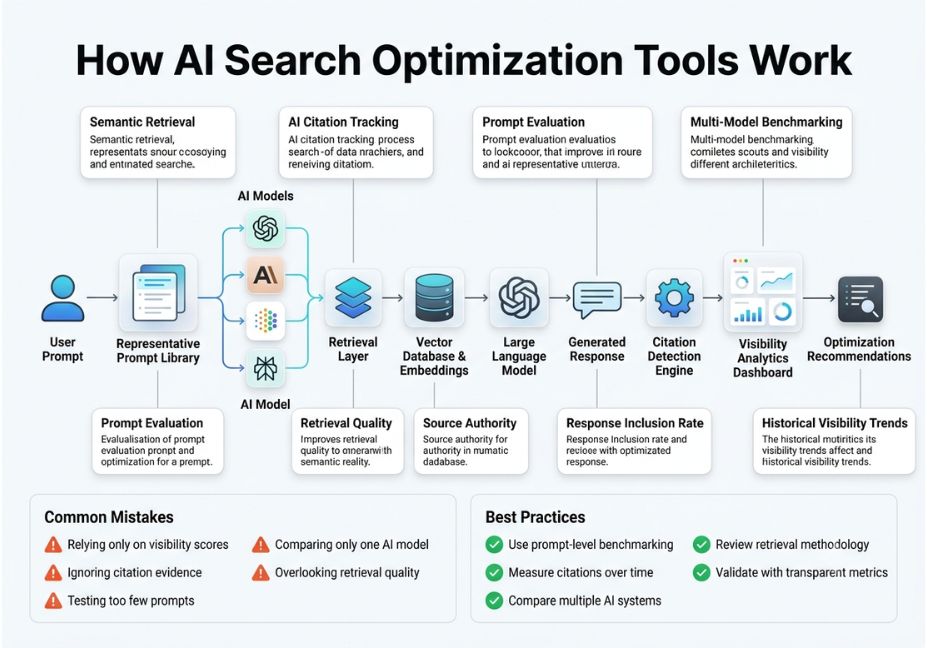
Every generative engine, regardless of vendor, runs some version of a three-stage pipeline: retrieval, summarization, and response generation with citation. Consequently, a tool that only audits one stage will only ever give you half the picture.
- Retrieval layer the engine fetches candidate documents, similar to how retrieval-augmented generation pulls external documents into an LLM’s context window before it generates a response.
- Summarization layer the engine compresses multiple sources into one coherent answer, weighting clarity, structure, and factual density along the way.
- Citation layer the engine decides which sources get named, linked, or paraphrased, and, importantly, how early they appear in the answer.
Technical Note: Position matters far more than most teams assume. The original GEO study found that content mentioned earlier and more prominently in a synthesized answer receives outsized user attention. Therefore, a tool that only reports whether you were cited — and not where is only measuring half the problem.
Most vendors specialize in just one or two of these three layers. So, knowing which layer a tool actually instruments is the fastest way to cut a crowded shortlist down to size.
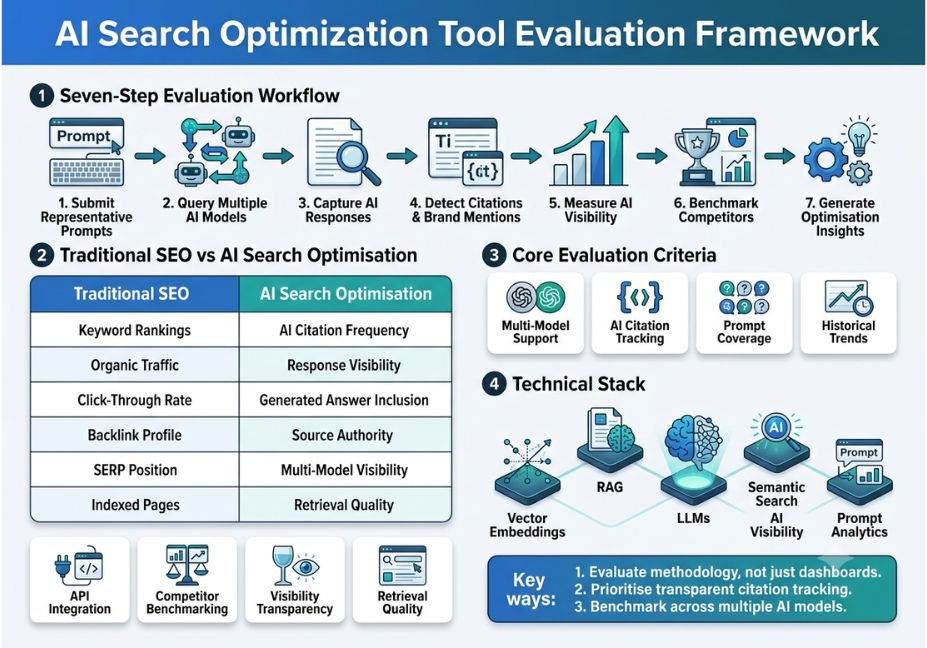
AI Search Optimization Tools Comparison: 4 Common Categories
Rather than comparing individual products, which rebrand and merge constantly, it’s more useful to compare categories first, then shortlist vendors within the category that matches your specific problem.
| Category | What it measures | Best for | Typical weakness |
|---|---|---|---|
| Content clarity / structured-data auditors | Schema markup, entity recognition, machine readability | Sites that need to become citable | Doesn’t track actual AI Overview appearances |
| AI visibility tracking tools | Brand mentions, share of voice, sentiment across ChatGPT, Perplexity, AI Overviews | Enterprise brands tracking GEO performance over time | Descriptive, not prescriptive — shows what happened, not what to change |
| Prompt-level testing tools | Simulates real user prompts against multiple engines | QA before and after content changes | Small sample sizes and prompt drift make trend data noisy |
| Hybrid SEO + GEO suites | Bundles AI-citation tracking with existing rank-tracking dashboards | Teams wanting one login | Often shallow on both sides compared to specialists |
If you’re specifically shopping for the best AI search optimization tools for enterprise SEO teams, prioritize category two. If you’re an ecommerce brand, prioritize category one first, since product-page structured data is usually the biggest unlock.
Did You Know? Independent analysis of Ahrefs-tracked traffic across ten major tech publications found combined US monthly Google visits fell from roughly 112 million to under 50 million between early 2024 and January 2026. Some sites lost over 85% of their Google-referred traffic in that window. That collapse is exactly the market pressure that created this entire tool category.
Step-by-Step Framework: How to Compare AI Search Optimization Tools
Instead of relying on a feature checklist, run every candidate tool through this five-step process.
- Identify your weakest pipeline stage. Audit a handful of your top pages against a simulated AI Overview or Perplexity query. Are you not retrieved at all? Retrieved but never cited? Cited but stripped of context? This answer determines which category you actually need.
- Score citation monitoring, not mention counting. A good tool reports position, sentiment, and frequency of citation not just a binary “mentioned or not.”
- Test structured-data recommendations against your CMS. Some tools recommend schema changes your CMS can’t implement without a dev sprint, so verify feasibility first.
- Run a side-by-side trial on the same 20–30 queries. Don’t trust vendor demos. Instead, feed identical prompts into two shortlisted tools and compare the results against what you observe manually.
- Check for actionability, not just dashboards. The most common complaint in this category is that dashboards report what happened without offering a clear next step. So, prioritize tools that turn a visibility drop into a specific, concrete fix.
python
# Minimal example: testing whether your content appears
# in a generative engine's retrieved context for a target query.
# (Illustrative only — real GEO tools do this at scale with citation parsing.)

import requests

def check_retrieval(query, target_domain, api_endpoint):
    response = requests.post(api_endpoint, json={"query": query})
    sources = response.json().get("cited_sources",
    return any(target_domain in s.get("url", "") for s in sources)

result = check_retrieval
    "how to compare ai search optimization tools",
    "agentiveaiagents.com",
    "https://your-geo-tool-api.example/v1/query"

print(f"Cited: {result}")
Pro Tip: Run this kind of check weekly against your five highest-traffic pages, both before and after any schema or structural change. It’s the closest thing to a controlled experiment available in this space right now.
Common Mistakes When Comparing AI Search Optimization Tools
- Confusing rank tracking with citation tracking. A page can rank #1 traditionally and still never appear in a generated answer, because these are genuinely different systems.
- Ignoring domain-specific variance. The E-GEO study on ecommerce content found that strategies effective in one industry didn’t transfer cleanly to another. So, a “universal” GEO score should be treated with some skepticism.
- Buying for feature breadth over pipeline depth. A suite that touches every stage shallowly is often worse than a specialist tool that instruments citation monitoring rigorously.
- Skipping the trial period. Vendor-reported visibility numbers are notoriously hard to verify independently. A structured trial against your own queries is non-negotiable.
- Assuming AI Overviews behave like Google’s classic algorithm. Google has publicly disputed some third-party traffic-loss analyses, calling the sample sizes too small a good reminder to treat any single vendor’s benchmark as one data point, not gospel.
Architect’s Note: If your team already runs retrieval-augmented generation pipelines internally, you have a head start here. That’s because the evaluation logic precision of retrieval, quality of synthesis, correctness of attribution is the same discipline, just applied to someone else’s black-box engine instead of your own. (For more on that architecture, see our internal guide to building production RAG pipelines.)
What Practitioners Are Saying
Developer discussion around this category consistently converges on one point: tool fatigue. Analysts at firms like Gartner and industry outlets such as Search Engine Land have separately noted that most marketing teams now run three or four overlapping trackers just to reconstruct a single coherent picture of AI visibility. That’s a clear sign the market hasn’t consolidated around a shared measurement standard yet. Until it does, the framework above — score by pipeline stage, verify with your own trial, prioritize actionability — will hold up better than chasing whichever vendor ranks highest this quarter.
FAQ People Also Ask
What is the difference between SEO tools and AI search optimization tools?
Traditional SEO tools optimize for ranking position in a list of links. AI search optimization tools optimize for whether and how content is retrieved, synthesized, and cited inside a generated answer. The signals overlap, but the thing being measured a link position versus a citation inside synthesized text is fundamentally different.
How do I measure my AI search visibility?
You measure AI search visibility by tracking citation frequency, citation position, sentiment, and share of voice across engines like AI Overviews, ChatGPT Search, and Perplexity. Most tools sample a set of representative queries and track how often, and how prominently, your domain appears across repeated runs.
What is Generative Engine Optimization (GEO)?
Generative Engine Optimization is the practice of adapting content so it’s more likely to be retrieved and cited by generative engines. The term comes from a black-box optimization framework that measured visibility gains of up to 40% using techniques like adding statistics and citations.
Can one tool handle both SEO and AEO?
Some hybrid suites bundle AI-citation tracking with existing rank trackers, but specialist tools generally go deeper on either side. Before buying, figure out which pipeline stage retrieval, synthesis, or citation is your real bottleneck.
How much do AI search optimization tools cost?
Pricing across this category ranges from free tiers to over $2,000 per month for enterprise plans. Cost usually scales with query volume, engine coverage, and how many domains or competitors you’re tracking.
Do these tools guarantee placement in AI Overviews?
No tool can guarantee placement, since generative engines operate as black boxes with proprietary retrieval and ranking logic. The best tools simply improve your odds by tightening structured data, content clarity, and citation-worthy structure.
Conclusion
Comparing AI search optimization tools isn’t about finding the longest feature list. It’s about matching a tool to the exact pipeline stage where your content is failing: retrieval, synthesis, or citation. Score candidates on citation monitoring quality, verify every claim with your own trial, and prioritize tools that turn a visibility drop into a concrete next action rather than another dashboard. Get that framework right, and choosing the right AI search optimization tool becomes a straightforward technical evaluation not a vendor guessing game. Bookmark this guide, and explore our related breakdowns on RAG pipeline architecture and agentic workflow design at agentiveaiagents.com.
One Response