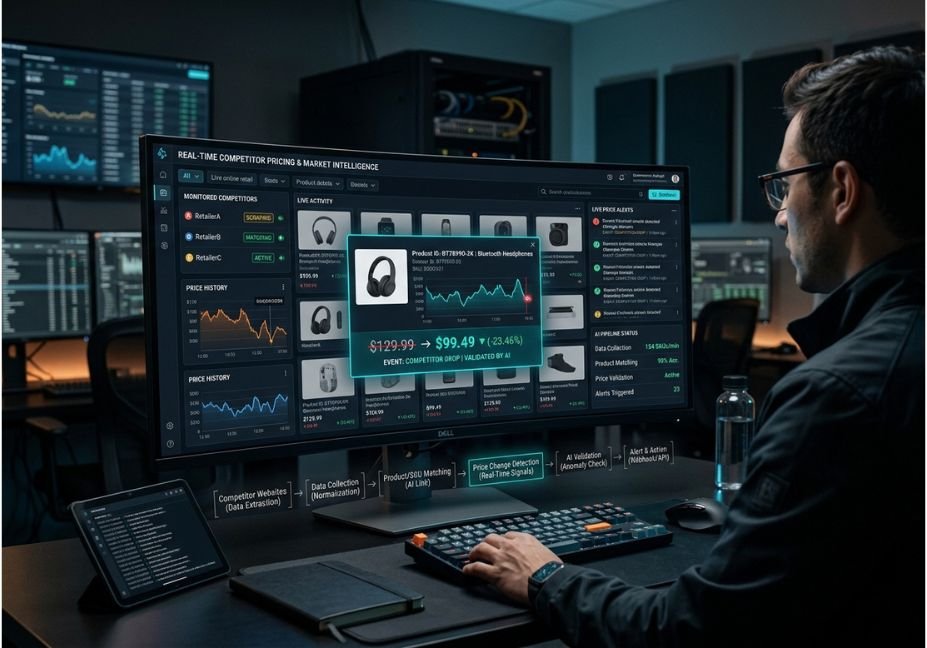
A rival might alter the price of an item from $129 to $99, while your pricing dashboard still reflects the previous day’s figure. By the time the analyst notices the modification, it might already be too late to act on the information.
As a result, in today’s e-commerce data pipeline, artificial intelligence tools for detection of price changes in real time are increasingly popular. Rather than behaving like a human and manually checking the prices of goods over and over again, the programs collect signals, compare them to data from the past, and let one know when some important price change has occurred.
The actual difference here is that real-time monitoring is not just about how often a website is checked. A proper system should also provide functions for matching prices, normalizing, detecting changes, filtering anomalies, and delivering the news.
The issue becomes even more critical in the case of using the received data by an AI agent or a pricing engine. If the data is of poor quality, the outcome will be inadequate.
What Is Real-Time Price Change Detection?
Real-time price change detection is an automatic and systematic price monitoring process. It uses a recent price observation and compares it with the baseline price to find substantial price differences.
A basic implementation is given as an example:
previous_price = $129 current_price = $99
change = $99 – $129 change_pct = -23.26%
A production application includes stock availability, discount information, currency type, product variations, shipping price, and timestamp data.
Tools of this type range from dedicated competitor monitoring tools to general web monitoring services using AI. For example, modern tools offer many functions such as monitoring competitors’ prices, price histories, matching products, filtering prices with AI, and sending automated notifications.
This concept is closely tied to the dynamic pricing system in which existing market conditions influence price decisions. The research based on Alibaba/Tmall experiment shows how price adjustment based on machine learning methods can work in practice using data from real ecommerce transactions.
How Do AI Price Change Detection Tools Work?
The best-performing systems do not rely on just one AI model but on proper pipeline.
1. Gather updated pricing information
The use of a scraper or API or feed reader or browser automation helps to obtain necessary information regarding the product.
2. Find items that match
The task of the system is to find out if two listings belong to the same item. This involves either SKU, GTIN, brand, model, similarity of title, features, or embeddings.
3. Identify the difference
Current observations have to be compared with previous valid observations.
4. Confirm the event
The AI has to be able to identify whether the change occurred in price, if it is just a temporary rendering problem, if it is a coupon or some sort of bundle or variation, and/or if the page was modified in any way.
5. Make sense of the event
The event can either be sent through email, Slack, webhook API or some internal pricing service.

7 AI Tools for Real-Time Price Change Detection
There is no universal “best” tool. The right choice depends on whether you need ecommerce-specific price intelligence, general webpage monitoring, APIs, or an AI-powered decision layer.
| Tool | Best for | Detection approach | Real-time capability | Notable strength |
| Prisync | Ecommerce competitor tracking | Automated price/stock monitoring | Varies by plan/channel | Dedicated pricing workflows |
| PagePulse | Competitor website monitoring | Structural + AI change detection | 24/7 monitoring | Filters meaningful page changes |
| Beaconmon | Shopify/WooCommerce monitoring | Feed + CSS selectors + AI filtering | Configurable intervals | Price + promotion + availability |
| Ovro | General product monitoring | AI page interpretation | Configurable checks | Human-readable change summaries |
| PriceMonkey | Retailer/distributor monitoring | Price detection + product matching | Automated | Price history and matching |
| Nesika AI | Enterprise pricing intelligence | AI matching + event-driven monitoring | Minutes-level monitoring claimed | API/webhook architecture |
| Custom AI pipeline | Developers | Scraper/API + rules + LLM | Fully customizable | Maximum control |
1. Prisync
Prisync has been created primarily for the purpose of tracking competitors’ prices, monitoring stock levels, price history, and dynamic pricing. Currently, the product pages indicate the use of automated monitoring across multiple channels like Shopify, Google Shopping, and Amazon.
A key point to keep in mind is that the term “real-time” cannot be taken for granted just based on the category of the product. According to the latest plans by Prisync, different frequencies of how often a product is updated will be provided relative to the kind of monitoring model used for the system, including once daily and even a few times per daily usage of some products.
Best To Use: The application is designed for organizations that wish to implement price monitoring system within their company and do not want to create their seamless infrastructure.
2. PagePulse
PagePulse focuses on monitoring competitors’ sites and claims to use structured analysis for identifying significant changes from the standard modifications applied. Its set of features includes price change alerts, identification of new products, changes in messaging, and the filtering of AI noise.
Best To Use: Perfect for the companies that monitor its competitors apart from price check.
3. Beaconmon
Beaconmon adopts a more extensive approach towards competing intelligence. It can request pricing, promotions, shipping thresholds, new items, website copy, and history of changes made before and after.
Its approach towards Shopify makes it more interesting, given that the platform talks about monitoring public product feed as opposed to each product page.
Best for: Teams that deal specifically with Shopify and need price as well as competitor changes monitoring.
4. Ovro
Ovro promotes AI as a layer of interpretation. It does not just see that a webpage has changed; it also interprets the change in a form that humans can understand and allows for notification through various channels such as email, SMS, Slack, Discord, or webhooks.
Best for: Smaller teams looking for monitored service offering without the need to set up an entire e-commerce data pipeline.
5. PriceMonkey
PriceMonkey looks into other competitors’ pricing, price changes, how prices have changed historically, and which products are the same as the ones offered by competitors. Its matching feature is quite handy because other competitors’ products may have different naming conventions than those used on your platform.
Best for: Retailers and wholesalers who require matching as well as history of price tracking.
6. Nesika AI
Nesika outlines a pricing intelligence system based on API architecture with features such as AI technology and product matching, event-based price monitoring, webhooks, historical price data, and competitive benchmarking. It claims in a matter of less than 10 minutes, prices changes can be detected anywhere.
Who it’s best for: Ideal for engineering and pricing departments that need their pricing intelligence connected to their in-house systems.
7. Custom AI Price Detection Pipeline
A custom pipeline may be better suited for developers whose requirements might be different from those satisfied by a standard platform.
The simplest of implementations would look as below.
Websites / APIs
↓
Collecto
↓
Normaliser
↓
Product matcher
↓
Price Change Detector
↓
AI Context Classifier
↓
Event Queue
↓
Slack/Webhook/Pricing Engine
How to Build a Real-Time Price Change Detector
Using an LLM at every stage is not a requirement when creating a functional prototype.
The initial step involves utilizing a changeless detection.
from decimal import Decimal
def detect_price_change(previous, current, threshold_pct=1.0):
previous = Decimal(str(previous))
current = Decimal(str(current))
if previous == 0:
return {
“changed”: current != 0,
“change_pct”: None
}
change_pct = ((current – previous) / previous) * 100
return {
“changed”: abs(change_pct) >= Decimal(str(threshold_pct)),
“old_price”: float(previous),
“new_price”: float(current),
“change_pct”: round(float(change_pct), 2)
}
event = detect_price_change(129, 99)
print(event)
In case the result becomes a fact, the following steps can be performed:
“event”: “price_changed”,
“product_id”: “ABC-123”,
“old_price”: 129,
“new_price”: 99,
“change_pct”: -23.26,
“currency”: “USD”
Afterwards, LLM can carry out a classification of the context:
Is it a true price decrease of the rival?
Inputs:
– Product title
– Previous price
– Current price
– Stock status
– Promotion text
– Page diff
– Timestamp
Return:
– change_type
– confidence
– promotion_detected
– requires_human_review
The reasoning for utilizing structured outputs at this point instead of asking LLM to generate free-text responses is that realization of automation in the process will be possible only when response fields are well-defined. The OpenAI documentation describes Structured Outputs as a tool.
Where Real-Time Price Detection Is Most Useful
Technology adds value when it comes to the time to price movements.
Competitive intelligence
Identify whether significant competitors undergo measures to raise or lower their prices.
Dynamic pricing
Relying on competitor signals is one of the inputs for a pricing engine instead of just matching the lowest price.
MAP monitoring
It helps defined the possible cases of MAP violations in the networks of resellers.
Monitoring marketplaces
Amazon, Shopify, Google Shopping, and many other marketplaces generate large volumes of pricing data, which is hard to check manually. That is why there are specialized tools designed for this purpose.
Promotion detection
A competitor may not change its original price but it can offer:
– 20% off promotions
– coupon codes
– bundled offers
– free shipping offers
– limited-time discounts and more.
Thus, price monitoring might miss important occurrences from a commercial point of view.
Common Failure Modes in AI Price Monitoring
1. Similar product names
The product names can seem similar while they may actually be different products.
2. Confusion in variant pricing
A given page shows $99 for the smaller variant even though the catalog value is $149.
3. Promotion confusion
An offer or temporary promo may be confused with the permanent price reduction.
4. Old screenshots
Checking the pricing once in a few hours does not necessarily mean that second-by-second information can be provided accurately.
5. Automatic price battles
Following the price changes of competitors leads to falling margins.
What Should Developers Look for in a Price Monitoring Tool?
Before selecting a platform, score it against the actual architecture you need.
| Capability | Basic monitoring | Production AI pipeline |
| Price extraction | ✓ | ✓ |
| Price history | Sometimes | ✓ |
| Product matching | Limited | ✓ |
| Promotion detection | Rare | ✓ |
| Stock context | Sometimes | ✓ |
| API/webhooks | Sometimes | ✓ |
| AI noise filtering | Limited | ✓ |
| Custom thresholds | ✓ | ✓ |
| Human approval | Sometimes | Recommended |
| Event-level audit trail | Rare | Essential |
The most important metric is not simply checks per minute. Evaluate:
. Detection time
. Accuracy of matching
. Chance of false positives
. Coverage on targeted websites
. The reliability of an API or webhook
. Stored historical data
. Cost for tracking SKU
Ability to detect the diff. between permanent prices and promotions.
In some cases, it could be said that a rapid detection system sending dozens of useless alerts is inferior to a slower solution with proper filtering.

How AI Agents Can Use Price-Change Events
The subject of the article is directly correlated to agentic workflows.
Unlike asking an LLM to mindlessly scan websites of competitors multiple times, we rather expose the monitoring system as an event generator.
Price Event
↓
AI Agent
↓
Get margin
↓
Compare with competitors
↓
Examine pricing rules
↓
Suggest action
↓
Human confirmation
↓
Commerce API
For instance:
Competitor A: $129 → $99
Your price: $119
Margin floor: $92
Agent:
1. Verifies SKU is identical
2. Checks competitors’ inventory
3. Identifies 23.26% reduction in prices
4. Looks for permanence of the promotion
5. Computes the margin impact
6. Proposes $109
7. Seeks confirmation
OpenAI’s current developer documentation allows tool and function calls where models can communicate with outside functions and information sources thus making it possible to create event-driven agent architecture.
FAQ – People Also Search
What exactly is real-time price change detection?
Real-time price change detection relies on an automatic process that allows the identification of price differences when compared with prior data points. Most price change detection systems also come armed with features such as AI algorithms, promotion detection mechanisms, anomaly filtering processes, and alert routing capabilities.
How do AI price monitoring technologies track changes in competitors’ prices?
AI price monitoring systems work by first accumulating product data, normalizing prices, matching similar products, and tracking changes in pricing trends when existing prices are compared with historical prices. Some technologies take into account promotions, inventory levels, website design before making a final decision.
What is the best tool for tracking competitors’ prices?
There is no single best tool; it all depends on monitoring frequency, catalogue size, marketplaces, matching criteria, and integrations. There are services dedicated to ecommerce competitor price monitoring such as Prisync, and there are broader services like PagePulse and Beaconmon that monitor additional website changes.
Is it possible for AI to reprice automatically when competitors change their prices?
Yes, but the automated repricing must be based on well-defined parameters. A more reliable approach would be to analyze competitor’s actions, match products, check stock availability, apply margin conditions, put price limits, and, if required, get confirmation from a human before changing the price on the site.
How does real-time price monitoring differ from dynamic pricing?
Real-time price monitoring refers to data capture about the market situation while dynamic pricing controls how self-pricing should react. The data obtained through monitoring may play the role of one of the inputs for dynamic pricing usage along with demand, stock level, margin conditions, conversion rate, seasonality, and business conditions.
Conclusion
The priciest AI solutions for noticing alterations in prices on the spot include not merely web scrapers with a language learning model plugged into them. An effective solution includes collecting data, matching stock-keeping units, comparing prices, keeping historical records, confirming prices with the help of AI, and raising alerts based on event triggers.
In the case of ecommerce teams, specialized platforms help avoid dealing with problems related to infrastructure. As for developer teams that build pricing agent workflows, a better solution is represented by an event pipeline as price fluctuations can become sorted input for an AI agent.
The best way to start is to use deterministic methods to detect price changes, then employ AI whenever the situation is not clear and, lastly, automate the pricing final steps when it is proved that the monitoring system works correctly.