

Most pricing failures in production aren’t caused by a bad model. They’re caused by a pricing pipeline with no memory, no market context, and no tool-use loop. For example, a repricing job that only reads yesterday’s CSV isn’t intelligent it’s a cron job wearing an AI label.
AI pricing algorithms, in short, are the logic layer that turns market signals demand, competitor prices, inventory, elasticity into a price decision. However, what’s changed in the last two years isn’t the math. Regression and reinforcement learning have existed for a decade. Instead, the real shift is in the orchestration layer: production pricing systems now behave like agents. They retrieve context, call tools, reason about constraints, and then act.
This guide breaks down how AI pricing algorithms actually work, where the ReAct pattern and retrieval-augmented generation fit in, and how to build a minimal pricing agent for ecommerce yourself. Along the way, we’ll also cover how to choose the best AI pricing algorithm for a small business, how reinforcement learning pricing agents differ from rule-based systems, and how to build a real-time AI repricing engine three of the most common long-tail questions developers ask when starting this kind of project.
What Is an AI Pricing Algorithm?
An AI pricing algorithm is a set of inputs, models, and business rules that compute an optimal price for a product. Specifically, it combines historical sales data, competitor pricing, and demand signals into a single output. Unlike a static price list, the algorithm recalculates continuously as conditions change.
Formally, many implementations treat repricing as a sequential decision problem, where a reinforcement learning model analyzes customer demand, seasonality, competitor prices, and market uncertainty to reach a revenue-optimal price. In fact, this can be modeled as a Markov Decision Process, where each pricing decision moves the system into a new state. As a result, elasticity curves and demand forecasts feed directly into the reward function.
Companies like Amazon, Uber, and Airbnb popularized this approach at scale, and enterprise teams including those at Klarna now use similar orchestration patterns for internal pricing agents.
How Does an AI Pricing Agent Work?
A pricing agent differs from a pricing model in one key way: it doesn’t just output a number. Instead, it decides how to gather the information needed to produce that number.
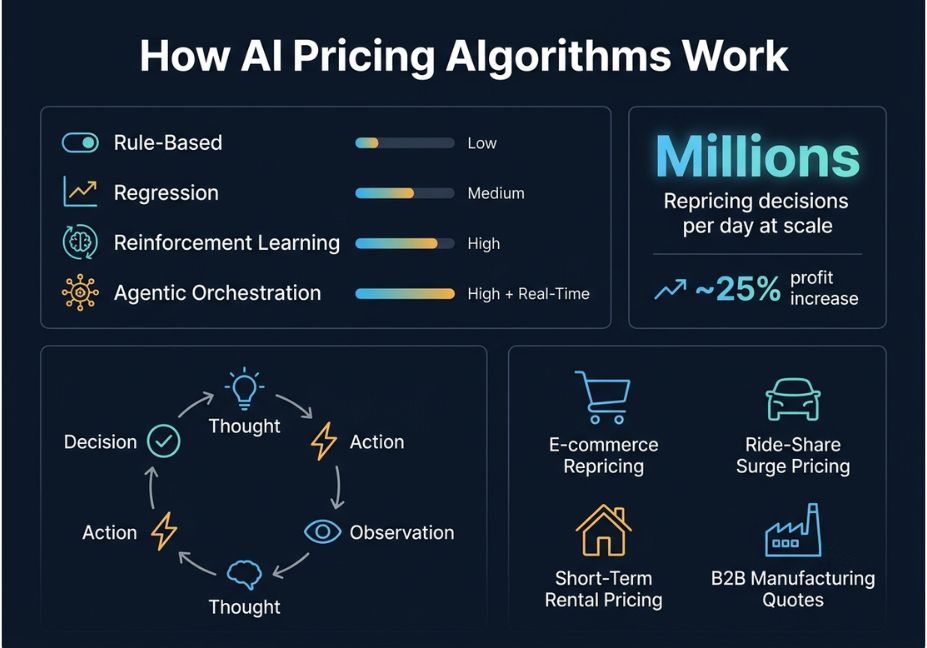
A typical agentic pricing loop follows the ReAct pattern reasoning traces interleaved with actions first formalized in a framework where language models generate reasoning traces and task-specific actions together. As a result, reasoning helps update action plans while actions pull in external information. Applied to pricing, that looks like this:
- Thought: “I need current competitor prices for SKU-4471 before repricing.”
- Action: Call a
get_competitor_prices()tool. - Observation: The tool returns scraped price data.
- Thought: “Inventory is at 12% of normal, so I should also check demand elasticity.”
- Action: Query the RAG layer for recent elasticity reports.
- Final decision: Pass all context to the pricing engine and output a bounded price recommendation.
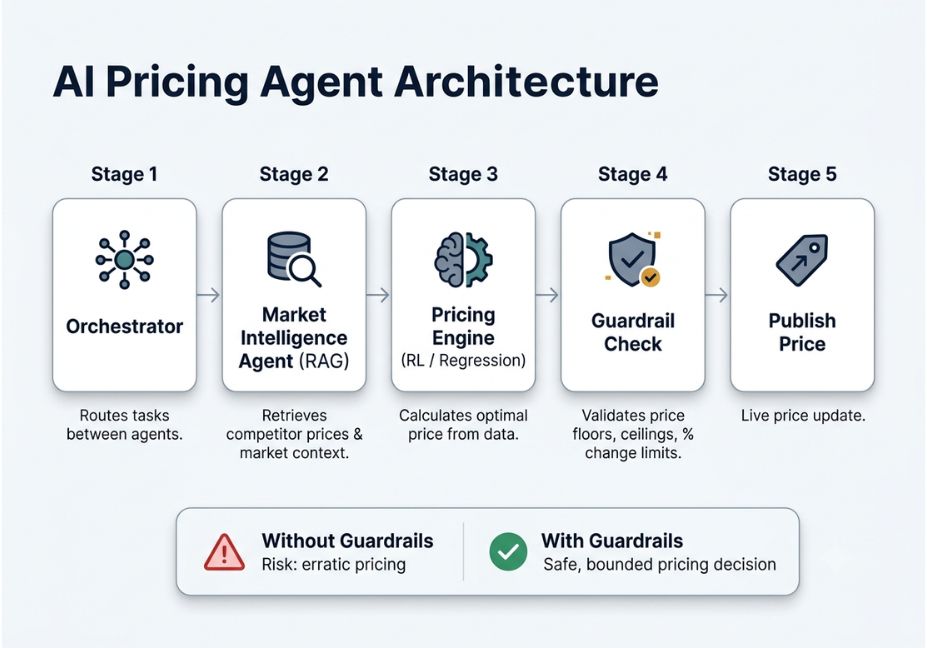
Meanwhile, recent production implementations split this into a multi-agent system: a market intelligence agent handles RAG retrieval of competitor data and market news, while a separate RL pricing agent runs the optimization algorithm that determines the actual price adjustment. Consequently, an orchestrator commonly built on LangGraph routes between them and enforces guardrails so the RL agent’s exploration never breaches minimum margin rules.
Pro Tip: Don’t let the RL or regression model output go straight to production. Instead, route it through a validation node that checks price floors, ceilings, and percentage-change limits before publishing. This is the single highest-leverage guardrail in an agentic pricing stack.
AI Pricing Algorithm Use Cases: 4 Real-World Examples
- E-commerce repricing at scale: Large marketplaces such as Amazon run millions of repricing decisions daily, adjusting SKU-level prices based on competitor moves and inventory depth.
- Ride-share and logistics surge pricing: Similarly, surge pricing algorithms raise fares during peak demand to balance supply and demand in real time the same mechanism agentic systems now apply to freight and delivery pricing.
- Short-term rental pricing: Rental platforms like Airbnb combine historical bookings, seasonal trends, and real-time competitor listings to recommend host pricing and adjust it automatically based on availability.
- B2B manufacturing quotes: Additionally, agents ingest ERP data to reprice components as raw-material costs shift, supporting custom quotes based on volume and service level.
Pricing Algorithm Approaches Compared
| Approach | How It Decides Price | Data Needs | Best Fit |
|---|---|---|---|
| Rule-based | If/then thresholds (time, inventory, demand) | Low | Simple catalogs, fast to ship |
| Regression models | Forecasts demand impact of a price change from historical data | Medium | Stable markets with clean history |
| Reinforcement learning | Learns a pricing policy via trial-and-reward (often Q-learning) | High | Volatile markets, many SKUs |
| Agentic orchestration (LLM + tools) | Routes between retrieval, RL/regression tools, and rule checks | High + real-time | Enterprise systems needing explainability and governance |
Did You Know? Large marketplaces make roughly a quarter more profit from dynamic pricing alone, processing on the order of millions of repricing decisions per day a scale no manual pricing team could match.
Step-by-Step: How to Build an AI Pricing Agent
A minimal pricing agent needs three things: a tool that fetches market context, a tool that computes a price, and an orchestrator that decides when to call each.
from langchain_core.tools import tool

@tool
def get_market_context(sku: str) -> dict:
    """Fetch competitor prices and inventory signals for a SKU."""
    # Replace with a real RAG/vector-store or API call
    return {"competitor_avg": 42.50, "inventory_pct": 0.18, "demand_trend": "rising"}

@tool
def calculate_price(sku: str, base_price: float, context: dict) -> float:
    """Apply a bounded pricing rule using market context."""
    price = base_price
    if context["inventory_pct"] < 0.2 and context["demand_trend"] == "rising":
        price *= 1.08  # scarcity + demand adjustment
    price = min(price, context["competitor_avg"] * 1.05)  # competitive ceiling
    return round(price, 2)
Next, wire both tools into an agent. LangGraph, for instance, is a low-level orchestration framework for building, managing, and deploying long-running, stateful agents which makes it a natural fit for a loop that needs to persist state, such as current price and last check-in, across repricing cycles. Before wiring your own orchestrator, review the LangGraph documentation for models and tools guidance.
Technical Note: Framework versions evolve rapidly. The snippet above targets LangChain’s current tool-decorator syntax as of mid-2026. Therefore, always check the official docs for the latest API before shipping.
Common Mistakes and How to Avoid Them
- No price guardrails: An RL agent optimizing purely for reward can find degenerate policies for example, undercutting to zero. So, always cap the action space.
- Treating personalization and dynamic pricing as the same thing: Dynamic pricing adjusts to overall market conditions, whereas personalized pricing alters price based on individual behavior and raises separate privacy and fairness concerns. Conflating the two invites regulatory risk.
- Ignoring compliance: Pricing governance should include policies that ensure compliance with laws such as anti-price-gouging regulations, enforced by a named owner rather than an implicit assumption.
- Skipping human-in-the-loop for edge cases: Instead, route low-confidence or high-variance decisions to a human reviewer node before auto-publishing.
What Developers Are Saying
Builders experimenting with agentic pricing stacks are increasingly combining RL optimization with LLM-based governance layers. In this architecture, LLMs handle context retrieval, reasoning, and policy compliance, while a separate engine handles the mathematical optimization a pattern that’s becoming increasingly common across engineering communities and referenced in the open-source LangGraph repository, built by LangChain for standalone or full-ecosystem use. Research groups such as Google DeepMind and Stanford CRFM have also published related work on reinforcement learning agents that generalizes directly to pricing optimization.
FAQ: People Also Ask
What is an AI pricing algorithm?
An AI pricing algorithm is a system that computes product prices from market data demand, competitor prices, and inventory using machine learning or rule-based logic. Instead of a fixed price list, it updates continuously.
How do AI agents calculate product prices?
AI agents typically call a retrieval tool for market context, pass that context to a pricing model such as regression or reinforcement learning, and then validate the output against guardrails like margin floors before publishing a final price.
Is AI-driven dynamic pricing legal?
Yes, dynamic pricing based on market conditions is generally legal. That said, businesses must comply with anti-price-gouging and consumer-protection laws, which vary by jurisdiction. This is a factual summary, not legal advice, so a lawyer should review specific implementations.
Can a pricing agent operate without human oversight?
Technically, yes but best practice keeps guardrails and periodic human review in place, especially for edge cases like sudden demand spikes, where an unsupervised agent can make erratic decisions.
What’s the difference between rule-based and reinforcement-learning pricing?
Rule-based pricing applies fixed if/then logic, such as discounting when inventory is high. Reinforcement-learning pricing, on the other hand, learns a policy through trial and reward over time, adapting to patterns a static rule set would miss.
What is the best AI pricing algorithm for a small business?
For most small businesses, a rule-based or regression model is the best starting point, since it requires less data and is easier to explain. Reinforcement learning becomes worthwhile only once there’s enough sales volume and SKU variety to train it reliably.
Conclusion
AI pricing algorithms have moved from single-model scripts to full agentic systems. Specifically, they now combine a retrieval layer for market context, a pricing engine such as regression or reinforcement learning, and an orchestrator that enforces guardrails before anything goes live. In other words, the math hasn’t changed much the orchestration layer has. So if you’re building one, start with a bounded, rule-checked prototype before letting any RL policy touch a live price.
Bookmark this guide and explore more hands-on agentic AI tutorials at agentiveaiagents.com.