A challenge that people using AI will face in the year 2026 requires becoming more informed not about the existing AI tools but about the choice of the tools to be permanently included in the working processes.
The term “AI tools to be used in 2026” now embraces everything from traditional LLMs and AI programming assistants to autonomous agents, retrieval-augmented generation systems, vector databases, research instruments, and automation processes. Contemporary selections of tools usually group them into productivity categories like those of chat, coding, research, design, and automation.
To developers, though, a list of 100 tools would seldom be of use. The key issue concerns the architecture of AI processes, more specifically, the contribution of a particular tool to the implementation of an AI-based process.
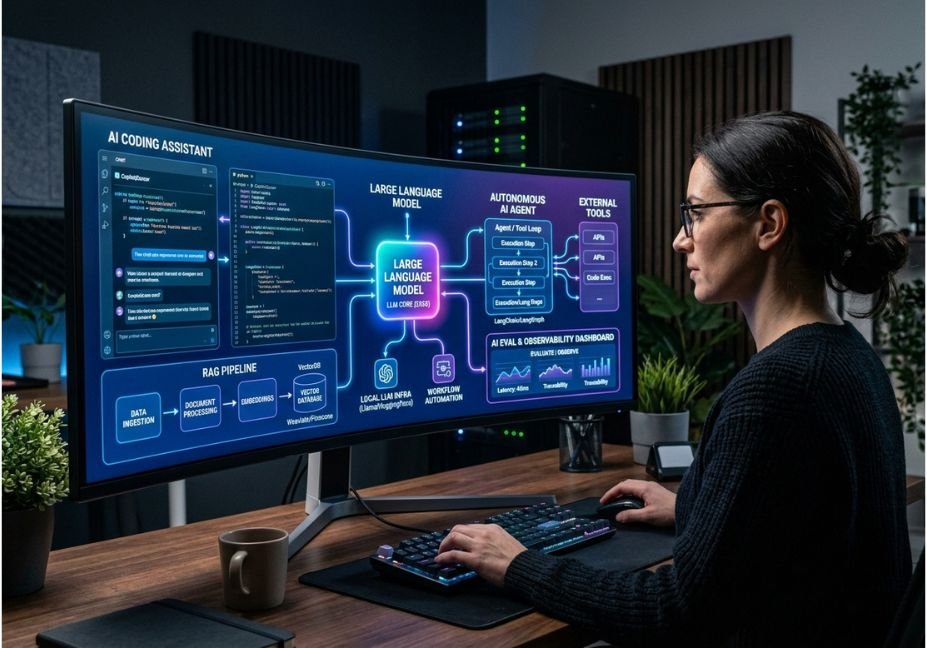
A modern AI application can rely on LLMs for reasoning, agent frameworks for orchestration, vector databases for retrieval of data, AI IDEs for programming, and observability layers for debugging.
This means that the trend that can be observed nowadays refers to the replacement of standalone AI solutions by the advent of composable AI systems.
What Are AI Tools in 2026?
AI tools refer to any piece of software, API, framework, or infrastructure that uses AI technology (especially LLMs) to perform certain tasks, thus automating or augmenting them.
The shift occurring by 2026 is that an AI tool may not necessarily be a chatbot.
The set of tools making up an AI stack can be the following:
Foundation models meant for reasoning and generation
AI coding assistants meant for software development
Agent frameworks meant for utilizing the tools and utilizing workflow autonomously
RAG frameworks meant for grounding LLM answers in private datasets
Vector databases meant for semantic search
Automation platforms meant for application integration purposes
Local RAGs meant for privacy and unfolding experiments nifer
The reason for this difference is that an agent signifies something fundamentally different compared to a model which simply generates text. Currently, LangChain states that an agent is a system where language models and tools are combined.
1. General-purpose LLMs: The Foundation Layer
The first category that needs to be understood by any AI developer is defined as a foundational model layer.
The competition between OpenAI, Anthropic, Google, Meta, and other models has shifted focus towards reasoning capabilities, multimodality, context handling, usage of tools, and cost rather than on text generation.
For developers, it is necessary to assess the models according to the criteria defined by the respective workflows.
Quality of reasoning – Does the model solve multi-step problems?
Using tools – Does the model use the functions accurately and reliably?
Handling context – Is the model able to process the incoming information from a specific app?
Latency – Does the model send responses in time?
Cost – Is model affordable when scaled?
Structured output – Does the model return machine-readable data?
For example, OpenAI’s current developer model supports such tools as web search, file search, function calling, and remote MCP integrations, while its agent tool allows for multi-agent orchestration.
Pro tip: Do not select a model just because it is the best in a common benchmark. Take a small sample coming from the real-life application and analyze its precision, reliability of tool call, latency, and price.

2. AI Coding Assistants: Cursor, Copilot and Agentic Development
AI coding assistants have moved beyond autocomplete.
Modern developer tools can understand repository context, modify multiple files, generate tests, explain unfamiliar code, and assist with debugging.
Two tools developers should know are Cursor and GitHub Copilot.
| Capability | AI IDE / Agent | Traditional autocomplete |
|---|---|---|
| Code completion | Yes | Yes |
| Repository context | Strong | Limited |
| Multi-file changes | Yes | Limited |
| Natural-language commands | Yes | Limited |
| Debugging assistance | Yes | Basic |
| Test generation | Yes | Basic |
| Agentic task execution | Increasingly common | Limited |
Current 2026 developer-tool coverage shows this broader transition from autocomplete toward codebase-level development workflows.
The real productivity gain comes when the assistant can understand the relationship between:
requirements → code → dependencies → tests → errors → fixes.
Architect’s Note: Treat AI-generated code as an untrusted contribution. Run tests, inspect dependency changes, review security-sensitive operations, and keep human approval around production-impacting changes
3: RAG and Vector Databases: A basis for LLM Applications
One of the major AI technologies that is going to be vital by 2026 is Retrieval Augmented Generation (RAG).
This technology allows the application to obtain information about the data relevant to the question before usage of LLM to get the response to the query.
The general process is as follows:
Documents
↓
Chunking
↓
Embedding model
↓
Vector database
↓
Semantic retrieval
↓
Relevant context
↓
LLM
↓
Grounded response
Various applications like LlamaIndex are aimed at connecting applications based on LLM with relevant external data, whereas vector database solutions like Pinecone provide a seamless mechanism for the embeddings storing and retrieval.
The key performance relationship is as follows:
embedding model → retrieval quality → context quality → answer quality
Failing to chunk properly (or retrieve the information correctly) results in using a robust LLM for providing a wrong answer.
4. AI Research and Search Tools
AI-assisted search is another key category.
Tools like Perplexity and NotebookLM are good for tasks where combining information from different sources is more important than creating information entirely from scratch.
Here are some things these tools can do:
– Literature discovery
– Competitive research
– Technical documentation
– Source comparison
– Document summarization
– Formulating research questions
– Evidence extraction
However, it is important for developers to know the difference between search assistance and verified research.
A large language model creates a solid summary but does not always interpret the source correctly or makes false connections between documents.
A better research process is:
search → find source → check evidence → compare results → summarize after verifying the information.
5. Local LLMs and Open-Source AI Tools
Not all AI workloads should rely on hosted APIs.
Hugging Face has played a significant role in the ecosystem for open models, models, libraries, and AI tech. Runtimes such as Ollama have simplified the experimentation to a large degree.
Using local AI may make sense if you want:
– Higher privacy
– Offline inference
– Low marginal inference cost
– A chance to experiment with custom models
– Prototypes used internally
– Ability to control the version of the model
– Less reliance on external APIs
But being local does not mean it is more cost-effective.
You still need to consider:
– The price of GPUs or accelerators
– The amount of memory required
– Trade-offs in quantization
– Model quality
– Maintenance in the long run
– Inference speed
– Security level
The best way is to test the task both on a local level and a hosted one before making a decision.
7. Automation Tools and Agentic Workflows
AI tools are becoming better significant due to the connection between logic and existing software.
Typical automation follows this cycle:
Trigger → Rule → Action
While agentic automation follows this path:
Goal
↓
LLM determines the task
↓
Chooses the tools to use
↓
Checks the state of the application
↓
Carries out actions
↓
Assesses the outcome
↓
Repeats / elevates / finishes
Tools such as n8n, Zapier, and other processes give way to the integration of apps, APIs, databases, and AI.
The main point is reliability. While a process sending out a notification can be easily predicted, one that determines which client should receive it causes uncertainty.
8. The Best AI Tools to Know in 2026: Comparison
Rather than asking which AI tool is universally “best,” match each tool category to the engineering problem.
| Tool / Category | Best Use | Main Strength | Key Risk |
| OpenAI | LLM apps and agents | Models + tools + APIs | API/model changes |
| Claude | Reasoning and coding | Strong long-context workflows | Cost/latency tradeoffs |
| Cursor | AI-assisted development | Codebase-aware editing | Generated-code errors |
| GitHub Copilot | Developer productivity | IDE/GitHub integration | Review still required |
| LangChain | Agent applications | Model/tool abstraction | Abstraction complexity |
| LangGraph | Agent orchestration | Stateful execution | More architecture overhead |
| LlamaIndex | Data/RAG applications | Data and retrieval workflows | Retrieval quality |
| Hugging Face | Open-source AI | Models and ecosystem | Deployment complexity |
| Ollama | Local LLM experimentation | Simple local inference | Hardware limitations |
| n8n | Workflow automation | Flexible integrations | Complex workflows become difficult to maintain |
The strongest stack is usually small and composable, not the one containing the largest number of subscriptions.
9 . How to Construct Your 2026 AI Stack
Rather than adopting every trendy AI tool, consider creating solutions to address difficulties in workflows.
Step 1: Identify the task
Make a list of the repetitive or particularly tricky processes you would like to optimize.
Examples:
Customer-support triage
Code checking
Internal knowledge retrieval
Research summaries
Documents processing
Data extraction
Step 2: Determine if you need an LLM or an agent
An LLM will be the right choice for workflows of the type:
input → transformation → output
An agent will be needed for workflows of this type:
goal → decisions → tools → feedback → next steps
Step 3: Retrieving information strictly when it is necessary
If the process involves proprietary or dynamic information, then RAG has to be taken into consideration.
Do not implement the vector database simply because it allows the use of LLMs.
Step 4: Introduce observability
Monitor the following:
Model response time
Use of tokens
Tool activation events
Unsuccessful tool activations
Information retrieval outcomes
End products
Feedback from the user
The LangChain family features LangSmith for monitoring agent activity while LangGraph offers such capabilities as durable execution and reliability of results.
Step 5: Prepare the evaluation set
Before altering your models or prompts, you need to create an evaluation set of 20 to 100 tasks.
You will also need to calculate:
-accuracy
-accuracy of tool activations
-quality of retrieval resources
-speed of working of the models
-cost of implementation
-proportion of failures
This gives the engineers an objective point of reference to rely on.
10 Errors Frequently Made While Selecting AI Tools
The largest error is in selecting tools depending on their fame instead of their patterns.
Error 1: Applying a single model for all purposes
Every task requires specific capabilities.
A speedy model is useful for classification but in tough planning situations a more robust reasoning model is useful.
Error 2: Using an agent in fields where workflow suffices
A self-sufficient agent generates more options for failure than a deterministic way of completing a task.
Should the problem have a known sequence, use this very sequence.
Error 3: Underestimating retrieval quality
Even if using a powerful LLM, the retrieval of unrelated documents would still generate problems.
Error 4: Assessing prompts
A prompt that works correctly for five cases could fail with the sixth example.
Error 5: Giving the agents unnecessary rights
An agent which has access to email, databases, payment systems, and production APIs poses a huge business risk.
Use the following system:
Least privilege authorization
Whitelist for tools
Confirmation gates
Validation at input
Limits on the flow
11. What Comes Next for Developers
An important trend is not simply that there are “more AI tools.”
It is that AI systems become more composable.
Three developments are worth special notice:
1. Agent orchestration
The trend is in the direction of durable and stateful systems where agents can pause, continue, use tools, and involve people.
2. Context engineering
The competitive advantage has increasingly resided in the ability to choose what information is delivered to the model, when it gets to the model, and how it is formatted.
3. Tool interoperability
AI systems are becoming more reliant on their ability to work with external tools and services via standardized interfaces instead of custom builds for every project.
LangChain ecosystem currently, for instance, provides separate high-level abstractions of agents from low-level orchestration via LangGraph while offering tracking and evaluation possibilities via LangSmith.

FAQ: People Are Asking
Which is the best AI tool and technology for 2026?
The best AI tools are determined by the process, with developers needing to be aware of the use of foundational models, AI programming assistants, agent frameworks, RAG frameworks, and vector databases, automation tools, and local LLM runtimes. Some examples are tools such as OpenAI, Claude, Cursor, GitHub Copilot, LangChain, LangGraph, LlamaIndex, Hugging Face, and Ollama employed in the current AI stack. This is dependent on the usage of tools by the developer.
What are the best AI tools for programmers for the year 2026?
There is no best AI tool for programmers. The AI-native IDEs such as Cursor are good for building codebases, and GitHub Copilot is arguably superior to work with in the GitHub development environment. At the same time, frameworks like LangChain and LangGraph work better for developing AI systems and agents.
What is the distinction between AI agents and AI chatbots?
An AI chatbot responds to the user’s input, while an AI agent selects tools, takes actions, analyzes outcomes while maintaining the state of the actions taken until a certain objective is achieved. LangChain explains agents as systems of agents that work in a continuous circle of actions until a final answer or a stop event occurs.
Is it necessary to have RAG for all applications that use LLMs?
No. RAG is needed when there is a need to use private, external, particular to a domain, or continually changing information. If there is enough knowledge in the model to complete the task, then adding a retrieval layer will only make things more complicated.
Should local LLMs be used in 2026?
Getting local LLMs could be useful for taking privacy into consideration, carrying out trials, working offline, or if the costs of API provided by third-party services or the costs related to data transfer are an issue.
In what way should I go about assessing a tool developed using artificial intelligence before I start using it?
You need to assess the tool by testing it against activities related to your work in real time. Look into its accuracy, reliability while performing the task, speed of performing the functions, cost of using the tool in your work, ease of integration of the tool into existing systems, security of the tool performance and its capacity to recover from failures.
To conclude
The major takeaway from the materials listed above is that the biggest stack is not necessarily the most effective one.
Here are the main principles to keep in mind:
Select tools based on their practical capabilities rather than their hype. Start from identifying the problem and think of the minimum set of components needed to solve it.
Learn how the tool works. LLMs offer advanced reasoning and generation capabilities; agents add option of using the tool for performing different tasks; RAG tool enables getting new data; orchestration allows to control the process of work with the tool created and evaluation will allow to determine the reliability.
The real benefit for the people who create such products is in realizing how to use these parts simultaneously.
The following step should be to choose any real workflow, prepare a small sample set, and construct the simplest design necessary to fulfill this task.
Remember to save the link to this manual and visit agentiveaiagents.com for other practical tutorials about the use of AI agents, LLMs, RAGs, and agentic workflows.