

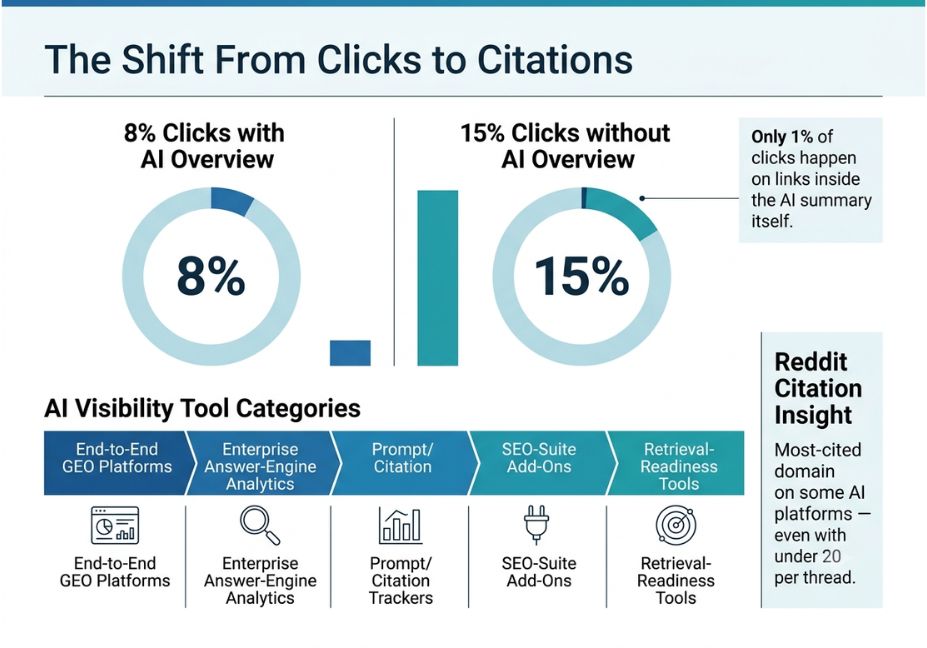
Most brands still measure search performance the way they did in 2019 rankings, clicks, organic sessions. Meanwhile a growing share of queries never produce a click at all. When Google shows an AI Overview, users click a normal organic result on roughly 8% of visits, compared with 15% when no summary appears, and links embedded inside the summary itself get clicked barely 1% of the time. That’s the problem AI visibility optimization tools exist to solve: they measure and improve whether your content gets cited inside an AI-generated answer, not whether it ranks in a list beneath it.
This shift has a name generative engine optimization (GEO) and it behaves nothing like traditional SEO. Instead of crawling and ranking full pages, systems built on Retrieval-Augmented Generation (RAG) pull small, semantically relevant passages from an index, then a language model decides which of those passages earns a citation in the final answer. If you’ve built or debugged a RAG pipeline, you already understand the mechanism these tools are trying to influence from the outside.
What Is AI Visibility Optimization?
AI visibility optimization is the practice of monitoring and improving how often, and how prominently, a brand’s content is surfaced inside answers generated by systems like ChatGPT, Gemini, Claude, and Google AI Overviews. According to the Wikipedia entry on generative engine optimization, the practice grew directly out of the shift toward RAG architectures, which index and retrieve semantically relevant text segments rather than ranking whole pages. That reframing from page rank to passage retrieval is why visibility tools track citations and share of voice instead of SERP position.
Two co-occurring terms matter here: citation allocation (which sources actually get quoted or paraphrased in the final answer) and passage-level optimization (structuring content so an individual chunk is self-contained enough to be lifted out and cited correctly).
How Does AI Visibility Optimization Work?
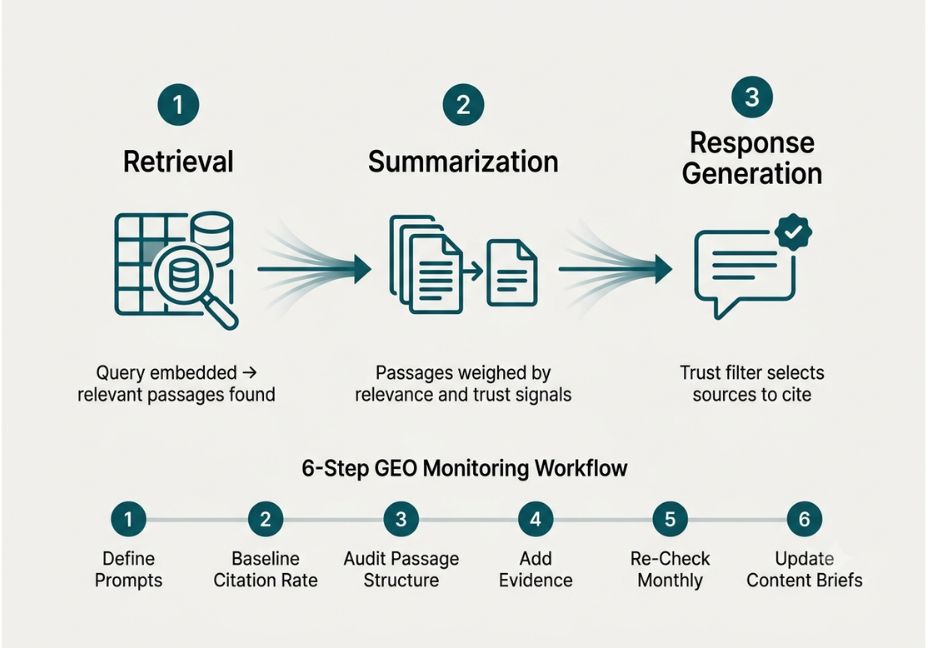
Every generative answer engine regardless of vendor moves content through three stages: retrieval, summarization, and response generation. A visibility tool’s job is to instrument and influence each stage.
- Retrieval: The system embeds the user’s query and searches a vector index (its own crawl, a live search API, or both) for semantically similar chunks. Content that isn’t chunked cleanly walls of text with no clear claim boundaries is harder to retrieve accurately.
- Summarization: The model condenses retrieved passages, weighing them by relevance and trust signals rather than keyword density.
- Response generation: The model applies what researchers describe as a probabilistic “trust filter,” favoring third-party, corroborated sources over brand-owned pages, and rewarding passages with unique statistics, direct citations, and unambiguous claims.
The original GEO research from Aggarwal et al. formalized this as an optimization problem distinct from SEO, showing that adding statistics, quotations, and citations to a passage measurably increases how often it gets pulled into generated answers. That’s the mechanism every tool in this article is ultimately trying to measure or manipulate.
Architect’s Note: If you already run a RAG pipeline internally, treat your own chunking and embedding strategy as a preview of how public generative engines will treat your content. A passage that a retriever can’t isolate cleanly from surrounding boilerplate is a passage that won’t get cited by your system or anyone else’s.
AI Visibility Optimization Use Cases
- Competitive share-of-voice tracking measuring how often your brand vs. competitors appear across a fixed set of prompts.
- Citation source auditing identifying which of your pages are actually being pulled into AI answers, and which never make it past retrieval.
- Content gap discovery surfacing prompts where a topic is discussed but your brand is absent, so editorial teams know what to publish next.
- Cross-platform monitoring comparing visibility across ChatGPT, Perplexity, Gemini, and Google AI Overviews, since each platform’s retrieval index and citation behavior differs meaningfully.
- Schema and technical readiness audits checking that structured data, clear entity naming, and crawlable markup aren’t blocking retrieval in the first place.
Did You Know? Reddit is disproportionately represented in generative answers: on some platforms it’s the single most-cited domain, and analysis of hundreds of thousands of cited Reddit posts found AI systems paraphrase that content rather than quote it directly, with most cited threads having fewer than 20 upvotes engagement volume isn’t what drives citation.
Best Tools and Frameworks Compared
Coverage, depth, and workflow integration vary a lot across the current landscape. Here’s how the major categories stack up:
| Tool category | Example platforms | Best for | Watch out for |
|---|---|---|---|
| End-to-end GEO platforms | Dageno AI, Evertune | Monitoring + content execution in one workflow | Higher price point, steeper onboarding |
| Enterprise answer-engine analytics | Profound, AthenaHQ | Agent-level analytics, large prompt libraries | Built for enterprise scale, less useful for solo sites |
| Prompt/citation trackers | Peec AI, Otterly.AI | Lightweight monitoring across multiple LLMs | Monitoring only no content generation |
| SEO-suite add-ons | Semrush AI Visibility Toolkit, Ahrefs Brand Radar | Teams already invested in an SEO stack | AI visibility is a bolt-on, not the core product |
| Retrieval-readiness tools | Scrunch AI | Auditing how AI agents crawl and parse your site | Narrower scope than full GEO suites |
Pro Tip: Before comparing dashboards, decide which platforms your actual audience uses. A tool that monitors five LLMs in depth is worse than a narrower tool if four of those five are irrelevant to your buyers.
If you’re building your own monitoring layer instead of buying one, Hugging Face’s retrieval-augmented generation documentation is a solid starting point for understanding how retrievers score and rank passages the same scoring logic that determines whether your content gets cited in the wild.
Step-by-Step: How to Build a GEO Monitoring Workflow
- Define your prompt set. Pull real queries from your existing keyword data, sales calls, and support tickets not guesses.
- Baseline your current citation rate. Run the prompt set through ChatGPT, Perplexity, and Google AI Mode manually or via a tool, and log every mention.
- Audit passage-level structure. Check whether your key claims are self-contained (a retriever can lift them out and they still make sense) rather than buried in narrative paragraphs.
- Add corroborating evidence. Original statistics, named studies, and clear attributions increase citation likelihood more reliably than keyword additions.
- Re-run the prompt set monthly. Citation behavior shifts as models update; a one-time audit goes stale fast.
- Feed findings back into content briefs. Treat citation gaps the same way you’d treat a missing keyword as a prioritized backlog item.
python
# Minimal example: log which of your prompts return a brand citation
prompts = ["best project management tools for remote teams", ...]
results =
for p in prompts:
    answer = query_llm_api(p)  # your chosen provider's API
    results[p] = "yourbrand.com" in answer.lower()
Common Mistakes and How to Avoid Them
- Chasing rank-based tactics. Keyword density and backlink volume don’t move citation rates the way they move SERP position GEO rewards evidence density, not repetition.
- Ignoring passage boundaries. If your best insight is the third sentence of a five-sentence paragraph, a retriever may never extract it cleanly.
- Treating one platform as representative. Perplexity, ChatGPT Search, and Google AI Mode have measurably different citation patterns and source preferences; optimizing for one doesn’t guarantee visibility on another.
- Assuming visibility tools are tamper-proof. Recent research on GEO content manipulation shows that retrieval and citation systems can be influenced by adversarially optimized content, which is a reminder that citation share is a signal to monitor critically, not an infallible scoreboard.
Technical Disclaimer: AI visibility platforms update their prompt libraries and platform coverage frequently, and vendor feature sets referenced here reflect what was publicly documented as of mid-2026. Confirm current platform coverage directly with each vendor before purchasing.
FAQ People Also Ask
What is the difference between SEO and AI visibility optimization?
SEO optimizes for ranked search results; AI visibility optimization (GEO) optimizes for being cited inside a synthesized AI answer. SEO rewards page-level ranking signals, while GEO rewards passage-level clarity, evidence, and retrievability within a RAG pipeline.
How do AI search engines decide which sources to cite?
Generative engines retrieve semantically relevant passages, then a language model applies a trust filter that favors third-party corroboration, unique statistics, and clear attribution over brand-owned promotional content, selecting a small subset for citation.
Can you track your brand’s visibility inside ChatGPT answers?
Yes. AI visibility tools run a fixed set of prompts against ChatGPT and other platforms on a schedule, logging brand mentions, cited URLs, and sentiment to build a share-of-voice metric over time.
What is Generative Engine Optimization (GEO)?
GEO is the practice of structuring content so generative AI systems can retrieve, summarize, and cite it accurately. It’s closely tied to how RAG systems index and rank text passages rather than full web pages.
Do AI visibility tools guarantee more website traffic?
No. Citation inside an AI answer often satisfies the user’s query without a click XZSA traffic may stay flat or fall even as citation share rises. Most teams treat citation rate as a brand-exposure metric, not a direct traffic lever.
Conclusion
AI visibility optimization tools exist because the mechanics of discovery changed: citation, not rank, now determines exposure. The platforms worth evaluating whether an end-to-end suite like Dageno or Evertune, an enterprise analytics layer like Profound, or a lightweight tracker like Otterly.AI — all ultimately measure the same underlying pipeline: retrieval, summarization, and citation-based generation. Understanding that pipeline, rather than memorizing a vendor feature matrix, is what lets a technical team pick the right tool and actually act on what it reports.
Bookmark this guide and explore more hands-on RAG and agentic workflow tutorials at agentiveaiagents.com.