Rank #1 on Google today and you can still lose the click. When an AI Overview appears, the top organic result can lose more than 30% of its clicks because the answer is already visible on the page. That single fact is why AI Overview tracking has become a required line item in any serious SEO stack traditional rank trackers were never built to see inside a generative answer block.
This guide breaks down what these tools actually measure, how the detection mechanism works under the hood, which platforms are worth paying for, and how to wire the output into a content-refresh workflow the same pattern agentic SEO tools use to auto-trigger updates when a citation drops.
What Is a Google AI Overview Tracking Tool?
A Google AI Overview tracking tool monitors when Google’s AI-generated answers appear for your target keywords and records which brands or websites receive citations. Unlike a standard rank tracker, it isn’t watching ten blue links it’s parsing a synthesized paragraph for embedded source links, then mapping those links back to a domain.
Google generates these summaries using a customized Gemini model that works alongside its existing search ranking systems and Knowledge Graph to synthesize information from across the web and link to supporting sources. That distinction matters for anyone building or evaluating a tracker: you’re not just monitoring ranking positions, you’re monitoring retrieval and citation behavior — closer in spirit to evaluating a RAG pipeline than to classic SEO rank tracking. For background on that architecture, Wikipedia’s entry on the retrieval-augmented generation architecture that underlies most AI answer engines is a useful primer.
How Does AI Overview Tracking Actually Work?
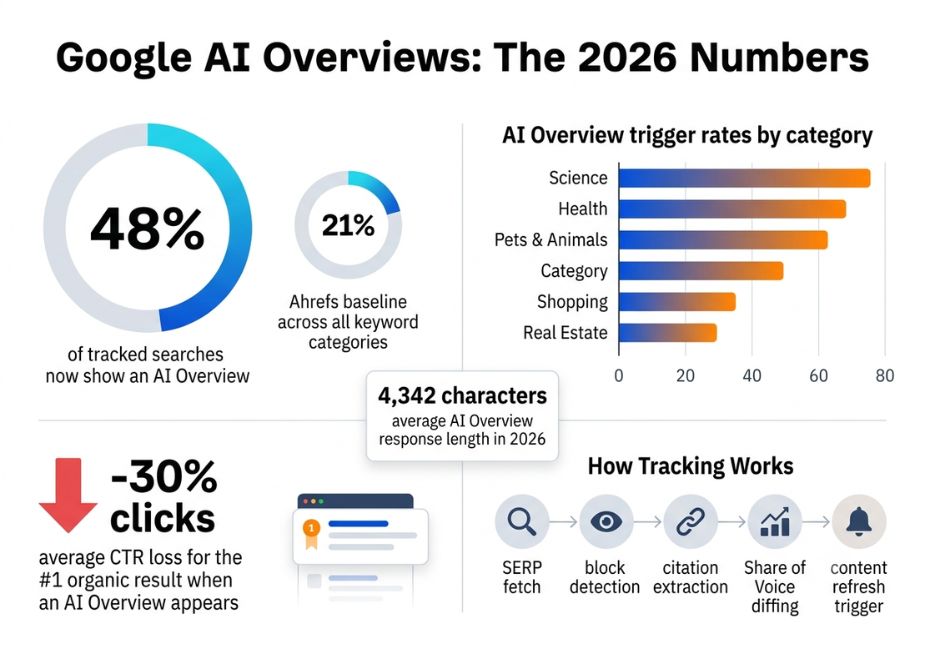
Under the hood, every AI Overview tracker runs some version of the same loop: fetch the SERP, detect the Overview block, extract the cited URLs, and diff the result against yesterday’s snapshot.
- SERP fetch the tool queries Google (often geo- and device-segmented) for each tracked keyword.
- Block detection the parser has to distinguish an actual AI Overview from a Featured Snippet or a People Also Ask box, which sit in similar DOM positions.
- Citation extraction every URL inside the Overview is pulled out, normalized, and matched to a domain.
- Diffing and Share of Voice the new snapshot is compared to prior runs to compute trend lines and competitive share.
Technical Note: Detection accuracy separates functional tools from unreliable ones false positives occur when tools mistake featured snippets or “People Also Ask” boxes for AI Overviews, and false negatives happen when layout changes confuse parsers. Ask any vendor how they handle both failure modes before you commit to a contract.
Did You Know? The average AI Overview response now runs about 4,342 characters, up from roughly 3,485 previously Overviews are getting longer and citing more sources per query, which makes accurate parsing harder, not easier.
How Often Do AI Overviews Actually Appear?
Trigger rates vary wildly by methodology and query type, which is worth knowing before you panic over a single vendor’s dashboard.
- BrightEdge measured AI Overviews appearing on roughly 48% of all tracked search queries as of around February 2026.
- Other 2026 tracking puts the figure closer to 47% of US searches, with AI answers surfacing across three distinct placements: the standalone Overview panel, folded inside People Also Ask, and inside a “Things to Know” panel.
- Ahrefs’ large-scale analysis of AI Overview trigger rates across keyword categories found a much lower baseline roughly 21% overall with informational, question-form, and long-tail queries triggering far more often than branded or transactional ones, and categories like Science and Health showing the highest AIO share while Shopping and Real Estate showed the lowest.
The takeaway: don’t compare your trigger-rate percentage across tools without checking whether they’re sampling the same keyword mix, device, and market.
Why Google Search Console and GA4 Aren’t Enough
Pro Tip: Before buying a dedicated tracker, understand exactly what your existing Google tools can’t show you.
Google Search Console doesn’t provide granular AI Overview mentions data or show which specific URLs are referenced in AI-generated answers that’s the core gap purpose-built trackers exist to fill. GA4 has the same blind spot on the traffic side: Google Analytics and Google Search Console do not separate AI Overview traffic from regular organic traffic, so a spike or drop in an AI Overview-heavy query cluster just looks like ordinary organic movement.
There’s a partial workaround. AI Overview click-throughs frequently carry a text-fragment parameter in the URL the “#:~:text=” pattern Google uses to auto-highlight the cited passage on your page. Setting up a GA4 event that fires when that fragment is present in a landing-page URL gives you a directional estimate of AI Overview-driven clicks, without needing a third-party tool. It’s not a full replacement, but it’s a free first step.
Best AI Overview Tracking Tools and Frameworks
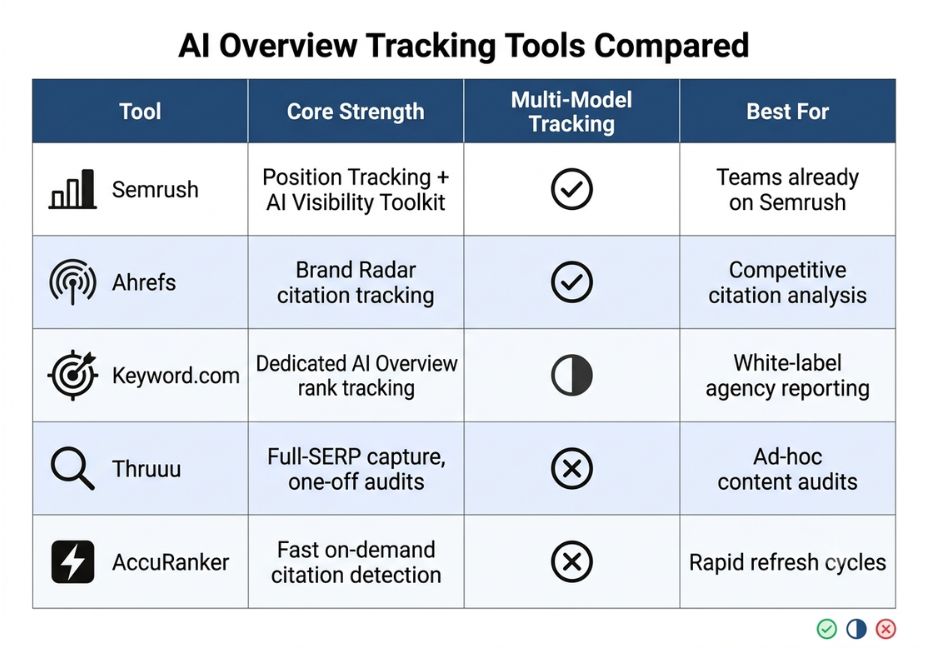
Every major SEO platform now ships some form of AI Overview monitoring, but they’re built for different jobs enterprise SERP analytics versus lightweight AI-citation monitoring versus multi-model brand tracking.
| Tool | Core strength | Multi-model tracking | Best for |
|---|---|---|---|
| Semrush | Position Tracking + AI Visibility Toolkit inside existing SEO workflow | Yes — ChatGPT, Perplexity, Gemini | Teams already running Semrush campaigns |
| Ahrefs | Brand Radar for citation and brand-mention tracking | Yes | Competitive citation analysis |
| Keyword.com | Dedicated AI Overview rank tracking | Limited | Agencies needing white-label reports |
| Thruuu | Full-SERP capture, one-off audits | No | Ad-hoc content audits, not ongoing monitoring |
| AccuRanker | Fast on-demand AI Overview citation detection | No | Teams wanting rapid refresh cycles |
Semrush offers the AI Visibility Toolkit and an AI Overviews Visibility Checker to track citations in Google AI Overviews, ChatGPT, and Gemini, while Ahrefs provides Brand Radar, which tracks brand mentions across Google AI Overviews and other AI assistants. Within Ahrefs’ AIO tracking specifically, you can see whether your page holds position 1, 2, or 3 inside the Overview itself often the citations visible by default before a user expands anything.
Technical Disclaimer: Vendor feature sets change quickly in this category. Pricing, model coverage (ChatGPT/Perplexity/Gemini vs. Google-only), and detection accuracy noted here reflect publicly available information as of mid-2026 verify current specs directly with each vendor before purchasing.
Step-by-Step: Setting Up AI Overview Tracking
- Pick your keyword set prioritize informational, question-form, and long-tail queries, since AI Overviews appear for 57.9% of all question queries versus a much lower share of transactional ones.
- Segment by device and market trigger rates differ meaningfully between mobile and desktop, and by country.
- Set your baseline capture a first snapshot before making any content changes, so you have something to diff against.
- Layer in GA4 text-fragment tracking create the
#:~:text=event in GA4 via Google Tag Manager as a free cross-check against the paid tracker’s traffic estimates. - Monitor weekly, not daily check data at least weekly to spot patterns like new keywords triggering AI Overviews where your domain appears, improved positions, or new citations showing up.
- Route drops into your content workflow when a tracker flags a lost citation, that event should trigger a content-refresh task, not just sit in a dashboard.
python
# Simplified pseudocode: citation-drop -> refresh-agent trigger
def check_citation_status(tracker_api, page_url, keyword):
    result = tracker_api.get_aio_status(keyword)
    if page_url not in result["cited_urls"]:
        trigger_content_refresh_agent(page_url, keyword, reason="citation_lost")
Common Mistakes and How to Avoid Them
- Treating trigger-rate percentages as universal. A 21% figure from one study and a 48% figure from another aren’t contradictory they’re sampling different keyword mixes, and category matters enormously, from 60% for some clusters down to 1% for others.
- Ignoring where the citation sits. Only about 27% of AI answers surface in the standalone Overview panel the rest fold into People Also Ask or a “Things to Know” panel and most trackers report these differently.
- Assuming a lost citation means lost traffic. It correlates with lower click-through, but as much as 43.42% of AI Overview responses still include links back to regular organic results, so a citation loss and a traffic loss aren’t always the same event.
- Skipping structured data. Implementing schema markup enables structured data on your pages, which describes your content and helps AI understand and cite it an easy technical win most teams skip.
What Developers and SEOs Are Saying
Practitioner threads comparing AI Overview tracking tools in the field are worth skimming before you buy vendor comparisons rarely mention parser edge cases the way working SEOs do in the open. One widely shared take on Ahrefs’ AIO launch noted that because historic AI Overview data only starts accumulating once tracking begins, older comparisons “aren’t that valuable yet” but will compound as more history builds up a fair caveat for any tool you’re evaluating today.
FAQ People Also Ask
What is a Google AI Overview tracking tool?
It’s a monitoring platform that detects when an AI Overview appears for a target keyword, extracts which URLs are cited inside it, and tracks that Share of Voice over time something standard rank trackers and Google Search Console don’t do natively.
How often do AI Overviews appear in search results?
Estimates vary by study, with one large-scale Ahrefs analysis putting overall trigger rate around 21% of keywords, while other 2026 data puts total AI-answer presence closer to 47–48% of US searches. It depends heavily on query type, category, and device.
Can Google Search Console show AI Overview data?
No. Google Search Console doesn’t provide granular AI Overview mentions data or show which specific URLs are referenced in AI-generated answers, which is exactly the gap dedicated tracking tools fill.
Do AI Overview trackers work for ChatGPT and Perplexity too?
Some do. Semrush’s AI Visibility Toolkit and Ahrefs’ Brand Radar both extend beyond Google to track citations across ChatGPT, Perplexity, and Gemini, while lighter-weight, Google-only tools like Thruuu and AccuRanker focus solely on the Google SERP.
Does losing the AI Overview citation mean losing traffic?
Not necessarily. Losing a citation typically correlates with lower visibility and clicks, but a meaningful share of AI Overview responses still link back to standard organic results, so the two metrics should be tracked separately, not assumed to move together.
Conclusion
AI Overview tracking has moved from novelty to necessity: with generative answers touching roughly half of all searches by some measures, a page that ranks #1 but isn’t cited is functionally invisible at the moment it matters most. The tools that matter most for 2026 Semrush’s AI Visibility Toolkit, Ahrefs’ Brand Radar, and dedicated trackers like Keyword.com and AccuRanker all solve the same core problem: detecting a citation Google Search Console can’t show you. Pick a tool based on detection accuracy and multi-model coverage, then wire its output into your content-refresh workflow so a lost citation triggers action instead of sitting in a report. Bookmark this guide and explore more hands-on AI agent tutorials at agentiveaiagents.com.