
Finding an AI tool is easy. Finding one that actually deserves a place in a production workflow is much harder.
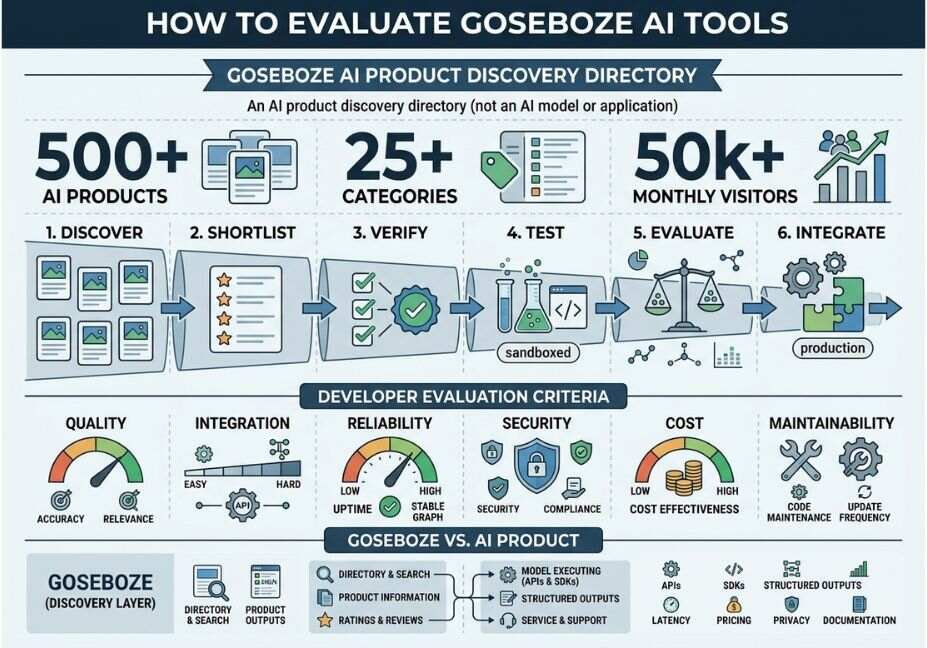
That distinction matters when exploring goseboze ai tools. Goseboze is not itself an LLM, AI agent, coding assistant, or RAG platform. It operates as an AI product directory where users can discover and compare third-party software. Its homepage currently states that it has 500+ AI products, 25+ categories, and 50k+ monthly visitors.
For developers, the useful question therefore isn’t simply “Which AI tool should I click?”
It is: How do I move from directory discovery to technical validation?
That requires looking beyond feature lists. Model quality, tool calling, API access, data handling, latency, integration depth, observability, pricing, and failure modes all matter.
What Are Goseboze AI Tools?
Goseboze AI tools are third-party AI products discovered through the Goseboze directory. Goseboze itself functions as the discovery layer rather than the execution layer.
Its current directory contains products organized into categories such as chatbots, image generation, writing assistants, productivity, and other AI applications. Individual listings can show pricing models and product descriptions before directing users toward the actual product.
This distinction prevents a common misconception:
- Goseboze: discovers and organizes AI products.
- Listed product: performs the actual AI task.
- Developer: validates whether that product fits the workflow.
- Production system: integrates the selected capability through its UI, API, SDK, or automation layer.
A useful mental model is a software catalog. The catalog helps you find candidates; it does not guarantee that every candidate is reliable.
The distinction becomes even more important for agentic systems, where a tool may become one component inside an LLM-driven workflow.
For background, the ReAct reasoning-and-acting architecture demonstrates the broader concept of an LLM combining reasoning with external actions.
How Does the Goseboze Discovery Workflow Work?
The practical Goseboze workflow is straightforward:
- Define the technical problem.
- Search the relevant AI category.
- Build a shortlist.
- Inspect pricing and product claims.
- Open the vendor’s official website.
- Verify API, integration, security, and documentation.
- Run a controlled test.
- Compare results against your baseline.
- Only then consider production adoption.
Goseboze’s own submission page says product listings can be submitted for free and are generally reviewed within 24–48 hours. The platform also asks submitters for information such as category, pricing model, website, description, company information, and key features.
That creates both an advantage and a risk.
Advantage: new products can become discoverable quickly.
Risk: being listed is not equivalent to passing an engineering benchmark.
Technical Note
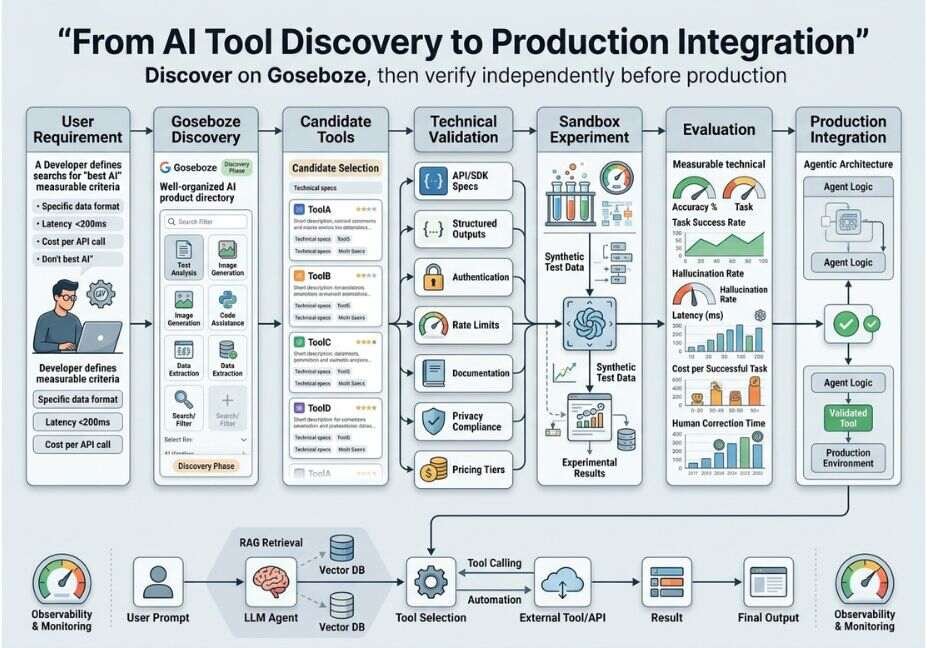
For an agentive workflow, think of the directory as a candidate-generation stage:
User requirement ↓Goseboze discovery ↓Candidate tools ↓Technical validation ↓Sandbox experiment ↓Evaluation ↓Production integration
This approach prevents directory discovery from being confused with technical approval.
Which AI Tool Categories Can You Find?
Goseboze currently presents a broad range of AI products. Its directory includes categories such as chatbots, image generation, writing assistants, productivity, audio, and other specialized applications.
For technical users, the categories can be mapped to workflow functions:
| Category | Typical Function | Technical Evaluation |
|---|---|---|
| Coding assistants | Code generation and debugging | Context handling, IDE integration, accuracy |
| Chatbots | Conversational interfaces | Model quality, latency, memory |
| Writing tools | Content generation | Output quality, controllability, API |
| Productivity | Task automation | Integrations, triggers, reliability |
| Marketing AI | Campaign automation | Data access, analytics, workflow depth |
| Image generation | Visual generation | Model quality, consistency, licensing |
| Audio/voice | Speech and music | Latency, voice quality, API access |
| Analytics | Data interpretation | Data connectors, accuracy, exportability |
The important point is that category is not capability.
Two products may both appear under “coding” while having completely different architectures. One may provide basic autocomplete. Another may expose repository context, terminal execution, code search, planning, and autonomous task execution.
For developers, that difference can be more important than the product’s headline feature list.
How Should Developers Evaluate Goseboze AI Tools?
The fastest way to make a bad AI purchase is to evaluate only the marketing page.
Instead, use a technical scorecard.
1. Define the task
Write a measurable requirement:
“Generate a Python function that converts 10,000 JSON records into validated database rows with fewer than 2% manual corrections.”
That’s much better than:
“I need a good coding AI.”
2. Check integration depth
Look for:
- REST API
- SDK
- webhooks
- function calling
- MCP support
- structured JSON output
- authentication options
- rate limits
- usage monitoring
Modern LLM applications increasingly depend on tools and external functions. OpenAI’s developer documentation, for example, describes connecting models to external data and functions through tools and function calling.
3. Measure output quality
Don’t ask whether an AI tool is “smart.”
Measure whether it solves your task.
Useful metrics include:
- accuracy
- task success rate
- hallucination rate
- latency
- cost per successful task
- human correction time
- failure frequency
4. Evaluate operational fit
A technically impressive model can still be a poor production choice if it creates unacceptable operational overhead.
Check:
- uptime
- documentation
- support
- data retention
- privacy controls
- export capabilities
- pricing predictability
- version stability
Pro Tip
Score candidates from 1–5 across quality, integration, reliability, security, cost, and maintainability. A simple weighted score often produces a better decision than a subjective “this tool looks better” judgment.
Can Goseboze Tools Be Used in AI Agent Workflows?
Goseboze can help you discover products that may become components in an agentic architecture. The actual agent workflow depends on the selected product’s API, SDK, integration layer, or automation capabilities.
A simplified architecture looks like this:
┌──────────────┐ │ User │ └──────┬───────┘ ↓ ┌──────────────┐ │ LLM │ └──────┬───────┘ ↓ ┌─────────────────┐ │ Tool Selection │ └────────┬────────┘ ↓ ┌──────────────┼──────────────┐ ↓ ↓ ↓ Search API RAG Store Automation ↓ ↓ ↓ Result Context Action └──────────────┼──────────────┘ ↓ Final Output
This is where technical evaluation becomes essential.
A tool may look useful as a standalone application but be almost impossible to integrate into an agent because it lacks APIs or structured outputs.
Conversely, a relatively simple SaaS product with a strong API can become extremely valuable inside an orchestration layer.
The ReAct research illustrates why external actions matter: agents can interact with external environments rather than relying entirely on internally generated responses.
Architect’s Note
For agentic systems, prioritize tools that provide:
- deterministic interfaces
- structured responses
- explicit error states
- authentication controls
- predictable latency
- idempotent operations where possible
A beautiful UI is useful for humans. A stable API is usually more important for agents.
Goseboze vs. Direct AI Tool Discovery
Goseboze is most useful at the discovery stage, while vendor documentation and hands-on testing become more important later.
| Stage | Best Approach | Goal |
|---|---|---|
| Discovery | Goseboze | Find candidate products |
| Shortlisting | Category + pricing filters | Reduce options |
| Technical validation | Official documentation | Confirm capabilities |
| Quality testing | Sandbox | Measure actual performance |
| Security review | Vendor policies | Assess data risk |
| Production decision | Internal benchmark | Prove business value |
This means Goseboze doesn’t need to be your only research source.
Use it to expand your search space, then narrow it using primary technical evidence.
That is especially important because the official directory currently contains products with different pricing models, including free, freemium, and paid listings.
A Practical Developer Test for Any AI Tool
Suppose you find an AI API through Goseboze and want to test it.
Don’t immediately connect it to your production application.
Create a small evaluation harness first.
fromdataclassesimportdataclassfromstatisticsimportmean@dataclassclassResult:success: boollatency_ms: floatcost: floatdefscore(results):success_rate=mean(r.success forrinresults)avg_latency=mean(r.latency_ms forrinresults)total_cost=sum(r.cost forrinresults)return {"success_rate": round(success_rate*100, 2),"avg_latency_ms": round(avg_latency, 2),"total_cost": round(total_cost, 4), }results= [Result(True, 820, 0.012),Result(True, 910, 0.013),Result(False, 1400, 0.019),]print(score(results))
The code is intentionally simple. The important idea is methodological:
measure the workflow, not the marketing copy.
For more sophisticated systems, evaluation can include expected output schemas, retrieval accuracy, tool-call correctness, regression tests, and human review.
OpenAI’s evaluation tooling similarly reflects the broader industry shift toward testing model behavior rather than relying solely on qualitative impressions.
What Are the Biggest Risks When Using Goseboze AI Tools?
The main risk isn’t that Goseboze is inherently unsafe. The bigger issue is assuming that directory presence equals product quality.
Goseboze’s own listing process allows product creators to submit their software, so users should independently validate important claims.
Watch for these warning signs:
- No working product after clicking through.
- Vague AI capabilities with no technical documentation.
- No transparent pricing.
- No API or integration information when integration is essential.
- No recent product updates.
- Unclear data retention policies.
- No explanation of which model or infrastructure powers the service.
- Claims of autonomous agents without describing tools, permissions, or safeguards.
For an enterprise or production workflow, also ask whether sensitive data is sent to external services.
Technical Note
Never send production credentials, customer records, proprietary source code, or confidential documents into an unfamiliar AI product merely because it appears in a directory.
Start with synthetic or sanitized data.
How to Build a Smarter AI Tool Stack
Instead of choosing one “best AI tool,” design a stack around functions.
A practical AI workflow might look like:
Research ↓Retrieval / RAG ↓LLM reasoning ↓Tool calling ↓Business application ↓Observability ↓Evaluation
For example:
- A research assistant gathers information.
- An embedding model converts documents into vectors.
- A vector database stores those embeddings.
- A retrieval layer supplies relevant context.
- An LLM generates the response.
- An agent calls external APIs when necessary.
- An evaluation layer measures whether the workflow succeeded.
This architecture is closer to how modern AI engineering works than simply asking which chatbot has the best interface.
Did You Know?
The current Goseboze homepage positions the service around discovery, comparison, and listing of AI products, rather than presenting it as a single AI model or application.
That makes it more useful as an input to an AI-tool research process than as the endpoint of one.
Is Goseboze Worth Using in 2026?
For AI product discovery, yes.
For final technical selection, not by itself.
The platform can reduce the initial search burden by putting many AI products into one searchable environment. Its current directory shows a wide range of categories and products, making it useful when you know the problem you want to solve but don’t yet know which vendor provides the right solution.
The right workflow is therefore:
Discover → Shortlist → Verify → Test → Evaluate → Integrate.
Not:
Discover → Subscribe.
That distinction is particularly important for developers building agentic systems, because an AI product that looks impressive in a browser may fail when exposed to automated workflows, structured tool calls, high request volumes, or production data.
FAQ: Goseboze AI Tools
Is Goseboze an AI tool?
No. Goseboze is an AI product directory rather than a standalone AI application. It helps users discover and compare third-party AI products, while the actual AI functionality is provided by the individual products listed on the platform.
Is Goseboze AI Tools free to use?
Yes, browsing the Goseboze directory is currently free. However, each listed product has its own pricing model, which may be free, freemium, or paid. The cost of using a selected AI application is determined by that product’s provider.
What types of AI tools can I find on Goseboze?
You can find AI products across categories including chatbots, image generation, writing assistants, productivity, audio and voice, marketing, and other specialized applications. The exact catalog changes as products are added or updated.
How should developers evaluate an AI tool found on Goseboze?
Developers should evaluate task accuracy, API access, structured outputs, latency, cost, security, documentation, reliability, and integration requirements. A directory listing should be treated as a discovery signal, not a production-quality benchmark.
Can Goseboze help me find tools for AI agents?
Yes, indirectly. You can use the directory to discover coding, automation, chatbot, analytics, and other AI products that may become components of an agentic workflow. Whether a specific product can function as an agent tool depends on its APIs, integrations, permissions, and technical architecture.
Is a Goseboze listing proof that an AI tool is reliable?
No. A listing should not be treated as proof of reliability. Validate the vendor independently, inspect its documentation, test its actual output, review data-handling practices, and benchmark the product against your workflow before adoption.
Conclusion
Goseboze AI tools are best understood as a discovery ecosystem for third-party AI software not as one AI model or autonomous agent.
Three principles matter most:
- Use directories for discovery, not certification.
- Evaluate AI products against measurable technical requirements.
- Test integrations, reliability, security, and output quality before production adoption.
For developers, the strongest workflow is simple: use Goseboze to expand the candidate pool, use official documentation to verify capabilities, and use your own evaluation harness to determine whether a product actually delivers.
Bookmark this guide as a practical framework for evaluating AI software, and explore the broader AI-agent and LLM engineering resources at agentiveaiagents.com.