

Many academic AI writing tools fail to gain traction on Product Hunt for reasons that do not relate to the quality of the product itself. Instead, the problem lies in the fact that the listing does not appear valuable. Voters will look at the tagline, the screenshot of the product, and the first line of the maker comment in no more than five seconds before being able to decide whether to upvote the tool or not. If you are developing a tool that is able to draft, cite and edit, then you are already familiar with how restrictive the context window is. In other words, a Product Hunt profile is simply a similar kind of constraint problem but in marketing.
This guide will cover the topic of Product Hunt profile optimization from the perspective of a positioning exercise instead of just a checklist of profile details. From this guide you will get a useful definition of value proposition in this regard, how Product Hunt organizes its ranking of listings, real word examples, different options for framing, a step-by-step strategy, common mistakes and verification of the information included.
Short answer: Product Hunt profile optimization for an academic AI writing tool is the process whereby all of the tagline, description and maker comment are made to be centered on one clear value proposition.
What Is a Value Proposition for an Academic AI Writing Tool on Product Hunt?
A value proposition is the single sentence that answers three questions at once: who the tool is for, what problem it removes, and why this tool beats the alternative. As Wikipedia’s overview of value propositions frames it, a strong value proposition goes beyond a slogan. It lays out the product’s purpose, its intended audience, and what sets it apart, in plain, direct language.
For an academic AI writing tool, the value proposition should not lead with “AI-powered.” Every competitor already says that, so it signals nothing. Instead, it should lead with the specific academic pain point citation accuracy, plagiarism risk, or research-to-draft speed and name the exact user (graduate students, academic editors, research teams) who feels that pain today.
Pro Tip: Write your value proposition before you write your tagline. The tagline is a compression of the value proposition, not a substitute for one.
How Does Product Hunt Profile Optimization Actually Work?
Product Hunt profile optimization is the process of improving a listing title, tagline, description, gallery, and maker comment to increase visibility, engagement, and conversions on the platform. A well-optimized profile helps users quickly understand the product’s value and, as a result, encourages them to interact instead of scroll past.
Three mechanisms drive what voters see first:
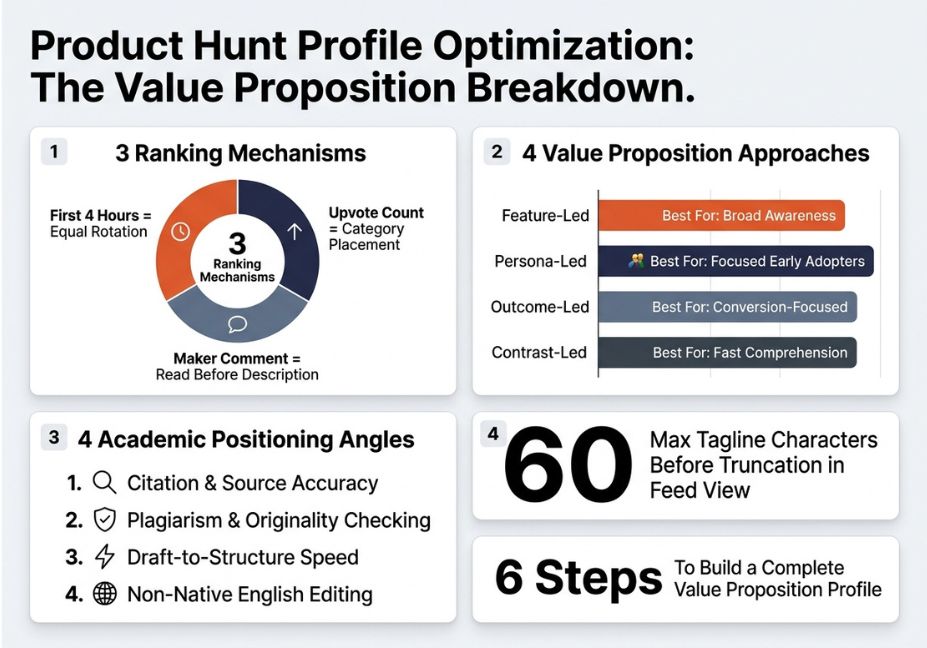
- Launch-day ranking: the first four hours rotate all launches equally; after that, upvote count determines category placement.
- Maker comment weight: the founder’s first comment functions like a landing page above the fold. Consequently, it’s read before the description.
- Follower compounding: every “notify me” click becomes a permanent audience for future launches, which matters if this isn’t your only release.
This is the same launch mechanic that SaaS founders coming out of accelerators like Y Combinator rely on before a public beta: build the audience before the day you need it, not on the day itself.
Technical Note: Framework and platform UI details evolve rapidly. Screenshots and field names referenced here reflect Product Hunt’s layout as of mid-2026. Therefore, always confirm current field limits before publishing.
Underneath the marketing layer, the credibility of an academic AI tool also depends on model transparency. If your writing assistant is built on a fine-tuned open model, linking to the underlying model card on Hugging Face gives reviewers something concrete to evaluate instead of a vague “powered by AI” claim.
Academic AI Writing Tool Use Cases: 4 Real Positioning Angles
Different academic-writing pain points call for different value propositions. Therefore, match yours to the actual user instead of writing one generic pitch for everyone:
- Citation and source accuracy : for research-heavy writers who need retrieval-grounded citations instead of hallucinated references.
- Plagiarism and originality checking : for tools competing directly with Grammarly and Turnitin-style detection on transparency, not just accuracy.
- Draft-to-structure speed : for students converting research notes into a structured paper draft.
- Editing and clarity for non-native English writers : for academic authors publishing in English-language journals.
Did You Know? Listings that name a specific user segment in the tagline (e.g., “for graduate researchers,” not “for everyone who writes”) consistently generate longer first-comment threads, because the audience self-selects into relevant feedback.
Positioning around use case 2 also means being explicit about how the tool respects academic integrity standards. Otherwise, voters in this category actively distrust tools that oversell automation without addressing originality risk. This is exactly the trap founders fall into when they ask how to write a Product Hunt tagline for an AI writing assistant without sounding evasive about accuracy the fix is to name the risk instead of hiding from it.
Comparing Value Proposition Approaches
| Approach | Best for | Risk |
|---|---|---|
| Feature-led (“AI grammar, citations, and plagiarism check”) | Broad awareness | Undifferentiated; sounds like every competitor |
| Persona-led (“Built for PhD candidates writing their first paper”) | Focused early adopters | Smaller addressable audience, higher relevance |
| Outcome-led (“Cut your literature review time in half”) | Conversion-focused launches | Requires a defensible, provable number |
| Contrast-led (“Grammarly for citations, not just grammar”) | Fast comprehension | Only works if the comparison is instantly recognizable |
Pro Tip: Persona-led and outcome-led framing combine well. Simply name the user first, then attach one measurable outcome to them.
Step-by-Step: How to Build a Value Proposition Into a Product Hunt Profile
Follow this sequence in order each step depends on the one before it:
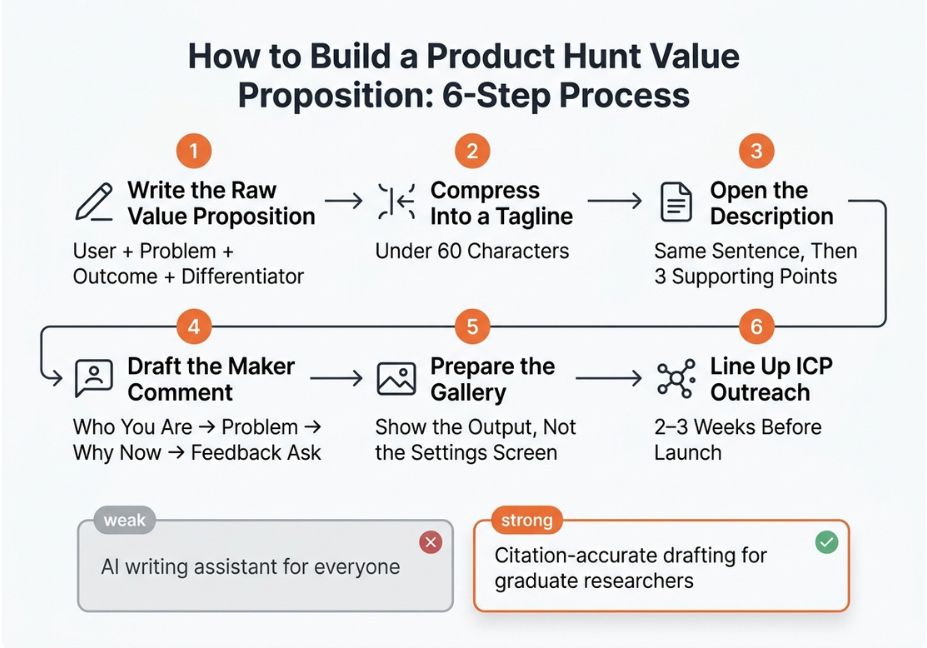
- Write the raw value proposition in one sentence: [user] + [problem] + [outcome] + [differentiator].
- Compress it into a tagline under 60 characters Product Hunt truncates longer taglines in feed view.
- Open the description with the same sentence, then expand into three supporting points (features tied to outcomes, not features alone).
- Draft the maker comment using this structure: who you are → the problem you saw → why now → what feedback you want.
- Prepare the gallery so the first screenshot visually restates the value proposition (show the output, not the settings screen).
- Line up ICP outreach two to three weeks ahead — voters who match your ideal customer profile (ICP) drive higher-quality comments than generic upvote requests.
# Example: scoring tagline candidates against your value proposition
def tagline_score(tagline, value_prop_keywords):
    hits = sum(1 for kw in value_prop_keywords if kw.lower() in tagline.lower())
    length_ok = len(tagline) <= 60
    return hits, length_ok

candidates = [
    "AI writing assistant for everyone",
    "Citation-accurate drafting for graduate researchers",
]
keywords = ["citation", "research", "graduate", "draft"]

for t in candidates:
    print(t, tagline_score(t, keywords))
Common Mistakes and How to Avoid Them
- Leading with “AI-powered” instead of the outcome. Every listing says this, so it signals nothing.
- Describing features instead of the value proposition. A bullet list of capabilities doesn’t tell a voter why to care.
- Skipping the maker comment structure. A comment that opens with “Hey Product Hunt!” and no context loses the first five seconds of attention.
- Ignoring academic integrity framing. For this category specifically, silence on plagiarism or hallucination risk reads as evasive, not confident.
- Treating launch day as the only day. After all, follower compounding means the listing should keep working as a discovery asset months later.
What Builders Are Saying
Discussion threads among people building and evaluating AI writing tools consistently return to the same tension: positioning versus proof. In active threads where developers compare writing-assistant benchmarks on r/MachineLearning, claims about citation accuracy tend to hold up only when backed by a reproducible evaluation rather than marketing copy alone — a reminder that the value proposition still has to be true.
FAQ People Also Ask
What is a value proposition in a Product Hunt listing?
It’s the single sentence explaining who the product is for, what problem it solves, and why it’s better than the alternative. On Product Hunt, this sentence should be recoverable from the tagline alone, since most voters never read past it.
How do you optimize a Product Hunt profile before launch?
Start with the value proposition, compress it into the tagline, structure the maker comment around problem-and-credibility, and prepare a gallery that visually restates the outcome rather than the settings screen.
What makes an academic AI writing tool different from a general writing assistant?
It has to address citation accuracy, source grounding, and plagiarism risk directly general writing assistants can stay at the grammar-and-tone level, but academic tools are evaluated on research integrity as much as prose quality.
Do you need a hunter to launch successfully?
No. A known hunter can add initial visibility, but a clear value proposition and an engaged maker comment matter more for sustained upvotes than who posted the launch.
How long should a Product Hunt tagline be?
Keep it under 60 characters. Product Hunt truncates longer taglines in feed view, which is where most voters make their first decision.
Conclusion
Profile optimization on Product Hunt isn’t a formatting exercise it’s a compression problem, the same one AI agent builders solve every day when writing a system prompt: say the most important thing first, cut everything that doesn’t serve the outcome, and prove the claim instead of asserting it. For an academic AI writing tool, that means leading with citation accuracy or integrity, not “AI-powered,” and building the maker comment around a real problem instead of a feature list. Get the value proposition right first the tagline, description, and gallery are just compressed versions of it.
Bookmark this guide and explore more hands-on AI agent and tooling tutorials at agentiveaiagents.com.