

Competitor positioning of AI academic writing tools refers to the way how a tool or product like Paperpal, Jenni AI, or Grammarly gets compared to established alternatives and characterized based on the information from an automated data aggregation pipeline, instead of a conventional manual analysis.
The results of competitor positioning keep the documents generated once, in Google Docs, unchanged, as the underlying dynamics of the market change every couple of weeks with Paperpal launching another citation tool and Jenni AI improving updates of its autocomplete feature. Therefore, by the time the product managers notice something, the data that is included in the message will be outdated.
Thus, the main problem of AI academic writing tools competitor positioning lies in the fact that the market is too dynamic for manual research cycles to be successful. And there is no point in organizing more meetings; instead, one needs to treat the competitor positioning process like any other information pipeline, ensuring timely access to competitor updates before issuing your own messages.
What Is Competitor Positioning for AI Writing Tools?
Competitor positioning is a structured statement of how your product serves a specific user better than named alternatives, tied to a concrete reason to believe. In practice, that means filling in this formula: [target user] who [need] chooses [product] because [reason to believe].
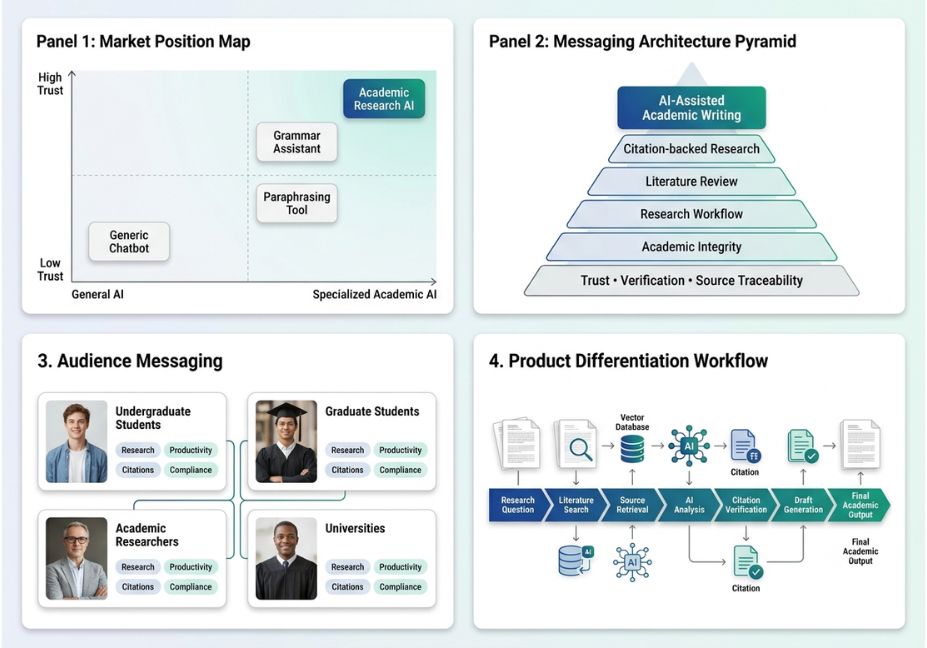
In the AI academic-writing space, that reason to believe is rarely generic. Instead, it’s usually a specific capability gap for example, sentence-level AI-detection accuracy or citation fidelity across a large research corpus. Because buyers in this niche are research-literate, vague superiority claims tend to backfire. Before you write a single line of messaging, it helps to see how this space is actually segmented.
How Do AI Agents Track Competitor Messaging?
An agent pipeline fetches competitor pages on a schedule, embeds the text into a vector store, diffs it against the last snapshot, and summarizes what changed so a human can update messaging quickly.
Concretely, a planner decomposes “track competitor X” into sub-tasks. A retrieval layer pulls the competitor’s current pricing page, changelog, and review sentiment into that vector store using semantic search rather than keyword matching. Then a synthesis step drafts the messaging delta. This is the same tool-use loop used in the ReAct pattern for reasoning-and-acting agents — reason about what changed, act by fetching it, observe the diff, and repeat.
- Planner: breaks “monitor Paperpal” into fetch, diff, summarize
- Retriever: embeds new page content, compares it against the last snapshot using named-entity and semantic matching
- Synthesizer: drafts a one-paragraph messaging delta for the team
Pro Tip: Don’t rebuild this from scratch. LangChain’s retrieval and agent documentation covers the retriever, memory, and tool-call loop you need for a v1 competitor-tracking agent in under 100 lines.

AI Academic Writing Tools Positioning Real-World Market Segments
The market splits into distinct positioning lanes. In fact, most vendors are already fighting for a specific lane rather than “best AI writing tool” broadly:
- Manuscript polish and submission-readiness : Paperpal leans on journal-specific formatting checks and a sentence-level AI detector that flags lines before a plagiarism checker does.
- Drafting speed : Jenni AI centers its pitch on continuous autocomplete and claim validation as you write.
- General-purpose grammar : Grammarly’s academic mode extends a broad consumer tool rather than starting from research-writing conventions.
- Paraphrasing and rewriting : QuillBot’s core differentiator is language-mode variety, not structural or citation support.
Each of these is a semantic differentiation point your messaging should map to directly. In other words: not just “more accurate,” but accurate at what task, for whom. This kind of market map is also what turns a single blog post into a topic cluster link this segmentation section to a companion piece on building an ICP (ideal customer profile) matrix, and you reinforce topical authority for the whole site.
Best Tools and Frameworks for Building the Pipeline
| Layer | Tool/Framework | What it does |
|---|---|---|
| Orchestration | LangChain | Chains retrieval, memory, and tool calls |
| Embeddings/store | Vector database (e.g., Pinecone, Chroma) | Indexes competitor page snapshots |
| Reasoning pattern | ReAct | Alternates reasoning steps with tool actions |
| Change detection | Diff-on-fetch script | Flags pricing/messaging changes between crawls |
Did You Know? Independent benchmarking by Editage’s editorial team found that Paperpal’s suggestion coverage and accuracy outpaced Grammarly’s academic mode and QuillBot on identical source manuscripts. That’s the kind of granular, sourced claim that should anchor a positioning doc not a vague “more accurate” line.
Step-by-Step: How to Position an AI Academic Writing Tool Against Competitors
- Define the comparison set. Pick three to five direct competitors, not every tool in the category.
- Set up a fetch-and-embed job. Pull homepage, pricing, and changelog text weekly into your vector store.
- Write a diff-summarization prompt. Ask the model to output only what changed, categorized as pricing, feature, or messaging.
- Draft the positioning statement. Use the formula above, populated from the diff output rather than from memory.
- Route it to a battlecard. Push the summarized delta to Slack or a shared doc so sales and marketing can act on it immediately.
# Minimal fetch-and-diff loop (simplified)
import requests
from datetime import datetime

def fetch_page(url):
    return requests.get(url, timeout=10).text

def snapshot_and_diff(url, store):
    current = fetch_page(url)
    previous = store.get(url)
    store.set(url, current, ts=datetime.utcnow())
    if previous and previous != current:
        return {"url": url, "changed": True}
    return {"url": url, "changed": False}
Technical Disclaimer: Framework versions evolve rapidly. The code above is illustrative pseudocode, not tied to a specific LangChain release. Always check the official docs for the current retriever and tool-calling API before shipping.
Common Mistakes in AI Writing Tool Competitor Messaging Strategy
- Positioning against features, not jobs-to-be-done. “We have more citation styles” means less than “researchers publishing in biomedical journals get submission-ready formatting in one pass.”
- Ignoring compliance messaging. Academic buyers care about integrity claims, and many check policies from Elsevier, Springer Nature, or their target journal directly. COPE’s position statement on AI tools and authorship is a useful anchor if your positioning touches disclosure or authorship language. Get this wrong, and your messaging looks careless to a research-literate buyer who also checks Crossref or ORCID-linked publication records.
- Treating positioning as a one-time doc. Without a retrieval-based refresh loop, your battlecards go stale within a quarter.
- Skipping failure-mode disclosure. Tools that paraphrase academic text can quietly change technical meaning. For instance, a tool like Turnitin’s AI-detection layer exists precisely because buyers expect vendors to be upfront about this risk pretending it doesn’t exist erodes trust with technical reviewers.
What Builders Are Saying
Engineers experimenting with agent-based competitive monitoring frequently trade implementation notes in ongoing discussion threads in r/MachineLearning. A common theme: keeping embedding costs low when re-crawling competitor pages on a schedule rather than continuously.
FAQ People Also Ask
What is competitor positioning for AI writing tools?
Competitor positioning is a structured statement of how your product serves a specific user better than named alternatives, tied to a concrete reason to believe a feature, benchmark, or workflow fit rather than a general superiority claim.
How do AI agents track competitor messaging?
An agent pipeline fetches competitor pages on a schedule, embeds the text into a vector store, diffs it against the last snapshot, and summarizes what changed so a human can update messaging quickly.
Is Paperpal better than Grammarly for academic writing?
For research-specific tasks like citation retention and submission formatting, Paperpal is generally the stronger fit. Grammarly’s academic mode extends a broader consumer grammar tool rather than starting from scholarly conventions.
Can AI writing tools hallucinate citations?
Yes. General-purpose assistants in particular can invent references at a meaningful rate, which is why disclosure and human verification remain necessary regardless of which tool drafts the text.
How often should you update competitor positioning for an AI writing tool?
Ideally continuously, through an automated retrieval pipeline. At minimum, update monthly, since pricing, feature, and messaging changes in this market happen on that cadence or faster.
Conclusion
Competitor positioning for AI academic writing tools breaks down when it’s treated as a static document instead of a live data problem. The teams getting this right build small retrieval pipelines fetch, embed, diff, summarize that keep messaging tied to what’s actually true about the market this week, not last quarter. Start with a narrow comparison set, wire up a weekly fetch-and-diff job, and let the retrieved deltas write your first positioning draft. Explore more agentic workflow breakdowns like this one at agentiveaiagents.com.