
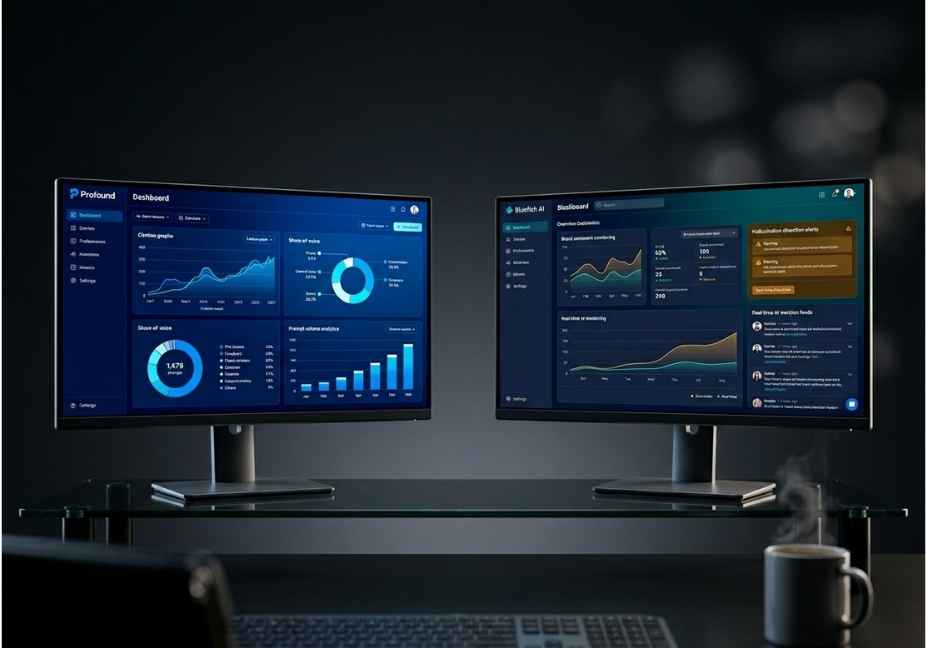
The majority of marketing teams who are evaluating answer engine optimization solutions have all made the same common mistake and have not noticed it yet; they’ve only looked at the vendor’s comparison page. Everyone agrees that Profound is the best solution according to Profound’s article, and that Dageno is the best solution according to Dageno’s article, so of course this is no help to your making an informed decision.
So what does the data show? In just the first half of 2025, generative AI referrals to B2B websites increased by 123%. Additionally, leads generated through AI have a conversion rate of 2 to 4 times higher than those coming from typical organic search traffic. Further, research on citation drift shows that between 40 and 60 percent of the domains referenced in monthly data have changed for each of the major AI platforms, so the volume of new data keeps changing at such a high rate that whether your brand is compounding its visibility or quietly falling behind your more rapidly changing competitive set, will be determined by how frequently you monitor this data, the accuracy of the data you’re using to monitor it, and how quickly you execute the content you create.
This guide will compare Profound and Bluefish AI in all ways that matter when making an AEO platform evaluation in 2026: quality of prompt data, citation intelligence, means of detecting hallucinations, depth of content workflow, and total cost of ownership; thus providing a clean and neutral approach to making an objective decision versus allowing anyone to pitch their vendor.
What Is AEO and Why Does the Platform Choice Matter?
Answer engine optimization is the practice of ensuring your brand gets accurately cited in AI-generated responses across platforms like ChatGPT, Perplexity, Google AI Overviews, Gemini, and Microsoft Copilot. In other words, it is the discipline of making your content retrievable, trustworthy, and citable by large language models not just rankable by traditional search crawlers.
Google’s own guidance confirms that foundational SEO remains relevant because generative AI features draw from core Search ranking systems. However, generative engine optimization extends that work into AI-native retrieval environments where topical authority, entity clarity, and structured content matter far more than raw backlink volume.
Consequently, the AEO platform you choose determines what you can measure, how fast you can act on it, and whether your strategy rests on real user demand data or educated guesses. One of the most underrated signals in the space is query fanout — the internal sub-queries an AI model generates before assembling a final answer. Therefore, a platform that surfaces query fanout gives you retrieval intelligence before the output stage, which is a genuinely different category of insight from monitoring where you appeared in a completed response.
What Each Platform Was Actually Built to Do
Before comparing features, it helps to understand the founding philosophy behind each product. Because that philosophy shapes every subsequent product decision, ignoring it leads to bad procurement choices.
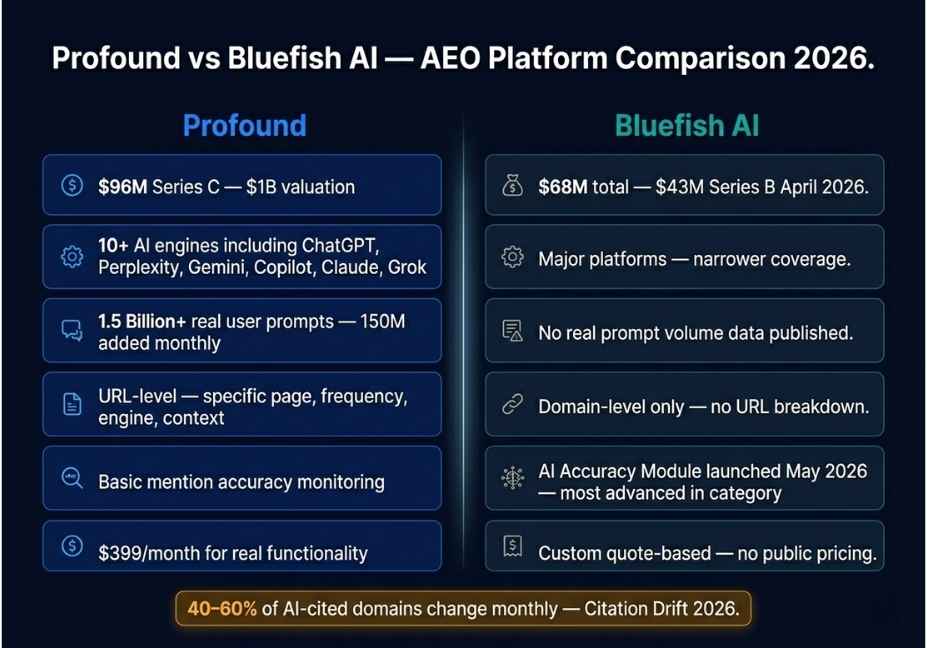
Profound launched in 2024 and operates on what the company calls a read/write model. The read side tracks brand mentions, citations, share of voice, and AI crawler behavior across ten or more engines including ChatGPT, Perplexity, Gemini, Google AI Overviews, Google AI Mode, Microsoft Copilot, Claude, Grok, Meta AI, and DeepSeek. The write side, specifically its Agents feature, generates AEO-optimized content briefs and full article drafts based on live citation and prompt volume data. It then publishes directly to your CMS. As of February 2026, Profound raised a $96 million Series C at a $1 billion valuation, backed by Sequoia, Kleiner Perkins, and Khosla Ventures. Customers include Ramp, Figma, DocuSign, MongoDB, and Walmart.
Bluefish AI, by contrast, launched around the same period and raised $68 million in total, including a $43 million Series B in April 2026. Its core positioning is AI brand protection and reputation monitoring. More specifically, it detects hallucinations, tracks brand sentiment, and manages how your narrative appears across generative AI platforms in real time. Because of this focus, its customer base skews toward Fortune 500 consumer brands Adidas, American Express, Hearst, and Ulta Beauty are among the publicly named accounts. CB Insights recognized Bluefish as a GEO Market Leader in October 2025, validating its category positioning.
The framing matters enormously. Profound is an AEO execution platform. Bluefish is an AI brand safety platform. Both track citations in AI-generated answers. However, the product philosophy and therefore the feature depth diverges sharply beyond that surface-level overlap.
Prompt Volume Data: The Biggest Technical Differentiator
This is where Profound holds a genuine, hard-to-replicate edge over every other AEO platform in the category Bluefish included.
Prompt volume data tells you how often real users query AI platforms about topics in your category. Importantly, this is not which synthetic prompts your marketing team manually added to a tracking dashboard. Rather, it represents actual demand signals drawn from the live AI user base. Profound is currently the only AEO platform that publishes this data, drawing from a corpus of more than 1.5 billion real user prompts growing at approximately 150 million per month.
For example, for a query like “best content operations software,” Profound’s dashboard shows total monthly prompt volume, platform distribution across engines, and demographic signals. As a result, your content strategy rests on observed demand instead of assumption. Most AEO programs, by comparison, are built on prompts someone on your team guessed were important. That approach works until a competitor with better demand data identifies the queries that actually drive AI search volume in your category and builds content around those instead.
Bluefish, however, does not surface prompt volume data. The platform relies on expert-configured prompt sets, which works well for structured brand safety auditing. Nevertheless, it limits both the scalability and organic accuracy of a content strategy built on top of it. Without prompt volume signals, moreover, there is no principled way to prioritize which citation gaps to close first or which topics are growing versus declining in AI search demand.
Citation Tracking: URL-Level vs Domain-Level Intelligence
Both platforms track citations in AI-generated answers. However, the granularity of that tracking has real strategic consequences that compound over time.
Profound tracks citations at the URL level. That means you can see which specific pages on your site get cited by which AI engines, how frequently, in what prompt contexts, and how that pattern changes week over week. For instance, you might discover your pricing comparison page earns citations in ChatGPT but not in Perplexity or that a blog post which drove strong citations six weeks ago has decayed and needs refreshing. That URL-level resolution makes content investment decisions measurable and defensible.
Bluefish, on the other hand, tracks at the domain level. You can see that your domain gets cited and which third-party sources carry influence in your category. However, you cannot identify which specific pages are earning citations and which are being ignored. As a result, you know citations are happening somewhere on your site, but you cannot build a content optimization strategy on that information alone. You simply do not know where to invest or what to fix.
For growth-focused AEO programs, therefore, this difference is significant. For brand safety monitoring programs where the primary question is whether AI models represent your brand accurately the distinction matters less. Domain-level visibility is sufficient to catch hallucinations and sentiment shifts, which is precisely Bluefish’s primary use case.
Hallucination Detection: Where Bluefish Leads in 2026
For regulated industries, enterprise PR teams, or any organization where AI misrepresentation carries legal or reputational risk, Bluefish’s AI Accuracy module is the strongest hallucination detection capability in the AEO category right now. Launched in May 2026, this module monitors AI-generated responses for factual inaccuracies about your brand in real time wrong product specifications, incorrect pricing, outdated leadership information, or fabricated claims about integrations and compliance certifications.
Notably, no other major AEO platform has shipped comparable depth here. Profound tracks mention sentiment and basic accuracy as part of its broader visibility dashboard. However, it is not purpose-built for compliance-aware hallucination auditing. The platform optimizes for helping you earn more correct citations not for defensively auditing the accuracy of citations you already have.
This, therefore, is the clearest scenario where Bluefish wins outright. If your team’s primary concern is “what false things are AI models currently saying about us, and how do we correct them at scale,” Bluefish has the stronger answer today. Furthermore, as Gartner projected that traditional search volume would decline by 25 percent by 2026 due to AI chatbot adoption, hallucination risk for brands scales proportionally with that shift and Bluefish is building directly for that risk vector.
Content Workflow Automation: Profound’s Closed-Loop Advantage
Most AEO platforms create a frustrating visibility gap. They show you where you are missing citations but leave content execution entirely to your team. Profound’s Agents feature is the most developed attempt in the category to close this loop and the gap between what it delivers and what Bluefish offers on the execution side is substantial.
Specifically, Profound’s content workflow runs from opportunity detection through brief generation, full draft creation, and CMS publishing to WordPress, Contentful, or Sanity in a single connected pipeline. Additionally, Profound Sheets extends this further with a spreadsheet-like interface where each row runs as an independent Agent, enabling bulk content production at the cadence AI visibility opportunities open and close. Crucially, the entire pipeline draws from live citation data and prompt volume signals. Therefore, the content being produced reflects what AI models actually retrieve in your category rather than what your team assumes they should retrieve.
Bluefish, in contrast, offers Content Briefs: structured documents that tell your team what to create and how to frame it. However, the platform does not generate, optimize, or publish content. The execution gap between brief and published piece remains human-dependent. For teams with large content operations already in place, this may be acceptable. For teams trying to run a content-led AEO program without significantly expanding headcount, though, the gap compounds quickly and meaningfully.
Pricing Reality: What You Actually Pay for Meaningful Access
Both platforms require scrutiny beyond their headline numbers, because the entry price and the functional price are meaningfully different in both cases.
Profound publishes three tiers. The Starter plan at $99 per month covers ChatGPT only with a cap of 50 prompts. It is enough to orient your team to the interface but not enough to run a real AEO program. The Growth plan at $399 per month is the effective entry point, because it unlocks multi-platform tracking, the Opportunities panel, and the Agents content generation engine. Enterprise pricing typically lands between $1,500 and $2,000 or more per month, depending on engine coverage, seat count, and compliance requirements. Consequently, the jump from Starter to Growth has drawn consistent criticism from mid-market teams that have outgrown the ChatGPT-only sandbox but cannot yet justify the Growth investment.
Bluefish, however, publishes no public pricing. The custom, quote-based model across all tiers signals a sales-led procurement process designed for large enterprise budgets. With $68 million in total funding and a customer base anchored in Fortune 500 consumer brands, this architecture makes sense for their ideal customer profile. Nevertheless, it effectively excludes growth-stage companies and mid-market teams who need to evaluate cost before committing.
In short, if your team cannot internally justify an AEO budget of $399 per month or more with a clear ROI case already built both platforms are premature for your stage. Build the case with a lighter tool first, then graduate to enterprise infrastructure once the channel has demonstrated measurable pipeline impact.
Long-Tail Keyword Scenarios: Which Platform Wins Each Use Case
Beyond the head-to-head comparison, it helps to map each platform to specific decision scenarios. These long-tail situations represent the most common purchase contexts in 2026.
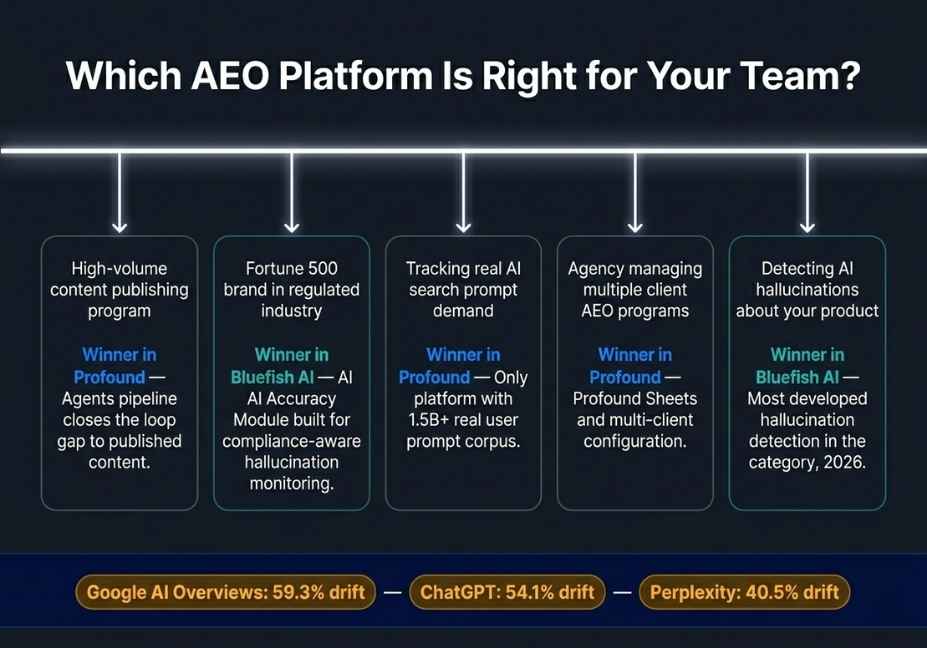
“Best AEO tool for content teams running a high-volume publishing program” Profound wins clearly here, because its Agents feature generates briefs, drafts, and publishes content in a single workflow connected to real prompt volume data. No other platform closes this loop with comparable maturity.
“Best AI brand monitoring tool for Fortune 500 regulated industries” Bluefish wins clearly here, because its AI Accuracy module detects hallucinations in real time across AI platforms, and its customer base in financial services and consumer goods reflects that enterprise brand safety focus.
“Best AEO platform for tracking prompt volume and AI search demand” Profound wins, because it is the only platform with a proprietary corpus of real user prompts at meaningful scale. Furthermore, that data advantage compounds over time as the corpus grows.
“Best generative engine optimization tool for agencies managing multiple clients” Neither platform is ideally suited for agency use at accessible price points. However, Profound’s multi-client configuration, Profound Sheets, and white-label reporting options make it the better fit for agencies that can justify Growth or Enterprise pricing.
“Which AEO tool is best for detecting AI hallucinations about my product” Bluefish wins this without qualification. Its AI Accuracy module is the category’s most developed hallucination detection system as of mid-2026.
Common Mistakes When Choosing an AEO Platform
The most frequent error is optimizing for monitoring breadth over action depth. A platform that tracks ten AI engines but produces no actionable output is a dashboard not a program. Therefore, always evaluate what the tool does after it shows you a gap.
The second most common mistake is treating prompt volume data as equivalent across platforms. Most AEO tools use synthetic or expert-curated prompts that approximate real demand instead of measuring it. The difference shows in content strategy quality over months, not days.
Additionally, teams consistently underestimate citation drift. Because 40 to 60 percent of cited domains change monthly, a quarterly AEO audit decays faster than it can be acted on. Daily or near-daily monitoring cadence is, therefore, table stakes for any program trying to hold and compound AI visibility in competitive categories.
Finally, the wrong platform for the wrong use case is a subtle but expensive mistake. Bluefish is built for brand reputation defense. Profound is built for visibility growth and content execution. Using a brand safety tool as your primary growth lever or vice versa means you will either over-invest in monitoring or under-invest in protection. As a result, neither outcome serves your program well.
What Developers and Marketers Are Saying
Across G2 reviews, independent audits, and community discussions on Reddit’s r/SEO and r/MachineLearning, a consistent signal emerges. Profound is the enterprise standard for teams serious about AEO however, the pricing structure frustrates mid-market teams that need multi-engine coverage before they can justify Growth-tier spend.
One G2 reviewer from a fintech marketing team wrote that the Opportunities panel justified the cost on its own, specifically because of the specificity of recommendations: naming individual journalists at specific publications, identifying particular Reddit threads driving competitor citations, and flagging content gaps by estimated visibility impact. That level of specificity, they noted, is unlike anything else in the category.
Bluefish reviews are harder to find publicly, because the platform does not maintain as prominent a G2 presence. Nevertheless, customer case studies from Adidas and American Express consistently point to brand safety and AI narrative control as the primary value drivers not content execution or prompt volume analytics.
FAQ People Also Ask
What is the difference between Profound and Bluefish AI for AEO?
Profound is an AEO execution platform. It covers citation tracking, prompt volume data, content generation, and CMS publishing across ten or more AI engines. Bluefish AI is an AI brand safety platform focused on hallucination detection, brand reputation monitoring, and narrative control in real time. Both track brand mentions in AI-generated answers however, they diverge sharply in what they do with that data after detection.
Which AEO platform is better for brand safety monitoring?
Bluefish AI leads on brand safety. Its AI Accuracy module, launched in May 2026, is the most developed hallucination detection capability in the AEO category. It is purpose-built for regulated industries and Fortune 500 brands where AI misrepresentation carries legal or reputational risk. If brand safety is your primary need, therefore, Bluefish is the stronger choice.
Does Profound have real prompt volume data for AI search?
Yes and it is currently the only AEO platform that does. Profound surfaces real prompt volume drawn from more than 1.5 billion actual user prompts across AI platforms. Consequently, this gives teams measurable demand signals rather than synthetic estimates, which leads to more accurate content prioritization decisions.
What is citation drift in AI search, and why does it matter?
Citation drift is the month-over-month churn in which domains AI engines cite for a given query. Research shows 40 to 60 percent of cited domains change monthly across major platforms. Specifically, Google AI Overviews shows 59.3 percent drift, ChatGPT 54.1 percent, Microsoft Copilot 53.4 percent, and Perplexity 40.5 percent. Because of this volatility, static AEO audits decay quickly therefore, continuous daily monitoring is essential for any serious program.
Can AEO platforms detect AI hallucinations about my brand?
Yes, but with varying capability. Bluefish’s AI Accuracy module is the most capable for real-time hallucination detection in 2026. Profound tracks mention accuracy as part of its broader visibility dashboard. However, it is not purpose-built for compliance-aware hallucination auditing. For most teams, running periodic hallucination checks alongside a full AEO monitoring program is, therefore, the right architecture.
Is Bluefish AI good for enterprise brands in regulated industries?
Yes. Bluefish is particularly strong for consumer-facing Fortune 500 organizations where brand narrative control and AI reputation monitoring are primary concerns. Its customer roster — Adidas, American Express, Hearst, Ulta Beauty — and $68 million in total funding signal strong enterprise fit. Moreover, its focus on regulated industries means compliance-aware AI accuracy monitoring is central to the product, not an afterthought.
Conclusion
The Profound vs Bluefish AI question does not have one right answer. Instead, it has a team-fit answer that depends on your primary use case.
Choose Profound if your team runs a growth-focused AEO program that needs real prompt volume data, URL-level citation intelligence, content automation, and a closed-loop workflow from insight to published content. Specifically, budget for the $399 per month Growth plan at minimum the Starter tier is an orientation tool, not a program foundation.
Choose Bluefish if your primary concern is AI brand safety. More specifically, choose it if you need to detect hallucinations, monitor narrative accuracy across generative platforms, and manage how AI systems represent your organization in real time. It is the category’s strongest answer for regulated industries and Fortune 500 brand teams where a single fabricated AI claim carries legal or reputational downstream risk.
Importantly, for teams building agentic AI workflows or running content-led AI visibility programs, the read/write architecture Profound ships combining real-user demand signals with autonomous content generation is the closer match to where answer engine optimization is heading as a discipline. Therefore, if content execution is central to your AEO strategy, Profound’s closed-loop model gives you the structural advantage in 2026.
Bookmark this guide and explore more AI search visibility and agentic workflow tutorials at agentiveaiagents.com.