

A rank tracking tool for AI Mode monitors whether Google’s AI Mode mentions, cites, or links your brand when it answers a query. Unlike classic rank trackers, it measures citation and mention data instead of a numbered position, because AI Mode synthesizes one conversational answer instead of listing ten links.
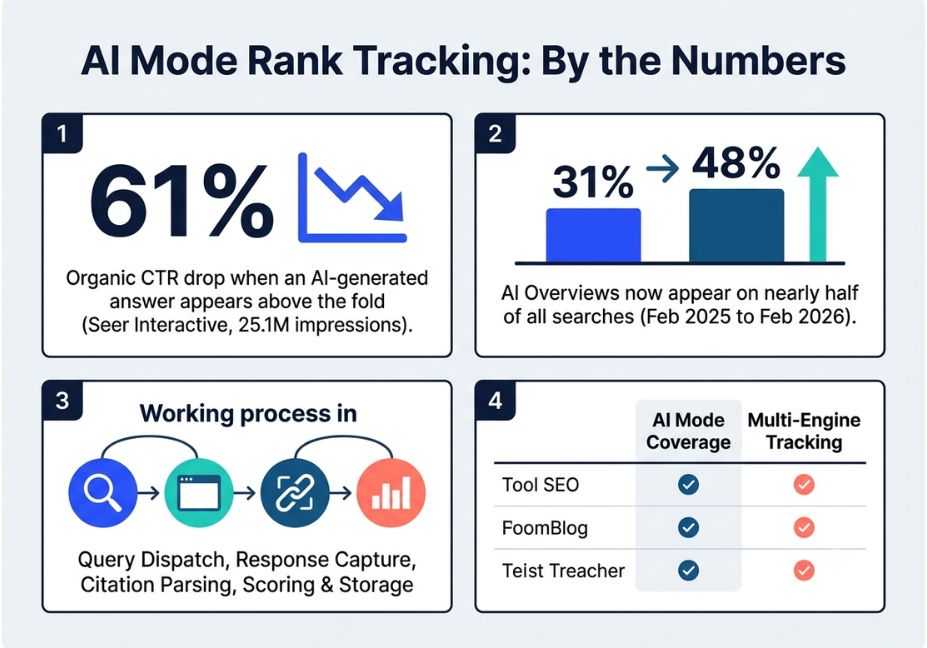
Position #1 in Google Search Console doesn’t mean much anymore if the traffic isn’t following it. According to Seer Interactive’s analysis of 25.1 million impressions, organic click-through rate drops from 1.76% to 0.61% the moment an AI-generated answer appears above the fold. That’s a 61% decline, even for content holding the top spot. As a result, a rank tracking tool ai mode teams can actually trust needs to answer a different question than legacy SEO software ever did: not “where do I rank,” but “did the model cite me at all.”
This shift is exactly why generic keyword trackers fall short here. Google’s AI Mode doesn’t return ten blue links; instead, it synthesizes an answer from multiple sources in real time and reshapes that answer with every follow-up question. Therefore, tracking it requires the same retrieval-and-synthesis thinking behind retrieval-augmented generation architecture, applied to a search engine instead of a chatbot.
What Is an AI Mode Rank Tracker?
An AI Mode rank tracker is a monitoring system that runs your target queries against Google’s AI Mode on a schedule, then parses the response to detect whether your brand or domain was mentioned, cited, or linked. Instead of a single ranked position, it produces citation tracking data: inclusion rate, mention count, citation order, and competitor overlap for the same prompt.
In short, this is a generative engine optimization (GEO) problem, not a classic SEO one. The foundational GEO research frames generative engines as systems that synthesize and summarize information from multiple sources rather than ranking pages individually which is precisely why “position 3” doesn’t translate from Google Search to AI Mode, ChatGPT, Perplexity, Bing Copilot, or SearchGPT-style tools.
How Do You Track Rankings in Google AI Mode? (Voice Search / How-It-Works)
If you’re asking your phone “how do I track my rankings in Google AI Mode,” here’s the short version: a tracker automates the query, captures the response, and extracts citations. In more detail, most tools whether a SaaS dashboard or a script you build yourself follow four steps:
- Query dispatch a scheduler fires a set of conversational prompts, not just keywords, at AI Mode through automated sessions.
- Response capture a headless browser renders the answer, since AI Mode isn’t accessible through a stable public API.
- Citation parsing the tool extracts every cited domain, its position in the citation list, and any brand mentions in the answer text.
- Scoring and storage results are normalized into metrics like share of voice, then stored for trend comparison over time.
Pro Tip: Standardize geo-location, device type, and login state across every scan. Otherwise, comparing logged-out desktop results against logged-in mobile results produces noise that looks like ranking volatility but is really just an inconsistent testing setup.
Meanwhile, Google Search Console still plays a supporting role: you can isolate AI Mode-driven impressions using the Search Appearance filter. However, it won’t tell you whether your content was the one AI Mode actually leaned on to build its answer.
Rank Tracking Tool AI Mode Real-World Use Cases
- Content teams validating whether a newly published guide gets picked up as a citation source within days of going live.
- Enterprise SEO teams benchmarking share of voice against named competitors across a fixed prompt set every week.
- Agencies running the same citation audit across multiple client accounts to prioritize which pages need GEO-focused rewrites a common long-tail need for “best ai mode rank tracker for agencies.”
- Product marketers tracking whether AI Mode surfaces pricing or comparison pages when users ask “vs” style questions, a pattern also seen on Bing Copilot and SearchGPT.
Did You Know? Google’s AI Overviews now appear on nearly half of all search queries as of February 2026, up from 31% a year earlier. Consequently, brands earning a citation inside those summaries see meaningfully higher organic clicks than those that rank but go uncited.
Best Tools and Approaches Compared
| Tool | AI Mode Coverage | Multi-Engine Tracking | Best For |
|---|---|---|---|
| Rankscale | Yes | ChatGPT, Perplexity, Gemini, Claude, Copilot | Cross-engine brand visibility |
| Rankability (Reporter) | Yes | AI Overviews, ChatGPT, Perplexity, Gemini | Historical citation snapshots |
| Omnia | Yes | Google-focused, with execution layer | Turning citation gaps into content briefs |
| SE Ranking | Yes (add-on) | Bundled with traditional SEO suite | Teams already on a legacy SEO platform |
| Custom-built (headless browser + LLM eval) | Yes | Fully configurable | Engineering teams needing full control |
Architect’s Note: If you’re building your own tracker rather than buying one, don’t stop at binary “was I cited” detection. The GEO paper’s evaluation framework scores citations on relevance, uniqueness, and overall influence on the generated answer a far more useful signal than a simple yes/no flag.
Step-by-Step: How to Build a Basic AI Mode Tracking Workflow
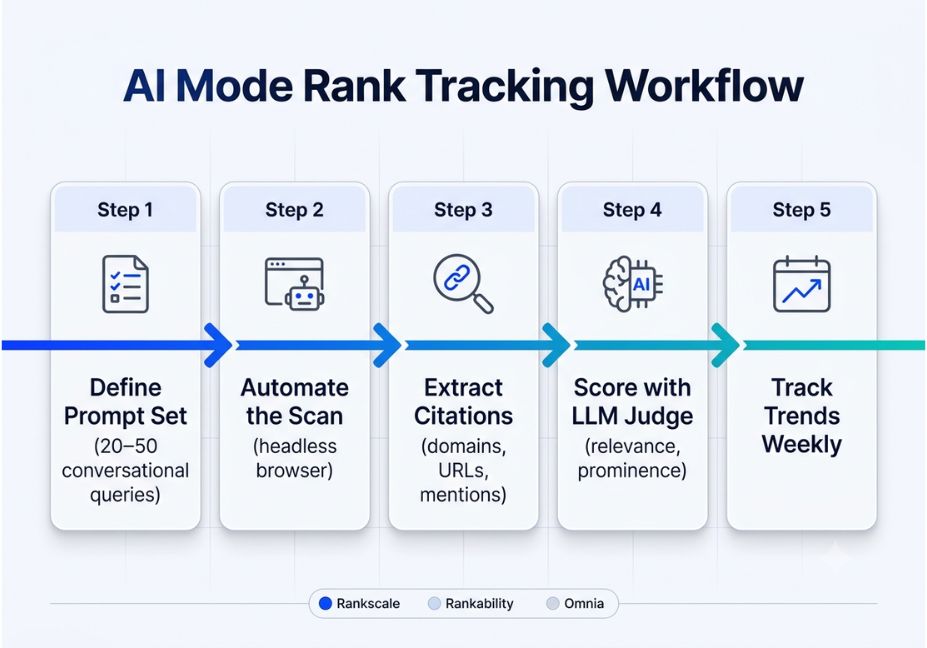
- Define your prompt set. Write 20–50 real conversational queries your audience would ask, not just head keywords for example, “what’s the best free ai mode rank tracker” rather than just “ai mode tracker.”
- Automate the scan. Use a scheduled headless-browser job to run each prompt against AI Mode and save the rendered HTML.
- Extract citations. Parse cited domains, URLs, and surrounding mention text from each response.
- Score with an LLM judge. Pass the response and your target domain into a model prompt that rates relevance and prominence, mirroring the G-Eval approach from the original GEO research.
- Track trends weekly. Since AI Mode’s citation logic shifts with every model update, a single snapshot tells you very little on its own.
# Simplified citation-extraction sketch
import re

def extract_citations(ai_mode_html, target_domain):
    urls = re.findall(r'https?://[^\s"\'<>]+', ai_mode_html)
    cited = [u for u in urls if target_domain in u]
    position = urls.index(cited[0]) + 1 if cited else None
    return {"cited": bool(cited), "position": position, "total_sources": len(urls)}
Technical Disclaimer: AI Mode’s rendered markup changes frequently and isn’t a stable public API. Consequently, the extraction pattern above is illustrative only production trackers need resilient DOM parsing and ongoing maintenance as Google updates the interface.
Common Mistakes and How to Avoid Them
- Treating AI Mode like AI Overviews. They share a synthesis engine, but their triggers and citation behavior differ, so track them separately.
- Only checking initial queries. Since AI Mode is conversational, a brand cited in the first answer can disappear entirely by the second follow-up turn.
- Ignoring uncited mentions. Your brand name can appear in the answer text without a linked citation that’s still visibility worth tracking.
- Skipping a manual baseline. Before trusting any automated dashboard, run a small manual audit; it’s the fastest way to catch parsing errors.
What Developers Are Saying
Engineers building or evaluating these tools increasingly compare notes on implementation details scan frequency, headless browser reliability, and citation-parsing edge cases in threads on r/SEO and r/LocalLLaMA, as well as in coverage from outlets like Search Engine Land and Gartner’s AI search research. Generally, the consensus favors prompt-level granularity over single-keyword tracking.
FAQ People Also Ask (Voice Search & Featured Snippet Optimized)
What is a rank tracking tool for AI Mode?
A rank tracking tool for AI Mode automatically queries Google AI Mode and reports whether your brand appears, is mentioned, or is cited as a source, since AI Mode doesn’t produce a traditional ranked list of links.
How is AI Mode different from AI Overviews?
AI Mode is a dedicated, fully conversational search interface, whereas AI Overviews are AI-generated summaries embedded at the top of standard search results. Both rely on generative engine optimization principles, but they trigger and cite sources differently.
Can you track rankings in Google AI Mode for free?
Yes several vendors offer limited free tiers for basic AI Mode citation checks, and you can also build a manual or scripted audit yourself using a headless browser, though scaling it reliably usually requires a dedicated tool.
Does ranking well in Google Search mean you’ll show up in AI Mode?
Not necessarily. Strong organic rankings help, but AI Mode weighs structured, citation-friendly content and passage-level relevance more heavily than raw position, according to generative engine research showing citation behavior differs fundamentally from page-ranking logic.
Conclusion
A rank tracking tool for AI Mode only earns its keep if it measures citation, not just inclusion. After all, there’s a real difference between appearing somewhere in an answer and actually driving the trust and traffic that come with being the cited source. Whether you adopt a vendor dashboard or build your own headless-browser pipeline around retrieval-augmented generation principles, the fundamentals stay the same: standardized queries, consistent scan conditions, and citation-level scoring over time.
Bookmark this guide and explore more hands-on AI agent tutorials at agentiveaiagents.com.