
Even if you are on top of the Google search result page, that does not guarantee getting customers into your business. The reason for this is that people get the answer they need from an AI source right on top of the page and do not continue to scroll down further. That first answer might even refer to your competitors but not you, and you will not know what is the reason for that. Such a gap in understanding is what the ZipTie AI performance tool aims to fill.
Most of the ranking tools were created for the Internet consisting of blue links only. However, search engines, on their side, usually retrieve small amounts of information and only from selected sources. Thus, in case you have never made it into this selection, you are invisible to a bigger audience of searchers.
Now you have a good idea about how the agent tool-use loop and retrieval pipeline technology works. ZipTie uses this strategy to analyze brand visibility in AI-generated answers.
What Is ZipTie?
ZipTie (ziptie.dev) is a cloud-based platform that monitors and scores how often and how favorably a brand is mentioned or cited inside AI-generated answers across Google AI Overviews, ChatGPT, and Perplexity. It was built by the team behind Onely, a technical SEO agency, which gives it credibility with practitioners who care about detection accuracy over marketing polish.
Conceptually, ZipTie sits downstream of the same problem RAG builders spend their time on: a generative engine retrieves candidate sources, ranks them, and decides which ones to cite in its synthesized output a process research literature now formalizes as generative engine optimization, the answer-engine equivalent of the same retrieval-augmented generation pattern used in most production AI agents. ZipTie doesn’t influence that retrieval step it observes and scores the outcome.
How Does ZipTie Work?
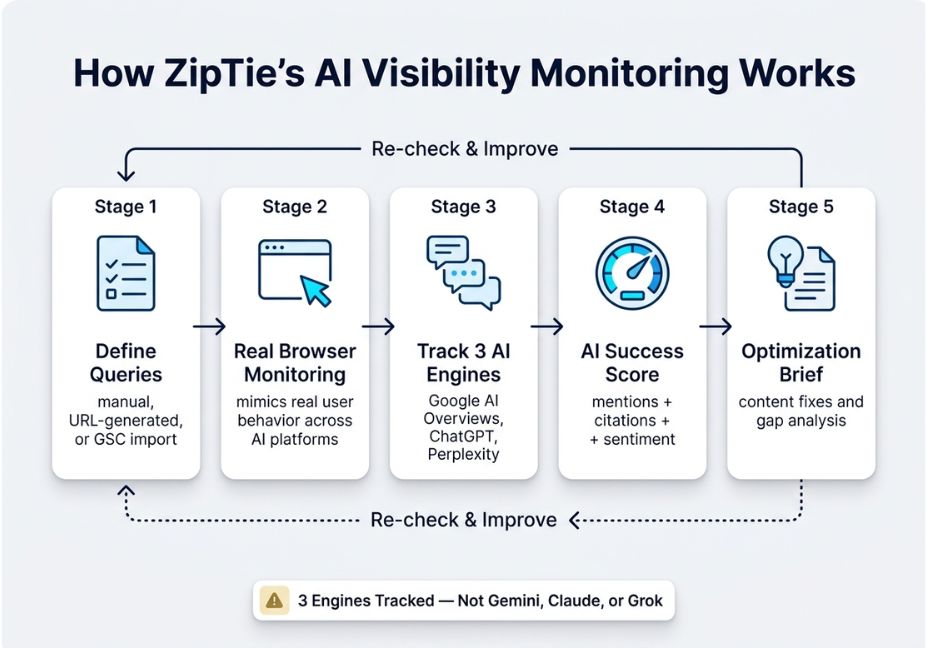
ZipTie runs on three modules: Monitoring, Content Optimization, and Insights.
- Query definition you define the prompts that matter to your business: category searches, comparison queries, or product questions. Queries can be added manually, generated automatically from a URL, or imported from Google Search Console.
- Monitoring ZipTie mimics real user behavior to track how AI tools answer target queries, capturing the full generated response and flagging whether the brand or its competitors get mentioned. Unlike API-based competitors, it uses real browser sessions and logged-in Google accounts, which is closer to a tool-calling loop similar to OpenAI’s function-calling spec than a static scrape it’s actually invoking the interface the way a user or agent would.
- Scoring every tracked query gets an AI Success Score, a composite of mention frequency, citation quality, and sentiment.
- Optimization briefs the platform inspects the pages AI engines did cite, compares them against your own content, and recommends specific structural or evidentiary fixes.
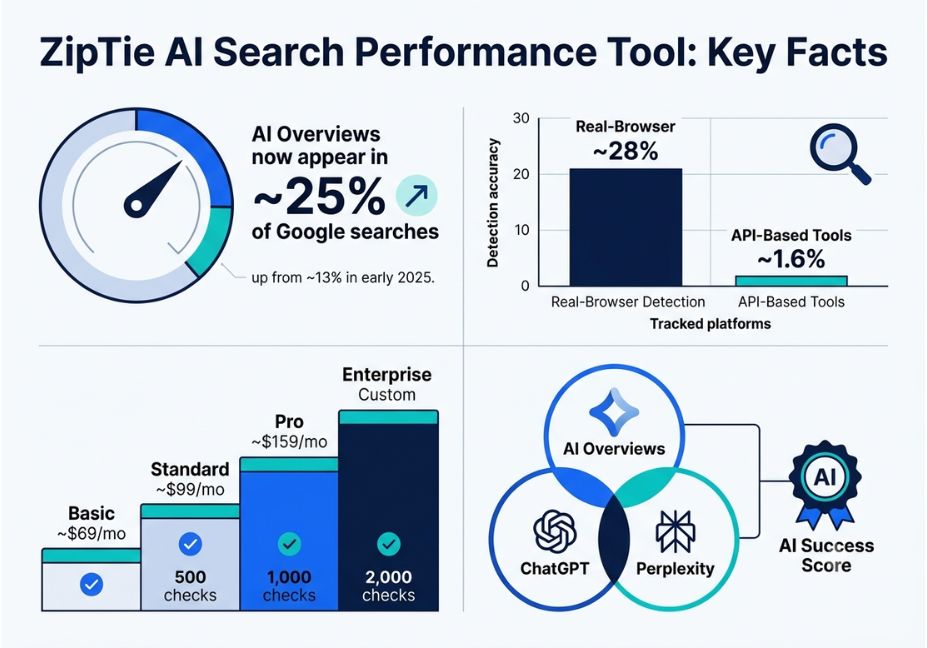
Technical Note: ZipTie’s real-browser approach reportedly detected AI Overviews on roughly 28% of tracked keywords in head-to-head benchmarks, versus as low as 1.6% for some API-based competitors a meaningful gap if your reporting depends on knowing an AI Overview existed at all.
The scoring logic leans on findings from the GEO paper that first formalized this optimization problem: in controlled tests, the strongest content interventions lifted position-adjusted word count by roughly 22% and subjective impression scores by about 37%. Statistics, citations, and quotations were the strongest levers, echoing what ZipTie’s own briefs tend to recommend.
ZipTie Use Cases 4 Real-World Examples
- SaaS vendor comparisons: Tracking “best CRM for small business” style prompts to see whether ChatGPT recommends you or three competitors instead.
- Agency reporting: Seer Interactive has reportedly deployed ZipTie across client accounts monitoring thousands of queries weekly, using it as a standing visibility dashboard alongside traditional rank reports.
- Health and YMYL content: SEO practitioner Lily Ray has cited it as her preferred tool for checking client inclusion in AI Overviews for health-related queries, where citation accuracy carries higher stakes.
- Content gap diagnosis: When a competitor gets cited and you don’t, ZipTie’s optimization module flags why missing comparison points, feature-only framing instead of use-case framing, or reviews AI crawlers can’t access.
Pricing and Plans
ZipTie uses credit-based billing, where one “AI Search check” covers a single query monitored simultaneously across all three platforms.
| Plan | Price | Checks/Queries | Notes |
|---|---|---|---|
| Basic / Starter | ~$69/mo | 500 checks, 1 brand | Single seat |
| Standard | ~$99/mo | 1,000 checks | Single seat |
| Pro | ~$159/mo | 2,000 checks, ~100 AI summaries | Single seat |
| Enterprise | Custom | 5,000+ checks | API access (private beta) |
A 14-day free trial with 10,000 credits is available, though Google Search Console integration is typically excluded from the trial.
💡 Did You Know? According to Conductor’s analysis of nearly 22 million queries, AI Overviews now appear in roughly a quarter of all Google searches up from about 13% in early 2025. That growth curve is the entire reason a specialist tracking layer like this exists.
Common Mistakes and How to Avoid Them
- Treating ZipTie as a full SEO suite. It’s a diagnostic layer, not a replacement for Semrush or Ahrefs it tells you what’s wrong but doesn’t write or publish fixes for you.
- Ignoring the three-engine ceiling. ZipTie does not currently track Gemini, Claude, Grok, DeepSeek, or Microsoft Copilot. If your buyers research vendors on Gemini or Copilot, you have a coverage gap the dashboard won’t show you.
- Underestimating credit burn. Agencies tracking hundreds of prompts per client across multiple accounts routinely outgrow the entry tiers faster than expected, since each check is single-seat and non-transferable.
- Skipping manual spot-checks. As with any GEO or RAG evaluation harness including the methodology behind the open-source GEO-bench repository automated scoring should be periodically validated against live queries, since generative outputs vary session to session.
Pro Tip: Before committing to a paid tier, manually run your 10–15 highest-value queries across ChatGPT, Perplexity, and Google directly, then compare against ZipTie’s trial output. Systematic mismatches, not occasional ones, are the real dealbreaker.
Best Tools and Frameworks Comparison
| Tool | Engines Covered | Entry Price | Best For |
|---|---|---|---|
| ZipTie | Google AI Overviews, ChatGPT, Perplexity | ~$69/mo | Highest-fidelity AI Overview detection |
| Otterly AI | ChatGPT, Perplexity, Google AI Overviews | ~$29/mo | Budget-conscious startups |
| Peec AI | Multi-engine, reporting-heavy | ~$95/mo | Agencies needing GSC/GA/Looker integration |
| Semrush AI Toolkit | Bundled with existing SEO suite | ~$99/mo add-on | Teams consolidating into one platform |
Technical Disclaimer: Pricing and engine coverage change frequently in this category. Figures above reflect publicly reported pricing as of mid-2026 always confirm current tiers on each vendor’s pricing page before budgeting.
What Developers and Practitioners Are Saying
SEO community sentiment is generally positive on detection accuracy, with practitioners on r/SEO describing the interface as clean and the AI Overview data as reliable, while noting that credit-based pricing is harder to forecast than flat-rate competitors. Discussions around generative engine optimization on broader AI research forums increasingly treat citation tracking as a necessary observability layer not unlike logging and tracing for an agentic pipeline rather than a nice-to-have SEO add-on.
FAQ People Also Ask
What does the ZipTie AI search performance tool actually track?
It tracks brand mentions, sentiment, and citations inside Google AI Overviews, ChatGPT, and Perplexity responses, then scores each tracked query with an AI Success Score.
How much does ZipTie cost?
Plans start around $69/month for roughly 500 checks, scaling to $159/month or more for higher query volumes; Enterprise pricing is custom.
Does ZipTie track Gemini or Claude?
No. As of mid-2026, ZipTie covers Google AI Overviews, ChatGPT, and Perplexity only Gemini, Claude, Grok, and Copilot are not included.
Is ZipTie a replacement for traditional SEO tools?
No. It’s a complementary visibility layer for AI-generated answers, not a substitute for keyword, backlink, or technical SEO platforms like Semrush or Ahrefs.
How accurate is ZipTie’s AI Overview detection?
Independent benchmarks have shown real-browser detection methods like ZipTie’s catching a meaningfully higher share of AI Overviews than API-based competitors, though exact figures vary by test set and change as engines update their output formats.
Conclusion
The ZipTie AI search performance tool answers a question traditional rank trackers can’t: when a generative engine talks about your category, does it mention you or your rival? It does that job well for Google AI Overviews, ChatGPT, and Perplexity specifically, backed by real-browser detection and an AI Success Score that prioritizes what to fix first. Its limits are just as real three-engine coverage, single-seat plans, and credit-based pricing that takes some planning to forecast.
If your buyers are already forming opinions inside AI answers before they ever hit your site, that’s a visibility layer worth instrumenting. Bookmark this guide and explore more hands-on AI agent and retrieval-optimization tutorials at agentiveaiagents.com.