Most teams pick an AI avatar platform by language count alone, then discover in production that 175 supported languages don’t mean 175 languages of equal quality. Lip-sync drifts on longer videos, cloned voices lose emotional range in low-resource languages, and dubbing pipelines built for short social clips choke on 20-minute training modules. Picking the right tool means understanding the underlying pipeline neural text-to-speech synthesis, voice cloning, and lip-sync re-rendering not just reading a features page.
This guide breaks down the platforms that actually hold up in production, how the multilingual pipeline works under the hood, where teams get burned, and how to pick a tool based on your actual workload rather than a marketing chart.
What Are AI Avatar Tools for Multilingual Voiceovers?
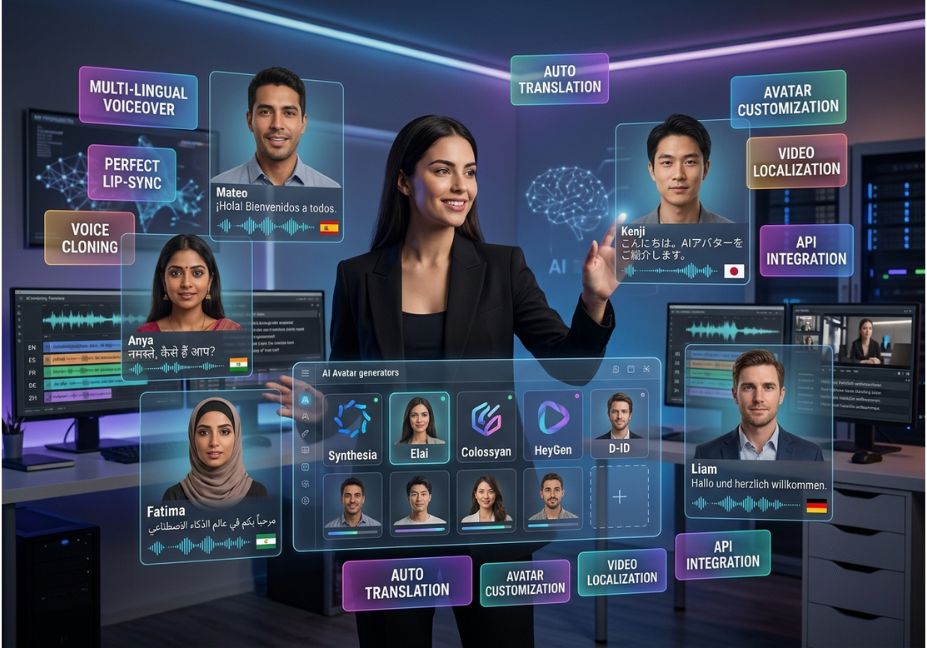
AI avatar tools for multilingual voiceovers combine a digital presenter (the avatar), a text-to-speech or voice-cloning engine, and a lip-sync renderer to produce talking-head video in a target language without filming or hiring voice actors. The underlying speech layer is typically built on neural text-to-speech synthesis models, a lineage that traces back to architectures like Tacotron 2, which paired an attention-based sequence-to-sequence network with a neural vocoder to generate near-human speech from text. Modern commercial platforms layer voice cloning and cross-lingual transfer on top of that foundation, which is why a script recorded in English can come out sounding native in Japanese or Portuguese.
How Does Multilingual Avatar Video Actually Work?
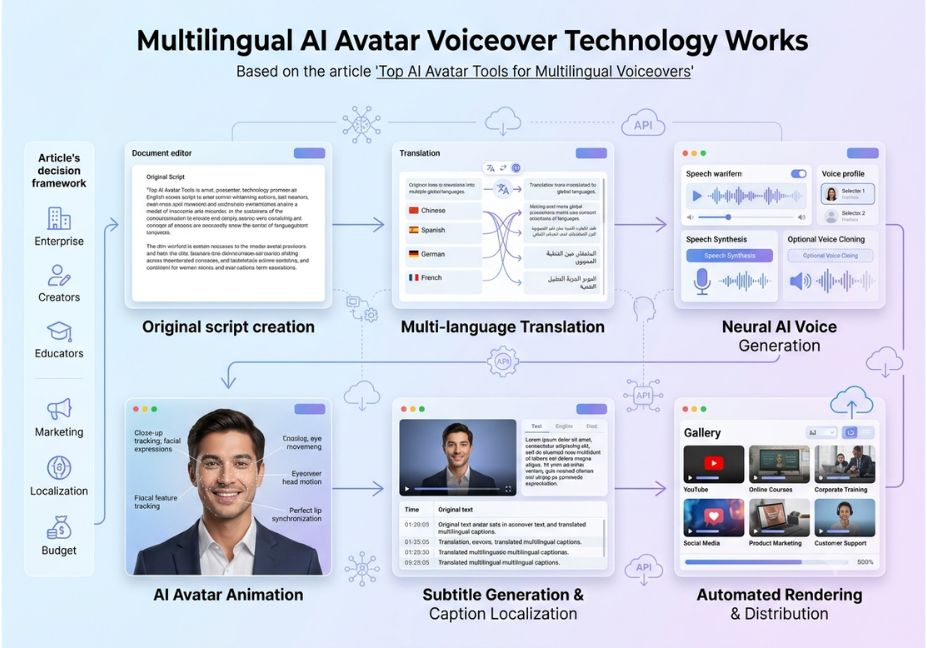
There are three distinct stages, and knowing them helps you diagnose where a tool will fail:
- Text-to-speech / voice cloning the script is converted into audio, either from a stock voice bank or a cloned voice trained on a short sample.
- Language and prosody mapping the model adapts pacing, stress, and pronunciation to the target language, not just a word-for-word translation.
- Lip-sync rendering the avatar’s mouth movements are re-rendered to match the new audio track, frame by frame.
Technical Note: Platforms differ most in step 3. Some (like HeyGen) can re-lip-sync existing footage into a new language; others only generate lip-sync from scratch alongside newly generated audio, which limits them to script-first workflows.
Did You Know? Voice-cloning accuracy on leading platforms now routinely lands in the 90%+ naturalness range on subjective tests, largely because cross-lingual cloning reuses the same speaker embedding across every supported language rather than training a new voice per language.
Top AI Avatar Tools for Multilingual Voiceovers Compared
Here’s how the leading platforms stack up as of mid-2026:
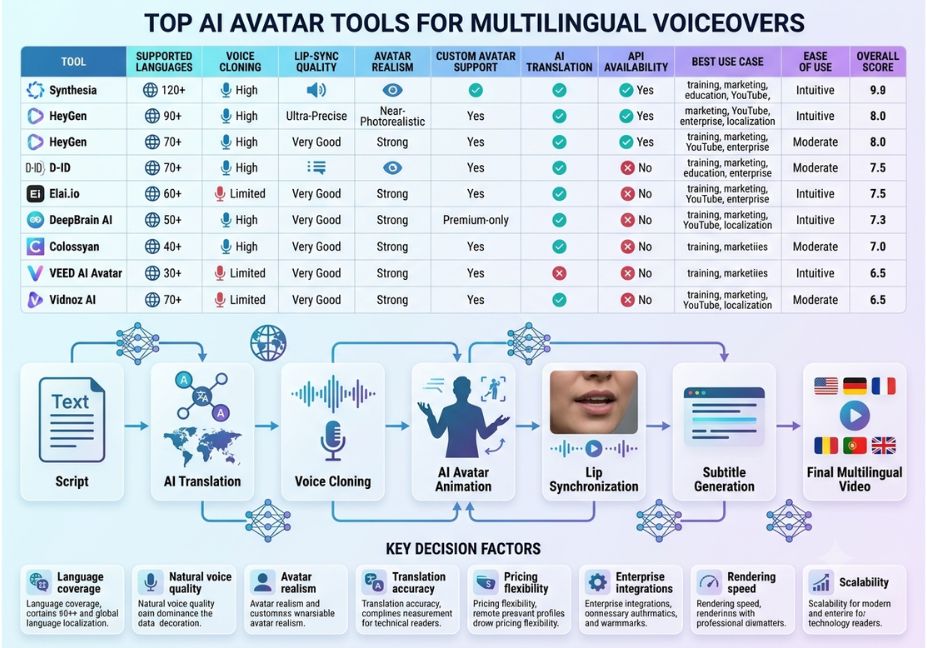
| Tool | Language coverage | Best for | Voice cloning | Starting price |
|---|---|---|---|---|
| HeyGen | 175+ languages/dialects, lip-sync dubbing on ~70 core languages | Marketing, sales, video translation of existing footage | Yes, on accessible paid tiers | ~$24/mo |
| Synthesia | 140–160+ languages | Enterprise training, LMS, compliance-heavy content | Enterprise plans only | ~$18/mo |
| D-ID | Broad language support via TTS providers | Lightweight talking-head clips from a single photo | Limited | Free tier + paid plans |
| Colossyan | 80+ languages | Branching e-learning and course authoring | Limited | ~$28/mo |
| DeepBrain AI (AI Studios) | 150+ languages | Document-to-video at scale | Yes (custom clones) | ~$24/mo |
| ElevenLabs | Wide language set, cloning-first | Voice layer only pairs with a separate avatar tool | Industry-leading | Usage-based |
Pro Tip: If your workload is “localize a library of existing videos,” prioritize tools with a dedicated dubbing/re-lip-sync feature over ones built purely for script-to-video generation the workflow is fundamentally different.
Use Cases: Where Multilingual Avatar Tools Actually Pay Off
- Corporate training and onboarding one master video, localized into a dozen languages without re-recording.
- Sales outreach at scale personalized, language-matched outreach clips generated programmatically via API.
- Product marketing a single launch video repurposed for every target market simultaneously.
- Customer support and FAQ videos consistent brand presenter across every supported region.
- E-learning course libraries branching training content maintained in one source language and pushed to many.
Step-by-Step: Building a Multilingual Avatar Workflow
- Draft one master script in your source language, written for speech rather than reading short sentences, minimal idioms.
- Select an avatar and base voice, or clone your own voice if brand consistency matters.
- Generate the base video in the source language and QA the pacing and pronunciation.
- Run the translation/dubbing pass into each target language, checking terminology against a locked glossary.
- Review lip-sync and prosody per language don’t assume every language renders equally well; some tools’ 175-language claim covers TTS only, not full dubbing.
- Export via API for scale, if you’re producing dozens of localized variants. HeyGen’s own product documentation outlines batch generation and webhook-based automation for exactly this workflow.
# Example: batch-generating localized avatar videos via a REST API
import requests

payload = {
    "script": "Welcome to our Q3 product update.",
    "avatar_id": "avatar_042",
    "target_languages": ["es", "fr", "ja", "pt-BR"],
    "voice_clone_id": "clone_98a1"
}

response = requests.post(
    "https://api.example-avatar-platform.com/v1/videos",
    json=payload,
    headers={"Authorization": "Bearer YOUR_API_KEY"}
)
print(response.json())
Technical Disclaimer: Platform APIs and pricing tiers change frequently. The endpoint above is illustrative always confirm request formats and language codes against the current official documentation of whichever platform you use.
Common Mistakes and How to Avoid Them
- Assuming “language count” equals “dubbing quality.” A platform can support 175 languages for TTS while only offering full lip-sync dubbing for a much smaller subset — check which number applies to your workflow.
- Skipping a terminology glossary. Machine-translated scripts drift on brand names and technical terms without a locked glossary per language.
- Ignoring long-form stability. Some avatars that look flawless in a 30-second clip show visible drift or expression fatigue past the 10-minute mark test with your actual video length, not a demo clip.
- Treating voice cloning as legally simple. Cloning a real person’s voice for commercial use requires documented consent; don’t assume a platform’s terms of service cover this for you.
Now that you understand the pipeline and where it breaks, let’s look at what practitioners are actually reporting in production.
What Developers and Marketers Are Saying
Beyond vendor benchmarks, developer discussion threads on r/ArtificialIntelligence and similar communities consistently surface the same trade-off: platforms optimized for expressive, short-form avatars (like HeyGen) tend to win on realism for social and sales content, while platforms built around structured editing and LMS integration (like Synthesia) hold up better across longer, compliance-driven training video. Teams that need the voice layer alone without an avatar increasingly reach for a dedicated cloning-first tool and pair it with a separate video platform rather than relying on one all-in-one product.
FAQ People Also Ask
What are the best AI avatar tools for multilingual voiceovers?
HeyGen, Synthesia, D-ID, Colossyan, and DeepBrain AI are the platforms most consistently recommended in 2026, each optimized for different use cases HeyGen for marketing and video translation, Synthesia for enterprise training, and DeepBrain AI for document-to-video at scale.
Can AI avatars speak multiple languages with accurate lip-sync?
Yes, but accuracy varies by platform and language pair. Full re-lip-sync dubbing (not just TTS narration) is typically limited to a smaller “core” language subset even on platforms that advertise 150+ total languages.
Is AI voiceover as good as a human voice actor?
For most business use cases training, product demos, internal comms modern AI voiceover is close to indistinguishable. For emotional storytelling or cinematic delivery, human voice actors still generally outperform AI narration.
Do AI avatar platforms support voice cloning?
Most leading platforms offer some form of voice cloning, though access differs: some include it on standard paid tiers, while others (like Synthesia) restrict it to enterprise plans.
How much do multilingual AI avatar tools cost?
Entry plans typically start around $18–$29 per month for individual creators, while team and enterprise pricing with API access, custom avatars, and higher usage caps commonly runs from a few thousand to tens of thousands of dollars per year depending on volume.
Conclusion
Choosing among the top AI avatar tools for multilingual voiceovers comes down to matching the pipeline to your workload: HeyGen and similar creative-first platforms excel at short, expressive content and translating existing footage; Synthesia and Colossyan hold up better for long-form, compliance-heavy training video; and dedicated voice-cloning tools like ElevenLabs are worth pairing in when voice quality matters more than the avatar itself. Test with your actual script length and target languages before committing to a plan the demo clip is never the whole story.
Bookmark this guide and explore more hands-on AI agent and automation tutorials at agentiveaiagents.com.